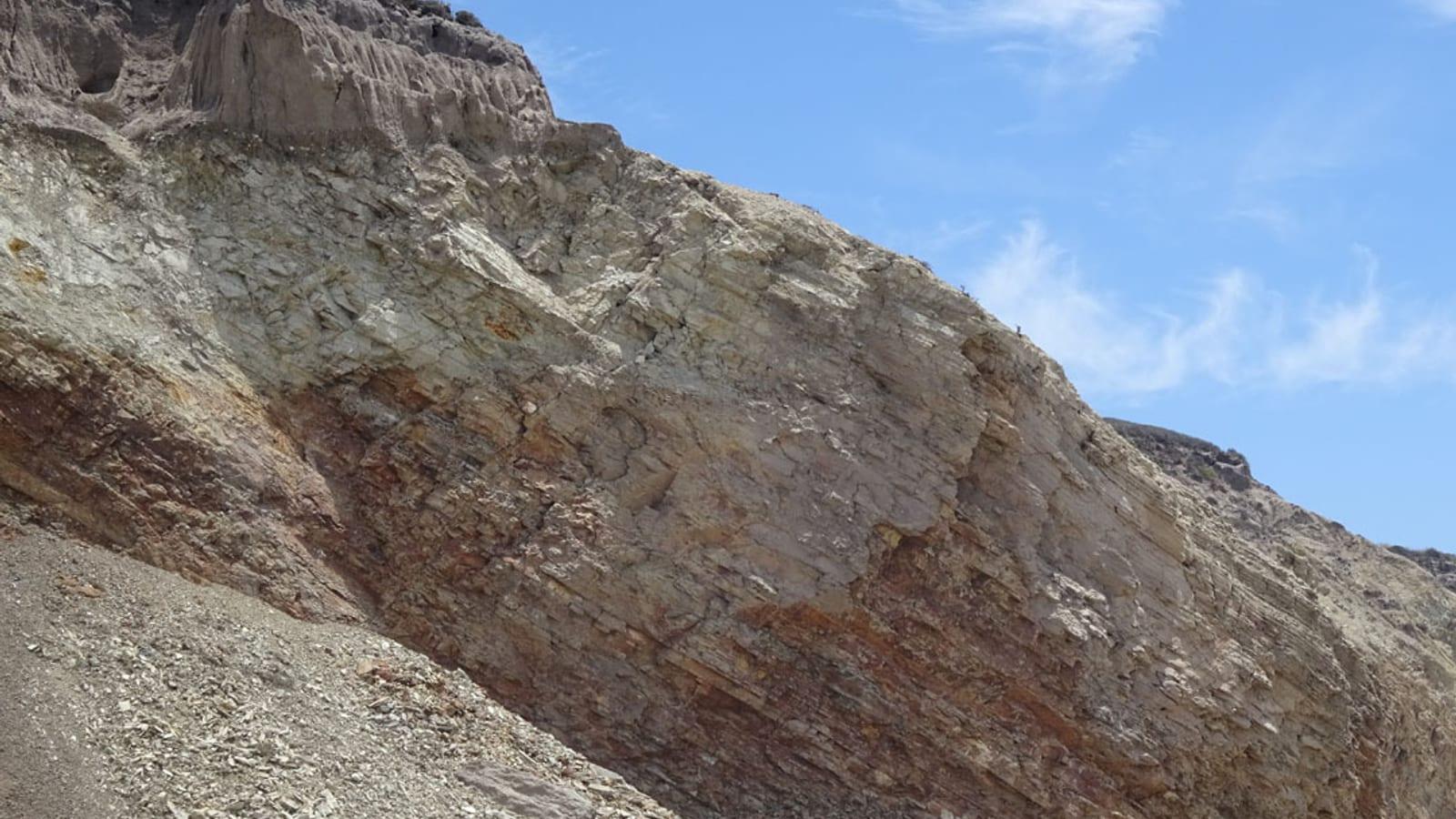
Jalama Beach Fossil Hunting Guide
Image: John Murphy (CC BY-SA 2.0)
Jalama Beach sits at the foot of a long stretch of sea cliff on the remote southwest coast of Santa Barbara County, north of Point Conception.
By Edward Chen · Updated 2 August 2026
Introduction
Jalama Beach sits at the foot of a long stretch of sea cliff on the remote southwest coast of Santa Barbara County, north of Point Conception. The cliffs cut through dark, papery shale of the Monterey Formation, the same Miocene marine unit that has produced the famous Lompoc fossil fish quarried inland for more than a century. At Jalama, fish-bearing shale slabs occasionally tumble onto the beach from the cliff face, and weathered fragments of marine mammal bone, including ribs and vertebrae from Miocene whales, turn up in the talus. This is a coastal viewing locality on a Santa Barbara County beach park, with private and ranch land flanking the access road. Collecting from the cliffs themselves is unsafe and the surrounding land status is restrictive, so most visits are best treated as surface inspections of fallen material along the wave zone. This guide covers how to reach the park, what fish and mammal fossils are realistically findable, the depositional history of the Monterey Formation, and the rules that apply on the beach and the road in.
Location and Directions
Jalama Beach County Park is operated by Santa Barbara County. The park is at the end of Jalama Road, southwest of the town of Lompoc.
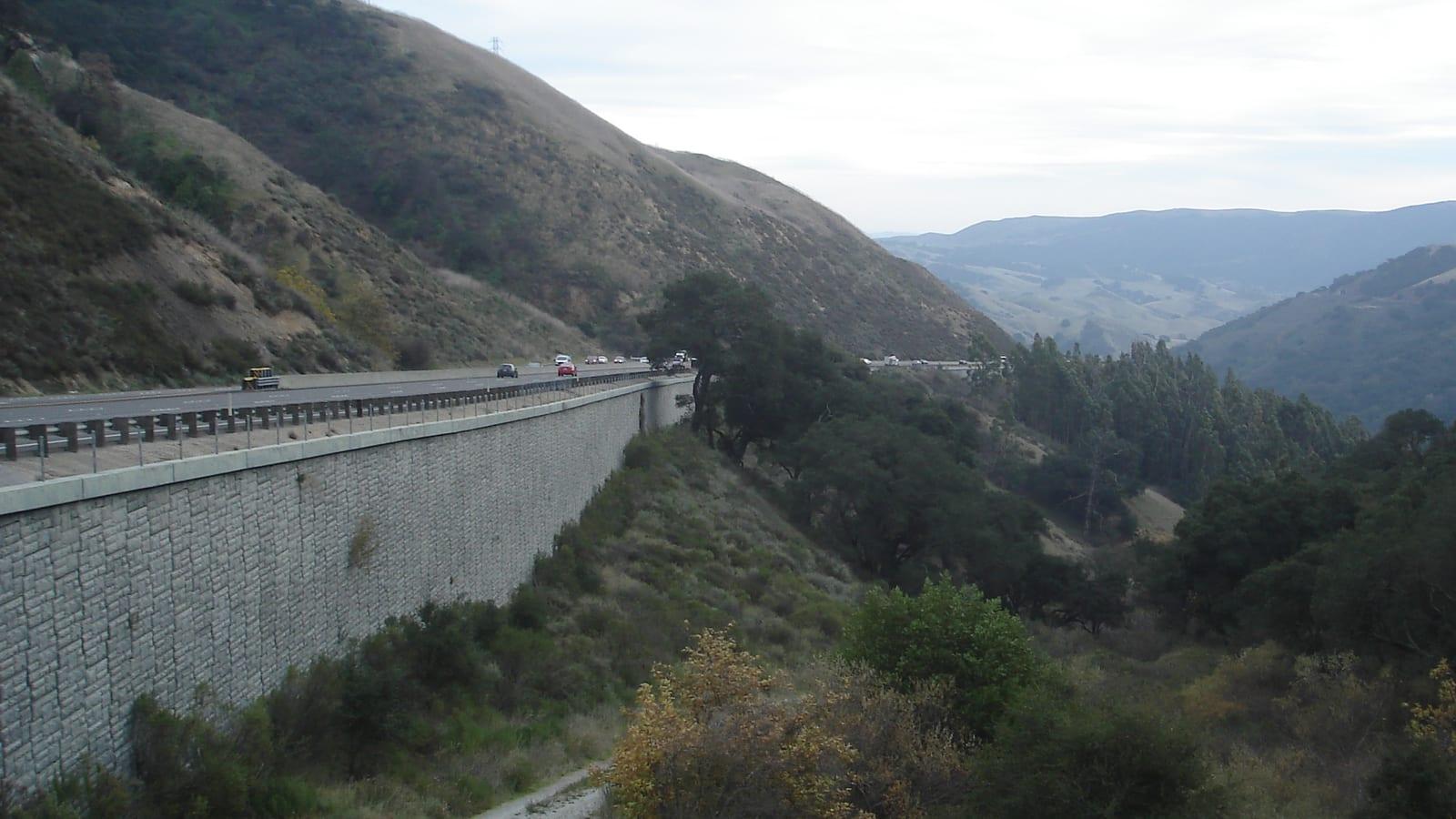
From U.S. Highway 101, take the State Route 1 (Cabrillo Highway) exit at Las Cruces and drive south on Highway 1 for roughly 14 miles. Watch for the signed Jalama Road turnoff on the right. Jalama Road is a paved but narrow and winding county road that drops 14.5 miles down to the coast through working ranch land. The road has no shoulders for most of its length, and large sections are single-lane with blind curves. Allow 30 to 40 minutes from the highway to the park.
The road ends at the Jalama Beach County Park entrance station. There is a per-vehicle day-use fee. The park has a paved parking lot, a small store, a campground, and direct walk-on access to the beach. From the parking lot, the most productive cliff exposures lie north and south of the main beach apron and require a short walk along the sand.
Tide and weather windows matter. The cliffs are most accessible on a low or falling tide, and the talus slopes at the cliff base can be cut off by the waves at higher tides. Winter storms and the southwest swell wash new material out of the talus and onto the beach. Summer visits are quieter but expose less fresh material. The road can be closed during heavy rain because of slope failures along the canyon. Check the Santa Barbara County Parks website before driving down.
What Fossils You'll Find
The fossils at Jalama Beach come almost entirely from the Miocene Monterey Formation shale exposed in the sea cliff and from talus that has slumped down to the beach.
Fossil fish are the headline find. The Monterey Formation around Lompoc has produced articulated skeletons of herring relatives, anchovies, deep-water lanternfish, and rarer larger predators including barracudas. At Jalama the same horizons reach the coast, and split slabs of dark shale on the beach occasionally contain a complete or partial fish, preserved as a flattened carbon film with bones visible against the matrix. Look for elongated, symmetrical impressions a few centimeters long on freshly broken shale faces. The Stanford 1920 monograph by David Starr Jordan and his coauthors remains the standard identification reference for the Lompoc fauna and applies directly to Jalama specimens.
Marine mammal bone turns up less often. Pieces of rib, vertebra, and unidentifiable bone fragments from Miocene cetaceans, including small toothed whales and early baleen whales, have been recovered from the talus. These are usually petrified, hard and dense, and weather a darker brown than the surrounding shale.
Diatom-rich shale fragments are the third common find. The Monterey Formation is famous for its diatomaceous content, and the lighter, almost chalky pieces in the talus are blocks of diatomite or diatomaceous shale. Splitting these along bedding sometimes reveals fish scales or small bone fragments.
The most productive technique is to walk the talus apron and sort through fallen shale on the sand, splitting promising slabs along the bedding with a hand chisel. Working the cliff face directly is dangerous and not advised.
Geologic History
The fossil-bearing rocks at Jalama belong to the Monterey Formation, deposited during the Miocene Epoch of the Neogene Period, roughly 17 to 6 million years ago. The Monterey is one of the most extensive marine units on the California coast, draped along the Coast Ranges from the Bay Area to the southern California Bight.
During the middle and late Miocene, the area now occupied by the western Santa Ynez Mountains and the Santa Barbara Channel was a partly enclosed marine basin with high biological productivity. Cool, nutrient-rich water upwelled along the coast and supported dense plankton blooms. Diatoms and other siliceous plankton sank to the seafloor in such volume that they accumulated faster than they were diluted by clastic sediment, producing the distinctive diatomite, diatomaceous shale, and porcellanite that define the formation. Fish living in or just above this productive water column were buried rapidly when low-oxygen bottom conditions developed, which preserved their skeletons in articulation. The same low-oxygen conditions allowed organic matter to be preserved at high concentrations, which is why the Monterey is also the source rock for most of California's offshore oil.
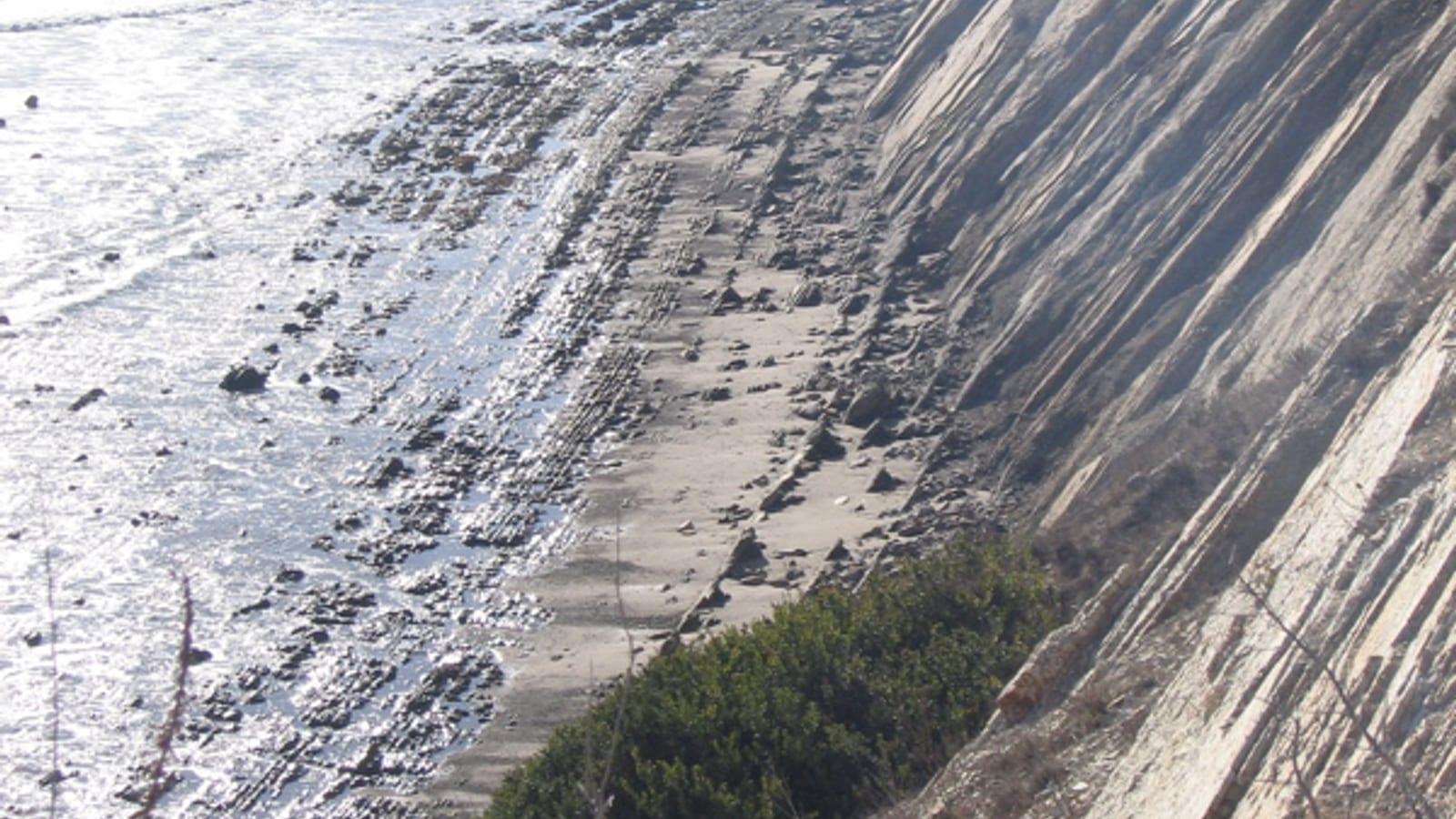
After deposition, transpression along the San Andreas system folded and uplifted the basin into the modern Santa Ynez and Purisima Hills. Wave erosion now cuts through the dipping and folded Monterey Formation along the open coast, creating the steep talus slopes and shale-banded cliffs that visitors at Jalama see. The three prominent outcroppings on the beach reflect differential erosion of harder porcellanite and diatomite beds within the section.
 Photo: John Murphy, CC BY-SA 2.0, via Wikimedia Commons
How Jalama Beach Became a Fossil Viewing Site
The Jalama exposures are products of ongoing coastal erosion. The sea cliffs along this stretch of coast have always been retreating, and each winter storm strips a fresh slice of Monterey Formation off the cliff face and onto the beach. No quarrying has ever been done here. The famous Lompoc fish localities a few miles inland were opened by diatomaceous-earth quarry operations, principally the Celite quarry near Lompoc, which produced the bulk of the Stanford 1920 collection. The Jalama coast offers the same fish-bearing horizons, but exposed naturally rather than in working quarry walls.
Santa Barbara County acquired the Jalama Beach property in the 1940s and developed it as a county park, which is the only point of public access to a long otherwise-private stretch of Pacific coast. The combination of public beach access and active cliff erosion is what makes the locality usable today.
Collecting Rules and Regulations
Casual surface collecting from the beach is generally tolerated, but the rules are nuanced. Jalama Beach County Park itself is owned by Santa Barbara County, and the park's general regulations follow the California state model: no significant disturbance of the cliffs, no excavation, no use of mechanical tools. Picking up small loose surface specimens of common shells, shale chips, and unattached fossil fragments along the wet sand is in practice not enforced against. Vertebrate fossils, including any identifiable bone, are protected under federal and state law and should be left in place and reported to the park or to the Santa Barbara Museum of Natural History rather than removed.
Practical rules and warnings:
- Do not dig into, hammer, or chisel the cliff face. The cliffs are unstable and rockfalls are frequent.
- Keep specimens to small, common, loose surface finds. Articulated fish, identifiable bone, and any obvious vertebrate material should be photographed and reported, not collected.
- Camping requires reservations through the Santa Barbara County Parks reservation system. Day-use does not.
- The road in is narrow and slow. Drive cautiously and watch for ranch traffic and cyclists.
- Cell coverage at Jalama is poor. Plan to be self-sufficient during your visit.
- Surrounding ranch land is private. Do not leave the park boundary or the public beach below the mean high-tide line.
Safety
Jalama sits just north of Point Conception, one of the most exposed and consistently rough stretches of the California coast, and the conditions here are not those of a sheltered southern beach.
The surf and the wind are serious. This coast takes the full Pacific swell with nothing in front of it, and the afternoon wind at Jalama is strong enough that the beach is known for it. Sneaker waves, larger sets that run far higher up the beach than the ones before, are a genuine killer on this shoreline and arrive without warning. Never turn your back on the water when working the foreshore, keep well up the beach when a big swell is running, and treat the rocks below the cliffs as off limits in heavy surf. Rip currents are strong and the water is cold year-round.
Stay off the cliffs and out from under them. The Monterey Formation here is thin-bedded, brittle shale that fractures and falls readily. Do not climb, do not shelter beneath an overhang, and give the base of the cliff a wide margin after rain.
Getting there and back matters. Jalama is reached by a long, winding single-road drive from Highway 1 with no services along it, and the county park at the end is the only facility for a considerable distance. Fill the tank beforehand, carry water, and note that mobile coverage is poor. The gate and campground have their own hours.
Check a tide table before working the lower beach. Wear grippy footwear for wet rock, and bring a windproof layer whatever the forecast says, because the wind here makes a mild day feel cold.
Sources
- Jordan, D.S. and others, 1920. "Fossil Fishes of Diatom Beds of Lompoc, California." Stanford University Publications, University Series. https://books.google.com/books?id=Fj0sAAAAYAAJ
- Surpless, K.D. and others, 2007. "Evolution and stratigraphic architecture of marine slope gully complexes: Monterey Formation (Miocene), Gaviota Beach, California." Trinity University. https://www.trinity.edu/directory/ksurples
- Santa Barbara County Parks, "Jalama Beach County Park." https://www.countyofsb.org/parks/jalama.sbc
- The Nautiloid Network, "Jalama Beach." http://www.nautiloid.net
- Santa Barbara Museum of Natural History, "Paleontology Collections." https://www.sbnature.org
_(2).jpg)