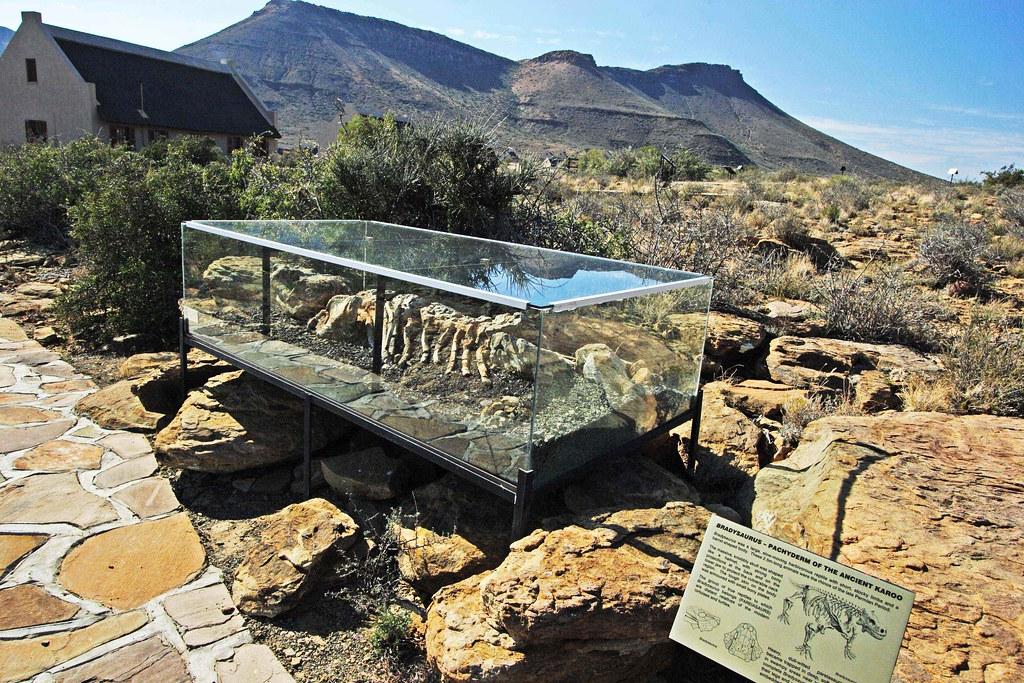
Karoo National Park Fossil Trail Fossil Hunting Guide
Image: South African Tourism (CC BY 2.0)
The Fossil Trail at Karoo National Park near Beaufort West, South Africa, is a 400-metre interpretive walk that explains the late Permian therapsid record of the Beaufort Group through in-place specimens and weather-proof panels. The wider park preserves dicynodonts and gorgonopsids from the Tropidostoma and Cistecephalus assemblage zones.
By Edward Chen · Updated 2 August 2026
Introduction
Karoo National Park covers 88,000 hectares of plateau and escarpment outside the town of Beaufort West in South Africa's Western Cape. The park was proclaimed in 1979 to protect a representative sample of the Great Karoo landscape, including its mountain zebra population, and the underlying late Permian Beaufort Group rocks that hold one of the world's most complete therapsid fossil records. Almost the entire interval recorded in the park, from the Tropidostoma assemblage zone up into the Cistecephalus and Daptocephalus assemblage zones, falls between 260 and 252 million years ago and captures the diversification of mammal forerunners in the runup to the end-Permian mass extinction. The Fossil Trail at the main rest camp is a 400-metre paved interpretive walk that brings public visitors face to face with prepared in-place specimens of dicynodonts, gorgonopsids, pareiasaurs, and therocephalians, with full skeletons, individual skulls, and limb bones displayed alongside short explanations of the late Permian ecosystem and the end-Permian crisis. The Kitching Fossil Exploration Centre at the camp runs ranger-guided walks to additional fossil localities elsewhere in the park. Collecting is prohibited everywhere inside the park. This guide covers how to reach the trail, what is visible on it, the late Permian geology of the Karoo Basin, and the rules that apply.
Location and Directions
Beaufort West sits midway between Cape Town and Johannesburg on the N1 highway, about 460 kilometres northeast of Cape Town. The Karoo National Park entrance lies 5 kilometres south of town, off the N1.
The Main Camp is reached by a 9-kilometre paved internal road that climbs from the gate to the camp. GPS for the camp is 32.3219 degrees south, 22.5092 degrees east. The camp holds the reception, restaurant, swimming pool, fuel station, chalet and camping accommodation, and the Fossil Trail trailhead.
The Fossil Trail starts directly behind the reception building. The 400-metre loop is paved, wheelchair accessible, and equipped with shaded benches at each major specimen.
The Kitching Fossil Exploration Centre, named for paleontologist James Kitching, sits adjacent to the camp and runs ranger-guided fossil walks to specimens beyond the main trail. Tours are booked at reception on the day or the day before. Tour fees are modest, additional to the standard park entry fee.
Park entry fees at the time of writing are 80 South African rand for South African adults, 160 rand for Southern African Development Community visitors, and 322 rand for international visitors, with reduced rates for children and seniors. Wild Card holders enter free. The park is open daily, with reduced hours in winter.
The closest commercial airports are Cape Town International and George (about three hours and four hours respectively). Fuel and groceries are widely available in Beaufort West. Self-catering and catered accommodation is available at the Main Camp.
What Fossils You'll Find
You will not collect at Karoo National Park. What you can do is walk the Fossil Trail and see in-place skeletons and skulls of late Permian therapsids and other Karoo Basin vertebrates, with each station explained on weather-proof panels. Identifications follow the 2023 Geological Society Special Publication overview of Karoo geoheritage sites.
- Aulacephalodon bainii. A medium-sized dicynodont with paired upper tusks. A near-complete skeleton is exposed on the trail, mounted in the prone burial position.
- Oudenodon bainii. A common tuskless dicynodont. Several skulls are displayed at separate stations along the trail.
- Rubidgea atrox. A large sabre-toothed gorgonopsid known from skull material recovered in the wider park. A cast skull is shown at one station for size comparison.
- Pareiasaurus serridens. A heavily built herbivorous reptile from the upper Tropidostoma and Cistecephalus zones, displayed by partial postcranial material.
- Therocephalian skulls. Small predatory therapsids represented by complete skulls of two species, including Theriognathus.
- Plant remains. Compressed and permineralised Glossopteris leaves and rooted axes are shown in a separate panel that explains the southern Gondwanan flora.
The Kitching Fossil Exploration Centre next to the trail holds prepared cabinet specimens, including stratigraphic charts showing where in the Beaufort Group each species sits.
 Photo: flowcomm, CC BY 2.0, via Wikimedia Commons

Geologic History
The Karoo Basin formed as a foreland basin south of the Cape Fold Belt during the late Carboniferous through the Early Jurassic. The Beaufort Group, the unit exposed across Karoo National Park, is the middle, dominantly continental part of the Karoo Supergroup and records floodplain, channel sand, and lake sediments deposited during the late Permian and earliest Triassic.
Within the park, the Adelaide Subgroup of the Beaufort Group is exposed from the Abrahamskraal Formation at lower elevations up into the Teekloof Formation at the plateau top. Biostratigraphy and recent U-Pb radiometric dates place the section between roughly 260 and 252 million years ago, spanning the Capitanian through the Changhsingian stages of the late Permian.
The Karoo Basin during this interval was a vast inland floodplain crossed by sand-bed rivers and dotted with shallow lakes. The mean annual climate cooled from warm temperate in the lower beds to cool temperate by the upper beds, and seasonal aridity increased toward the top of the section. The therapsid fauna shifted in parallel, with the high-richness early-late Permian assemblages of the Tropidostoma zone giving way to low-richness assemblages dominated by Lystrosaurus in the basal Triassic, immediately above the end-Permian extinction boundary.
The end-Permian mass extinction interval itself is recorded in a thin sequence of strata in the upper Beaufort Group, well exposed elsewhere in the basin and partially visible within the park.
After deposition, the basin was subjected to Cape Fold Belt thrusting and then to widespread Jurassic Karoo dolerite intrusion. Modern erosion has stripped the dolerite caps from much of the central basin, exposing the soft mudstone and sandstone of the Beaufort Group in extensive badland country.
How Karoo National Park Became a Fossil Site
Andrew Geddes Bain, a Scottish-born engineer working for the British Royal Engineers in the Cape Colony, identified the first Beaufort Group fossils in 1838 and corresponded with Richard Owen in London about their identification. Bain's collections became the founding material of the Karoo therapsid record. Through the late nineteenth and twentieth centuries, work by Robert Broom, Lieuwe Boonstra, and James Kitching of the Bernard Price Institute for Palaeontological Research at the University of the Witwatersrand built up the assemblage-zone biostratigraphy that is still in use.
South African National Parks proclaimed Karoo National Park in 1979 around an existing reserve. The Fossil Trail at the main camp was installed in the early 1990s under the direction of James Kitching and Bruce Rubidge, with cooperation from Wits University and the South African Museum. The Kitching Fossil Exploration Centre opened adjacent to the trail in 2010.
Collecting Rules and Regulations
Collecting is prohibited. Karoo National Park is administered by South African National Parks (SANParks). Removing fossils, rocks, plants, or any material from the park is an offence under the South African National Environmental Management Protected Areas Act 57 of 2003 and the National Heritage Resources Act 25 of 1999.
Practical rules:
- Stay on the paved Fossil Trail loop. Climbing on or touching the in-place skeletons is not permitted.
- Photography for personal use is welcomed across the trail and at the Kitching Centre.
- Park entry fees apply. Wild Card members enter free.
- Pets are not allowed in the park.
- Drones are not permitted in SANParks parks.
- Research collection is restricted to permitted teams under the National Heritage Resources Act, administered by the South African Heritage Resources Agency (SAHRA).
Safety
Summer temperatures (November through March) regularly reach 36 degrees Celsius. Sun cover, sunscreen, and water are needed even on the short Fossil Trail loop. Winter (June through August) is sunny but cold, with overnight lows below freezing.
The park sits at about 850 metres elevation. The Fossil Trail is paved and largely level, but the longer ranger-guided walks cross uneven veld with loose rock.
The wider park hosts puff adders and Cape cobras. Stay on marked paths during any guided walk. Lion were reintroduced to the park in 2010 and the predator section is fenced off from the camp area, but always follow SANParks signage about animal-viewing zones.
Park internal roads are gravel. Standard sedans can reach most viewpoints in dry weather. After heavy rain, some loops may close.
Sources
- Karoo Information, "The Famous Fossil Trail at Karoo National Park." https://www.karoo-information.co.za/routes/article/1185/the-famous-fossil-trail-at-the-karoo-national-park
- Rubidge, B.S. et al., 2023. "Selected Karoo Geoheritage Sites of Palaeontological Significance in South Africa and Lesotho." Geological Society, London, Special Publications, SP543. https://www.lyellcollection.org/doi/full/10.1144/SP543-2022-202
- Karoo Origins Fossil Centre, Graaff-Reinet. https://fossilcentre.co.za/about-the-centre/
- Smith, R.M.H. and Botha-Brink, J., 2014. "Anatomy of a Mass Extinction: Sedimentological and Taphonomic Evidence for Drought-Induced Die-Offs at the Permo-Triassic Boundary in the Main Karoo Basin, South Africa." Palaeogeography, Palaeoclimatology, Palaeoecology, 396.
- South African National Parks, "Karoo National Park." Visitor information accessed June 2026.
Nearby sites
 Sterkfontein Caves Fossil Site GuideAustralopithecus, Hominin remains
 Maria Island Fossil Cliffs Fossil Hunting Guidebrachiopod shells, bryozoans
 Porcupine Gorge National Park Fossils Fossil Hunting GuideGlossopteris, Glossopteris leaves
 Guadalupe Mountains National Park Fossil Reef GuideBrachiopods, Crinoids