Sterkfontein Caves Fossil Site Guide
Image: Francesco Bandarin (CC BY-SA 3.0 igo)
Sterkfontein Caves in the Cradle of Humankind UNESCO World Heritage Site near Johannesburg are the in-situ source of more early hominin fossils than any other site on Earth, including Mrs Ples and Little Foot, the latter still partly embedded in the cave wall. Guided cave tours descend into the working dig.
By Edward Chen · Updated 26 September 2026
Introduction
The Sterkfontein Caves are a network of dolomitic limestone caverns about 50 km northwest of Johannesburg, set within the Cradle of Humankind UNESCO World Heritage Site. Robert Broom recovered the adult Australopithecus africanus skull "Mrs Ples" here in 1947. Since then the caves have produced more early hominin fossils than any other locality on Earth. Excavation continues today, and the near-complete Australopithecus skeleton known as Little Foot is still partly embedded in the rock of Member 2.
The caves are owned and managed for research by the University of the Witwatersrand. Hour-long guided tours descend through the working caves to the active dig sites. Visitors are issued helmets and headlamps and walk past the Silberberg Grotto where Little Foot lies in situ. New boardwalks installed during the 2020s renovation give visitors a clear view onto the actual excavation faces.
This guide covers what you will see, how to reach the caves, and the rules governing one of paleoanthropology's best-known localities.
Location and Directions
Sterkfontein lies on the R563 Hekpoort Road in Gauteng, about a one-hour drive from central Johannesburg or Pretoria.
Directions to Sterkfontein Caves
From Johannesburg, take the N14 highway west, exit onto the R563 north, and follow signs through the Cradle of Humankind to Sterkfontein. The site has secure parking, a ticket office, on-site café, and the Robert Broom Museum building. Hours are typically 09:00–17:00 daily (closed Christmas Day). Tours run on the hour and the last departs around 16:00. The Maropeng Visitor Centre, the official interpretive hub for the World Heritage Site, is 10 km away. Pair it with a Sterkfontein cave tour as a half- or full-day visit.
Combined tours from Johannesburg cover both sites in one day. A Sterkfontein Caves and Maropeng tour and a Maropeng museum and cave experience are bookable online.
Affiliate links. We earn a commission at no extra cost to you.
All cave visits are guided, independent entry to the caves is not permitted. Tours descend approximately 60 m below the surface through narrow passages with low ceilings, slippery steps, and constant water seepage. Comfortable closed shoes are essential and the tour is unsuitable for people with severe claustrophobia or limited mobility.
 Photo: Anrie, CC BY-SA 3.0, via Wikimedia Commons

What Fossils You'll See
The Sterkfontein cave fill records hominin and faunal accumulation between roughly 3.7 and 2.1 million years ago. That span covers the late Pliocene and early Pleistocene of southern Africa. More than nine decades of work have recovered over 800 hominin specimens and roughly half a million identified bones of other vertebrates. That makes Sterkfontein one of the most prolific paleoanthropological localities in the world.
The cave tour itself is the main fossil experience. Visitors descend through natural cave passages, with narrow squeezes, low ceilings, and steep stairs cut through dolomitic limestone. The route reaches a series of stations where guides interpret what the surrounding rock preserves. The tour passes breccia (cemented cave-fill sediment) exposed in walls and ceilings, and fossil-bearing flowstones with characteristic banded calcite. It also passes the active dig faces in Member 4 and Member 5, where excavation continues. The most-photographed station is the viewing platform overlooking the Silberberg Grotto, where the near-complete Little Foot skeleton (specimen number StW 573, assigned to Australopithecus prometheus) was excavated over more than 20 years.
Portions of the Little Foot skeleton remain embedded in the grotto floor, in the position they were found. Visitors look down onto an articulated hominin foot, leg, and pelvis still partly cemented into the breccia.
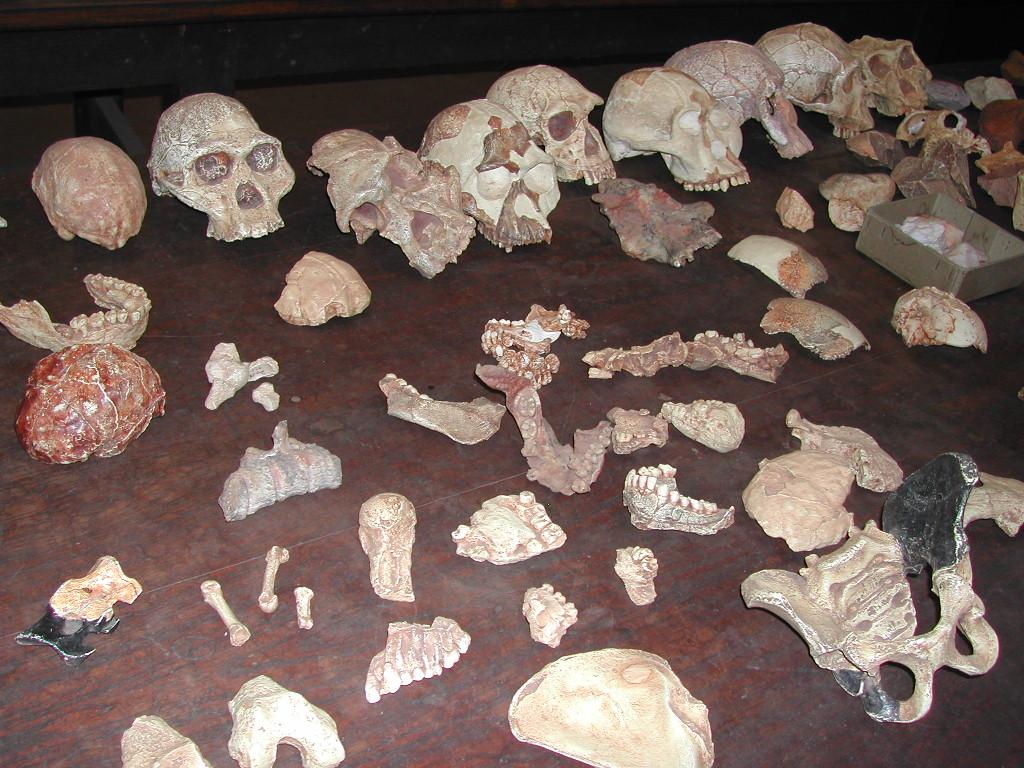
Above ground, an outdoor walkway passes the historic trenches where Robert Broom recovered "Mrs Ples" in 1947. That specimen, Australopithecus africanus Sts 5, is the most famous australopithecine skull in southern African paleoanthropology. Interpretive panels at each station show where major specimens originated, including the partial endocast (Sts 60) and the famous Australopithecus africanus mandibles. Many of the original fossils are now curated at the Wits University Evolutionary Studies Institute in Johannesburg. The Maropeng visitor centre 10 kilometres away displays high-quality casts of all the headline specimens.
Faunal fossils recovered from the same deposits include cercopithecid monkeys (Parapapio jonesi, Parapapio whitei, the long-faced Cercopithecoides williamsi). Sabre-toothed cats (Megantereon cultridens, Dinofelis barlowi). Spotted, brown, and giant short-faced hyenas.
Antelope and small bovids including the early kudu Tragelaphus and Aepyceros. Early equids. Carnivores including the leopard Panthera pardus and the now-extinct giant cheetah Acinonyx pardinensis. And a wide range of small carnivores, rodents, and bats.
Many of these accumulated as leopard or large-carnivore kills dropped into cave openings. Taphonomic work by C. K. Brain established that many of the early hominin fossils are likely leopard prey rather than deliberate cave burials.
"Staff members keep the fossils at the place where they were discovered, allowing visitors to see the fossils in their original geological context." Wits University Sterkfontein Caves
 Photo: José Braga and Didier Descouens, CC BY-SA 4.0, via Wikimedia Commons

Geologic History
The Sterkfontein caves formed in the Malmani Subgroup dolomitic limestones. These Precambrian carbonate rocks were laid down roughly 2.3 billion years ago, in shallow marine settings on the proto-Kaapvaal Craton. The dolomite was buried and remained largely stable through the Phanerozoic. Karst groundwater dissolved cave passages along bedding planes and joints over millions of years. By the Pliocene, a complex underground network of caves, shafts, and chambers had developed at depths ranging from 5 to 60 metres below the modern surface.
From the late Pliocene, about 4 million years ago, surface erosion progressively opened the karst system. It produced vertical entrance shafts at scattered points across the Sterkfontein outcrop. These open shafts and sinkholes acted as natural sediment and bone traps. Bones, bats, hyrax dung, plant debris, soil, and occasional hominin remains fell or were dragged through the openings. They accumulated in the cave chambers below as cone-shaped sediment piles. Calcite-saturated groundwater dripping through the karst cemented these accumulations into the hard, concrete-like breccia that fills the cave today.
The cave fill is divided into six stratigraphic units, Members 1 through 6. They span the late Pliocene at the base (about 4 million years ago) to the late Pleistocene at the top (about 250,000 years ago). The Silberberg Grotto, where Little Foot was recovered, contains the oldest fossil-bearing deposits. Cosmogenic isochron burial dating puts it at about 3.67 million years. That makes Little Foot older than the Ethiopian "Lucy" specimen (about 3.2 million years), and one of the oldest known articulated hominins.
Member 4, the source of Mrs Ples and most of the A. africanus specimens, dates to about 2.6 to 2.0 million years ago. Member 5 contains stone tools and may record the earliest hominin material culture in southern Africa.
Cycles of sediment infill, calcite cementation, partial collapse, and re-erosion produced the complex stratigraphy and articulated-in-breccia preservation seen in the cave today. The dolomite roof has been mined for lime since the late 19th century. A lime mining operation in 1936 first cracked open the cave to scientific attention.
Excavation in the modern sense began with Robert Broom's arrival at Sterkfontein in 1936. He recovered the first adult Australopithecus africanus fragment in 1937. Broom's discovery of "Mrs Ples" in 1947 brought the site to international fame. Phillip Tobias took over the project in the 1960s and ran it for more than three decades. Under Tobias, Sterkfontein became the type site for southern African Pliocene paleoanthropology.
In 1994 Ronald Clarke recognised articulated foot bones in storage boxes labelled "monkey". He then spent decades extracting the rest of the Little Foot skeleton from concrete-hard breccia in the Silberberg Grotto. It is one of the most painstaking excavations in the history of paleoanthropology. Clarke and his team published the full description of Little Foot in 2018 after more than 20 years of preparation.
How Sterkfontein Came to Be Protected
The caves were declared a National Monument in 1970 and a Provincial Heritage Site in 1999. Sterkfontein is part of the broader Fossil Hominid Sites of South Africa serial property, inscribed by UNESCO in 1999 (Site #915). A 2005 extension added caves at Bolt's Farm, Cooper's Cave, Drimolen, Gladysvale, Gondolin, Haasgat, Plovers Lake, Swartkrans, Coopers, and Wonderwerk. The site is held by the University of the Witwatersrand under heritage protection and the National Heritage Resources Act (Act No. 25 of 1999). All hominin and faunal fossils in South Africa are protected, and collection at Sterkfontein is restricted to Wits University researchers under SAHRA permit.
 Photo: Mike Peel (www.mikepeel.net), CC BY-SA 4.0, via Wikimedia Commons

Collecting Rules and Regulations
Is Fossil Collecting Allowed?
No. All hominin and faunal fossils in South Africa are protected under the National Heritage Resources Act. Collection at Sterkfontein is restricted to Wits University researchers.
Key Points:
- Entry is only on a guided cave tour booked at the ticket office.
- Do not collect, hammer, or remove anything from the cave.
- Touching fossils or breccia walls is prohibited.
- Photography without flash is allowed on most tours, but commercial filming requires permission.
- Report notable finds anywhere in South Africa to SAHRA.
Safety
The cave tour is the whole of the visit, and it is more physically demanding than most visitors expect.
The route descends roughly 60 metres below the surface through natural passages, with narrow squeezes, low ceilings, steep steps, and constant water seepage. The steps are wet and slippery throughout. Wear closed shoes with a grip. The tour is unsuitable for anyone with severe claustrophobia or significant mobility limitations. The same applies to a heart or breathing condition that would make a sustained climb back out difficult.
Helmets and headlamps are issued and are not decorative. Dolomite ceilings are low and irregular, and people knock their heads on this tour routinely. Keep the helmet on for the whole descent and watch the roof as well as your feet.
Stay with the guide and on the marked route. The passages branch, the lighting is limited, and the excavation faces are live research ground.
Above ground, the Cradle of Humankind sits on the highveld at around 1,500 metres. The sun is stronger than the air temperature suggests, and afternoon thunderstorms are common from roughly October to March. Take water and sun protection for the outdoor walkway.
The caves are about an hour from Johannesburg on the N14 and R563. Normal South African road and personal-security precautions apply. Use the secure parking at the ticket office and leave nothing visible in the car.
Sources
Nearby sites
 Karoo National Park Fossil Trail Fossil Hunting GuideDicynodonts (Aulacephalodon, Oudenodon), Gorgonopsids (Rubidgea)
 National Fossil Wood Park at Tiruvakkarai Fossil Hunting GuidePetrified Wood, Plants
 Lesvos Petrified Forest Fossil Hunting GuidePetrified wood, Plants
 Shivalik Fossil Park, Saketi Fossil Hunting GuideMammals, Proboscideans