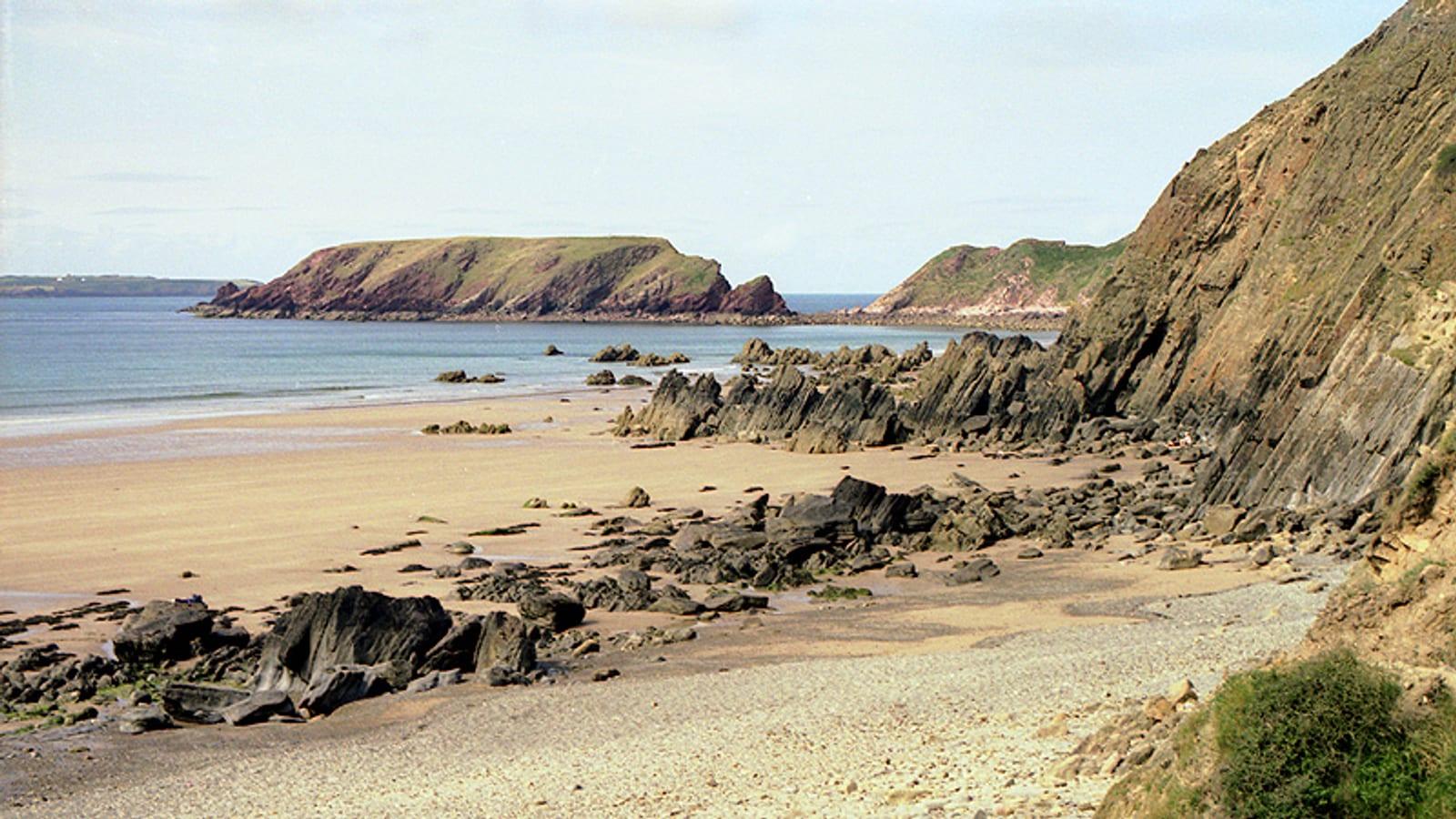
Marloes Sands Fossil Hunting Guide
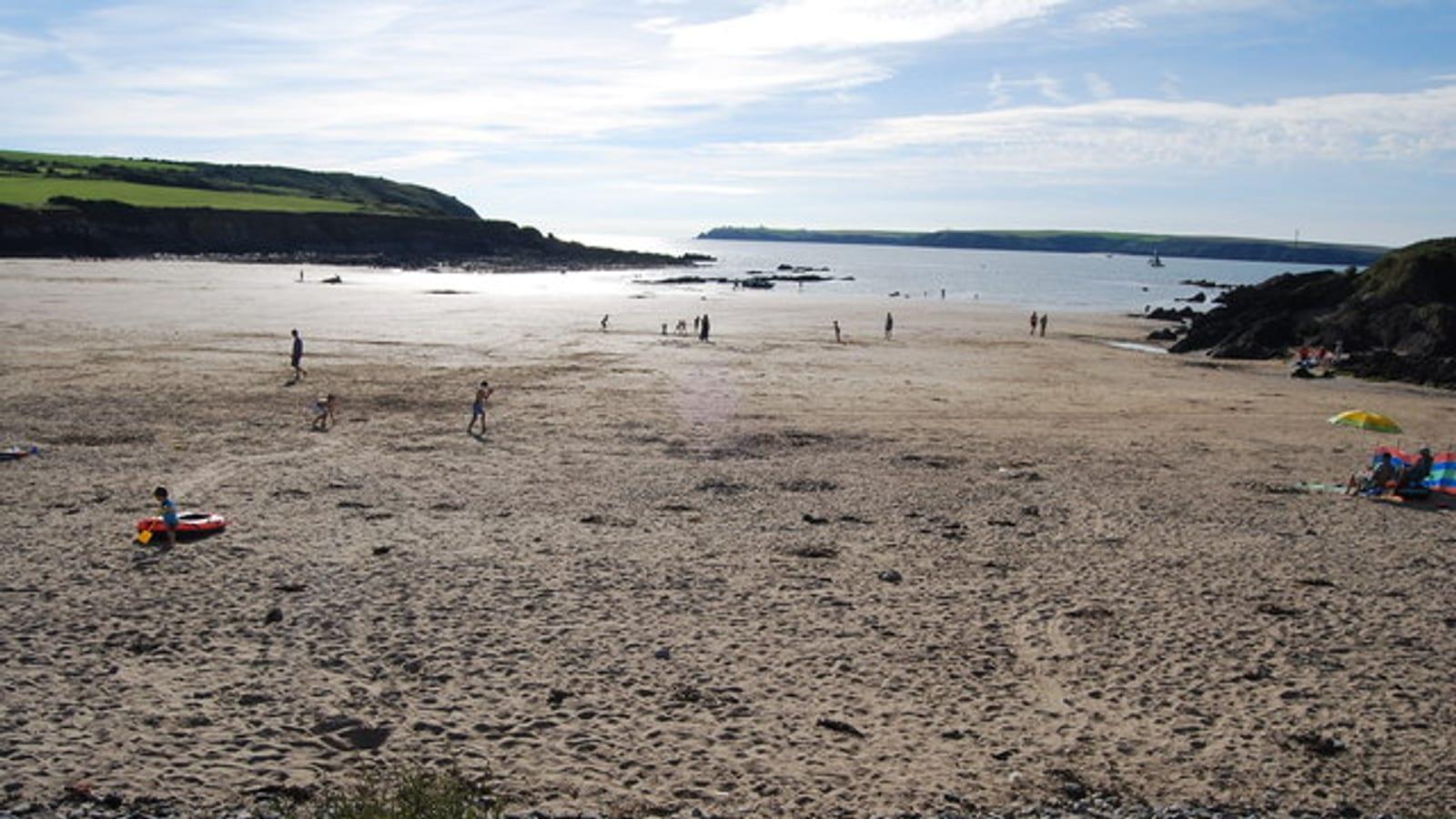
Image: Roger Kidd (CC BY-SA 2.0)
Find Silurian corals, brachiopods, and trilobites on the dramatically tilted strata at Marloes Sands, Pembrokeshire. Free surface collecting at a National Trust beach.
By Edward Chen · Updated 1 August 2026
Introduction
Marloes Sands in Pembrokeshire is one of the most geologically striking beaches in Wales. The strata here stand nearly vertical, tilted to the edge of perpendicular by the same Caledonian mountain-building events that shaped much of the geology of Wales and Scotland, and the result is an exposed cliff section that reads like a textbook on Silurian marine life. Corals, brachiopods, trilobites, and bryozoans emerge from the Coralliferous Group rocks in the centre of the beach, and the sequence transitions through younger Gray Sandstone and Old Red Sandstone beds at the southern end. The National Trust manages the land, and the Pembrokeshire Coast National Park designation protects the wider area. Two areas of the beach are particularly productive: one near the point where the descent path reaches the sand, and another some 300 metres further along in the direction of Gateholm Island. This guide covers how to reach Marloes Sands, what fossils the various rock units yield, the Silurian marine world these sediments record, and the collecting rules that apply on this important site.
 Photo: Roger Kidd, CC BY-SA 2.0, via Wikimedia Commons
Location and Directions
Address
Marloes Sands, Marloes, Pembrokeshire, Wales, SA62 3BH.
Directions
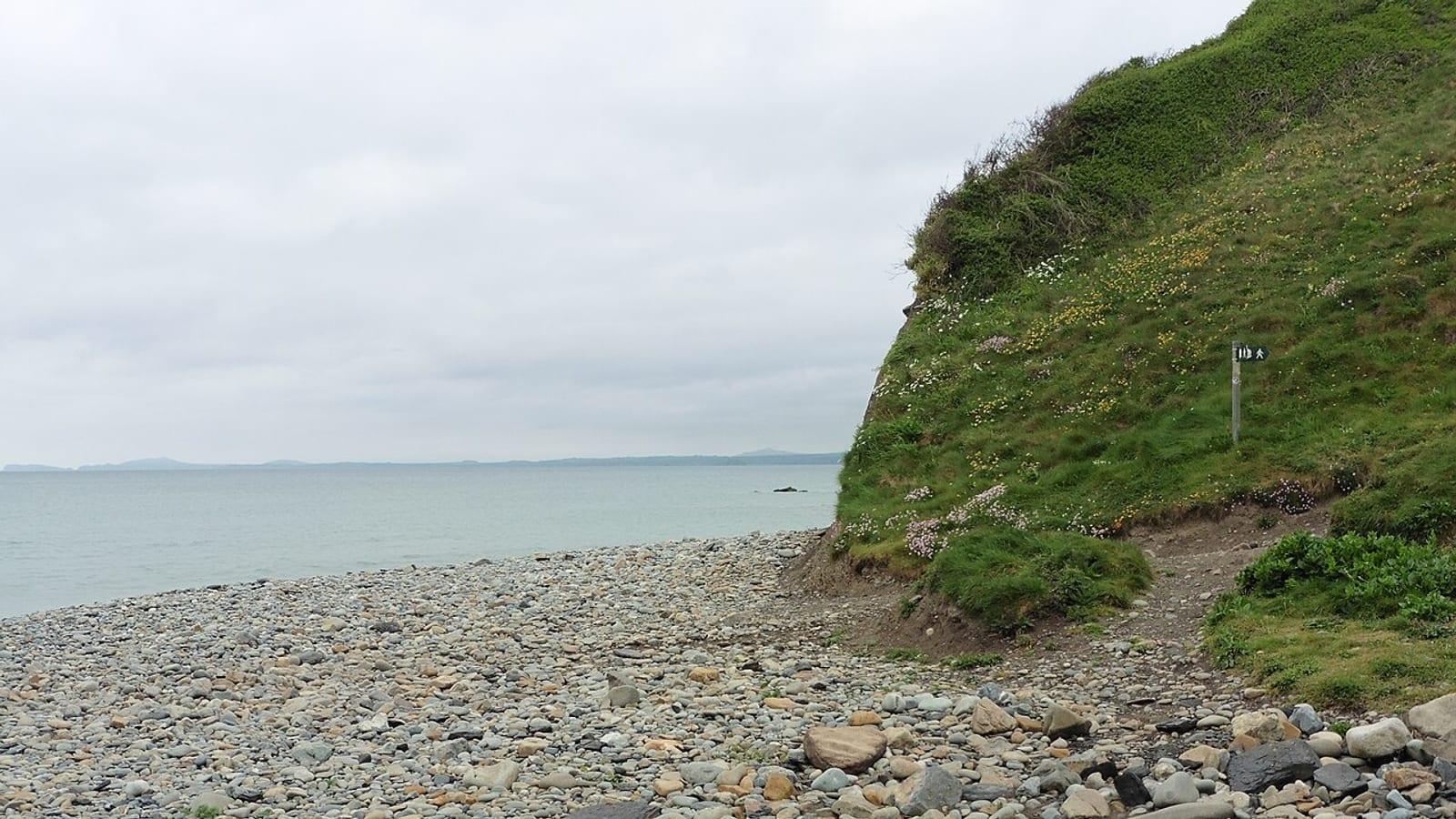
Marloes is a small village in the south-west of Pembrokeshire, reached via the B4327 from Haverfordwest. From the village, follow the signs for Marloes Sands along the narrow lanes toward the coast. The National Trust car park is situated at the cliff top above the beach and charges a seasonal parking fee. From the car park, follow the footpath downhill to the beach, a walk of approximately 15 to 20 minutes over uneven terrain. The descent path ends at the beach near the area of most productive Silurian outcrop. Turn left for the Coralliferous Group rocks. The geological section becomes progressively younger as you walk south toward Gateholm Island. Gateholm Island is accessible at low tide but be aware that the tidal channel can refill quickly. Check tide times for Milford Haven before visiting.
 Photo: Footpath to the coast path by Deborah Tilley, CC BY-SA 2.0, via Wikimedia Commons
What Fossils You'll Find
Corals are the most distinctive fossils at Marloes Sands. The Coralliferous Group, as its name suggests, contains dense concentrations of tabulate and rugose corals. Tabulate corals appear as masses of small, parallel tubes cemented together. Rugose (horn) corals occur as solitary, conical specimens with characteristic internal septa visible in cross-section. Many of the coral specimens at Marloes have been decalcified by weathering, leaving a carbon impression in the rock with the fine internal structure preserved as a ghostly outline. Fresh specimens from the scree at the foot of the cliff section retain more original detail.
Brachiopods are abundant throughout the Coralliferous Group. Both smooth and ribbed forms occur, including spiriferids with their distinctive wing-like shell outlines. Brachiopod shells often occur in concentrations within specific layers and can be found both embedded in the vertical cliff face and loose in scree at the cliff base.
Trilobites are present but require more searching than the corals and brachiopods. The Natural History Museum cites Marloes Sands as a recommended trilobite site, alongside Torquay and Coniston. They occur in the Coralliferous Group and Skomer Volcanic Group rocks and are more likely to be found as fragments of thorax segments or pygidium (tail shield) than as complete specimens. Complete trilobites do occur. The scree at the cliff base, where fresh material has recently fallen, gives the best chance.
Bryozoans appear as lacy networks and branching colonies. They are common associates of the coral-bearing horizons and can be found loose in the scree or as sections visible in the cliff face.
Fossil ripple marks in large slab sections, particularly within the Skomer Volcanic Group at the base of the sequence, record the gentle water movement in shallow lagoonal conditions. These cannot be collected but are striking features visible on the beach and cliff surface.
Geologic History
The Ancient Environment
The rocks at Marloes Sands span the Silurian period from approximately 441 to 427 million years ago, recording a transition from volcanic activity through shallow marine reef conditions to a final terrestrial red bed environment. The oldest rocks visible at the northern end of the section belong to the Skomer Volcanic Group (Aeronian Stage, approximately 440.8 to 438.5 Ma), which preserves subaerial lava flows interbedded with shallow lagoonal sediments. The ripple marks at the base of the sequence record the quiet water conditions of this early lagoonal setting. The Coralliferous Group (Sheinwoodian Stage, approximately 433.4 to 430.5 Ma) is the most fossiliferous unit and represents a period of warm, shallow marine shelf deposition on which a thriving community of tabulate and rugose corals, stromatoporoid sponges, brachiopods, bryozoans, trilobites, and molluscs flourished. Wales and the Silurian British Isles sat close to the equator at this time, within a warm tropical sea biologically comparable to a modern coral reef province. The overlying Gray Sandstone Group (Homerian Stage, approximately 430.5 to 427.4 Ma) records the transition toward the overlying terrestrial Old Red Sandstone, as the region shallowed and ultimately emerged from the sea.
How Marloes Sands Became a Fossil Collecting Site
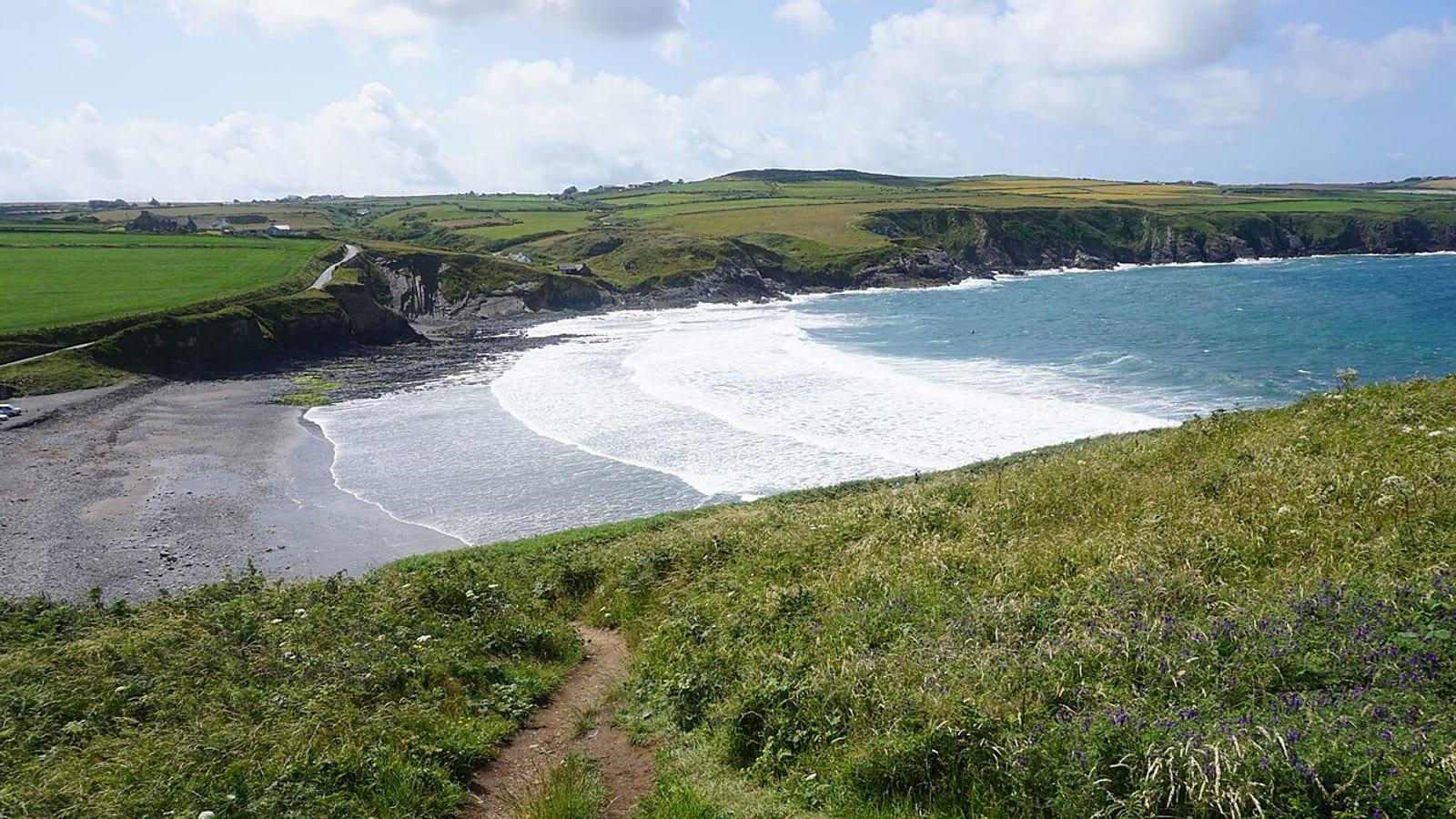
The dramatic vertical tilting of the strata at Marloes is the result of the Variscan orogeny, the late Carboniferous to early Permian collision that threw up a fold and thrust belt across south Wales and south-west England. Marloes lies south of the Variscan front, where steeply dipping and vertical beds are the rule rather than the exception. Beds that were originally horizontal have been rotated close to the vertical by the intense compression of this tectonic event, and subsequent erosion by the sea has cut through them to produce the cross-sectional exposures visible today. Wave action continues to erode the cliff base, releasing fossils from the Coralliferous Group and accumulating them as scree at the foot of the exposed section. The site is managed as part of the Pembrokeshire Coast National Park and is designated an SSSI for its geological significance.
 Photo: Pembrokeshire coast at Musselwick, near Marloes by Roger D Kidd, CC BY-SA 2.0, via Wikimedia Commons
Collecting Rules and Regulations
Is Fossil Collecting Allowed?
Surface collecting of loose fossils from the beach and the scree at the base of the cliff section at Marloes Sands is permitted for personal, non-commercial purposes at no charge. The site is within the Pembrokeshire Coast National Park and carries SSSI designation. Hammering the in-situ cliff face is prohibited. Collect from the beach surface and from naturally fallen scree material only. The fossil ripple marks and other in-situ sedimentary structures visible in the cliff face and on large bedding planes cannot be removed. Take care not to destabilise the scree at the cliff base, as this material protects the cliff from further rapid erosion.
Recommended Tools
A geological hammer for splitting scree material is useful, and a hand lens helps with examining coral and trilobite details. Bring a small brush for cleaning specimens in the rock pools, and a container for transporting delicate coral specimens without damaging them. Wear sturdy walking boots for the descent path and the rocky foreshore. The beach surface includes exposed bedding planes and loose boulders that are uneven underfoot.
Safety
The cliff face at Marloes Sands is steep and loose in places. Do not climb on the cliff or stand directly below overhanging sections. Gateholm Island at the south end of the beach is accessible at low tide but the tidal channel between the island and the main beach refills quickly. If you walk to the island, time your return carefully and do not linger if the tide has begun to come in. The beach itself is relatively safe but becomes narrow at high tide. Check tide times before you descend the path. The 15 to 20 minute walk back up to the car park should be factored into your tidal planning.