Monument Rocks (Chalk Pyramids) Fossil Guide
Image: Wistar92 (CC0)
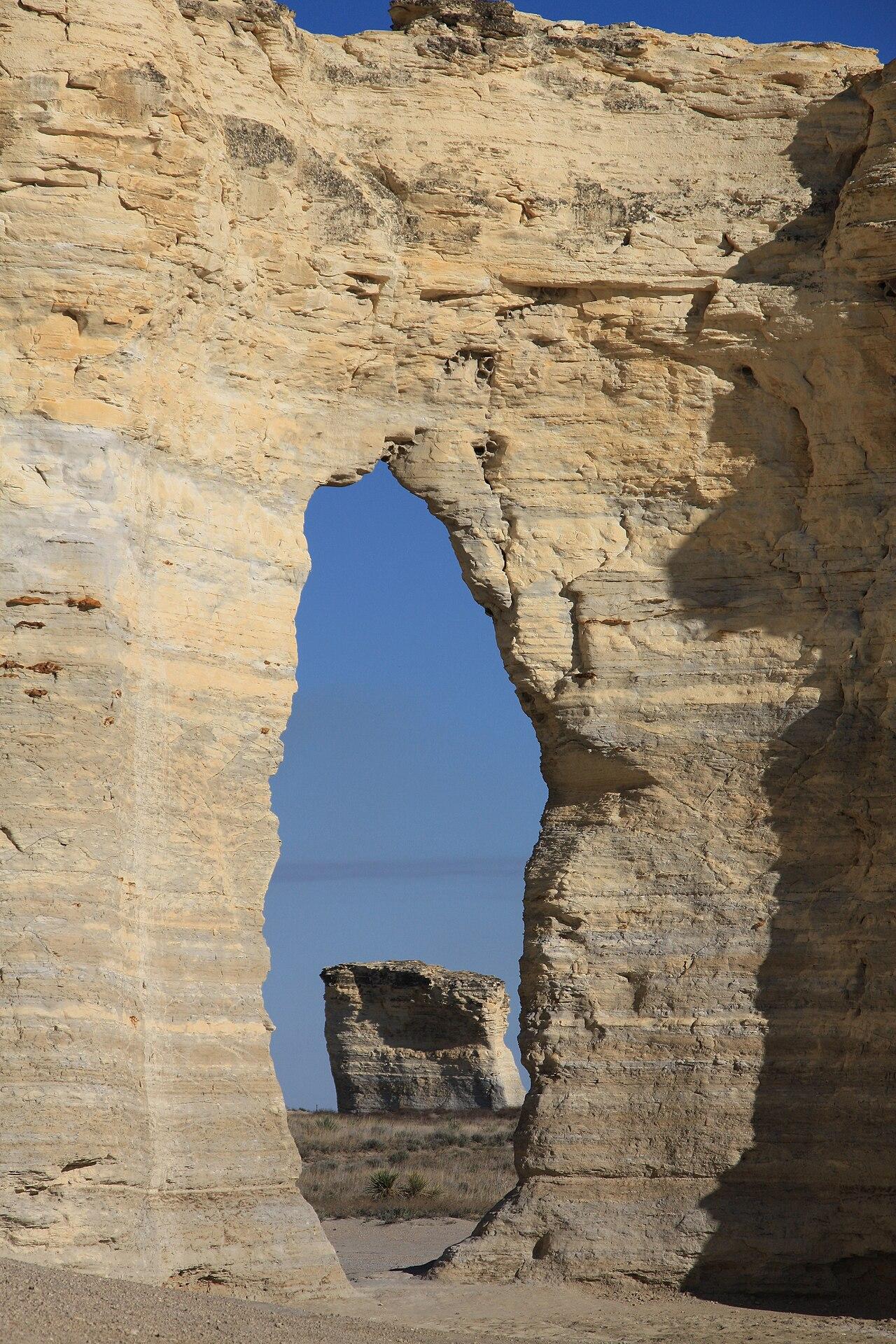
Monument Rocks, also known as the Chalk Pyramids, is a National Natural Landmark on private ranchland in Gove County, Kansas. The 70-foot Niobrara Chalk monoliths preserve one of North America's most productive Late Cretaceous marine fossil records: mosasaurs, giant clams, pterosaurs and the toothed bird Hesperornis have all come out of these beds. Free visitor access. No collecting permitted.
By Edward Chen · Updated 31 July 2026
Introduction
Monument Rocks, also called the Chalk Pyramids, is a cluster of soft chalk monoliths rising up to 70 feet from the High Plains of Gove County, western Kansas. Designated the first National Natural Landmark in the United States in 1968, the formations are erosional remnants of the Smoky Hill Chalk Member of the Niobrara Chalk, the same Late Cretaceous marine unit that has produced more than a century of striking finds: 15-metre mosasaurs (Tylosaurus), the toothed diving bird Hesperornis, the pterosaur Pteranodon, fish-within-fish predation specimens (Xiphactinus eating Gillicus), and refrigerator-sized clams (Inoceramus).
The land is privately owned but the rancher families graciously allow free public access during daylight hours. Fossil collecting is not permitted at Monument Rocks itself, but the surrounding Niobrara chalk badlands across western Kansas are some of the most productive marine Cretaceous beds in the world. The Keystone Gallery on US-83 between Oakley and Scott City sells legally collected specimens and arranges guided fossil prospecting on private land.
This guide covers what's visible, how to reach the site, and the etiquette that keeps it open to visitors.
Location and Directions
Monument Rocks sits in remote ranchland about 20 miles south of Oakley, Kansas, off US Highway 83.
Directions to Monument Rocks
From Interstate 70 at Oakley, take US Highway 83 south for roughly 20 miles, then turn east on Jayhawk Road (a gravel section road) and follow signs about 4 miles to the formations. There are no fences or gates, visitors simply pull off near the rocks and walk in. From the south, the same turn-off is signed from US-83 about 21 miles north of Scott City.
Practical notes: there are no toilets, no water, no shade, and no cell service at the site. Bring everything you need from Oakley or Scott City. Do not visit when wet, the gravel roads turn to slick gumbo and trap vehicles. Summer heat regularly exceeds 100°F. Drone use is at the discretion of the landowner. Check signage on arrival.
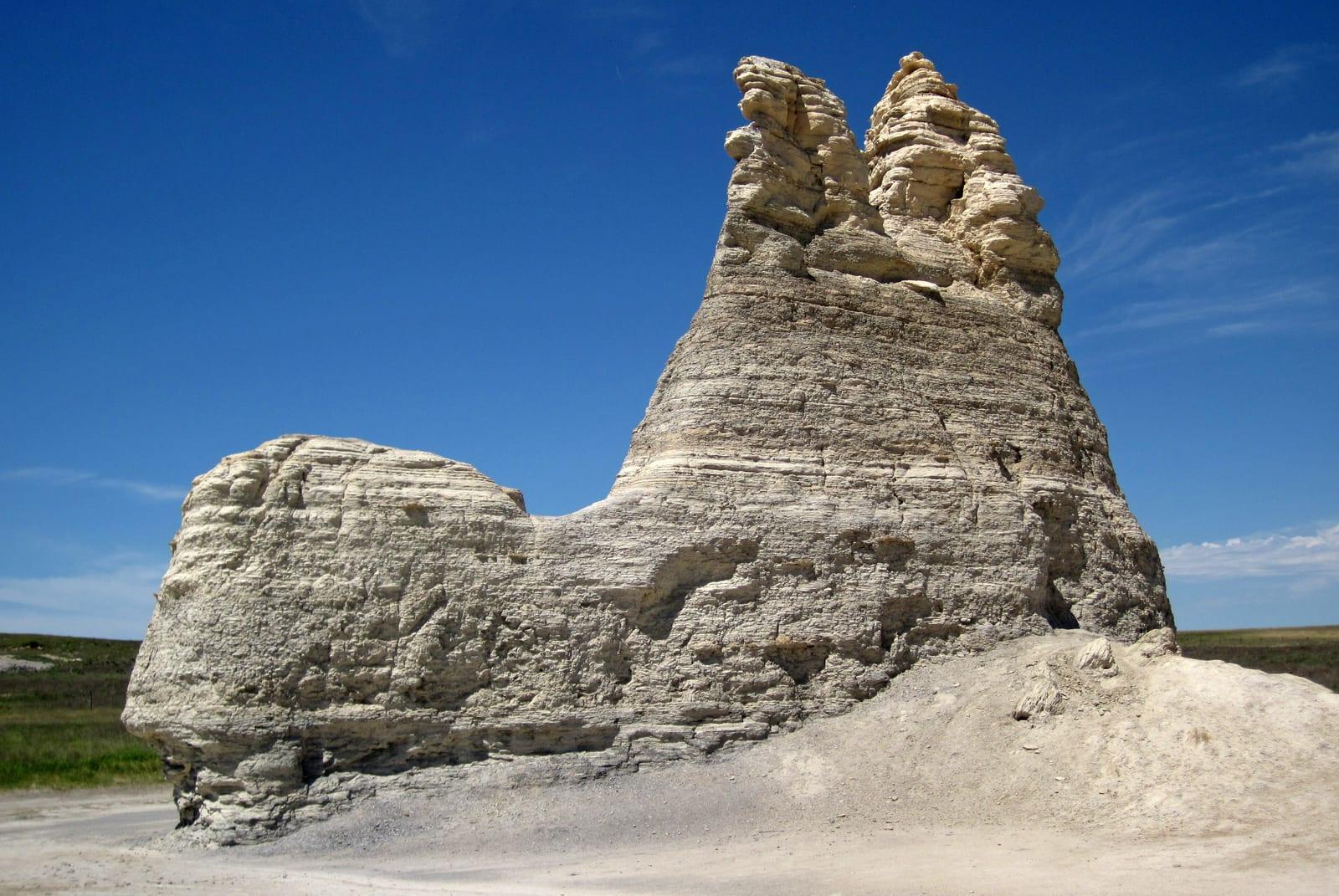
Combine the visit with nearby Castle Rock (also Niobrara Chalk, also free access on private land, about 30 miles east), the Keystone Gallery, and the Fick Fossil & History Museum in Oakley, which displays Xiphactinus, mosasaur skulls and a Pteranodon recovered from the surrounding chalk.
 Photo: James St. John, CC BY 2.0, via Wikimedia Commons
_1.jpg)
What Fossils You'll See
The Smoky Hill Chalk Member of the Niobrara Chalk records the open-marine, chalky bottom of the Western Interior Seaway during the early Late Cretaceous (Coniacian through early Campanian), between roughly 87 and 82 million years ago. It is the source unit for some of the most iconic marine reptile fossils in North America and has been internationally famous in palaeontology since the bone wars of the 1870s.
At Monument Rocks itself, visitors can see, but not collect, a range of marine fossils weathering out of the chalk spires and the surrounding badland flats. The most abundant and easily spotted are oyster shell fragments and the bright iridescent prisms of Inoceramus, a large, thin-shelled clam that lived on the chalk bottom and grew to striking sizes (some Smoky Hill Inoceramus shells exceed 2 metres in diameter). The smaller-scale prism layers are often the first fossils a new visitor spots, glittering against the white chalk. Occasional shark teeth, most commonly the small triangular Squalicorax and the more slender Cretoxyrhina mantelli, weather out at the base of the spires. Fish scales and vertebrae of Enchodus and Xiphactinus are scarcer but present in the gravel lag below the formations.
Major finds at Monument Rocks itself and across the broader Smoky Hill Chalk in Gove County have included some of the most famous fossil specimens ever recovered. Mosasaur vertebrae and articulated partial skeletons of Tylosaurus proriger, the giant 15-metre-long apex predator of the Western Interior Seaway, are recovered from the chalk regularly. The pterosaur Pteranodon longiceps, with its enormous head crest and 6-metre wingspan, has produced wing bones and partial skeletons from the Smoky Hill that are now displayed at the Fick Museum, the Keystone Gallery, and the Sternberg Museum. The flightless toothed seabird Hesperornis regalis, a 1.8-metre diving bird recovered as articulated leg bones and skulls, was first described from these chalks in the 1870s. The voracious bony fish Xiphactinus audax, with its deeply forked tail and fang-like teeth, has produced complete skeletons including the famous "fish-within-a-fish" specimen in which a 4-metre Xiphactinus was found with a 2-metre Gillicus arcuatus in its stomach.
Smaller but equally notable invertebrate finds include the ammonite Scaphites whitfieldi (a Late Cretaceous biostratigraphic index fossil), the heteromorph Acanthoscaphites, the straight-shelled Baculites, and the cup coral Micrabacia. The Keystone Gallery and Fick Fossil & History Museum displays in Oakley and the Sternberg Museum in Hays are the best places to understand what the broader Smoky Hill Chalk has produced and what kind of fragment you might be looking at when something turns up at your feet at Monument Rocks.
The Keystone Gallery describes the local chalk beds as among the most productive Cretaceous marine fossil sources in the world.
 Photo: James St. John, CC BY 2.0, via Wikimedia Commons
_(Niobrara_Formation,_Upper_Cretaceous;_western_Kansas,_USA)_6_(15115473009).jpg)
Geologic History
The Smoky Hill Chalk Member was laid down between roughly 87 and 82 million years ago in the deep, calm, normal-marine waters of the Western Interior Seaway, the warm, shallow tropical sea that bisected North America from the Gulf of Mexico to the Arctic Ocean during much of the Late Cretaceous. Water depths across western Kansas during chalk deposition averaged 100 to 200 metres, but the seaway extended both wider and deeper to the west and south. Microscopic calcareous plates of coccolithophore algae (golden-brown phytoplankton that secrete plates of calcite called coccoliths) rained onto the seafloor at notable rates, accumulating as thick, soft chalk. The time-equivalent chalks across Europe are the famous White Cliffs of Dover and the chalks of northern France, Denmark, and southern Sweden, products of the same global Cretaceous ocean and the same coccolithophore "white-chalk world."
The Niobrara Chalk in Kansas is divided into the lower Fort Hays Limestone Member and the upper Smoky Hill Chalk Member. The Fort Hays is harder, more massive, and supports the cap rock at sites like Castle Rock. The Smoky Hill is softer, more shaly, and forms the dramatic chalk badlands at Monument Rocks, Little Jerusalem, and along the Smoky Hill River. Bentonite layers, altered volcanic ash beds derived from the Sevier orogenic volcanic arc to the west, are interbedded with the chalk and provide some of the most precise radiometric dates anywhere in the upper Cretaceous record.
After the seaway withdrew in latest Cretaceous time, the chalk was buried by Paleogene and Neogene sediments and gradually lithified. The Tertiary Ogallala Formation, the famous High Plains aquifer-bearing unit, was deposited across the area between roughly 12 and 5 million years ago. Quaternary uplift of the High Plains and Pleistocene incision by the Smoky Hill, Solomon, Saline, and Republican river systems removed most of the Ogallala cover across Gove County and re-exposed the Niobrara Chalk at the modern surface. The dramatic erosional landforms, Monument Rocks, Castle Rock, and the Little Jerusalem badlands, are products of Holocene differential erosion, with the harder calcareous beds standing up while the softer surrounding chalk weathers back.
The Smoky Hill Chalk has been internationally famous in vertebrate paleontology since the 1870s, when Othniel Charles Marsh of Yale and Edward Drinker Cope of the Academy of Natural Sciences of Philadelphia began competing for fossil specimens during the "Bone Wars." Charles H. Sternberg and his sons collected for decades across western Kansas and supplied many of the foundational Niobrara specimens to museums worldwide. Their family's name lives on in the Sternberg Museum at Fort Hays State University, the principal regional repository of Niobrara material. Modern collecting continues under permit through Fort Hays State University, the University of Kansas, the Kansas State Geological Survey, and several private outfits including the Keystone Gallery.
How Monument Rocks Came to Be Protected
Monument Rocks was designated a National Natural Landmark in 1968, the first such designation by the U.S. National Park Service, which made it the inaugural site on the National Natural Landmarks Programme list. The land remains privately owned by ranching families and is managed informally with visitor goodwill rather than fences or paid entry. The landowners reserve the right to close access at any time, and visitor behaviour, particularly the strict no-collection-no-climbing rule, is what keeps the site open year after year.
 Photo: James St. John, CC BY 2.0, via Wikimedia Commons
_5_(19306096454).jpg)
Collecting Rules and Regulations
Is Fossil Collecting Allowed?
No. Fossil collection at Monument Rocks itself is prohibited. The National Natural Landmark designation and the landowner's policy both forbid removing fossils or rock.
Key Points:
- Free daylight-hours access. No permit or fee
- No collecting, hammering, or chipping
- No climbing the formations (the chalk is fragile and erodes easily)
- No litter. Carry out everything you carry in
- Visit only in dry weather. Gravel roads become impassable when wet
- Nearby Keystone Gallery arranges legal collecting trips on private Niobrara Chalk land
Safety
Monument Rocks stands on private land that the owners allow the public to visit, and the whole arrangement depends on visitors behaving well. It is also genuinely remote High Plains country.
The access roads are unpaved and become impassable when wet. This is the practical hazard that catches most people. The chalk-derived soil turns to deep, greasy mud after rain or snowmelt, and vehicles get stuck miles from help. Visit in dry weather, check the forecast, and turn back rather than pressing on if the surface starts to grease up. There is no phone signal to speak of and no services nearby.
Do not climb the formations. The chalk is soft and crumbles readily and the spires are undercut, which is why the formations in this part of Gove County lose material to storms. Climbing damages a National Natural Landmark and risks bringing part of it down on you. Stay on the ground and keep back from the base of overhanging faces.
There is no shade and no water. Western Kansas summers are hot with strong sun and persistent wind, and winter brings severe cold and wind chill. Carry water for everyone, wear sun protection, and tell someone your route.
Rattlesnakes are present on the prairie in the warmer months, so watch where you step around the base of the rocks. Watch the sky as well, since this is open country with nowhere to shelter and severe thunderstorms build fast on the High Plains. Take all litter out, and respect the landowners' access.
Sources
Nearby sites
 Castle Rock Badlands Fossil Hunting GuideInoceramus (giant clams), Foraminifera
 Black Mesa Triassic-Jurassic Fossil GuideDinosaurs, Sauropods
 Garden Park Fossil Area Fossil Hunting GuideAllosaurus fragilis (type), Stegosaurus stenops (type)
 Florissant Fossil Beds National Monument Fossil Hunting GuideInsects, Plant leaves