Helmsdale Fossil Hunting Guide
Helmsdale sits on the Sutherland coast of northeast Scotland, where the A9 runs along the lip of the North Sea between Brora and Berriedale.
By Edward Chen · Published 11 December 2025
Introduction
Helmsdale sits on the Sutherland coast of northeast Scotland, where the A9 runs along the lip of the North Sea between Brora and Berriedale. The harbour and the foreshore north of it expose one of Britain's most distinctive Late Jurassic sequences: the Helmsdale Boulder Beds, a stack of submarine conglomerates and turbidites laid down at the foot of an active fault scarp during the rifting that opened the proto-North Sea. Between the boulder beds, dark organic-rich Kimmeridge Clay carries ammonites, fish, and the bones of marine reptiles. The Kimmeridgian rocks here are roughly 157 to 152 million years old. This is the only stretch of Scottish coast where Late Jurassic fossils are accessible to a casual visitor on foot, and the Boulder Beds themselves are an internationally cited reference for syn-rift sedimentation. This guide covers how to walk the foreshore safely with the tide, where the productive sections lie, what the sequence records about the active Helmsdale Fault, and the conservation rules that apply on the Sutherland coast.
Location and Directions
The fossil-bearing exposures lie along the foreshore north of Helmsdale Harbour, in the village of Helmsdale, Sutherland, postcode KW8 6HG. A useful starting point is the harbour car park at grid reference ND 029 152.
From the south, follow the A9 north from Inverness for about 100 miles, through Tain, Brora, and over the Ord of Caithness. From the north, take the A9 south from Wick for 35 miles. In Helmsdale village, turn east off the A9 onto Stafford Street and follow signs for the harbour. Free parking is available at the harbour and at the Timespan Museum on Dunrobin Street, a six-minute walk away.
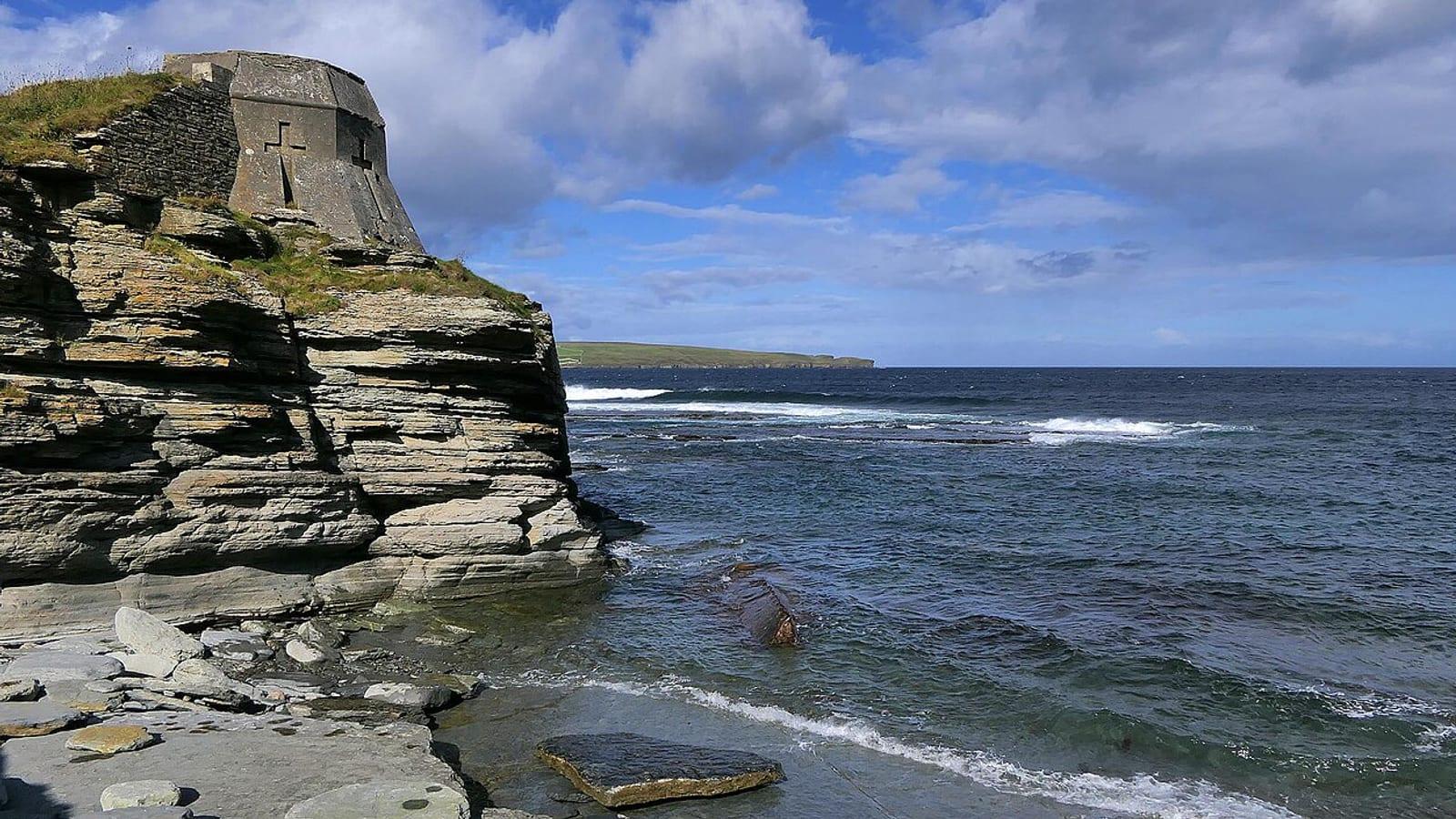
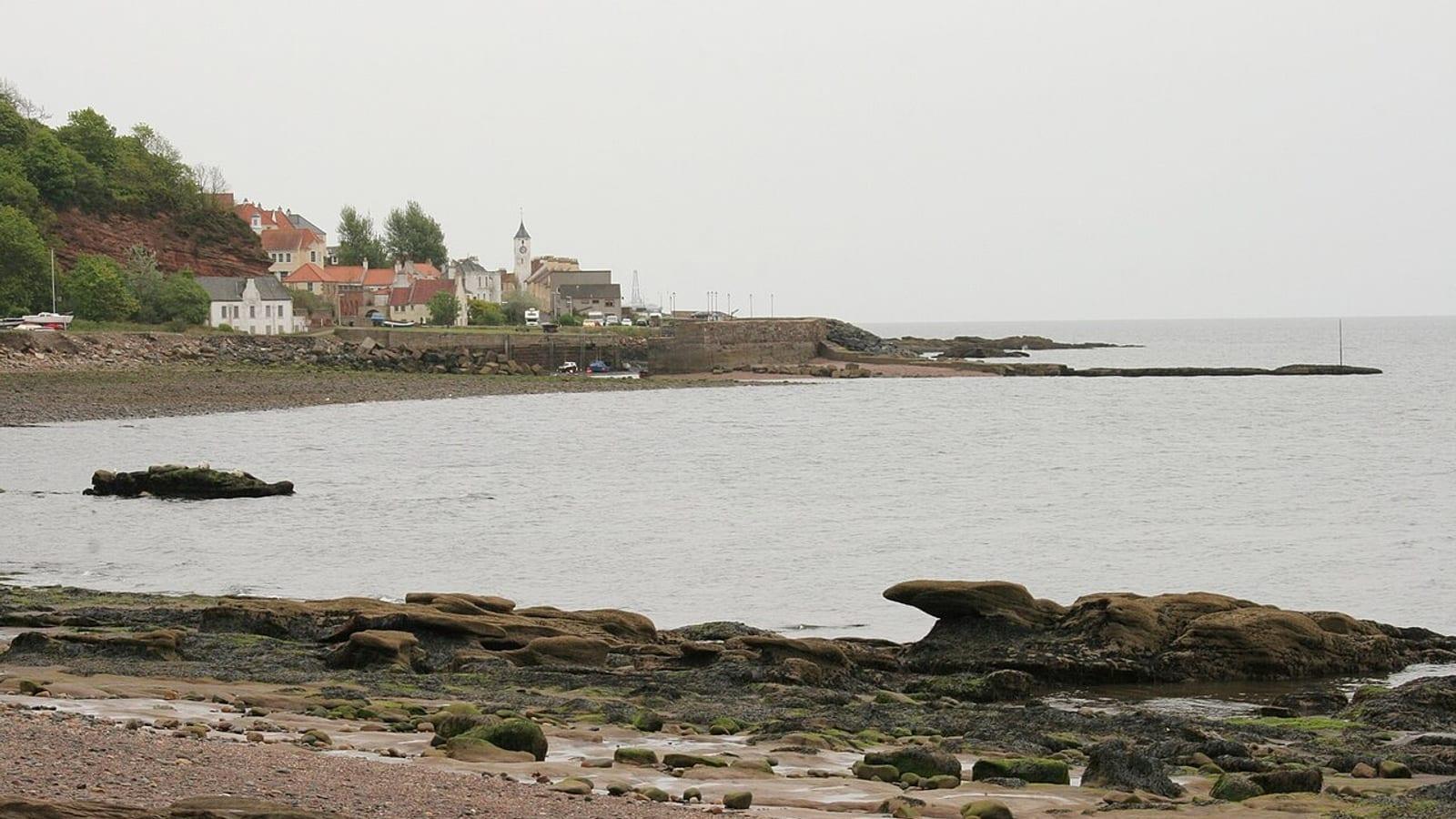
From the harbour, walk north along the foreshore. The first 200 metres pass modern harbour walls and gravel beach. Beyond the breakwater, the rocks begin to dip steeply seaward and the Kimmeridgian succession becomes accessible. The most productive ground extends from roughly half a kilometre north of the harbour to about 2 kilometres north, where the cliff path turns inland. Several small streams cross the beach and require dry-foot stepping at low water.
Tide planning is essential. You need a tide of at least mid-falling to clear the lower platforms, and a spring low gives the best access. Aim to be on the foreshore from two hours before low water until one hour after. Check Helmsdale or Wick tide tables before setting out. The North Sea swell can run high here even in calm weather, and the platforms become impassable in any onshore wind above force four. Do not turn your back on the sea, and do not work alone if you can avoid it.
What Fossils You'll Find
The Helmsdale foreshore yields fossils both from the conglomerate Boulder Beds and from the dark Kimmeridge Clay between them. The two units demand different search strategies.
Ammonites are the most reliable find. They occur in the Kimmeridge Clay as flattened impressions in dark shale and as three-dimensional specimens in nodular cementstone bands. Look for ribbed coiled outlines on cleaved shale faces, and check loose nodules from the foreshore for sectioned specimens. Pectinatites and related Kimmeridgian genera are typical.
Belemnite guards, the bullet-shaped internal skeletons of squid-like cephalopods, weather out of the clay and the boulder beds alike. They are often complete and easy to spot against the dark mudstone.
Fish remains include scales, teeth, and occasional bone fragments. The richest material occurs in dark organic-rich shales of the Kimmeridge Clay. Specimens are usually small and require careful splitting of fissile blocks.
Marine reptile material, including isolated vertebrae, ribs, and tooth fragments from ichthyosaurs and pliosaurs, has been recovered from the Kimmeridge Clay along this stretch. Articulated specimens are extremely rare and any substantial bone find should be reported rather than collected.
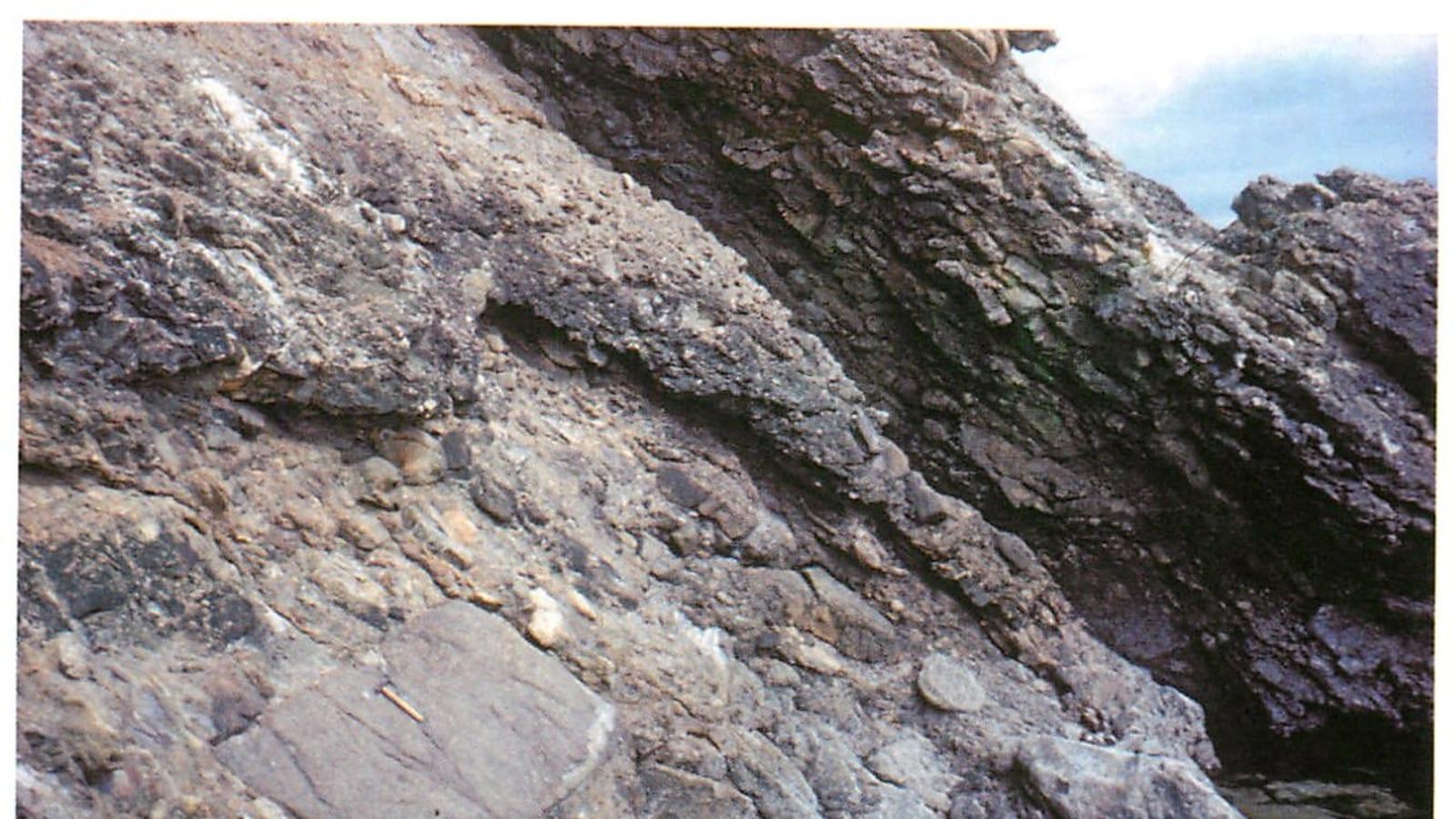
Giant corals, distinctive of the Boulder Beds, occur as large reworked clasts within the conglomerates. These are colonial scleractinian corals that grew on the high side of the active Helmsdale Fault, then collapsed down the submarine scarp as part of debris flows. They are often a metre or more across and are part of the SSSI feature. They are for viewing only.
Other bivalves and gastropods appear in shell-rich bands, particularly in the cementstone interbeds.
The whitish-weathering carbonate clasts in the conglomerate are the easiest visual cue for spotting the Boulder Bed horizons against the dark muddy matrix.
Geologic History
The Helmsdale succession records the Late Jurassic Kimmeridgian stage, roughly 157 to 152 million years ago, when northern Britain lay at mid-northern latitudes on the western flank of an actively rifting basin that would eventually become the North Sea. The local geology is controlled by the Helmsdale Fault, a major normal fault that runs offshore parallel to the present coast.
In the Late Jurassic, the Helmsdale Fault dropped down a deep marine basin to the east, while the Sutherland block to the west remained relatively high. Carbonate platforms and reefs grew on the upthrown high. Earthquakes along the fault repeatedly shook the high block, sending debris flows of reef boulders, sand, and mud down a steep submarine scarp into the deeper basin below. Each event deposited a coarse boulder bed. Quieter intervals between events allowed the dark organic-rich Kimmeridge Clay to accumulate over the scarp foot.
The result, exposed on the foreshore today, is a stack of conglomerates and clays interpreted as syn-rift submarine fan and slope deposits. Three lithofacies are recognised: chaotic boulder conglomerates from rockfall and debris flows, thinly bedded sandstone and mudstone turbidites from the more dilute tails of those flows, and laminated black mudstone from quiet-water deposition between events. The reworked corals and reef carbonate clasts in the boulder beds are direct evidence of the high-block shallow-water carbonate factory that fed the system.
After the Jurassic, the Sutherland coast was deeply buried, then exhumed during the Cenozoic uplift of the Scottish Highlands. North Sea wave action has since trimmed the cliffs back to expose the syn-rift section in foreshore platform.
How Helmsdale Became a Fossil Collecting Site
Helmsdale has been a working fishing village since the early nineteenth century, when the Sutherland Estates relocated cleared crofting families to the coast and built the harbour. Geologists working on the new coast in the mid-1800s recognised the unusual conglomerates and described the Boulder Beds as some of the earliest examples of submarine debris-flow deposits in the British literature. Twentieth-century work, particularly the studies that established the Helmsdale Fault as a syn-depositional structure, made the site internationally cited.
There has been no quarrying of these beds for fossils. Everything on the foreshore is the product of natural erosion. North Sea storms, freeze-thaw weathering, and the slow retreat of the cliff line continually expose new specimens. The site is part of the East Sutherland Coast SSSI, designated specifically for the Kimmeridgian succession and the Boulder Beds.
Collecting Rules and Regulations
Surface collecting of loose, weathered fossils is permitted under the Scottish fossil code. Hammering the bedrock and removing the giant coral boulders are not. The Sutherland coast SSSI designation protects the in-situ exposures, and the Scottish Fossil Code published by NatureScot sets out the responsible-collecting framework.
What is allowed: collecting small loose ammonites, belemnites, fish material, and bivalves that have already weathered free from the clay or that come from beach float. What is not allowed: hammering in-situ boulder bed outcrops, removing or damaging the giant coral clasts, or collecting any vertebrate specimen of scientific significance without reporting it.
Significant finds, especially marine reptile bones, should be reported to NatureScot or to the Hunterian Museum in Glasgow. Local interpretation and identification help is available at the Timespan Museum in Helmsdale village, which has displays on the geology and fossils of the coast.
Practical rules and safety notes:
- Watch the tide. Several stretches of the foreshore are cut off on a rising tide, and the gradient of the platforms is gentle so you can be caught out without realising.
- The cliffs are unstable, particularly after rain or frost. Stay clear of the cliff base.
- Wear sturdy boots. The platforms are weed-covered and slippery.
- The North Sea is cold year-round. Hypothermia is a real risk if you slip into the water in winter.
- Carry a charged phone and tell someone your route. Mobile coverage is patchy north of the village.
- Dogs are allowed on the foreshore but should be on a lead near sheep on the cliff path.
- No fees apply for foreshore access. Harbour parking is free.
Safety
This is a remote stretch of Highland coast on the North Sea, and the combination of tide, cold, and isolation deserves more respect than the modest scale of the site suggests.
Time the tide and know your way back. The exposures lie on the foreshore north of the harbour, and the sea reaches the base of the rocks at high water. Work the ebb, identify your exit before you start, and do not let a productive boulder keep you out past your margin. There is no easy escape upward along much of this shore.
The boulder beds are awkward ground. The Helmsdale exposures are a jumble of large blocks, and the surfaces are weed-covered, uneven, and slippery. Wear boots with a firm sole and good grip, and move deliberately rather than hopping between boulders, since a fall here means landing on rock with a gap underneath.
The North Sea is cold year-round and this coast takes real weather. Hypothermia is a genuine risk if you get wet in a wind, so carry windproof and waterproof layers even on a fine summer day, and add a hat and gloves outside high summer. Conditions change fast, and haar can roll in and cut visibility along the shore within minutes.
Keep clear of the cliffs above the foreshore, which shed rock. Note that the A9 runs close to the coast here and is fast, so park properly and do not walk the verge. Mobile coverage is patchy in Sutherland, daylight is very short in winter, and the nearest substantial services are some distance away. Tell someone your plans and when to expect you back.
Sources
- NatureScot, "Scottish Fossil Code." https://www.nature.scot/professional-advice/protected-areas-and-species/protected-species/protected-species-z-guide/scottish-fossil-code
- British Geological Survey, "Helmsdale Boulder Beds and Kimmeridge Clay of Sutherland." https://www.bgs.ac.uk/
- UK Fossils Network, "Helmsdale." https://ukfossils.co.uk/2005/04/14/helmsdale/
- Open University Geological Society East Scotland Branch, "Helmsdale and the Kimmeridgian." https://east.ougs.org/
- Timespan Museum, Helmsdale. https://www.timespan.org.uk/