Valentia Island Tetrapod Trackway Fossil Hunting Guide
Image: Phil Champion (CC BY-SA 2.0)
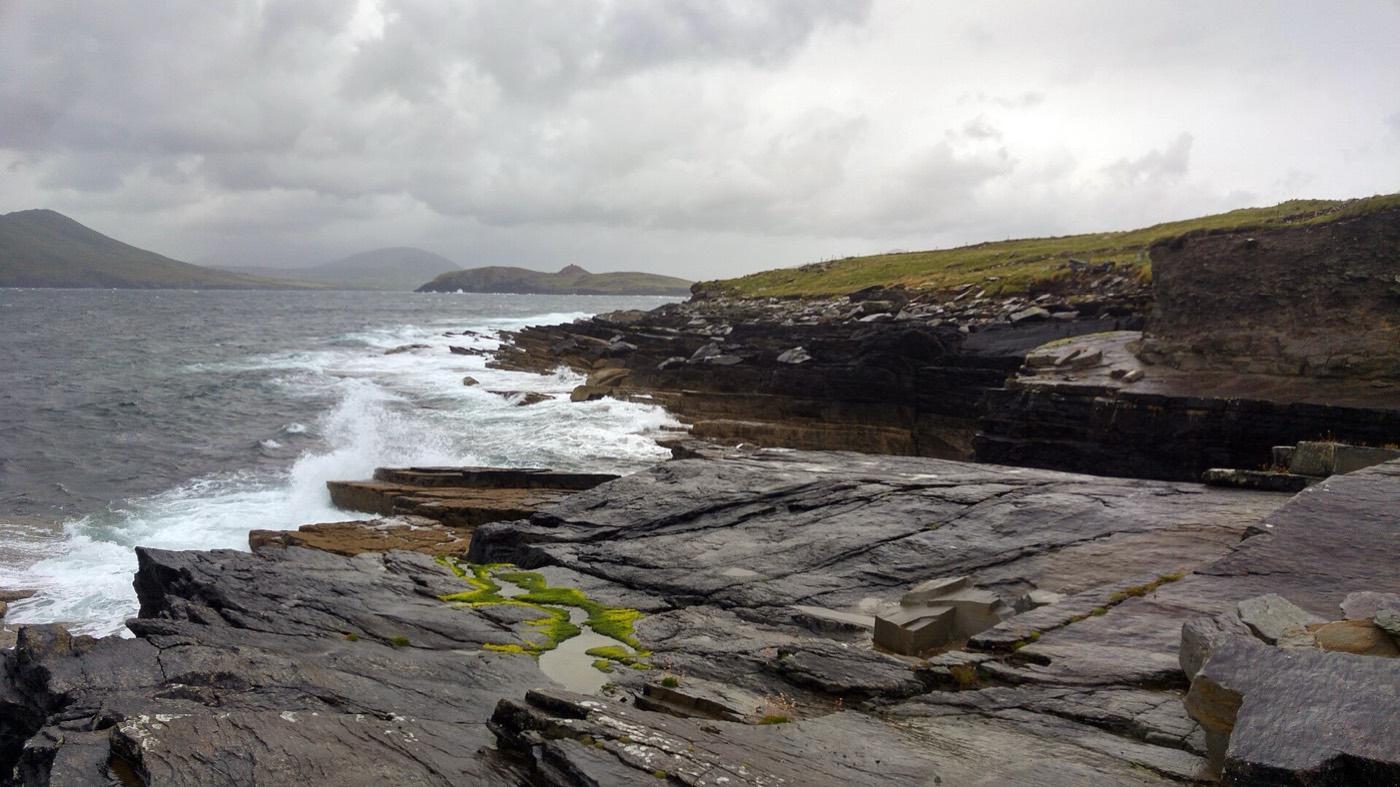
Middle Devonian footprints on the north-east coast of Valentia Island in County Kerry, among the oldest records of a four-limbed animal walking on land. Free and open access on the shore at Dohilla, with a viewing area and interpretation.
By Edward Chen · Published 11 September 2026
Introduction
Some fossils are bones. This one is a record of behaviour. An animal with four limbs walked across wet sediment roughly 385 million years ago. The moment is close to the point when vertebrates first moved onto land.
The Valentia Island trackway is preserved in the Middle Devonian Valentia Slate Formation on the north-east coast of the island. Nine trackways have been described from three sites, Dohilla, Coosadillisk and Culoo Head, with the latter two recorded more recently.
It is one of a very small number of such sites worldwide, and it costs nothing to see. The trackway at Dohilla near Chapeltown has free and open access on the shore.
Location and Directions
Valentia Island lies off the Iveragh peninsula in County Kerry, at the south-west corner of Ireland. It is reached by the road bridge at Portmagee or, in season, by the car ferry from Reenard Point to Knightstown.
GPS for the trackway: 51.9309°N, 10.3438°W. The site is at Dohilla, signposted from Chapeltown on the island's north-east coast. Coosadillisk lies 400 metres north-west of it and Culoo Head 3.5 kilometres south-west, but Dohilla is the one with public access and interpretation.
There is a car park, a bilingual Irish and English interpretation sign, and a viewing area above the trackway surface. Access is normally free and unrestricted. The National Parks and Wildlife Service closed the site in November 2025 for repair works. No reopening notice had appeared by mid-2026, so check with NPWS before you travel.
The island is on the Ring of Kerry tourist route, so it is busy in summer, and the roads are narrow.
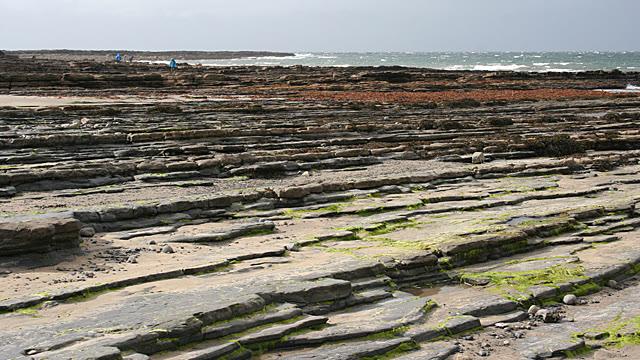
Manage expectations about the visit itself. The trackway is a set of shallow depressions on a sloping rock surface, viewed from above. In poor light it can look like nothing at all. Visitors who arrive at midday on a bright dry day often leave unsure whether they saw it. Go when the sun is low or the rock is wet.
What Fossils You'll Find
There is nothing to collect. There are footprints in rock, and the point is to see them.
The prints are shallow depressions in a bedding surface, arranged in trackways. Some show a body drag between the limb impressions.
They are easiest to read in low, raking sunlight, or when the rock is wet. In flat midday light on a dry surface they can be hard to pick out at all, which frustrates visitors who arrive expecting something obvious. Early morning, late afternoon, or just after rain are the best conditions.
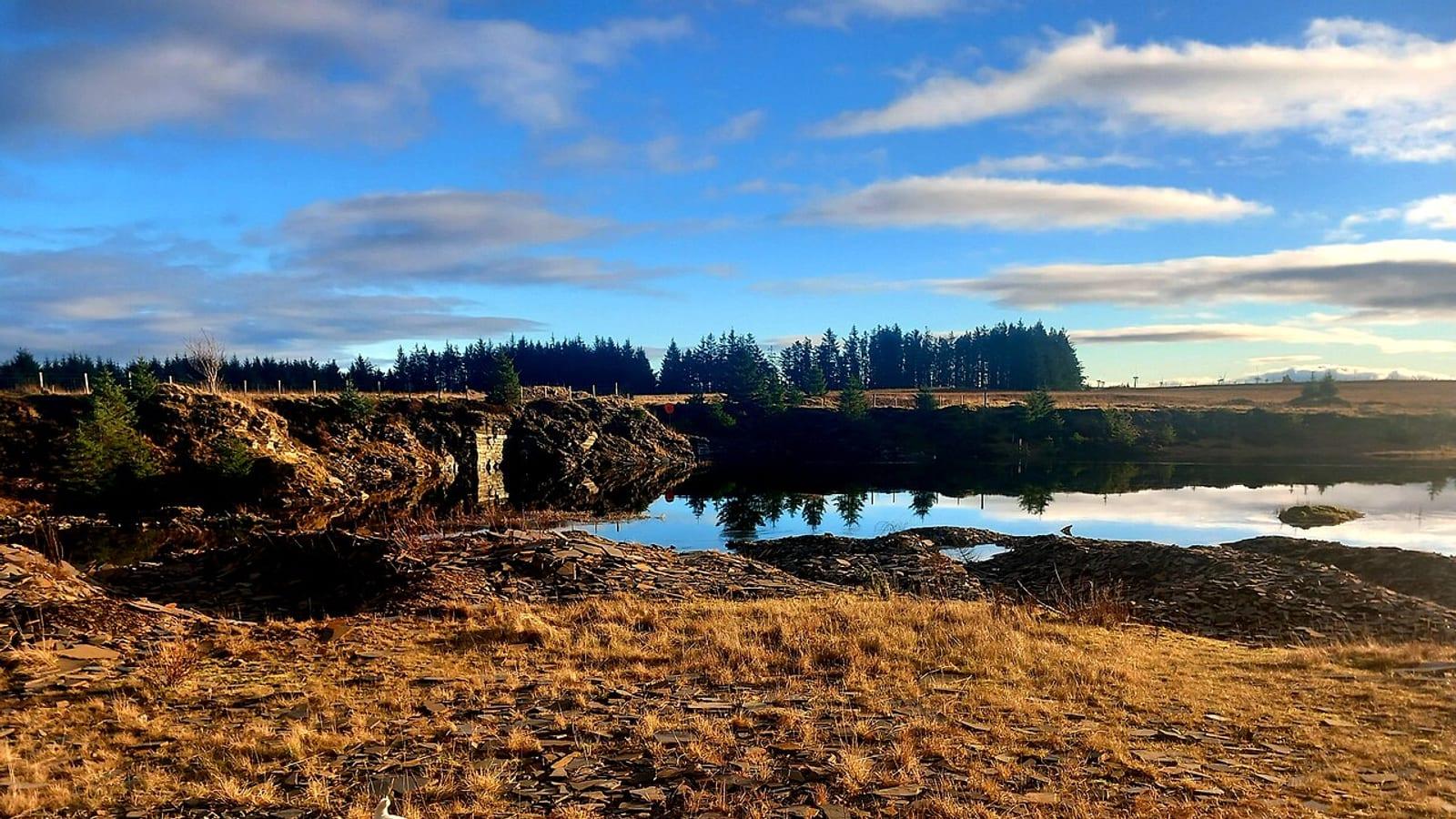
The surrounding Valentia Slate Formation is the rock that was quarried on the island for roofing slate. The slate quarry above Knightstown is a separate visitor attraction.
The trackway sits in a small group of sites that record the move onto land. Comparable Devonian trackways are known from Poland at Zachełmie and from Australia at Genoa River, and the Polish site is older. What Valentia adds is a long, clear, multiple-trackway surface that can be seen by anyone who drives to it.
 Photo: Mucklagh, CC0, via Wikimedia Commons
Geologic History
The Valentia Slate Formation is Middle Devonian, dated to roughly 388 to 383 million years ago. The approximate figure of 385 million used elsewhere on this page sits inside that range. The Devonian is sometimes called the Old Red Sandstone in these islands, after the continental red-bed sediments of the period.
The setting was not marine. These were river floodplains and shallow freshwater margins on a large continental landmass. In that period the first vertebrates made the transition from water to land.
An animal walked across wet mud. The mud dried and was buried by the next sediment layer, and the impression survived. Compaction and later metamorphism turned the sediment into slate, which is why the rock now cleaves the way it does.
The trackmaker is not known from body fossils here, and no published identification exists. Early tetrapods such as Ichthyostega and Acanthostega are the animals usually pictured for this interval. Naming either as the maker of these prints would go beyond the evidence.
The island has a second geological draw in the slate quarry above Knightstown. It is said locally to have supplied slate for the Houses of Parliament and the Paris Opera House. The quarry is now partly a grotto and is open to visitors.
 Photo: Mucklagh, CC0, via Wikimedia Commons
Collecting Rules and Regulations
Nothing is collectable. This is a trace-fossil surface, and its value is in the whole arrangement of prints, not in any single depression.
Do not hammer, chalk, chisel or cast the surface. Do not walk across the trackway itself where it is marked as protected.
The trackway is a recognised geological heritage site and the National Parks and Wildlife Service manages access to it.
Photograph it and leave it exactly as you found it.
 Photo: Phil Champion, CC BY-SA 2.0, via Wikimedia Commons
Safety
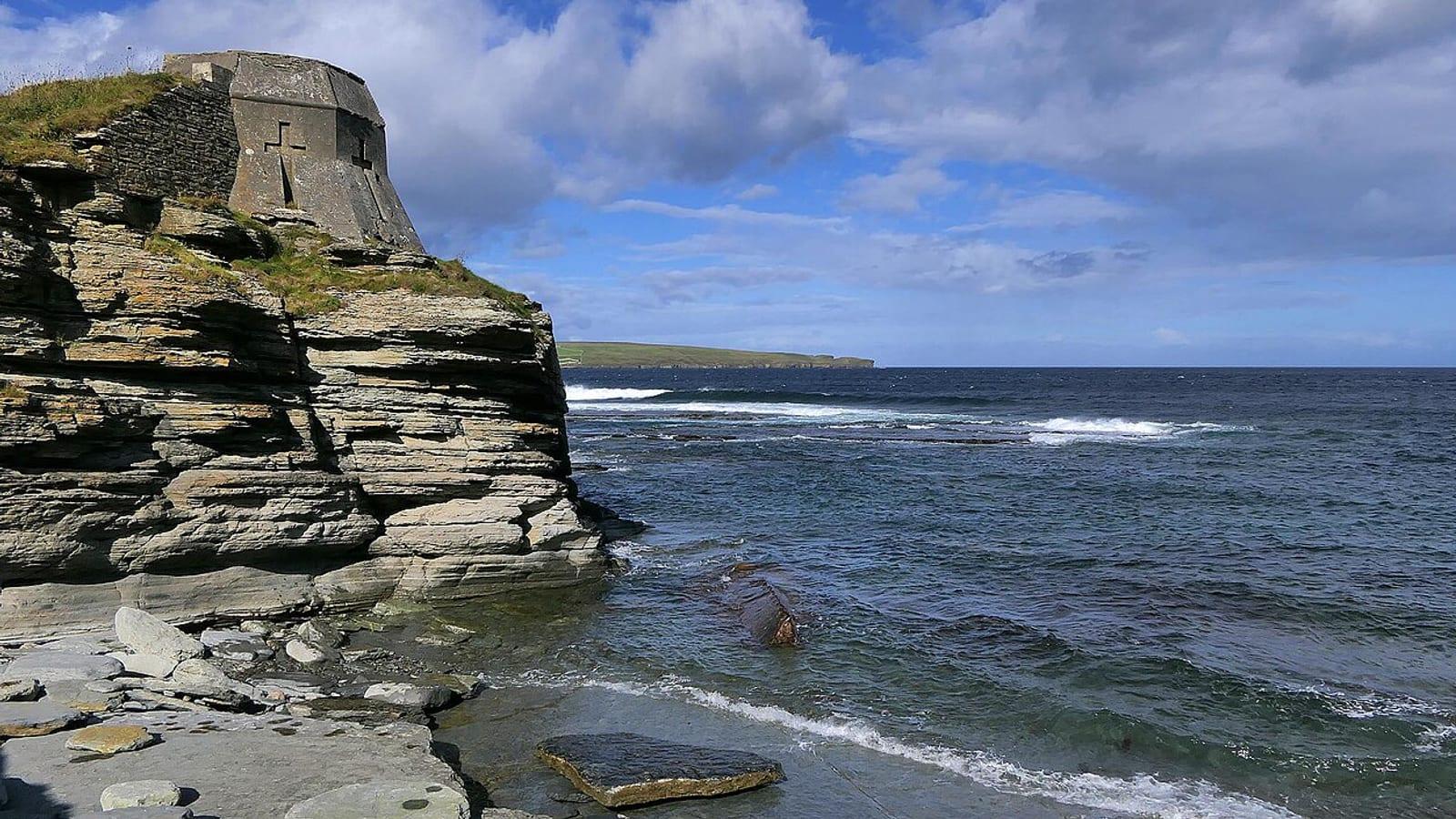
The site is on an exposed Atlantic shore. Rogue waves and swell can reach further up the rock than you expect, particularly in unsettled weather.
The rock surface is slippery when wet, and it is often wet.
Cliff edges nearby are unfenced in places. Keep children close.
Kerry weather changes quickly and the coast is exposed to the full Atlantic. Check the forecast, and do not visit the shore in a storm or a large swell.
Sources
https://kingdomofkerry.com/tetrapod-tracks-on-valentia-island/ https://www.sciencedirect.com/science/article/abs/pii/S0031018216303911 https://www.fossilguy.com/topics/tetrapod-trackway/index.htm https://timescavengers.org/2021/03/10/valentia-island-tetrapod-trackway-one-of-the-earliest-traces-of-vertebrates-on-land/