White Sands National Park Fossil Hunting Guide
Image: Ben Soyka (CC BY-SA 4.0)
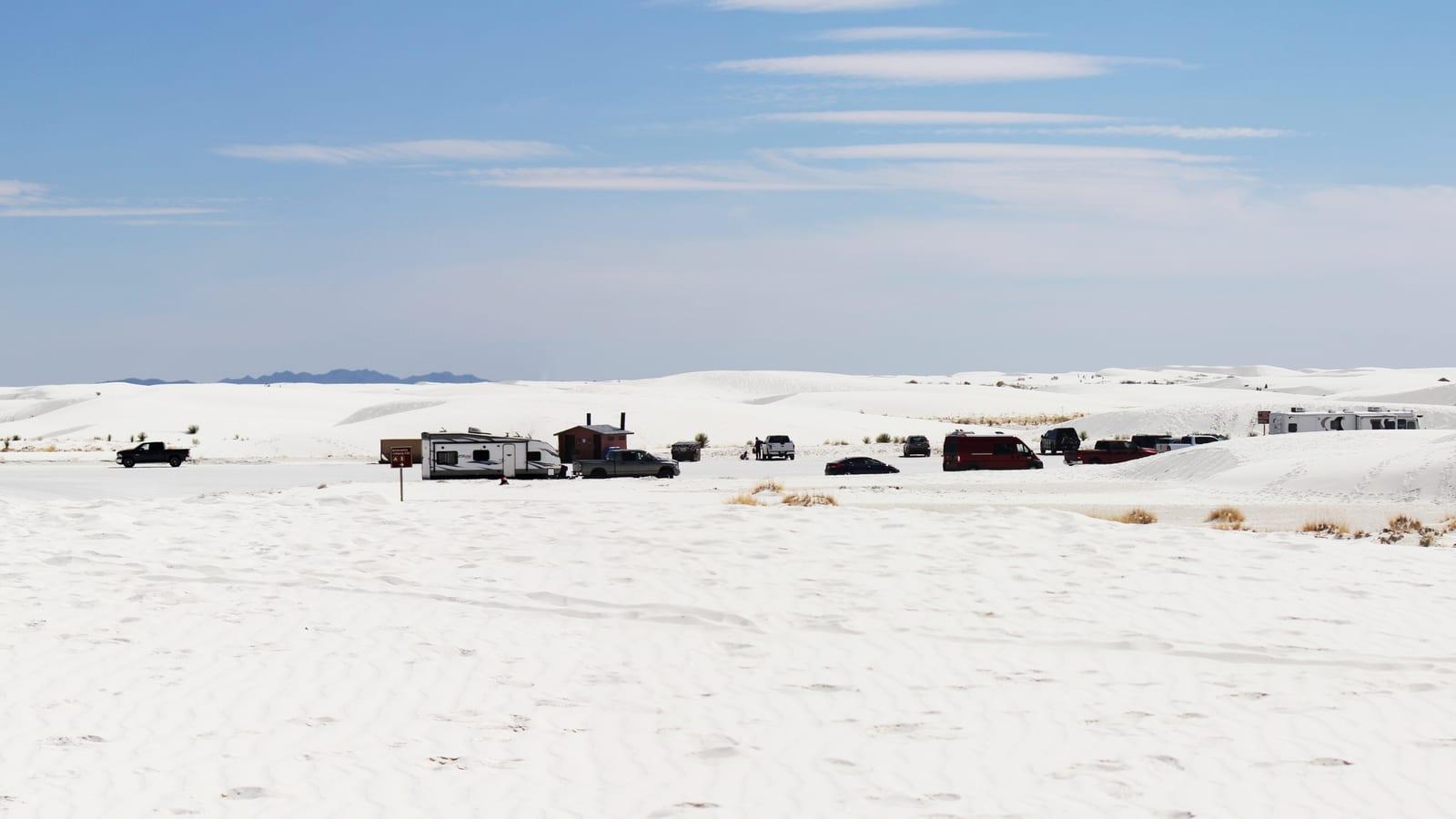
White Sands National Park covers about 145,000 acres of gypsum sand dune field in the Tularosa Basin of south-central New Mexico, between the San Andres.
By Edward Chen · Updated 31 July 2026
Introduction
White Sands National Park covers about 145,000 acres of gypsum sand dune field in the Tularosa Basin of south-central New Mexico, between the San Andres Mountains to the west and the Sacramento Mountains to the east. The dunes themselves are the largest gypsum dune field on Earth, but the paleontological resource that has put the park in front of the world's scientific press is the trackway record exposed in the playa sediments at the dune-field margins. Pleistocene footprints of Columbian mammoth (Mammuthus columbi), Harlan's ground sloth (Paramylodon harlani), dire wolf, Pleistocene camel, and the giant short-faced bear (Arctodus simus) crisscross the same surfaces as human footprints dated to between roughly 21,000 and 23,000 years ago, the oldest reliably dated human tracks in the Americas. The first dates were published in Science in 2021 and confirmed by independent radiocarbon dating of pollen and quartz grains in Science in 2023. The tracks are exposed in eroding gypsum and lake-bed sediment, are periodically reburied by wind, and are nearly all on closed research areas. Public viewing is rare and ranger-guided. This guide covers how to visit the park, what trackways the public can realistically see, the geology of Lake Otero and the dune field, and the federal rules that prohibit any disturbance of the resource.
Location and Directions
White Sands National Park is in Otero County, New Mexico. The main entrance and visitor centre are on U.S. Highway 70 between Las Cruces and Alamogordo, at 19955 U.S. Highway 70 West, Alamogordo, NM 88310.
From Alamogordo, drive 15 miles west on U.S. 70 to the entrance station on the south side of the highway. From Las Cruces, drive about 50 miles east on U.S. 70 over San Augustin Pass and across the Tularosa Basin floor. The Dunes Drive, an 8-mile paved and gypsum-paved road, runs from the entrance station out into the dune field and ends at a paved loop with picnic areas and trailheads. The visitor centre houses a museum, ranger desk, gift shop, and the only public restrooms inside the dunes.
The park is open daily, with operating hours that change seasonally. The Dunes Drive opens at 7:00 am and closes around sunset, check the current closing time before you go. The entrance station collects a per-vehicle fee (about $25 at the time of writing. America the Beautiful federal lands passes are accepted).
Important: U.S. Highway 70 closes for missile tests at White Sands Missile Range several times per month. Closures typically last one to three hours and can occur with limited notice. Check the WSMR / NPS closure schedule before you drive in from either direction.
The fossil trackways are not on the Dunes Drive. The richest documented trackways are on the western and northern margins of the dune field on land administered by the White Sands Missile Range (Department of Defense) and adjacent Bureau of Land Management parcels, not on the National Park itself. Public access to those areas is prohibited. The park's visitor centre exhibits and ranger-led programmes are the principal way for ordinary visitors to learn about and (occasionally, on rare special programmes) see the trackways. Confirm available programmes at the visitor centre when you arrive.
 Photo: Jengod, CC BY-SA 3.0 via Wikimedia Commons

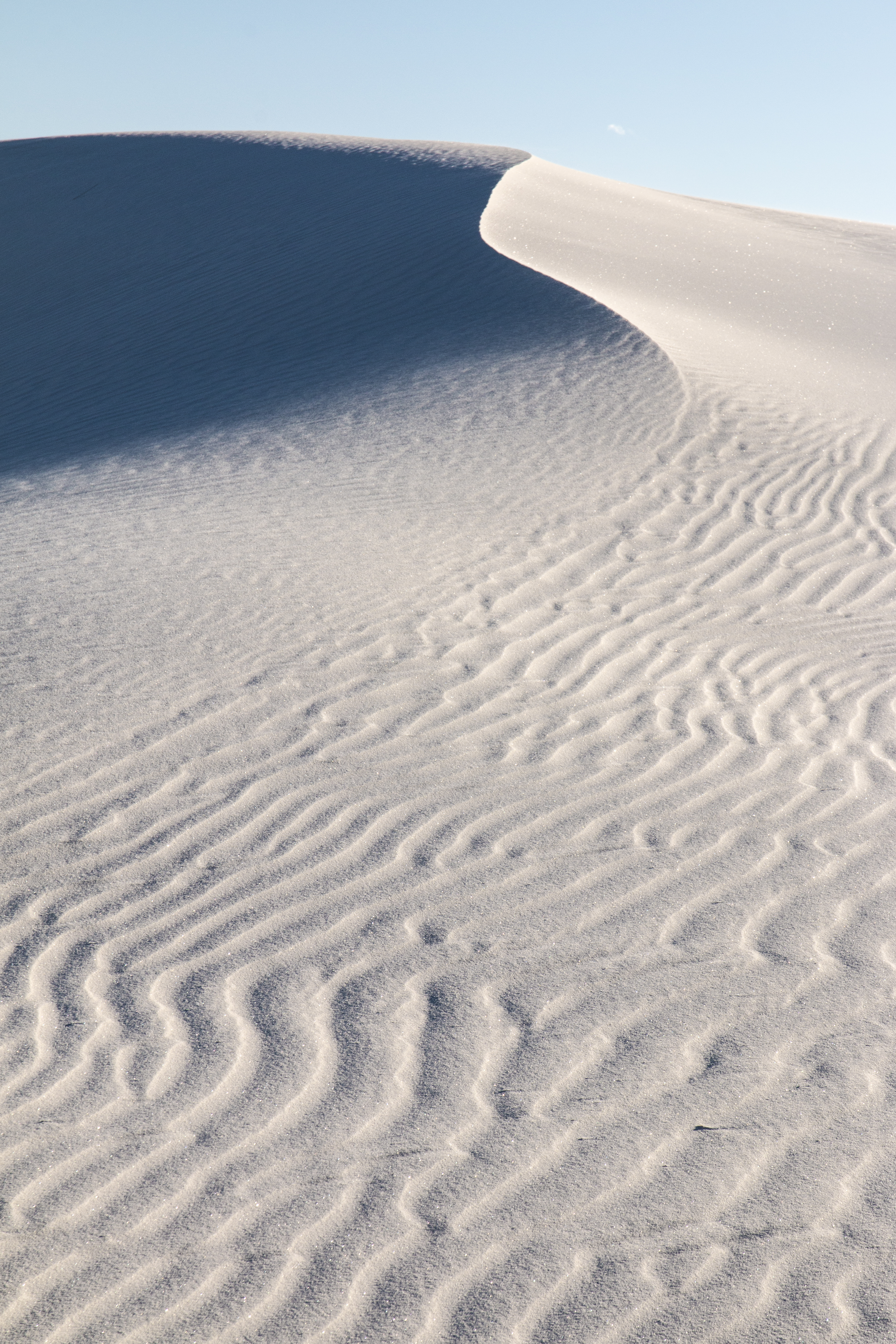 Photo: NPS Photo, public domain, via National Park Service
What Fossils You'll Find
You will not collect anything at White Sands. Everything in the park is protected, and the most important paleontological resources are on adjacent military land that is closed to the public. The fossil-related experience is in the visitor centre museum exhibits, occasional ranger programmes, and (less reliably) views of casts and interpretive panels along the Dunes Drive.
The documented ichnofauna from the broader Lake Otero shore deposits includes:
- Human footprints. Hundreds of individual prints across multiple bedding surfaces, attributed to adolescents and children based on track size, walking along the lake margin. The 2021 Science paper by Bennett et al. and the 2023 confirmation by Pigati et al. place the prints at about 21,000 to 23,000 years before present, predating the previously accepted earliest human presence in the Americas by several thousand years.
- Columbian mammoth, Mammuthus columbi. Round, flat-bottomed prints up to 60 cm across, often associated with the human trackways.
- Harlan's ground sloth, Paramylodon harlani. Bilobed, kidney-shaped prints with claw drags. Trackway sequences include evidence of behaviour, with one famous sequence interpreted as a human stalking or being avoided by a ground sloth.
- Pleistocene camel, Camelops hesternus. Two-toed prints.
- Dire wolf, Aenocyon dirus. Large canid prints, less common than the herbivores.
- Giant short-faced bear, Arctodus simus. Large plantigrade prints, very rare.
- Smaller vertebrate tracks. Pleistocene birds and smaller mammals are also represented in the deposits.
The park's visitor centre carries casts, photographs, and animation of the trackways, plus regular ranger talks during the peak season.
 Photo: National Park Service, Public domain via Wikimedia Commons
.jpg)
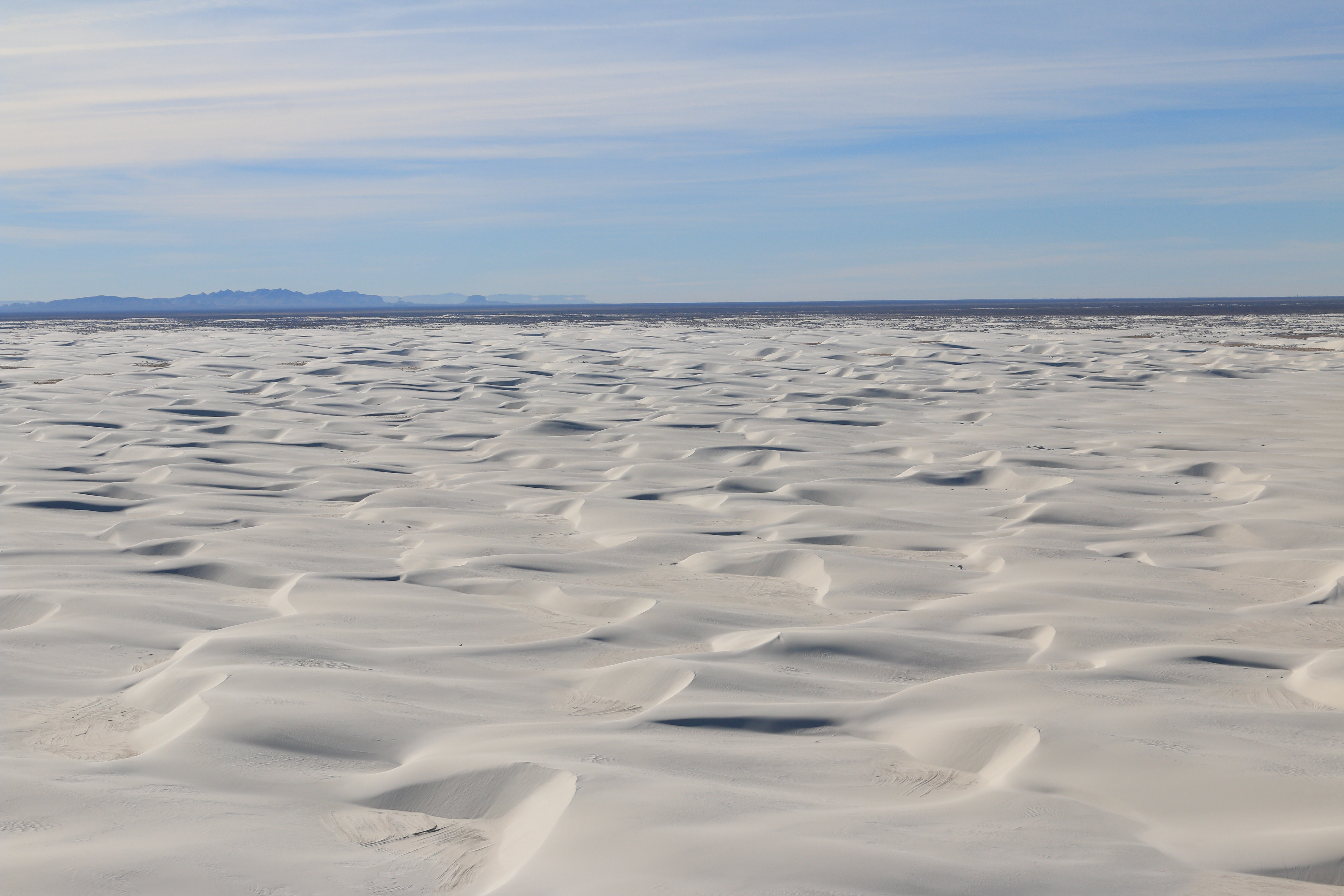 Photo: NPS Photo, public domain, via National Park Service
Geologic History
The Tularosa Basin is a closed structural basin of Cenozoic age, bounded on the west by the San Andres Mountains (uplifted along the San Andres-Organ fault system) and on the east by the Sacramento Mountains. The basin has no outlet to the ocean, and water that flows into it evaporates in place or sinks into groundwater. During the late Pleistocene, between roughly 30,000 and 11,000 years ago, the basin held a much larger and longer-lived lake, Lake Otero, fed by snowmelt and groundwater from the surrounding ranges in a wetter and cooler glacial climate.
Lake Otero's floor accumulated fine-grained gypsum-rich silt and clay, including layers of calcareous and organic mud that preserved the trackways and the pollen and seeds used to date them. The bedrock source of the gypsum is the Permian Yeso Formation and overlying Permian evaporites exposed in the San Andres and the surrounding uplands. Weathering and dissolution of those rocks delivered calcium sulfate into the basin.
When the climate dried at the end of the Pleistocene, Lake Otero shrank into a series of smaller playas (the modern Lake Lucero and the Alkali Flat). Wind began stripping gypsum crystals off the dry playa floor and piling them into dunes, building the modern dune field over the last 7,000 to 10,000 years. The dune field continues to migrate downwind, exposing and then reburying older lake-bed surfaces along its margins. That cycle of exposure and burial is the reason the trackways are accessible only intermittently: a single bedding surface might be exposed for a few years before windblown sand covers it again, and a different surface emerges nearby.
The trackway-bearing layer itself is a thin, organic-rich mud horizon within the lake-bed sequence. The footprints were made when the surface was soft and wet, were filled in by a slightly different sediment shortly afterward, and were buried by subsequent lake or aeolian deposits. Erosion now etches the prints back out as raised or recessed features in the gypsum sand.
 Photo: QKC, CC BY-SA 3.0 via Wikimedia Commons

How White Sands Became a Fossil Viewing Site
Tracks in the Tularosa Basin were noted by local ranchers and military personnel through the twentieth century, and a few were mapped sporadically before the 1980s. Systematic survey began in the 1980s and 1990s. The 2009 discovery by Bournemouth University and U.S. Geological Survey teams of large mammal and possibly human trackways at the dune-field margin opened the modern research programme.
The breakthrough came with the 2021 paper by Matthew Bennett (Bournemouth University), Daniel Odess, and colleagues in Science, "Evidence of humans in North America during the Last Glacial Maximum," which dated seeds from the layer immediately above and below human prints to roughly 21,000 to 23,000 years before present. The dates were challenged on the grounds of possible radiocarbon-reservoir effects in the Ruppia seeds used. The 2023 follow-up by Jeff Pigati, Kathleen Springer, and colleagues, also in Science, used independent radiocarbon dating of conifer pollen and optically stimulated luminescence dating of quartz grains, and produced statistically indistinguishable dates from the seed-based work, supporting the original interpretation.
White Sands was a National Monument from 1933 until 2019, when Congress redesignated it as White Sands National Park under the National Defense Authorization Act for Fiscal Year 2020. The park is one of the most-visited NPS units in the country, with around 600,000 annual visitors. The fossil tracks remain a research priority, with active fieldwork concentrated on the western and northern margins on lands shared with the White Sands Missile Range.
Collecting Rules and Regulations
Collecting and disturbance of fossils, tracks, and natural materials is prohibited. White Sands National Park is a unit of the National Park System and is managed under the National Park Service Organic Act, the Paleontological Resources Preservation Act of 2009 (PRPA), and the Archaeological Resources Protection Act. Removing, damaging, or altering any paleontological resource, archaeological resource, plant, animal, or rock on park land is a federal offence and prosecutable.
Practical rules:
- Stay on the Dunes Drive and on marked trails. Do not enter the boundary of the White Sands Missile Range, even by mistake. The boundary is signed but not fenced in many places, and unauthorised entry is a federal offence.
- Do not dig or hammer into the playa surfaces visible on the Dunes Drive. The lake-bed sediment, where it crops out under the gypsum, contains the same kind of fossil-bearing layers as the trackway sites.
- Photograph in place. Do not pick up gypsum crystals, plants, or other natural materials.
- Take all rubbish out. Pack out what you pack in.
- Report unusual surface features (apparent bones, tracks, or artefacts) to a ranger. Do not touch.
Safety
White Sands is a dune field in the New Mexico desert, and the two things that hurt visitors are heat and losing their bearings.
Heat comes first. Summer ground temperatures in the gypsum reach 130°F, and park rangers respond to multiple heat-related medical calls every summer. Carry at least one full bottle of water per person per hour in summer, more than you think you need, and treat the middle of the day in July and August as unsuitable for any walk beyond the parking loops. Winter is the practical season for extended visits, and summer mornings and late evenings are workable.
Navigation is the second. The dune field has no landmarks, footprints fill in within minutes on a windy day, and the marked trails are signed by posts that are easy to lose sight of over a crest. Keep the next marker in view. Do not walk out into the dunes off-trail. Carry a compass or a GPS, and know how to use it before you need it.
U.S. Highway 70 closes for missile tests several times a month, typically for one to three hours and sometimes at short notice. Check the closure schedule before driving in from Las Cruces or Alamogordo and build slack into your plan.
Do not cross into the White Sands Missile Range. The boundary is signed but unfenced in many places, and unauthorised entry onto an active military range is both a federal offence and physically dangerous.
The gypsum reflects hard, so sunburn comes from below as well as above. Use sunscreen under the chin and nose and wear sunglasses. Blowing gypsum during high winds, most common in spring, cuts visibility sharply. Wear shoes rather than going barefoot in summer, when the surface is hot enough to burn.
Sources
- National Park Service, "White Sands National Park." https://www.nps.gov/whsa/index.htm
- National Park Service, "Fossilized Footprints." https://www.nps.gov/whsa/learn/nature/fossilized-footprints.htm
- Bennett, M.R., Bustos, D., Pigati, J.S., et al., 2021. "Evidence of humans in North America during the Last Glacial Maximum." Science, 373.
- Pigati, J.S., Springer, K.B., Honke, J.S., et al., 2023. "Independent age estimates resolve the controversy of ancient human footprints at White Sands." Science, 382.
- U.S. Department of the Interior, "Paleontological Resources Preservation Act." https://www.nps.gov/subjects/fossils/fossil-protection.htm
- Public Law 116-92, National Defense Authorization Act for Fiscal Year 2020 (White Sands redesignation as a National Park).
Nearby sites
 Guadalupe Mountains National Park Fossil Reef GuideBrachiopods, Crinoids
 Ghost Ranch Coelophysis Quarry Fossil GuideCoelophysis bauri, Phytosaurs
 Petrified Forest National Park Fossil Hunting GuidePetrified Araucarioxylon logs, Phytosaurs
 Bisti / De-Na-Zin Wilderness Fossil GuidePetrified wood, Fossil leaves