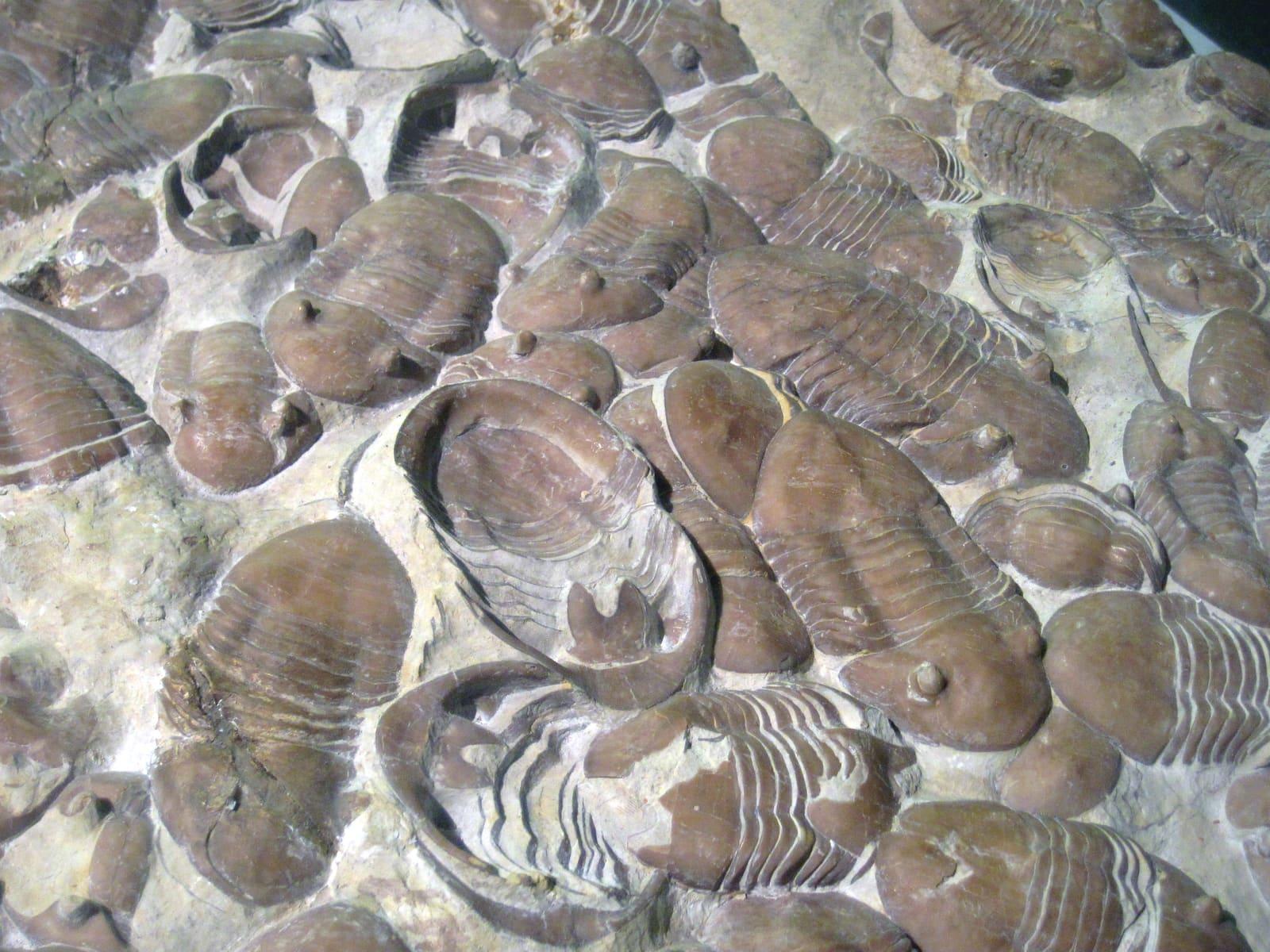
Arbuckle Mountains Bromide Formation Fossil Guide
Image: James St. John (CC BY 2.0)
The Late Ordovician Bromide Formation, exposed across the Arbuckle Mountains and Criner Hills of south-central Oklahoma, is one of North America's classic sources of beautifully preserved trilobites, crinoids, and other Ordovician invertebrates. Many outcrops are creek beds and road cuts on private land, so collecting requires permission, but the fauna is exceptional.
By Edward Chen · Updated 1 August 2026
Introduction
The Arbuckle Mountains of south-central Oklahoma are a low, ancient range that exposes a thick sequence of Paleozoic rock, and among the most prized of those layers is the Late Ordovician Bromide Formation. The Bromide is famous among paleontologists and collectors for its beautifully preserved invertebrate fossils, especially trilobites, along with crinoids and other stalked echinoderms, brachiopods, bryozoans, and snails. It is the uppermost unit of the Simpson Group and is well exposed throughout the Arbuckle Mountains and the nearby Criner Hills.
The formation records a varied Ordovician seafloor, from tidal flats and lagoons to deeper shelf, and that variety gives it an unusually varied fauna. Generations of researchers have collected here, and the Bromide remains a standard reference for Ordovician life in the southern midcontinent. Because most outcrops are creek beds and road cuts on private ranch land, the key to collecting is securing landowner permission.
Location and Directions
The Bromide Formation crops out across the Arbuckle Mountains and the Criner Hills in Carter, Murray, and neighboring counties, roughly between Ardmore and Sulphur, near 34.15°N, 97.15°W. There is no single fossil park. The rock appears in stream exposures, hillside outcrops, and highway road cuts spread across the region. A frequently cited collecting exposure is Rock Crossing, a creek-bed outcrop in the Criner Hills of Carter County, but like most localities here it lies on private property.
Reach the area via I-35 and US-77 through the Arbuckles, where dramatic road cuts reveal the tilted Paleozoic layers. Before collecting anywhere, find out who owns the land and ask permission. Do not assume road-cut access is legal or safe. Bring a hammer and chisel, hand lens, wrapping material for fragile specimens, water, and sturdy footwear. Spring and fall offer the most comfortable fieldwork weather.
What Fossils You'll Find
The Bromide Formation is best known for its trilobites, which occur as both isolated parts and, in some beds, clustered or near-complete specimens, and the formation has produced a wide range of genera that make it a favorite for trilobite collectors. Equally notable are the crinoids and other pelmatozoan echinoderms, whose calyxes and stems are preserved in abundance and diversity, the subject of detailed scientific study of how these animals partitioned the Ordovician seafloor.
Brachiopods are common throughout, along with bryozoan colonies, gastropod (snail) shells, cephalopods, ostracodes, and corals. The mix of fossils changes from bed to bed because the formation spans many different ancient environments, from shallow shoals to deeper, quieter water. Most specimens are found by splitting shales and searching weathered limestone surfaces.
 Photo: James St. John, CC BY 2.0, via Wikimedia Commons
Geologic History
The Bromide Formation was deposited during the Late Ordovician, roughly 460 to 455 million years ago, along a carbonate-and-sand ramp that sloped into the Southern Oklahoma Aulacogen, a deep trough in the Earth's crust. Its more than one hundred meters of sandstones, shales, and limestones record a sweep of environments, from tidal flats and lagoons through shoals and shoreface into the shallow and deep shelf, which is why its fossils are so varied. Warm, shallow seas covered the region, and the seafloor teemed with trilobites, crinoids, brachiopods, and other invertebrates.
Long after deposition, the rocks of southern Oklahoma were folded and faulted during the building of the ancestral Arbuckle Mountains in the late Paleozoic, tilting the once-flat layers and lifting them toward the surface. Subsequent erosion has worn the range down to its roots and sliced through the upturned beds, exposing the Bromide and the rest of the Simpson Group in the creeks and road cuts where they can be studied and collected today.
Collecting Rules and Regulations
Access here is governed by land ownership. Most Bromide Formation outcrops are on private ranch land, so you must obtain the landowner's permission before entering or collecting, and trespassing is both illegal and unsafe. Surface collecting of common invertebrate fossils such as trilobites, crinoids, and brachiopods for personal, non-commercial use is generally acceptable where you have permission, but take only a reasonable number of specimens, fill any holes, close gates, and leave the land as you found it. Do not collect on state or federal land, in protected areas such as the Chickasaw National Recreation Area near Sulphur, or on road cuts where stopping is prohibited or dangerous. Report any unusual or scientifically significant finds to the Oklahoma Geological Survey or a museum, and never sell material collected under a landowner's courtesy without their agreement.
Safety
The Arbuckle country is hot and humid in summer, so carry ample water and sun protection and watch for heat illness. Road cuts and creek banks can have loose, falling rock, so wear eye protection when hammering, keep clear of unstable faces, and never work directly beneath an overhang. Watch for rattlesnakes and copperheads among the rocks, plus ticks, chiggers, and poison ivy in the brush. Streams can flood quickly after storms, so avoid creek beds in wet weather. Stay well away from traffic on highways and never park or collect on the shoulder of a busy road.
Sources
https://link.springer.com/article/10.1007/s10347-014-0412-6 https://www.cambridge.org/core/journals/journal-of-paleontology/article/competition-or-coexistence-ecology-and-niche-partitioning-of-pelmatozoan-echinoderms-from-the-late-ordovician-bromide-formation-oklahoma-usa/8E521DD9312F0B255DACEA524E494B30 https://www.paleocurrents.com/docs/oklahoma_fossils.html https://ngmdb.usgs.gov/Geolex/UnitRefs/BromideRefs_12433.html
_1_(15402229571).jpg)