Faxe Quarry South Area Fossil Hunting Guide
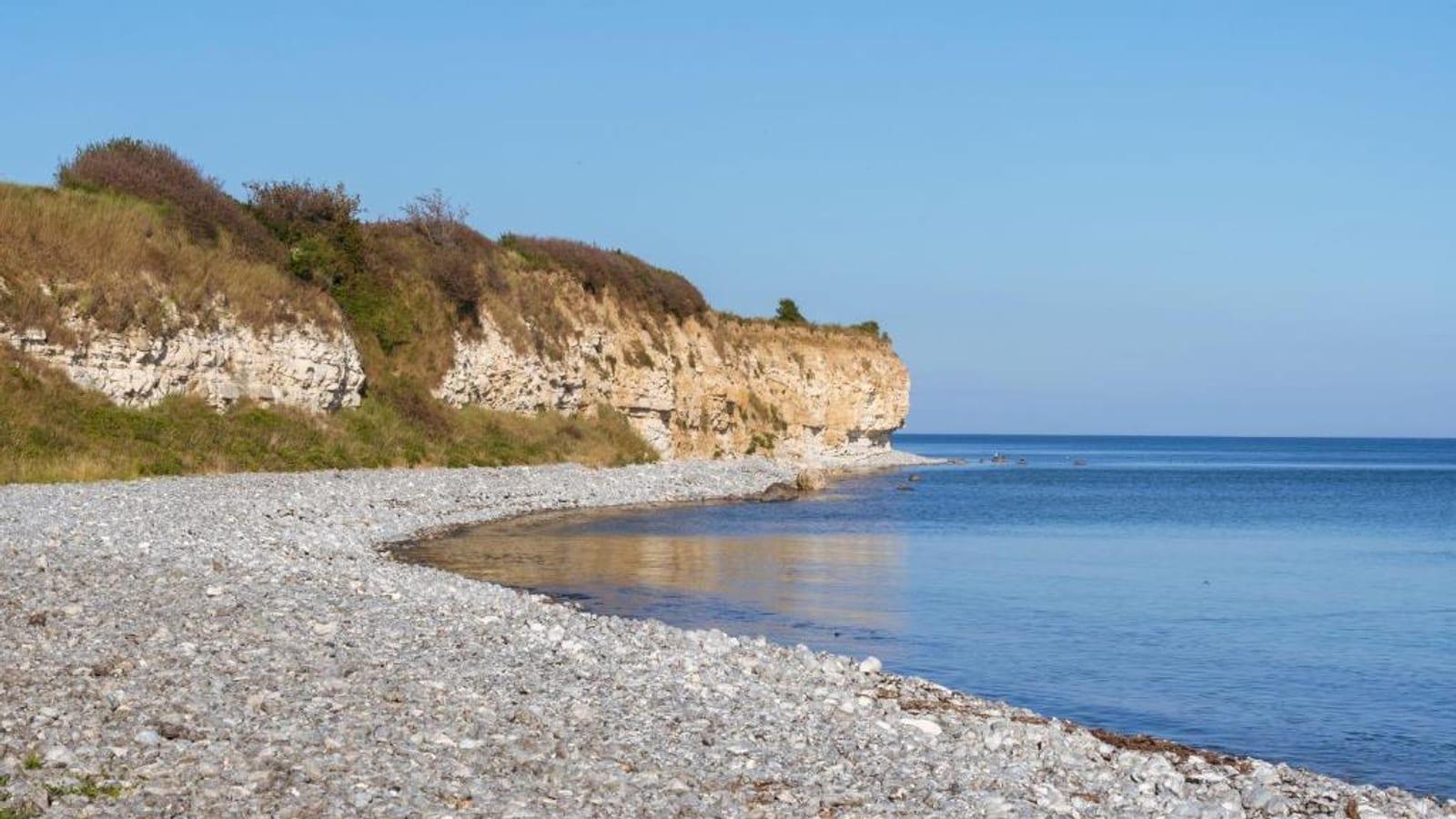
Image: Lrexie (CC BY-SA 4.0)
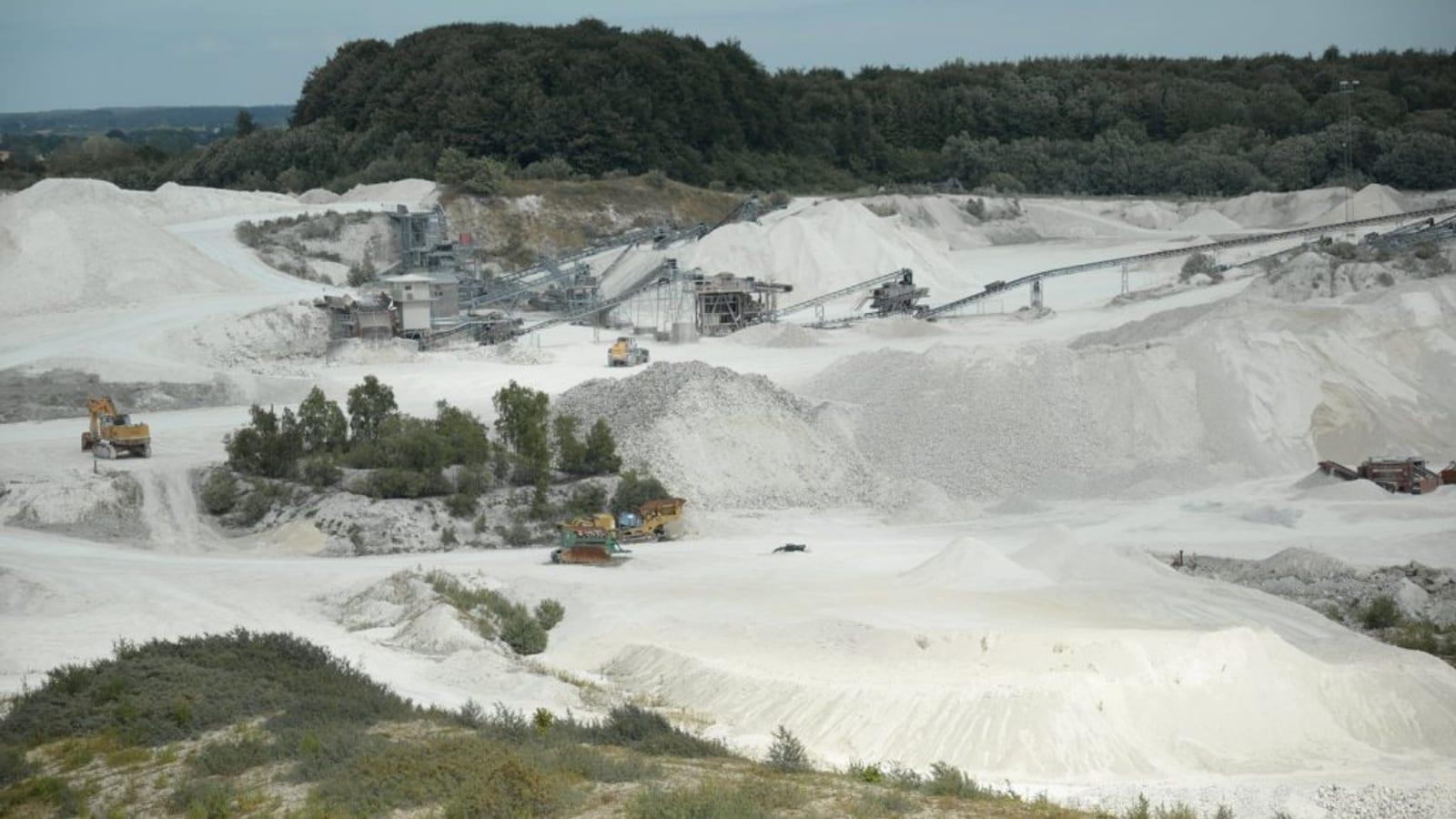
Faxe Quarry on the Danish island of Zealand exposes a Paleocene cold-water coral and bryozoan mound that grew on the seafloor in the few million years after.
By Edward Chen · Updated 4 August 2026
Introduction
Faxe Quarry on the Danish island of Zealand exposes a Paleocene cold-water coral and bryozoan mound that grew on the seafloor in the few million years after the dinosaur extinction. It is one of the most productive public fossil sites in northern Europe, and the only one in Denmark where you can hammer out coral colonies, bryozoan branches, crab claws, sea urchin tests, brachiopods, and the occasional shark tooth from an active commercial limestone quarry. Public collecting happens in the southern half of the workings, called Sydbruddet, which the operator and the adjacent Geomuseum Faxe set aside specifically for visitors. You sign in at the museum, pay a small day fee for the collecting area, and walk down into a working pit that is still being cut for the cement and chalk industries above. This guide covers how to reach Faxe, what the south pit produces, the unusual cold-water reef geology, and the rules and safety procedures the museum and the quarry operator enforce.
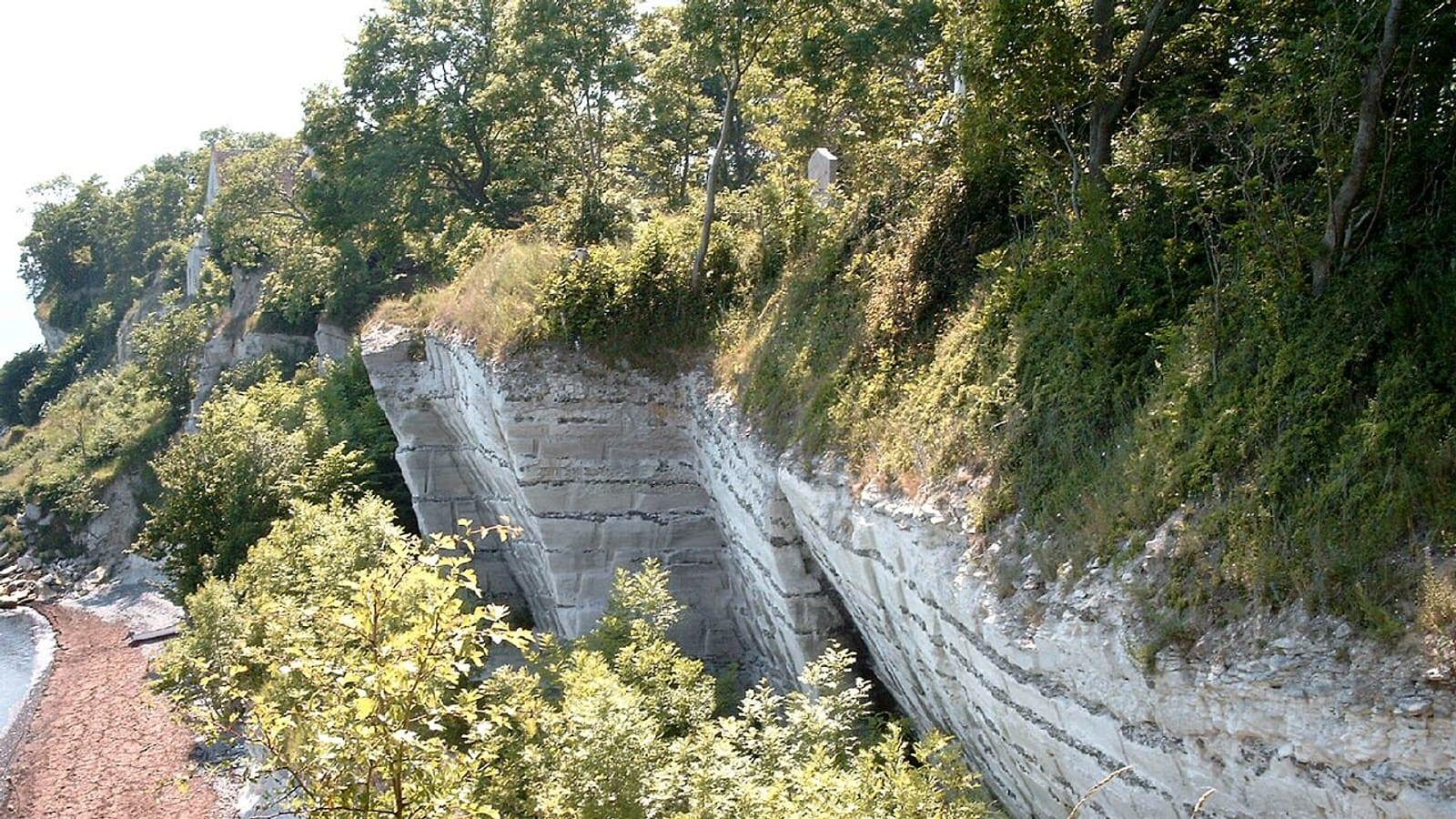
 Photo: Lrexie, CC BY-SA 4.0, via Wikimedia Commons
Location and Directions
The quarry and Geomuseum Faxe sit at the northern edge of the small town of Faxe in eastern Zealand, about 70 kilometres south of Copenhagen.
By car, drive south on Route 14 from the E20 motorway south of Køge, and follow signs for Faxe and Geomuseum Faxe. The museum address is Østervej 2, 4640 Faxe, Denmark, with a free visitor car park on site. By public transport, take the regional train from Copenhagen Central to Køge (about 45 minutes), then bus 102A or 274 to Faxe town centre and walk roughly ten minutes to the museum. GPS for the museum is approximately 55.2613 north, 12.1288 east.
Once you are at the museum, do not walk into the quarry on your own. Public collecting is in Sydbruddet (the south pit), which is reached by a marked footpath from the museum or by the museum's own quarry-edge entrance. The path drops down a graded ramp onto the pit floor. There is no public access to the active Nordbruddet (north pit), and you must not cross any of the painted lines, fences, or warning signs that separate the two.
The south pit is open during museum opening hours, normally Tuesday to Sunday, with longer summer hours from April to September and shorter winter hours from October to March. The pit closes Mondays. Always check the Geomuseum Faxe website on the day of your visit, as the quarry can close on short notice for blasting, weather, or operational reasons.
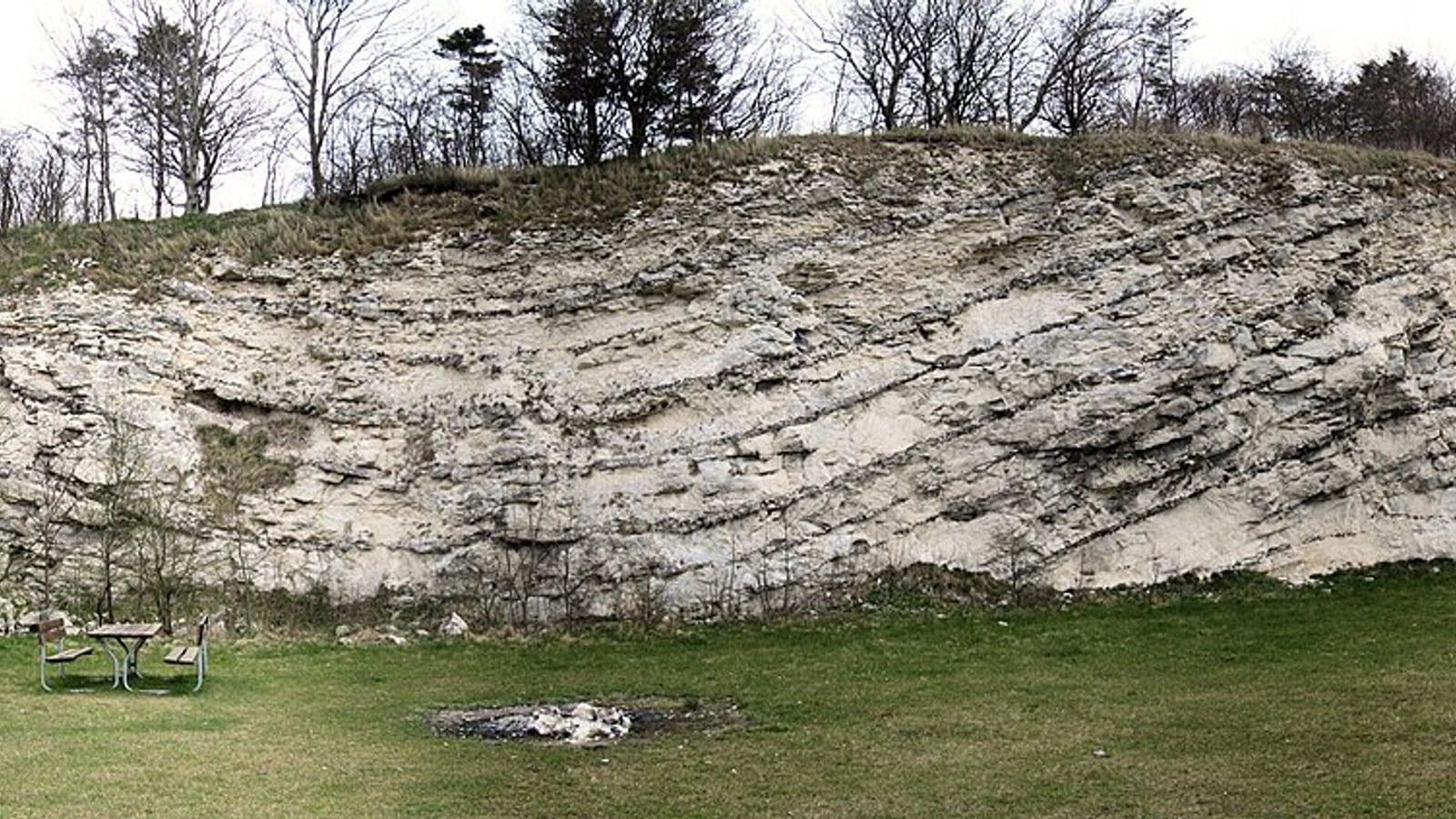
 Photo: Lrexie, CC BY-SA 4.0, via Wikimedia Commons
What Fossils You'll Find
Sydbruddet exposes the upper part of the Faxe Formation, and most of what you will find weathers out of fresh blocks lying on the pit floor. The matrix is a soft white-to-pale-grey carbonate with metre-scale coral and bryozoan colonies still in growth position in some areas.
- Scleractinian corals. The Faxe corals are dominated by Dendrophyllia candelabrum and Faksephyllia faxoensis, branching cold-water forms similar to the modern Lophelia pertusa reefs of the North Atlantic. Branch fragments 2 to 10 centimetres across are common. Complete heads of 20 to 30 centimetres turn up occasionally and are best left to the museum.
- Bryozoans. Lace-like and twiggy bryozoan colonies form the reef framework and are present in nearly every block. They preserve as fine networks of calcite tubes.
- Decapod crustaceans. Faxe is internationally known for its preserved crab claws and bodies. Dromiopsis, Faxegalathea, and other genera occur as isolated chelae and, more rarely, articulated specimens. The cold-water reef provided sheltered hollows where carcasses were buried before they could fall apart.
- Brachiopods. Small thecideid and terebratulid brachiopods are abundant as internal moulds.
- Bivalves and gastropods. Mostly preserved as moulds, with original shell rare.
- Echinoids. Small regular and irregular sea urchins, often as fragmentary tests or isolated spines.
- Shark teeth. Rare but present. Small lamniform teeth are the usual find.
Some specimens still show pinkish or orange tints from the original coral pigments where blocks have been freshly broken. The fragility of these colours is one reason why the museum asks visitors to wrap delicate finds carefully and keep them out of direct sunlight.
Geologic History
The fossiliferous rock at Faxe is the Faxe Formation, deposited during the Early Paleocene Danian stage, roughly 63 million years ago. The Danian itself sits just above the Cretaceous-Paleogene boundary, so the Faxe Formation records life recovering from the end-Cretaceous mass extinction.
The local geology is unusual. While most of the Danish chalk and Danian limestone landscape was a shelf of skeletal carbonate ooze, Faxe records a localised carbonate mound built by cold-water scleractinian corals and branching bryozoans, in water perhaps 200 to 400 metres deep. The mound grew in clean, well-circulated, relatively cool water, more comparable to the modern North Atlantic Lophelia reefs than to the warm, shallow tropical reefs that most fossil corals call to mind. The corals trapped fine bryozoan and skeletal sand between their branches, and the network of branches gave shelter to crabs, sea urchins, brachiopods, and a long list of smaller invertebrates whose remains accumulated between the colonies.
Subsequent burial pressed the loose carbonate into a friable limestone that retains much of the original framework. Where you can still see coral branches running through the rock, the colonies are essentially preserved in growth position. Later uplift along the Tornquist-Sorgenfrei zone brought the Faxe mound close enough to the surface that it could be quarried, first for stone, then later for the chalk and lime industries that the Faxe Kalk works still serves today.
How Faxe Quarry Became a Fossil Collecting Site
Limestone has been quarried at Faxe since at least the early 1600s, and the unusual fossils were noticed almost from the start. Decorative coral and bryozoan blocks were used in local churches, and in the 1820s the Danish geologist G. Forchhammer published the first scientific description of the deposit. Through the late 1800s and early 1900s, Danish and German monographs documented dozens of new species, and Faxe became the type locality for a long list of Paleocene corals, crustaceans, and bryozoans.
Through the 20th century, the quarry continued to expand for the cement and chalk industries, and the operator gradually formalised public access on the south side of the workings. Geomuseum Faxe opened on the quarry edge in 1989 as a partner institution to the operator, and the museum took on the role of running visitor access into Sydbruddet. The current arrangement, with a small day fee, registration, a safety briefing, and a marked collecting area, is the result of long negotiation between the operator (Faxe Kalk, part of Lhoist) and the regional museum service.
Collecting Rules and Regulations
You must register at Geomuseum Faxe before collecting in Sydbruddet. Independent entry is not allowed.
- Sign in at the museum reception, pay the day fee for collecting access (typically a modest amount per adult, with a reduced rate for children), and read the printed safety briefing. Confirm the current fee on the Geomuseum Faxe website, as it has changed over time.
- Safety glasses are mandatory whenever you are hammering. The museum lends them free at the desk, and they are also for sale in the shop.
- A geological hammer and chisel are useful but not required. The shop sells suitable hammers (about 175 DKK) and chisels (about 50 DKK). Sledgehammers, pry bars, and motorised tools are not allowed.
- Stay inside the marked Sydbruddet collecting area. Do not cross fences or warning lines into the active Nordbruddet, and stay clear of the working faces and any heavy-equipment routes.
- Do not climb the quarry walls. They are steep and unstable, and undercutting collapses without warning.
- All loose blocks on the pit floor are fair to break, and you may keep what you find for personal collections. Notable specimens, especially large articulated crabs or complete coral heads, should be shown to museum staff before leaving. The museum may request to retain them for the public collection.
- The site is wheelchair accessible at museum and rim level, but the ramp into the pit is uneven and not suitable for wheelchairs.
- Bring water, sun protection, sturdy footwear, and gloves. There is little shade in the pit, and the chalk-white surface throws back a lot of glare on bright days.
Safety
Faxe is an active commercial quarry, and access to the collecting area is conditional on registering at Geomuseum Faxe and following their briefing. That briefing is the safety system, so take it seriously rather than skimming it.
This is a working industrial site. Machinery operates elsewhere in the pit, and the collecting area is a designated part of it rather than the whole quarry. Stay inside the permitted zone, do not wander toward working faces or haul roads, and leave when you are asked to.
The faces are high and they shed rock. Do not work directly beneath a face, do not climb, and keep clear of the base of any wall showing fresh fall material below it. Loose blocks on the pit floor are the material to break, and they are safely away from the walls.
Wear a hard hat and eye protection. Both are standard here and the museum advises on what is required. Hammering limestone sends sharp chips a considerable distance, and coral-bearing rock breaks unpredictably.
Sturdy boots are essential. The pit floor is rubble, uneven and ankle-turning, and it holds water in places.
Dress for Danish weather in an exposed pit, which is colder and windier than the surrounding countryside. Bring water. Children must be supervised closely throughout, and the museum sets its own minimum ages and group rules, so check when you register rather than on arrival.
Sources
- Geomuseum Faxe. "Visit and collect fossils." https://www.geomuseumfaxe.dk/
- Faxe Kalk / Lhoist. "Faxe limestone quarry." https://www.lhoist.com/
- Bernecker, M. and Weidlich, O. "The Danian (Paleocene) coral limestone of Fakse, Denmark: a model for ancient azooxanthellate coral mounds." Facies (1990).
- Lauridsen, B.W., Bjerager, M., and Surlyk, F. "The middle Danian Faxe Formation, Denmark." Bulletin of the Geological Society of Denmark, 2012.
- Geological Survey of Denmark and Greenland (GEUS). "The Danian limestone." https://www.geus.dk/