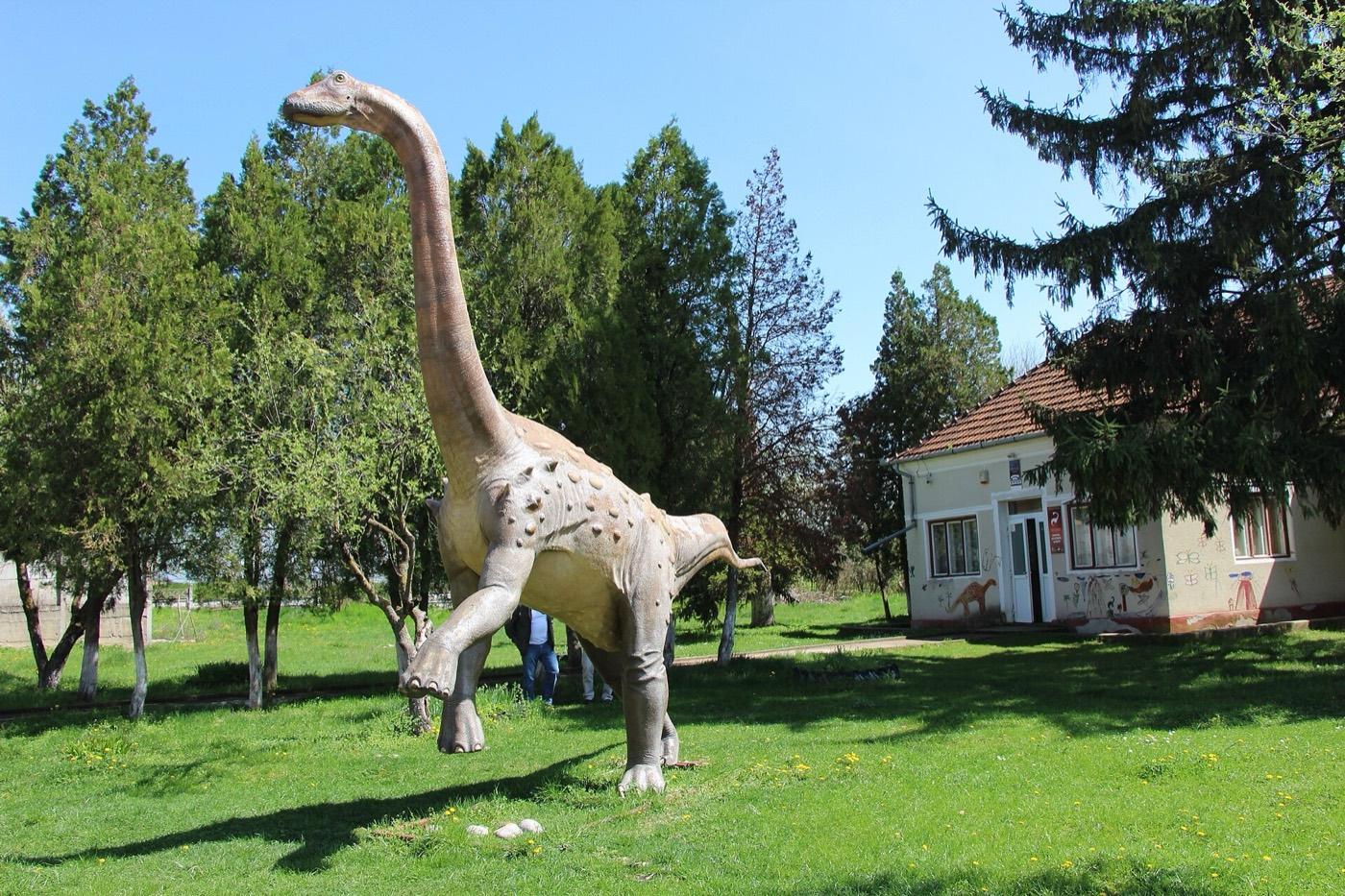
Hațeg Country Dinosaurs Geopark Fossil Hunting Guide
Image: N.Cayla (CC BY-SA 4.0)
A Late Cretaceous island fauna of dwarfed dinosaurs in the Hațeg basin of Hunedoara county, interpreted through a network of seven visiting centres rather than one hub. The Dinosaur Valley trail runs to the geosite where the first fossils were found.
By Edward Chen · Published 11 September 2026
Introduction
The dinosaurs of Hațeg are small, and the reason is one of the clearest examples of an evolutionary principle in the fossil record.
In the Late Cretaceous the Hațeg basin was an island in the Tethys sea. Large animals isolated on islands with limited resources tend to become smaller over generations, a pattern called insular dwarfism. The Hațeg fauna shows it across multiple lineages at once.
Magyarosaurus dacus is the emblem. It is a titanosaur sauropod, from a group that includes the largest land animals that ever lived. Recent estimates put it at 2.2 to 2.8 metres long. Its relatives elsewhere reached thirty.
The geopark covers about 112,400 hectares of Hunedoara county and was among the first to join the European and Global Geoparks Networks in 2005. It was Romania's first UNESCO Global Geopark, and Buzău Land joined it in 2022.
Location and Directions
The Hațeg basin lies in Hunedoara county in south-western Transylvania, ringed by the Retezat and Șureanu mountains.
GPS for Sânpetru: 45.5517°N, 22.9131°E. The village names the main fossil-bearing formation. Do not confuse it with Sânpetru de Câmpie in Mureș county, which is unrelated.
The geopark took a deliberate decision not to build a single large visitor hub. Instead it developed a network of interpretation across seven visiting centres with different themes, spread through the villages of the basin.
The route most visitors want is the Dinosaur Valley trail. That begins at the House of Dwarf Dinosaurs and leads to the La Scoaba geosite, where the first dinosaur fossils in the area were found.
Because interpretation is distributed, plan the visit around two or three centres rather than expecting everything in one building. Opening arrangements vary between centres and between seasons, so check before you travel.
The fossil localities are dispersed exposures in river banks and road cuttings across the basin. What the geopark presents on the ground is interpretation: models, casts, reconstructions and explanation, spread between the seven centres.
What Fossils You'll Find
Nothing is collectable. The fossil localities are protected and the geopark is an interpretation network.
The fauna is what makes the visit. Magyarosaurus dacus, the dwarf titanosaur. Telmatosaurus transsylvanicus, a small hadrosaur, which is also known from egg and nest material. Zalmoxes, a small ornithopod. Balaur bondoc, a stocky theropod described in 2010 with two enlarged claws on each foot.
Hatzegopteryx is the outlier. It was an azhdarchid pterosaur with a wingspan estimated around ten metres. On an island of small dinosaurs it was probably the dominant predator. Insular dwarfism shrank the dinosaurs and did nothing to shrink the pterosaur.
Nesting sites with eggs are among the material shown, and they are the most tangible evidence on display.
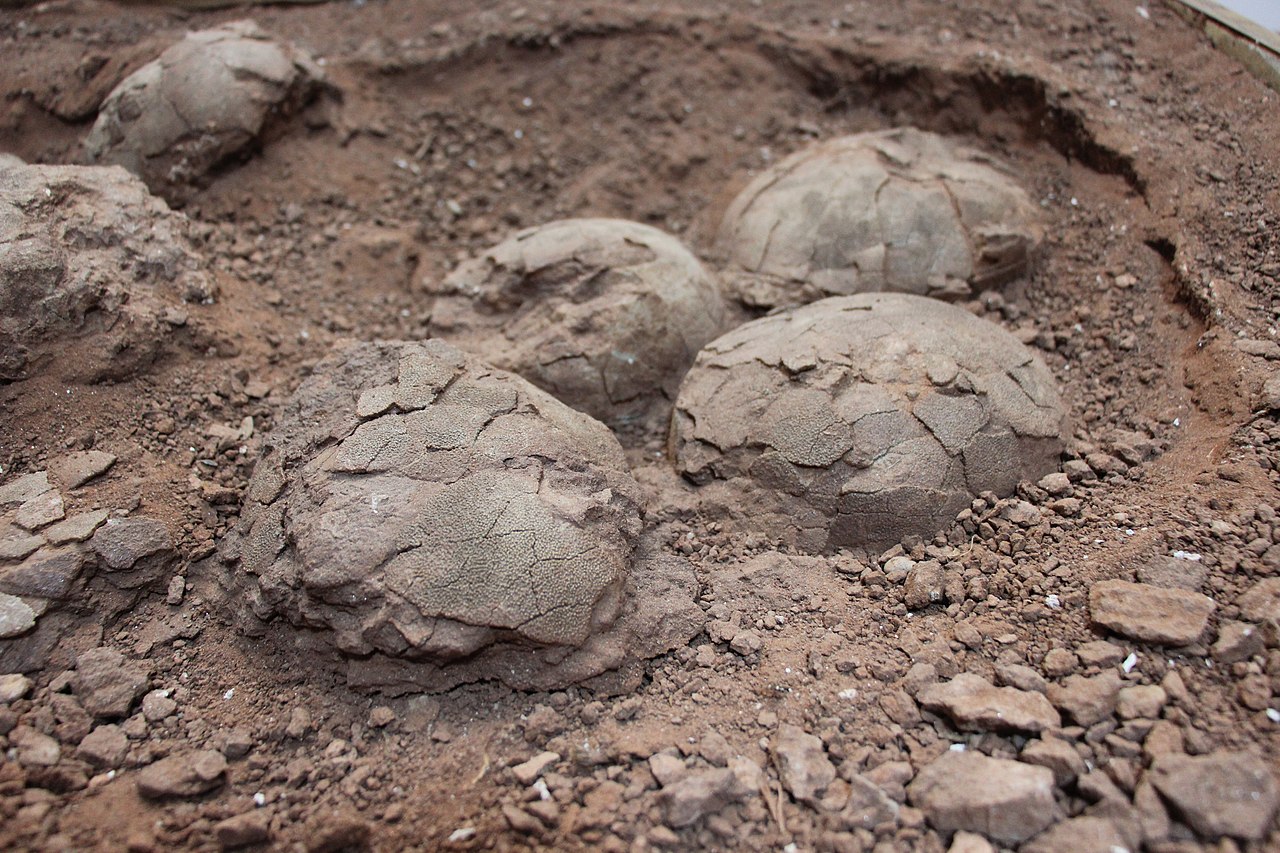 Photo: N.Cayla, CC BY-SA 4.0, via Wikimedia Commons

Geologic History
The rocks are Maastrichtian, the last stage of the Cretaceous, roughly 72 to 66 million years ago. The main fossil-bearing units are the Sânpetru and Densuș-Ciula formations.
Hațeg Island lay in the Tethys, the sea that separated Europe from Africa. Estimates of its size vary, but it was small enough and isolated for long enough to drive the dwarfing.
The sediments are continental, laid down by rivers and on floodplains rather than in the sea. That is why the fauna is terrestrial and why eggs and nests survive. The Sânpetru Formation records wetlands and moderately drained floodplains. The Densuș-Ciula Formation records better-drained ground.
The dating is still moving. Work published in 2025 places the lowest dinosaur-bearing beds of the Densuș-Ciula Formation in the late Campanian rather than the Maastrichtian. That pushes the start of the record earlier than the figure given above.
The fauna went extinct with everything else at the end of the Cretaceous.
The person behind the science is worth knowing. Baron Franz Nopcsa, a Transylvanian aristocrat, began studying these fossils in the 1890s after his sister found bones on the family estate. He proposed insular dwarfism to explain the small size of the Hațeg animals, and the idea is now standard in evolutionary biology.
 Photo: Tommy from Arad, CC BY 2.0, via Wikimedia Commons

Collecting Rules and Regulations
Collecting is prohibited. The geosites are protected within a UNESCO Global Geopark, and the geopark administration is the body to ask about any find. This page could not identify the Romanian statute that governs palaeontological material, so treat the geopark's own rules as the operative ones.
Excavation is carried out by researchers under permit, principally through Romanian universities and institutes.
Visit the interpretation centres and the marked geosites. Do not dig, and do not remove material from exposures.
If you see fossil material eroding out, report it to the geopark administration rather than collecting it.
Hațeg also holds one of Romania's densest concentrations of medieval architecture, including the church at Densuș, built partly from Roman stone taken from nearby Ulpia Traiana Sarmizegetusa. Most visitors combine the geology with that.
Getting around needs a car. The visiting centres are in separate villages across a rural basin, public transport between them is minimal, and the distances are too great to walk. Confirm opening before setting out, because several centres operate limited hours outside the summer season.
Safety
The geosites are rural and scattered, and the roads between the villages of the basin are narrow and variable in quality.
Trails are unsurfaced and become muddy after rain. Wear boots.
The surrounding Retezat mountains are serious terrain with bears present in Romanian forests. Keep to the marked trails in the basin and do not wander into the uplands without preparation.
Facilities in the villages are limited. Carry water and do not rely on finding food outside the main towns.
Sources
https://www.unesco.org/en/iggp/hateg-country-unesco-global-geopark https://www.europeangeoparks.org/?page_id=474 https://en.wikipedia.org/wiki/Ha%C8%9Beg_Country_Dinosaurs_Geopark https://projects2014-2020.interregeurope.eu/impact/news/news-article/2959/hateg-country-dinosaurs-geopark/
Nearby sites
 Pietraroja Plattenkalk Geosite Fossil Hunting GuideScipionyx samniticus (theropod), Notagogus parvus (fish)
 Robbedale Gravel Pit Fossil Hunting GuideTheropod dinosaur teeth, Ornithopod dinosaur teeth
 Find Campanian Fossils at Arnager Beach Bornholm Fossil Hunting GuideSponges, Ammonites
 Mons Klint Beach Fossil Hunting GuideMøns Klint, Belemnites