Find Campanian Fossils at Arnager Beach Bornholm Fossil Hunting Guide
Image: Socket0 (CC0)
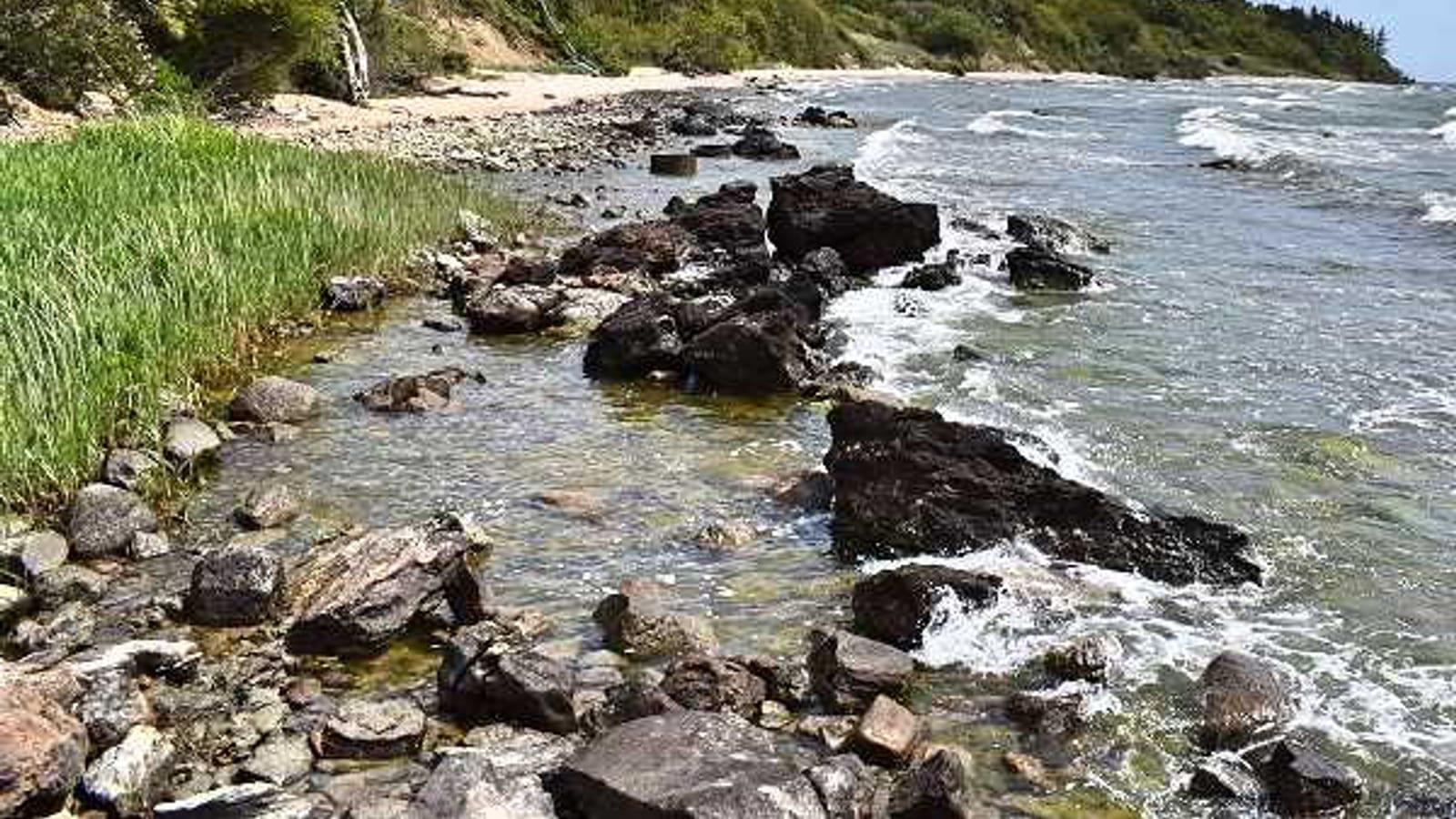
Arnager Beach on the south coast of Bornholm exposes the only Campanian marine succession in Denmark.
By Edward Chen · Updated 2 August 2026
Introduction
Arnager Beach on the south coast of Bornholm exposes the only Campanian marine succession in Denmark. Two thin units, the Arnager Greensand below and the Arnager Limestone above, sit on the foreshore as low ledges and loose blocks, and they are the closest thing the country has to a view of the middle of the Late Cretaceous. The fauna is older than the famous Maastrichtian chalk of Stevns Klint and Møns Klint by roughly ten million years, and it is dominated by sponges, ammonites, sea urchins, brachiopods, and bivalves rather than the belemnite-and-coccolith assemblage of the chalk. Productivity is moderate, not abundant, and the site rewards patience and a good eye for sponge moulds in the limestone. This guide covers how to reach the village of Arnager, how to work the foreshore safely, what the Greensand and Limestone each produce, and the rules that apply to a free, undeveloped Danish coastal collecting site.
Location and Directions
Arnager is a small fishing hamlet on Bornholm's south coast, about 15 kilometres south of Rønne and 8 kilometres west of Aakirkeby. There is no formal address for the collecting area. You walk down to the beach from the village.
To reach Bornholm from mainland Denmark, take the Bornholmslinjen ferry from Køge harbour to Rønne, a crossing of around six and a half hours, or fly Copenhagen to Bornholm Airport with DAT, which takes about 35 minutes. From Rønne, drive south on Route 38 for about 5 kilometres, then turn south onto Arnagervej and follow the signs to Arnager. The village ends at a small harbour with a long wooden pier (Bornholm's longest at around 200 metres). Park in the limited roadside spaces near the harbour. There is no dedicated visitor lot.
Walk west or east from the harbour along the shore. The most productive low limestone ledges are within a few hundred metres of the village in either direction, with the eastern foreshore generally giving the cleanest exposures. The path drops onto sand and gravel quickly, and the limestone ledges become exposed in the low water zone.
The Baltic has very small tides, but the water level changes meaningfully with wind and air pressure. Strong westerly winds push water out and reveal more ledge. Easterlies and storm surges cover them. Check a Bornholm coastal forecast before driving out, and avoid the foreshore in strong onshore winds. The wet limestone is slippery, especially where it is darkened by algae.
There are no public toilets, shops, or cafes at Arnager. The nearest services are in Aakirkeby (about 8 kilometres east) and in Rønne. Bring water and food for the day.
 Photo: Socket0, CC0, via Wikimedia Commons

What Fossils You'll Find
The two units behave differently in the field, and it helps to know which one you are looking at.
- Sponges (Arnager Limestone). The headline find. The limestone is built largely of siliceous sponge spicules and sponge bodies, and you will see fist-sized to dinner-plate-sized sponge moulds as pale, lumpy or vase-shaped inclusions in the rock. Hexactinellid (glass) sponges dominate. Most are best photographed in place because extracting a clean sponge from the limestone takes more than a hand hammer.
- Ammonites (Arnager Greensand). Several Campanian ammonite genera have been reported, including Scaphites, Hauericeras, and small heteromorph forms. Most occur as crushed or fragmentary moulds. Whole ammonites are rare and important enough to be worth reporting.
- Echinoids. Both regular and irregular sea urchins, mostly small (under 5 centimetres). Spines, plate fragments, and occasional complete tests turn up in the limestone and in the lag gravel along the beach.
- Brachiopods. Small terebratulid and rhynchonellid brachiopods, normally as moulds or chips of shell.
- Bivalves and gastropods. Common but mostly fragmentary. Inoceramid bivalve flakes are widespread and useful for confirming the Late Cretaceous age of a block.
- Plant debris. Carbonised wood and rare leaf impressions occur in the Greensand, washed in from nearby Bornholmian land.
- Shark teeth and fish bone. Rare. Small lamniform teeth show up occasionally in the lag.
The most productive method is surface searching of the foreshore at low water, with light hand-hammering of loose blocks only. Most of what you will identify in your first hour are sponge moulds and inoceramid fragments. The rarer ammonites and complete urchins reward longer visits.
Geologic History
The Arnager succession records a brief marine flooding event that put a shallow sea over the Bornholm fault block during the Campanian Stage of the Late Cretaceous, roughly 83 to 72 million years ago. Before and after this interval, Bornholm was emergent or in non-marine environments, which is why the Arnager units are so thin (combined thickness about 10 to 15 metres) and so geographically restricted.
The lower Arnager Greensand is a glauconitic sand deposited as the sea first transgressed across the island. The dark green grains are glauconite formed in slightly reducing conditions on a slowly accumulating shelf. Fossils in the Greensand are mostly remains of free-swimming and floating animals, ammonites in particular, plus debris washed in from nearby land.
The overlying Arnager Limestone is a fine-grained, sponge-rich carbonate deposited slightly later, in slightly deeper and quieter water (estimated tens of metres). The siliceous sponge spicules that dominate the rock indicate clear, cool, well-oxygenated water with low input of land-derived sediment. Brachiopods, bivalves, echinoids, and small fish lived on or just above the seafloor. Sponges built up scattered low mounds.
Sea level then dropped, marine deposition ended on Bornholm, and the next significant marine units in the Danish region are the much younger Maastrichtian and Danian chalks at Stevns Klint and Møns Klint. The Arnager beds were preserved on the downthrown side of the island's structural faults and brought back to the surface by Cenozoic erosion. The limestone now dips gently south under the Baltic, which is why the best exposures sit at the shore and in the shallow water just offshore.
How Arnager Beach Became a Fossil Collecting Site
Arnager has never been quarried at scale. The foreshore was always going to be the only practical way to see the formations here. Danish geologists have known the limestone since the early 1800s, and the unit was formally named after the village. Detailed paleontological work through the early 20th century established the Campanian age of the beds and described many of the sponge, brachiopod, and ammonite species. Modern research, including by Geological Survey of Denmark and Greenland staff, continues to use Arnager as a reference for Late Cretaceous sea level and paleogeography in the southern Baltic region.
Recreational fossil collecting has happened informally for as long as anyone has lived in the village. NaturBornholm in Aakirkeby occasionally runs guided educational walks to Arnager, but the site is otherwise undeveloped. There is no visitor centre, no signage, and no managed collecting area. That makes the locality very low-key, and it has stayed that way because the fossils take patience and the foreshore is small.
Collecting Rules and Regulations
Arnager is free and open to the public 24 hours a day, year round, but the site is not a designated protected area and basic Danish coastal common-sense rules apply.
- Surface collecting and light hand-hammering of loose foreshore blocks for personal use are accepted practice. Heavy or motorised tools are not appropriate at this scale of exposure.
- Do not chip or undercut the in-place limestone ledges. The unit is thin and the exposure is tiny. Once it is destroyed there is no equivalent elsewhere in Denmark.
- Significant finds (intact ammonites, articulated vertebrate material, complete sponges) should be reported to NaturBornholm in Aakirkeby or to the Geological Survey of Denmark and Greenland (GEUS). Personal retention of typical fragmentary finds is fine.
- Pack out everything you bring. There are no bins.
- Dogs are allowed on Bornholm beaches outside the summer holiday weeks. Check current municipal rules during peak season.
Safety
The foreshore is the hazard here, and it is a wet, slippery one. The Arnager Limestone darkens with algae where it stays damp, and wet algal limestone is as slick as ice. Wear boots with a deep rubber tread and take short steps on the ledges. Water shoes are worth having if you intend to wade at all.
The Baltic has almost no astronomical tide, so the water level is set by wind and air pressure instead. A westerly drops it and opens up more ledge. An easterly or a southerly surge covers the same ground, sometimes quickly. Check a Bornholm coastal forecast before you drive out and stay off the lower ledges in an onshore wind.
The water is cold for most of the year, and there is no lifeguard, no shelter, and often nobody else on the beach outside the summer weeks. If you go alone, tell someone your plan.
Light hand-hammering sends chips off the block. Wear eye protection, and do not swing at a slab you are standing on.
The harbour and its 200-metre pier are unfenced, so keep children away from the edge. There are no toilets, shops, or cafes at Arnager. The nearest services are at Aakirkeby, about 8 kilometres east, and the nearest hospital is in Rønne.
Sources
- Geological Survey of Denmark and Greenland (GEUS). "The Cretaceous of Bornholm." https://www.geus.dk/
- Surlyk, F. and Christensen, W.K. "The Arnager Limestone." Bulletin of the Geological Society of Denmark, 1974.
- Noe-Nygaard, N. and others. "Bornholm field guide and Cretaceous stratigraphy." Geological Society of Denmark.
- NaturBornholm. "Bornholm geology and fossil sites." https://www.naturbornholm.dk/
- Wikipedia. "Arnager Limestone Formation." https://en.wikipedia.org/wiki/List_of_fossiliferous_stratigraphic_units_in_Denmark
Nearby sites
 Robbedale Gravel Pit Fossil Hunting GuideTheropod dinosaur teeth, Ornithopod dinosaur teeth
 Mons Klint Beach Fossil Hunting GuideMøns Klint, Belemnites
 Store Klint Mons Klint Tallest Cliffs Fossils Fossil Hunting GuideBelemnites, Sea urchin
 Liselund Park Mons Klint Beach Access Fossil Hunting GuideBelemnites, Sea urchin