Lost River Fossil Hunting Guide
Roadcuts and small quarries along Route 55 west of Wardensville in Hardy County, West Virginia expose the Devonian Helderberg Group. The site is known above all for trilobites, especially Eldredgeops. Access is roadside and depends entirely on who owns the ground you are standing on.
By Edward Chen · Updated 26 July 2026
Introduction
Lost River is a collecting area rather than a single locality. It refers to a scatter of roadcuts and small quarries along West Virginia Route 55 and the older parallel road west of Wardensville, in Hardy County in the state's eastern panhandle. Road construction through the folded Appalachian ridges here sliced through Devonian marine rock, and the cuts have been worked by collectors ever since.
The draw is trilobites. The Helderberg Group exposed here has a reputation among east-coast collectors for producing them in reasonable numbers, which is not something many accessible sites can claim. Brachiopods, corals, and crinoid fragments come from the same beds.
The complication is access, and it is worth being straight about it. Some exposures sit on public road verges. Others are on private ground or in quarries that belong to somebody. There is no gate, no visitor centre, and nobody to ask on site, so the responsibility for establishing where you are standing falls entirely on you.
Location and Directions
The collecting area lies west of Wardensville, near 39.076 degrees north, 78.664 degrees west. Wardensville is on Route 55 close to the Virginia line, and the exposures run west from the town along both the current highway and Old Route 55, which parallels it.
One frequently cited exposure is roughly 4.5 miles west along Old Route 55, just east of Pinnacle Drive. Old Route 55 is the better road to work from, because it carries far less traffic than the main highway and has verges you can actually stop on.
Parking is the practical constraint. Pull well clear of the carriageway, park only where there is a genuine shoulder, and do not stop on a bend or anywhere your vehicle is hidden from approaching traffic. Wardensville has fuel and food and is the nearest place for supplies.
What Fossils You'll Find
Trilobites are the reason to come. The common one is Eldredgeops, which older books and most collectors still call Phacops, a rounded trilobite with large compound eyes made of individually visible lenses. Complete specimens are the exception rather than the rule, and enrolled individuals turn up, curled defensively and buried that way. Isolated head and tail shields are the more usual find and are worth keeping.
Brachiopods occur throughout the collecting area and in quantity, so they are what you will mostly be turning over on the way to something better. Corals appear as small solitary forms, and crinoid remains as stem sections and loose columnals.
The productive material is the loose rock at the base of the cuts rather than the standing face. Weather has already broken it up and started splitting it along the bedding, which is where fossils sit. Working the talus is also considerably safer than attacking a road cut face, and after a wet spell or a winter's frost the supply at the bottom is renewed.
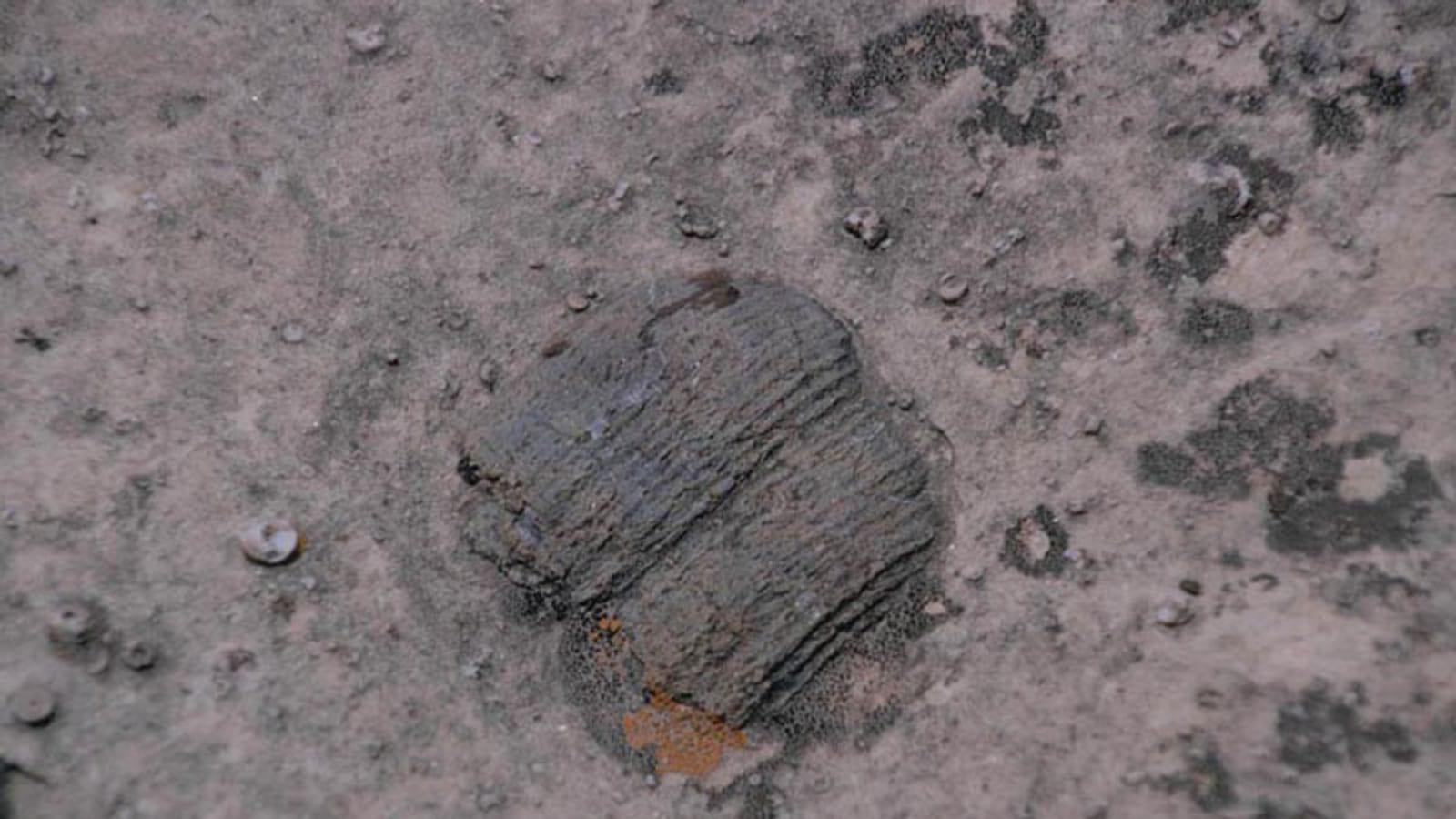
Photo: Smithsonian National Museum of Natural History, CC0, via Smithsonian Open Access
Geologic History
The Helderberg Group was laid down in the Early Devonian, roughly 419 to 393 million years ago, in a shallow, warm sea that covered what is now the central Appalachians. The rock is largely limestone and calcareous shale, deposited on a carbonate shelf populated by brachiopods, corals, crinoids, and the trilobites that make the area worth visiting.
What happened afterwards is why the rock is at the roadside. The Appalachian mountain-building episodes folded and thrust these beds into the long parallel ridges and valleys that define this part of West Virginia. The strata are no longer flat. They are tilted, and in places steeply so, which is why a road cut through a ridge exposes a slice across many beds at once rather than a single layer.
Road construction did the excavation. Cutting Route 55 through the ridges opened fresh faces in rock that would otherwise lie under soil and forest, and those faces continue to weather and shed material, which is what keeps the collecting going decades later.
Collecting Rules and Regulations
There is no single authority here and no permit system, which makes this a site where the collector carries the responsibility.
Establish who owns the ground. Some exposures are reachable from public road verges. Others are private, including working and disused quarries. Ask permission before collecting on private land, and take a refusal as final. An open gate is not an invitation.
Do not collect on the interstate-standard highway itself. Stopping on a fast main road to hammer a cut is both dangerous and likely to attract the attention of the state police. Work the quieter Old Route 55 exposures.
Work the talus, not the face. Beyond safety, cutting into a road cut face undermines a structure the highway department maintains, and it is not welcome.
Collect for personal use. Take a reasonable quantity rather than clearing a productive spot.
West Virginia has no general state fossil-collecting permit for invertebrates on private land with permission, but local ordinances and posted restrictions still apply, so read the signs where there are any.
Safety
Traffic is the single biggest hazard at this site, and it is a real one. You are collecting beside a road, sometimes on a bend, often with a narrow verge. Wear high-visibility clothing, face oncoming traffic where you can, park well off the carriageway, and keep children within arm's reach at all times. Do not let anyone step into the road to look at something.
The cuts themselves are unstable. Road cut faces are freshly exposed, often steeply dipping, and they shed rock without warning, which is precisely why the loose material accumulates at the bottom. Do not climb them, do not work directly beneath an overhang, and wear a hard hat if you intend to spend time close to a face. Eye protection is essential if you are striking rock at all.
The area is rural and wooded. Snakes, including timber rattlesnakes and copperheads, occur in the eastern panhandle, so watch where you put your hands and feet in loose rock and long grass. Ticks are active in the warmer months, and poison ivy is common along verges. Cell coverage is patchy in these valleys, so tell someone where you are going and when to expect you back.
Sources
https://www.fossilguy.com/sites/l_river/index.htm https://www.fossilguy.com/sites/l_river/lrvr_col.htm https://www.wvgs.wvnet.edu/ https://wonderfulwv.com/treasures-in-the-rock/
Frequently asked questions
- Where exactly is the Lost River fossil site?
- It is not one site. Productive roadcuts and small quarries are scattered along Route 55 and Old Route 55 west of Wardensville. One well-known exposure sits about 4.5 miles west along Old Route 55, just east of Pinnacle Drive.
- What trilobites are found at Lost River?
- Eldredgeops, long known to collectors by its former name Phacops, is the common one. Brachiopods, corals, and crinoid fragments occur throughout the same beds.
- Do you need permission to collect at Lost River?
- It depends on the exposure. Some are reachable from public road verges, others are private quarries where you must ask the landowner first. Always establish who owns the ground before collecting.