Messel Pit Fossil Site Guide
Image: Pedelecs (CC BY-SA 3.0)
The Messel Pit, a flooded former oil shale quarry near Darmstadt in Germany, is the world's most productive fossil site for understanding Eocene mammalian evolution 47 million years ago. Articulated mammal skeletons preserved with skin, fur, and stomach contents are continuously recovered. Visits are restricted to guided tours.
By Edward Chen · Updated 31 July 2026
Introduction
The Messel Pit (Grube Messel) is a disused open-pit oil-shale mine roughly 30 km south of Frankfurt am Main, Germany, that has become the world's most productive Eocene fossil locality. Inscribed as the first natural UNESCO World Heritage Site in Germany in 1995, it preserves whole-body fossils, with fur, feathers, skin, gut contents, and even structural insect colours, from a 47-million-year-old volcanic crater lake.
The pit and its rim are managed by the Welterbe Grube Messel gGmbH. A modern visitor centre, "Zeit und Messel Welten," sits at the south rim with exhibitions, a café, and a viewing platform. Entry into the quarry itself is by guided tour only. Independent walking onto the slopes is not permitted.
This guide covers what you'll see, how to arrange a tour, and the rules that protect this fine-scale Eocene Lagerstätte.
Location and Directions
The Messel Pit lies on the edge of the village of Messel, about 10 km northeast of Darmstadt and 30 km south of Frankfurt am Main, in the German state of Hesse.
Directions to the Messel Pit
The visitor centre is at Roßdörfer Straße 108, 64409 Messel, with on-site parking and a bus stop served by regional buses from Darmstadt and Dieburg. The Messel railway station (Odenwaldbahn line RB75) is about 25 minutes' walk.
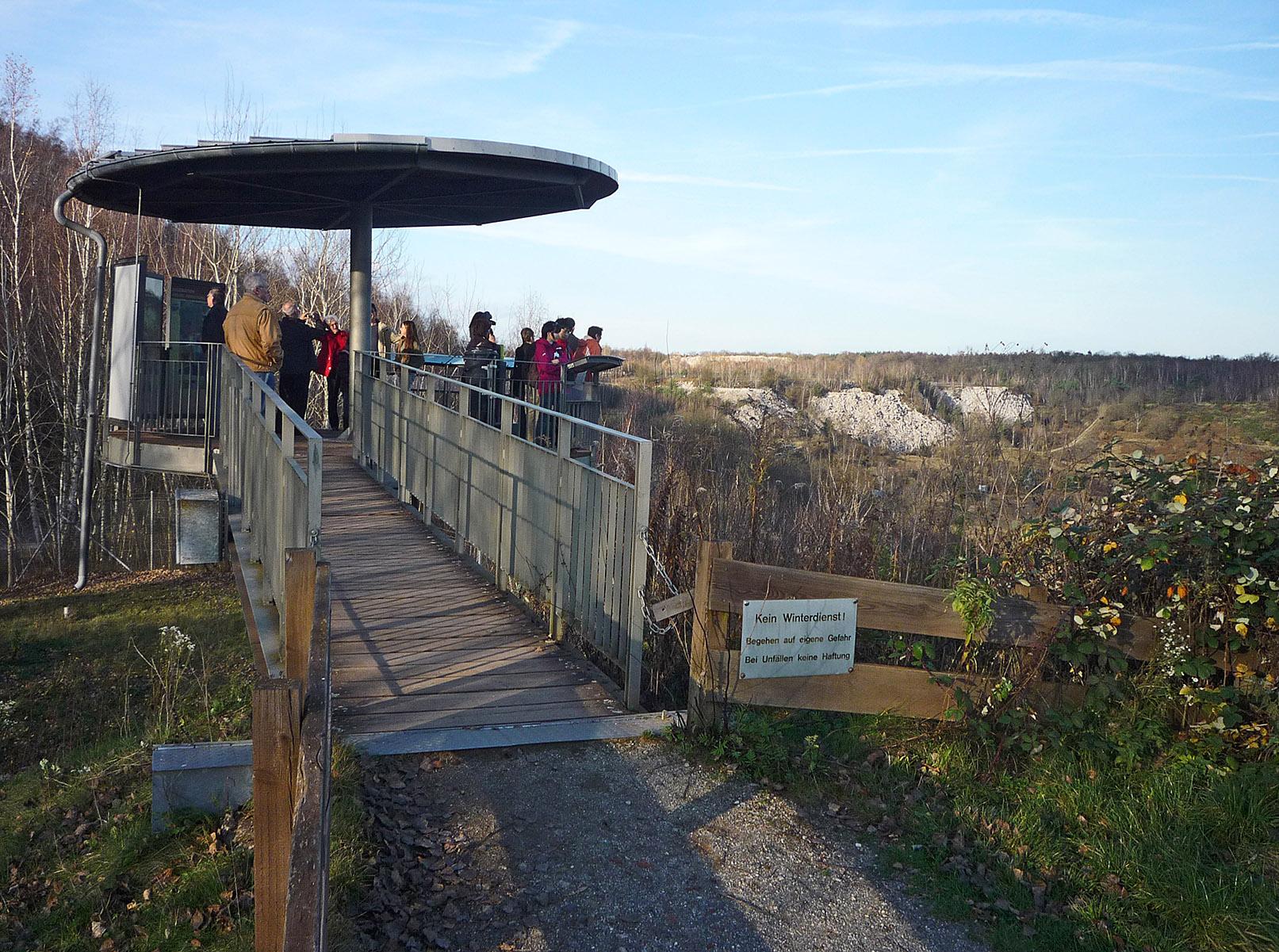
The visitor centre is open daily 10:00–17:00 (Mon–Fri offices 09:00–17:00). The exhibition is fully barrier-free with elevator and accessible toilets, and a viewing platform at the south rim looks down over the entire pit. Entering the pit floor requires booking a guided tour in advance. Multiple tour formats are offered, ranging from a 1-hour overview to half-day fossil-excavation experiences run with the Senckenberg Research Institute.
 Photo: josef knecht, CC BY 3.0, via Wikimedia Commons
.jpg)
What Fossils You'll See
The Messel Formation consists of finely laminated bituminous oil shales (locally called Ölschiefer) deposited in a deep, stratified, anoxic maar lake formed in a phreatomagmatic volcanic crater. The lake supported a closed-canopy subtropical rainforest catchment with a varied mammal, bird, reptile, fish, and insect fauna. Mass-mortality events and accidental falls into the lake repeatedly delivered terrestrial animals to the anoxic bottom waters where they were preserved with skin, fur, feathers, stomach contents, and even structural colour intact.
The mammal fauna includes some of the most famous fossils in paleontology. The early horse Propalaeotherium, about the size of a small dog and a leaf-browser rather than a grass-grazer, is preserved with its last meal of leaves still in its stomach in several specimens. The carnivorous Lesmesodon and the small primate Europolemur, along with the famous early primate Darwinius masillae (nicknamed "Ida" and described in 2009 as a possible early haplorhine), all appear with complete skeletons and clear soft-tissue outlines. Bat fossils, the long-tailed Palaeochiropteryx tupaiodon and the slightly later Hassianycteris, are particularly common at Messel, with several specimens preserving stomach contents that identify which moths they were eating. The hedgehog-like Pholidocercus, the anteater-like Eurotamandua joresi, the gliding Eomanis (an early pangolin), the small marsupial Amphiperatherium, and dozens of small insectivores and rodents round out the mammal fauna.
The bird fauna is at least as notable. The giant flightless predator Gastornis (formerly Diatryma) stood almost two metres tall and was once interpreted as a top carnivore, though more recent isotope work suggests it was herbivorous. The early raptor Messelastur, the kingfisher-like Messelornis, several rollers and trogons, and the iridescent-plumaged Eocoracias all preserve feathers. Reptiles include the boid snake Eoconstrictor, the early monitor Saniwa, several crocodilians, and turtles preserved as pairs caught mating in the lake. Frogs (Eopelobates) and salamanders are abundant. Fish include the bowfin-relative Cyclurus (the most common Messel fossil), the gar Atractosteus, and the eel Anguilla. Insects are particularly striking, beetles with their original iridescent structural colour still visible, leaf insects, jewel beetles, and crickets, with at least 25 orders represented. Plant material includes whole leaves, fruits, seeds, pollen, charcoal, and rare flowers of the early laurel family.
UNESCO calls Messel the leading fossil site in the world for documenting the Eocene environment, citing mammal fossils that range from fully articulated skeletons to preserved stomach contents.
 Photo: Nachosan, CC BY-SA 3.0, via Wikimedia Commons

Geologic History
The Messel maar formed around 48 million years ago when a body of rising basaltic magma encountered groundwater in the porous bedrock of the southern Sprendlinger Horst. The violent steam explosion that followed punched a crater nearly a kilometre across and several hundred metres deep, blasting fragmented bedrock across the surrounding forest. The crater rapidly filled with rainwater and groundwater to form a stratified maar lake several hundred metres deep, much like Crater Lake in Oregon or Lake Pavin in France today.
Because the lake was deep and stratified, its bottom waters became persistently anoxic. Periodic algal and bacterial blooms in the warmer surface waters periodically poisoned fish and other surface dwellers, while terrestrial animals occasionally fell or were washed into the lake. Both sources of carcasses settled into the dysoxic bottom and were preserved with fine-scale fidelity in fine, algae-rich muds. Over hundreds of thousands of years these muds accumulated as the laminated oil shales now exposed in the pit, with each annual varve preserving a thin record of seasonal change in the lake and its catchment.
The Messel Formation rests on Permian–Triassic basement and is overlain by younger Tertiary sediments. Tectonic subsidence of the Upper Rhine Graben to the west kept the maar from being eroded away during the rest of the Cenozoic. Oil shale was mined commercially at Messel from 1884 until 1971 to produce kerosene-grade light oil, paraffin wax, and gas. The mine was abandoned when the post-war oil market made the operation uneconomic, and the State of Hesse purchased the pit with the intention of converting it into a municipal landfill in the 1970s. A sustained scientific and public campaign, driven by the discovery in the 1970s of the first complete mammal skeletons, and by the Senckenberg Research Institute's emergency rescue excavations, halted the landfill plan in 1991. UNESCO inscribed the site as a World Heritage Site in 1995, the first natural Site in Germany.
How the Messel Pit Came to Be Protected
The Messel Pit is UNESCO World Heritage Site #720, inscribed in 1995. The pit and the surrounding 70 hectares of buffer land are owned by the State of Hesse and managed by Welterbe Grube Messel gGmbH, a non-profit organisation. Fossil research is led by the Senckenberg Research Institute, headquartered in Frankfurt. Their on-site team excavates the pit each summer, with finds going to the Senckenberg Natural History Museum collection. The visitor centre Zeit und Messel Welten, opened in 2010, anchors public access and education for what has become one of Germany's most-visited geological heritage sites.
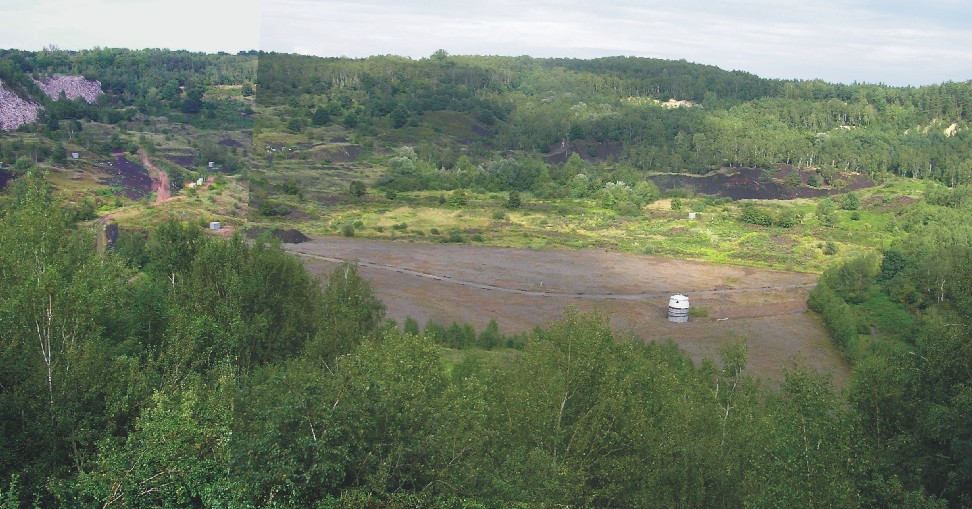 Photo: Amaltheus, CC BY-SA 4.0, via Wikimedia Commons

Collecting Rules and Regulations
Is Fossil Collecting Allowed?
No collecting by tourists. All fossil excavation is conducted by, or under permit from, the Senckenberg Research Institute and the State of Hesse.
Key Points:
- Entry to the pit floor only via guided tour
- No independent walking, climbing, or hammering
- Photography is allowed. Commercial filming requires permission
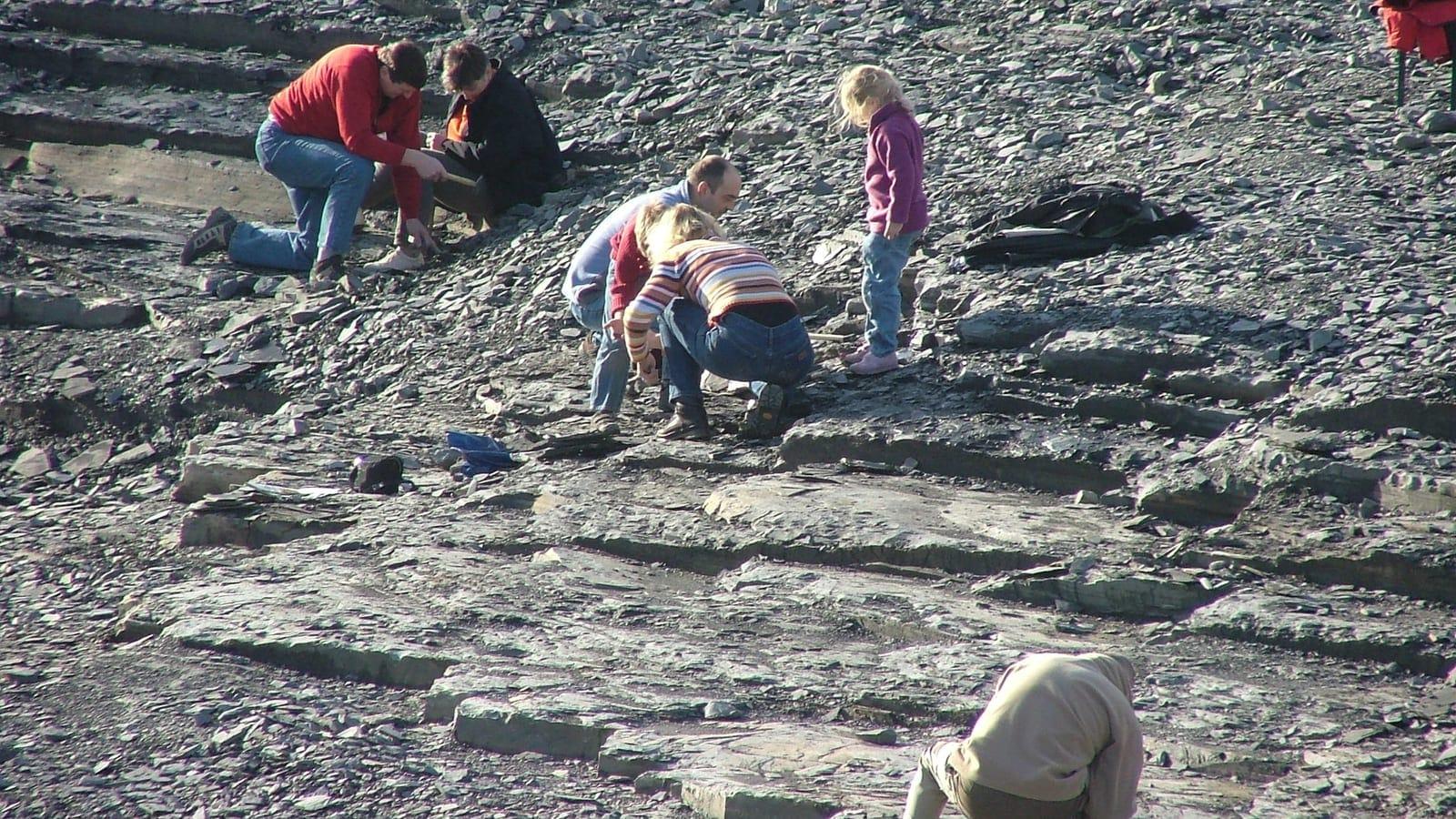
- Some half-day "research participation" tours allow guided splitting of fresh shale, finds remain property of the State of Hesse
Safety
Messel is a guided site and the tour structure handles most of the risk, but the pit is still a working excavation in an old oil-shale quarry.
The tour is the only legal and safe way onto the pit floor. The slopes are steep, the shale is slippery when wet, and independent walking, climbing, and hammering are prohibited. Book ahead rather than turning up and hoping.
Underfoot on the descent is loose shale and quarry track, so wear walking shoes with a grip. The pit is a basin and holds cold air, so take a layer even in summer, and take waterproofs, because tours run in most weather and there is no shelter on the floor.
The oil shale cracks and flakes as it dries in the sun and turns greasy when wet. Both states are slippery. Follow the guide's route rather than picking your own line across a bedding surface.
Sun exposure on the floor is stronger than the walk suggests, since there is no vegetation and the pale shale reflects. Take water, a hat, and sun protection for the longer tours, and expect the half-day excavation formats to be physically tiring.
The visitor centre and the rim viewing platform are fully accessible, with a lift and accessible toilets. The pit floor is not. If mobility is a concern, the rim platform gives you the whole pit in one view and asks nothing of you.
Sources
Nearby sites
 Herrenberg Mine Bundenbach Underground Fossil Hunting GuideDevonian marine fossils, Crinoids
 Schieferbruch Kromer Ohmden Posidonia Shale Fossil Hunting GuideAmmonites, Belemnites
 Urweltsteinbruch Holzmaden Posidonia Shale Fossil Hunting GuideAmmonites, Ichthyosaur
 Ries Crater Nordlingen Meteorite Impact Geopark Fossil Hunting Guidesuevite impact breccia