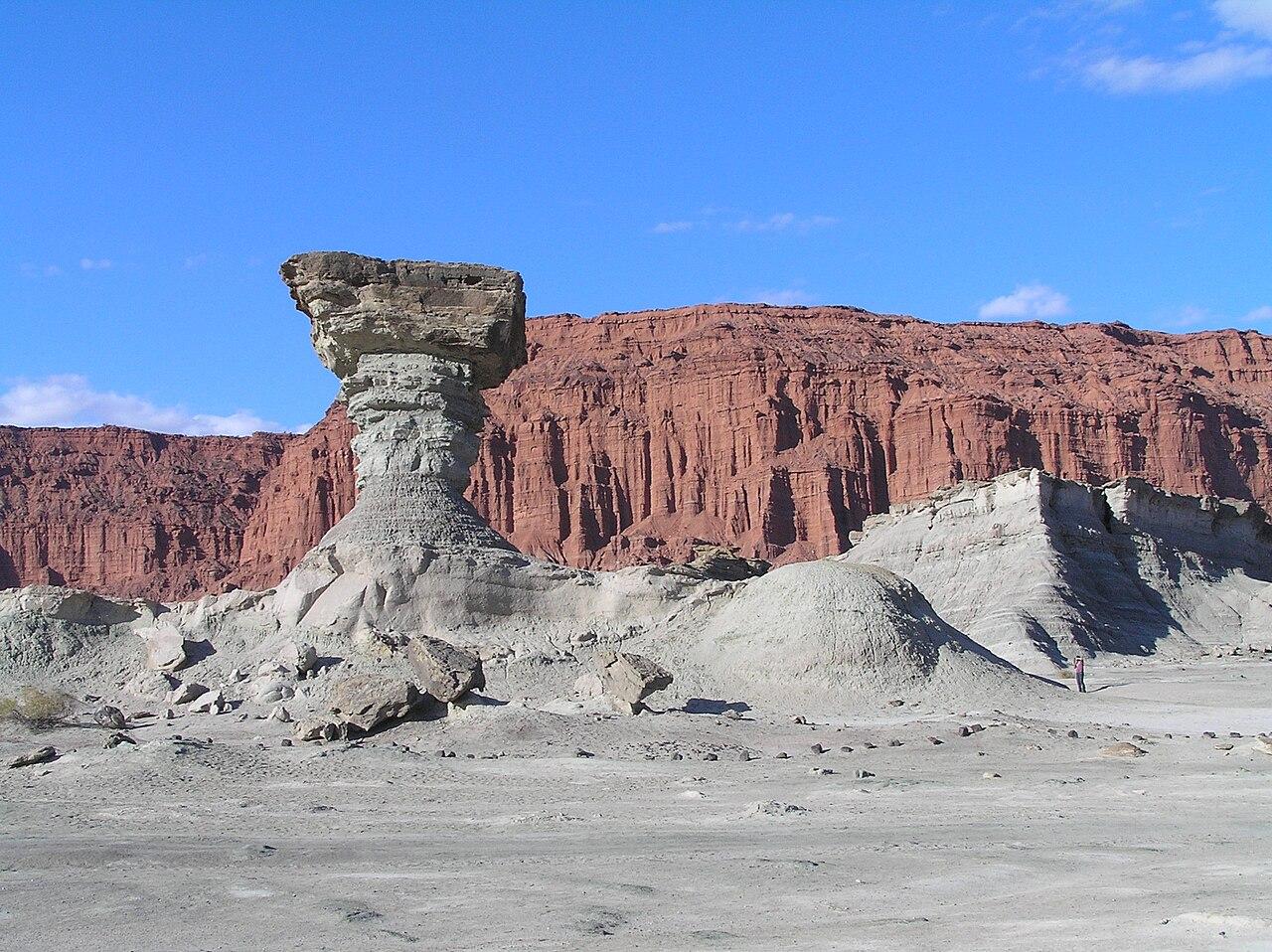
Ischigualasto Provincial Park Fossil Guide
Image: M.Bustos (CC BY-SA 4.0)
Ischigualasto Provincial Park, the "Valley of the Moon" in San Juan, Argentina, preserves the most complete Triassic terrestrial record on Earth, including five of the seven oldest known dinosaur species. Visits are made only by vehicle convoy with a park guide along a fixed circuit.
By Edward Chen · Updated 31 July 2026
Introduction
Ischigualasto Provincial Park, popularly known as the "Valle de la Luna" (Valley of the Moon), is a 63,000-hectare protected area in San Juan Province, northwestern Argentina. Together with the adjacent Talampaya National Park in La Rioja, it was inscribed as a UNESCO World Heritage Site in 2000 for preserving the most complete continental Triassic fossil record on Earth.
Five of the seven oldest known dinosaur species, including Eoraptor lunensis, Herrerasaurus ischigualastensis, and Eodromaeus, were discovered here, alongside an abundant fauna of rhynchosaurs, cynodonts, and other archosauromorphs. The badlands themselves are surreal: wind-carved sandstone, mushroom-shaped concretions, and grey-and-red bentonite hills with almost no vegetation.
Visits are restricted to a designated circuit followed in vehicle convoy with a park guide. Independent off-road travel and fossil collection are prohibited.
Location and Directions
Ischigualasto lies in the northeastern corner of San Juan Province, roughly 330 km north of San Juan city and adjacent to the border with La Rioja Province.
Directions to Ischigualasto
Most visitors drive from San Juan or La Rioja via Provincial Route 510 (San Juan side) or National Route 76 from Villa Unión (La Rioja side). The park entrance and Interpretation Center of the National University of San Juan sit just off the access road. From there, all visitors travel the 40-km loop circuit in their own vehicles, following a guide in a lead vehicle who stops at four to five interpretive viewpoints. The standard daytime tour lasts about three hours. Full-moon night tours are offered for four days each month, and longer hiking and mountain-bike circuits are available with advance booking.
The William Sill Site Museum, located mid-way along the circuit, displays original Herrerasaurus, Eoraptor, and Frenguellisaurus fossils alongside in-situ excavation areas.
What Fossils You'll See
The Ischigualasto Formation records a meandering river floodplain from the late Carnian Stage of the Late Triassic, and is the global type section for the Ischigualastian land-vertebrate age, the interval in which dinosaurs first appeared and began to diversify.
The interpretation centre at the park entrance and the William Sill Site Museum mid-circuit display articulated skeletons and skulls that show the full Ischigualasto vertebrate community. The dinosaurs are still rare in the assemblage, but the species that have been described are textbook references for early dinosaur evolution. Eoraptor lunensis is a small, lightly built sauropodomorph-grade dinosaur about a metre long, named in 1993 and for many years considered the oldest known dinosaur in the world. Herrerasaurus ischigualastensis is a much larger, three-metre saurischian predator with grasping hands and the long, recurved teeth that define the basal theropod body plan, and is the most famous large carnivore in the formation. Eodromaeus murphi, described in 2011, is a smaller, more clearly theropod-grade dinosaur that overlaps with Eoraptor in age and is now interpreted as a key piece in untangling the early saurischian split. The recently described Sanjuansaurus gordilloi and the basal sauropodomorph Panphagia protos round out the dinosaur fauna. Pisanosaurus mertii, possibly the oldest known ornithischian dinosaur, is also from these rocks.
The non-dinosaur Triassic vertebrate community matters as much as the dinosaurs and dominates the Ischigualasto vertebrate biomass. The pig-snouted rhynchosaur Hyperodapedon is by far the most abundant tetrapod and was the dominant herbivore. The large tusked dicynodont Ischigualastia jenseni and the smaller dicynodonts Stahleckeria and Dinodontosaurus fill out the herbivore guild. Among advanced cynodonts, the mammal-like reptiles that gave rise to mammals, Probainognathus and Exaeretodon are abundant and provide some of the best Late Triassic data on the cynodont-to-mammal transition. The top predator of the ecosystem was not a dinosaur but the rauisuchid pseudosuchian Saurosuchus galilei, a six-metre-long crocodile-line archosaur that ate everything below it on the food chain. Smaller carnivores include the proterochampsid Proterochampsa, the ornithosuchid Venaticosuchus, and various sphenosuchian crocodylomorphs. Permineralized conifer trunks (Rhexoxylon) and rhachiphyllum-grade fern remains are common in the lag deposits across the badlands.
"It is the only place in the world that reveals the evolution of life in the Triassic Period through the fossilized remains of animals and plants." Welcome Argentina / Ischigualasto Provincial Park
 Photo: Zissoudisctrucker, CC BY-SA 4.0, via Wikimedia Commons

Geologic History
The Ischigualasto–Villa Unión Basin formed during the Late Triassic as a half-graben rift basin in western Gondwana, on the trailing flank of the rising proto-Andean magmatic arc. The Ischigualasto Formation accumulated between roughly 231 and 225 million years ago in a broad foreland subsiding under monsoonal seasonal rainfall, with sluggish, anastomosing rivers and broad muddy floodplains punctuated by ash falls from contemporaneous Andean volcanism. Bentonite layers within the formation provide some of the most precise radiometric dates anywhere in the Triassic and have made Ischigualasto a global reference section for late Carnian biostratigraphy and chronostratigraphy.
The Ischigualasto Formation is succeeded upward by the overlying Los Colorados Formation, which records a much drier later Triassic, orange-red, cross-bedded aeolian sandstones and braided-river deposits with a sparser fauna dominated by basal sauropodomorph dinosaurs (Riojasaurus, Coloradisaurus), aetosaurs, and large crocodyliforms. Together the two formations capture the gradual rise of dinosaurs from rare and small members of a varied tetrapod community to ecologically dominant predators and herbivores, and the parallel decline of the dicynodonts, rhynchosaurs, and large pseudosuchian crocodile-line archosaurs.
Cenozoic tectonics raised the basin and tilted the section. Wind and sparse, intense desert rainstorm runoff have stripped overlying cover and sculpted the soft sediments into the dramatic mushroom-shaped concretions, badland slopes, and grey-and-red bentonite hills that give the park its "Valle de la Luna" nickname. The same erosion exhumes new fossils each year. The combined Ischigualasto–Talampaya UNESCO World Heritage area covers more than 275,000 hectares and is the most extensive continuous outcrop of Triassic continental rocks in the world.
Systematic excavation began with the Buenos Aires geologist Victorino de la Fuente in the 1940s, expanded under Osvaldo Reig and José Bonaparte from the late 1950s, and continues today as a long-running collaboration between Argentine institutions (CONICET, the National University of San Juan, the Museo Argentino de Ciencias Naturales) and international partners (notably Paul Sereno of the University of Chicago, whose 1988 and 1991 expeditions yielded Eoraptor and the Herrerasaurus skull). The William Sill Site Museum mid-circuit is named for the American paleontologist who spent much of his career documenting Argentine Triassic faunas.
How Ischigualasto Came to Be Protected
The site was established as a provincial park in 1971 by the Government of San Juan, jointly proclaimed with Talampaya National Park (in adjacent La Rioja Province) as a UNESCO World Heritage Site in 2000, and is managed today through cooperative agreements between the two provinces and the National University of San Juan, which runs the park interpretation centre and on-site museum.
 Photo: Julia B. Desojo, Lucas E. Fiorelli, Martín D. Ezcurra, Agustín G. Martinelli, Jahandar Ramezani, Átila. A. S. Da Rosa, M. Belén von Baczko, M. Jimena Trotteyn, Felipe C. Montefeltro, Miguel Ezpeleta & Max C. Langer, CC BY 4.0, via Wikimedia Commons

Collecting Rules and Regulations
Is Fossil Collecting Allowed?
No. All fossil collection is prohibited. Visitors must remain with their guided convoy and stay on the designated circuit.
Key Points:
- Entry only via guided vehicle convoy or organized hike
- No off-trail walking
- No collecting, hammering, or removal of any fossil or rock
- Drones are not permitted without a research permit
- Bring water and sun protection, the desert is exposed and hot
Safety
Ischigualasto is a 63,000-hectare desert park in San Juan Province visited by guided vehicle convoy, and both the guiding and the convoy exist for good reasons.
You cannot drive the circuit unaccompanied. Visits run as escorted convoys on a set route with a ranger or guide, which is how the park manages both conservation and the fact that this is remote desert with no infrastructure inside it. Book ahead, arrive in time for a departure, and stay with the group.
Desert heat and sun. Summer temperatures are severe, shade is essentially absent, and the altitude increases ultraviolet exposure. Carry substantially more water than you expect to drink, wear a hat and long sleeves, and use strong sun protection. Winter brings cold nights and strong wind instead.
Wind and dust. The park is notoriously windy, which is part of what carved the formations. Dust makes contact lenses uncomfortable and reduces visibility, so bring eye protection and something to cover your face.
The badland formations are fragile and undercut. Do not climb them, stay on the marked stops, and keep back from edges. The ground is loose and uneven, so wear closed shoes with a firm sole.
Nothing may be collected. This is a UNESCO World Heritage Site protecting one of the most important Triassic vertebrate records anywhere, and removing material is prosecuted. Fuel up and carry supplies before entering, since the nearest services are a long way off.
Sources
Nearby sites
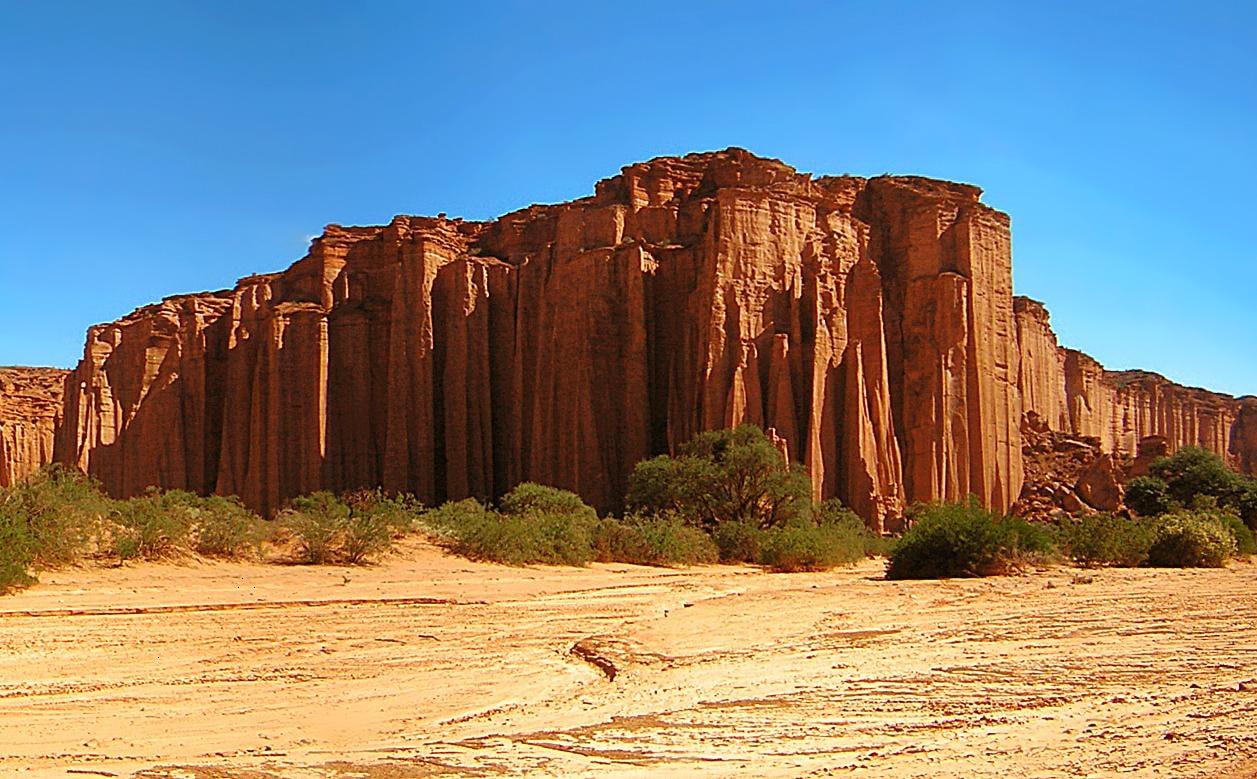 Talampaya National Park Fossil Hunting GuideDicynodonts (Dinodontosaurus), Cynodonts (Massetognathus)
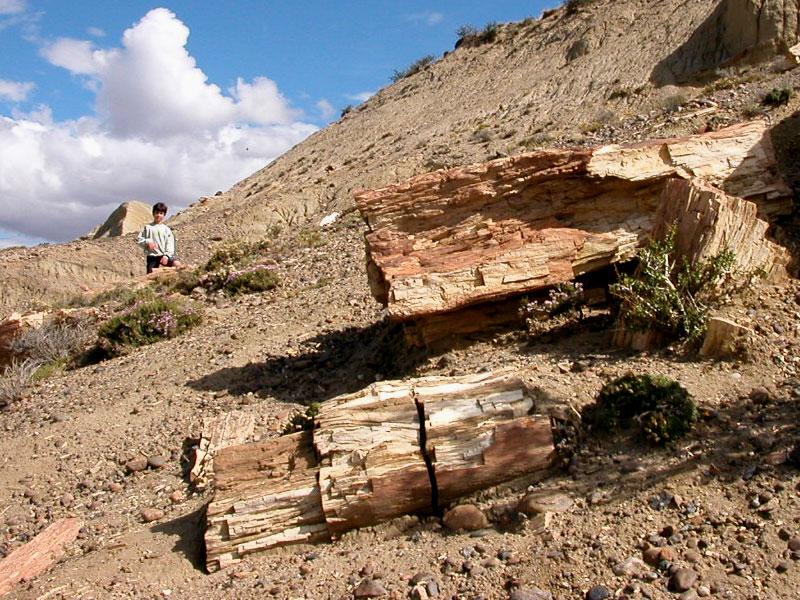 Sarmiento Petrified Forest Natural Monument Fossil Hunting GuideAraucariaceae trunks, Podocarpaceae wood
 Quarta Colônia Geopark Fossil Hunting GuideEarly dinosaurs, Cynodonts
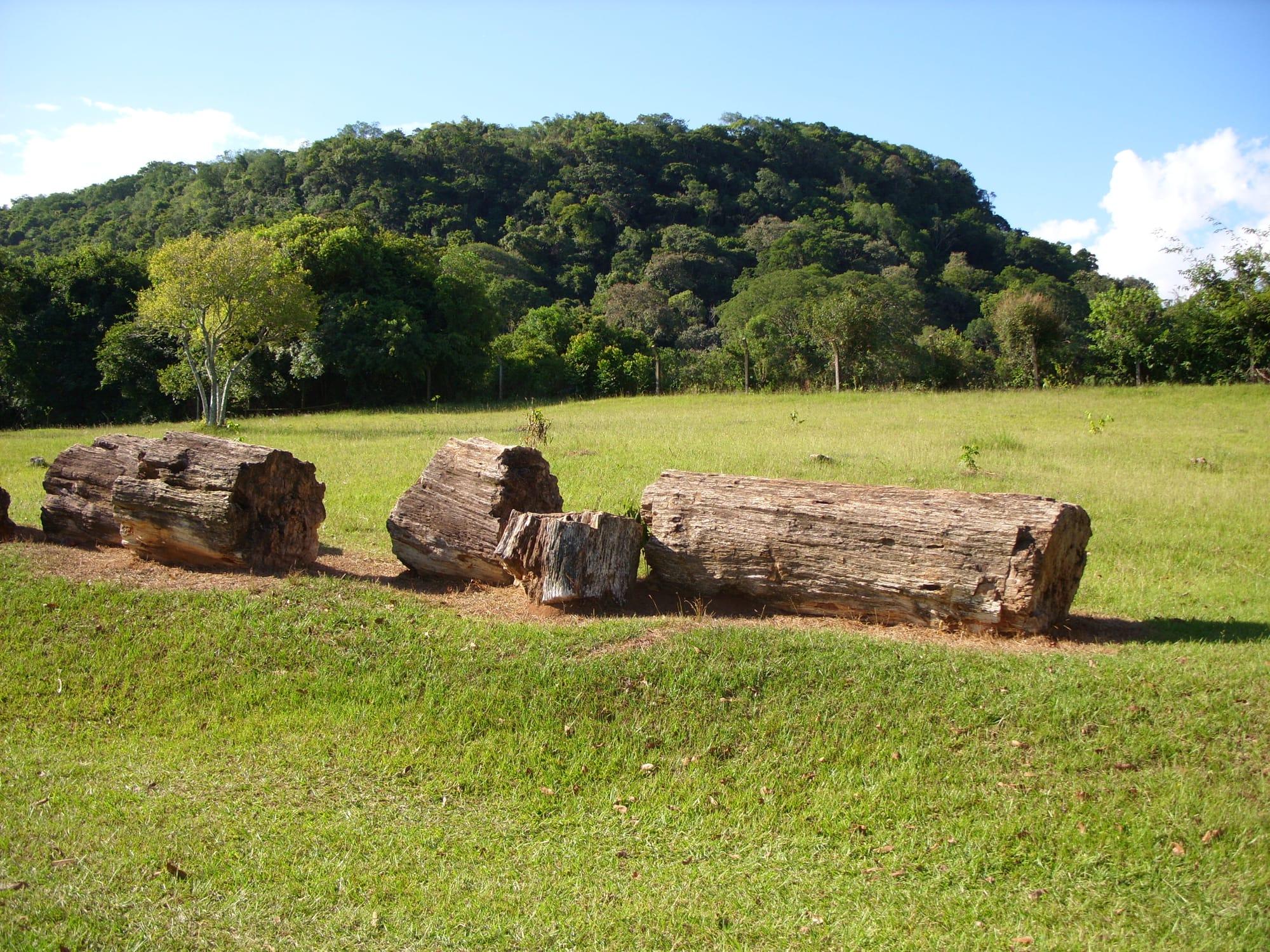 Paleorrota Geopark Fossil Hunting GuideStaurikosaurus pricei (early dinosaur), Hyperodapedon (rhynchosaur)