Pembina Gorge Public Fossil Dig Guide
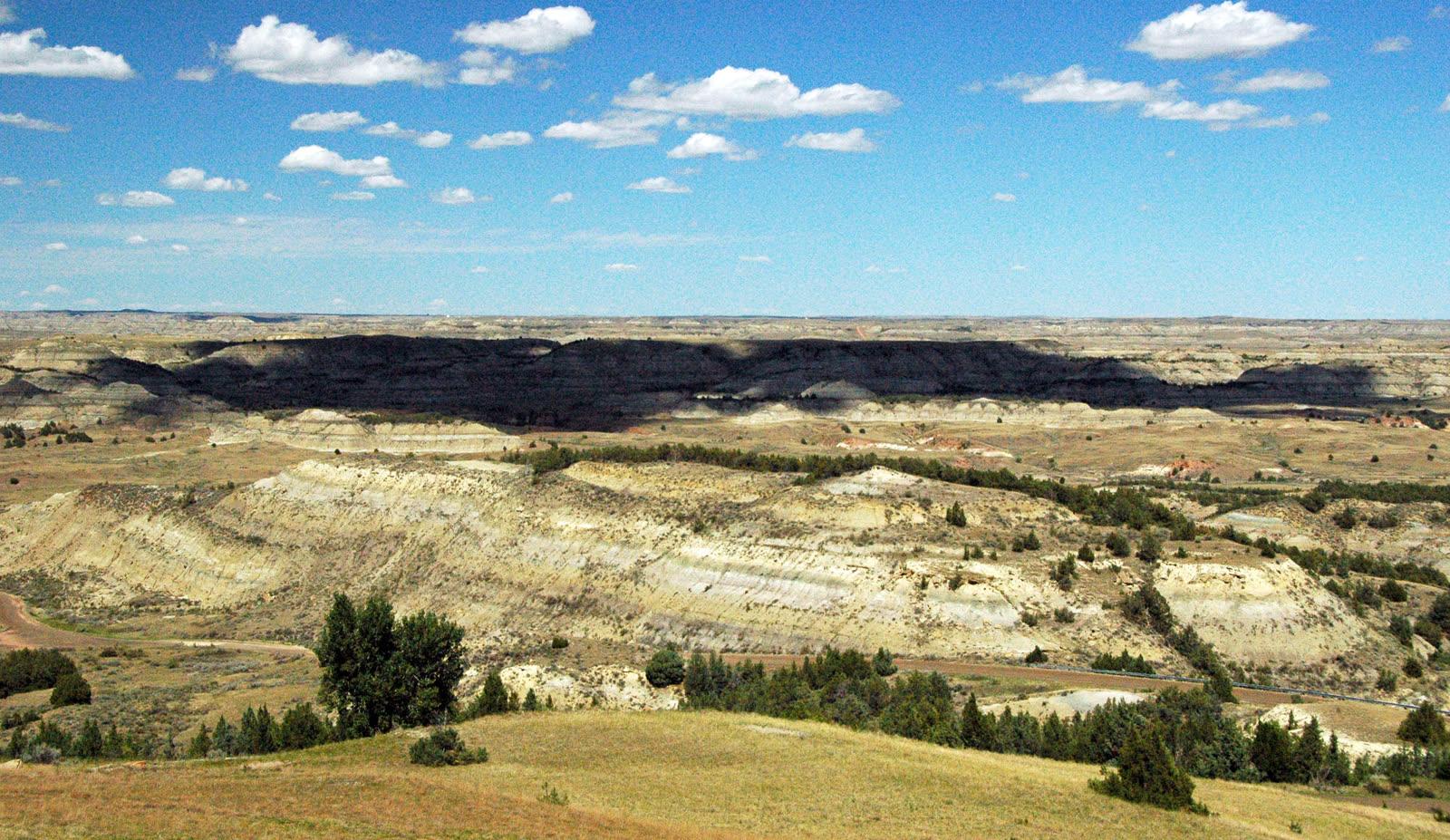
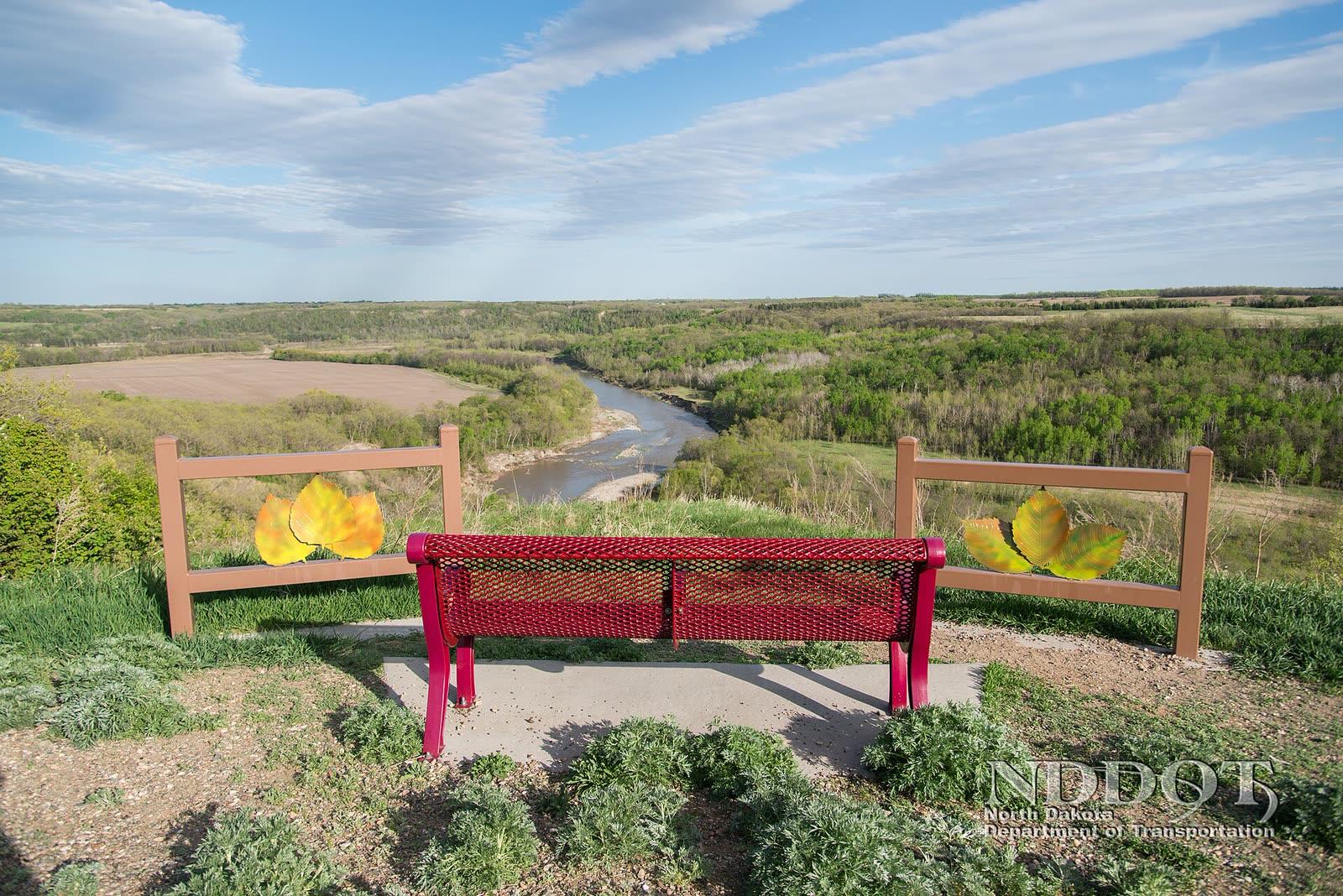
Image: North Dakota from Bismarck, USA (Public domain)
The North Dakota Geological Survey runs an annual public fossil dig at Pembina Gorge State Recreation Area near Walhalla, where the Late Cretaceous Pierre Shale produces mosasaurs, sea turtles, fish, sharks, and the toothed bird Hesperornis. Participants pay a small fee, work with NDGS paleontologists, and help excavate the dig faces.
By Edward Chen · Updated 31 July 2026
Introduction
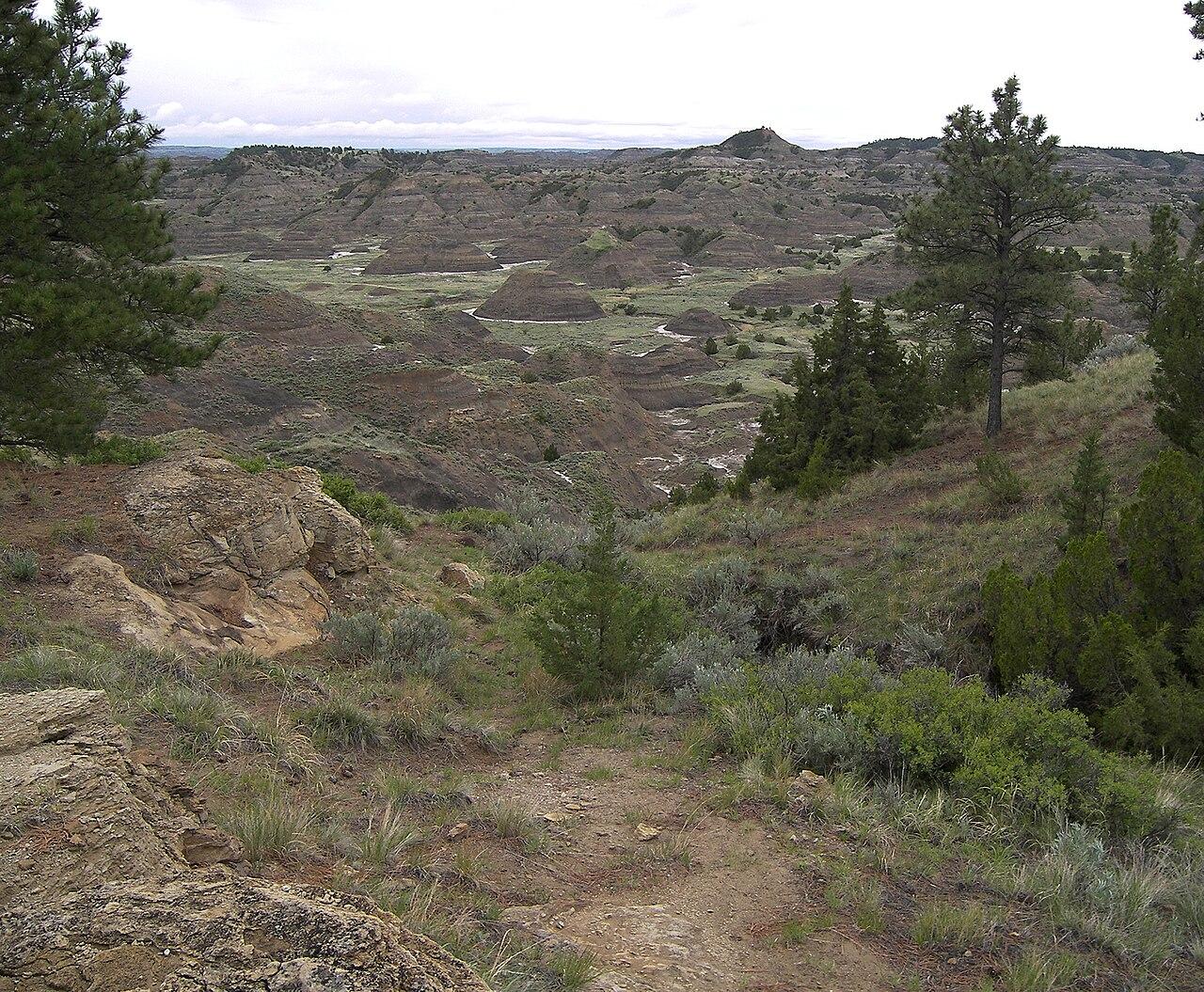
Pembina Gorge State Recreation Area is in far northeast North Dakota, just south of the Canadian border near Walhalla. The Pembina Gorge cuts through Late Cretaceous (Campanian) Pierre Shale, exposing one of the most productive marine vertebrate sites in the upper Midwest. Eighty million years ago this was the floor of the Western Interior Seaway, and the gorge's clay-rich shales preserve articulated mosasaurs (large marine lizards), sea turtles, the swordfish-like predator Xiphactinus, the flightless toothed seabird Hesperornis, and abundant shark and fish material.
The North Dakota Geological Survey (NDGS) runs the Pembina Gorge Public Fossil Dig each summer in partnership with the North Dakota Parks and Recreation Department. Participants pay a non-refundable program fee, are bussed daily from a Walhalla base to the dig site, and work alongside NDGS paleontologists on active excavations. The program is family-oriented and routinely draws diggers from across the United States and abroad.
Location and Directions
Walhalla is in Pembina County, North Dakota, about 230 miles southwest of Winnipeg, Manitoba, and 30 miles north of Grand Forks's nearest airport at Grand Forks International (GFK).
Directions to the Pembina Gorge Public Fossil Dig
Most participants fly into Grand Forks (GFK) or Winnipeg (YWG) and drive to Walhalla, where the dig program checks in. Daily transport from Walhalla to the dig face is provided as part of the program. Pembina Gorge State Recreation Area itself is just east of Walhalla on ND-32.
Registration opens in winter through the NDGS Public Fossil Digs page. Programs sell out, especially family days (ages 10+). The dig season is typically June through early August. The 2026 program details (dates, fees, day-by-day plans) are posted at the NDGS site linked below.
What to bring: closed-toed work boots, work gloves, sun hat, rain gear, layered clothing (weather is variable), water bottle, sunscreen, insect repellent (mosquitoes are aggressive), a small day pack, and a packed lunch (food is not provided in recent program iterations, check current details). NDGS provides excavation tools and supervises all field activity.
What Fossils You'll Find
The Pierre Shale at Pembina Gorge was deposited in the deep, open marine waters of the Western Interior Seaway during the Campanian Stage of the Late Cretaceous, about 80 million years ago, in what is now the deepest central part of the seaway between the Sevier orogen highlands to the west and the stable continental craton to the east.
Mosasaurs are the headline finds. Active dig faces have produced articulated skeletons of the long, ribbon-bodied tylosaurine Tylosaurus proriger, the smaller and earlier Platecarpus tympaniticus, the late-Campanian plioplatecarpine Plioplatecarpus, and the iconic genus Mosasaurus itself in the upper Pierre. Vertebrae, teeth, and jaw fragments of these large marine lizards are recovered every year, and articulated partial skeletons turn up regularly enough that the NDGS has named several individual specimens (the "Pembilier mosasaur," for example).
The giant sea turtle Archelon, one of the largest turtles ever to exist, with a shell up to 4 metres long, has been recovered as scattered shell fragments and the occasional articulated limb. The voracious bony fish Xiphactinus audax, a six-metre predator with a deeply forked tail and fang-like teeth, is regularly represented by vertebrae, the diagnostic spike-toothed jaws, and occasional articulated trunk sections. The smaller predatory fish Cimolichthys nepaholica and the gar relative Protosphyraena are also frequent finds.
The toothed diving seabird Hesperornis regalis, a flightless, primitive bird up to 1.8 metres long, has produced several partial skeletons, including elongate limb bones and the distinctive teeth-bearing jaws. Vertebrae and arm hooks of the huge soft-bodied squid relative Tusoteuthis longa are not uncommon. Ammonites include the straight-shelled Baculites compressus (a key Campanian biostratigraphic index fossil) and the disc-shaped Placenticeras meeki, sometimes preserved with iridescent ammolite shell. Shark teeth from Squalicorax kaupi, Cretolamna appendiculata, and Scapanorhynchus texanus are abundant in the dig spoil. Participants regularly find vertebrae, teeth, limb bones, and shell fragments. Well-studied specimens stay with the NDGS for research collection, while less scientifically valuable material is distributed among participants under a finds protocol set by the survey.
"Pembina Gorge is a sea monster site, where they are collecting fossils from the 80-million-year-old Pierre Formation." North Dakota Geological Survey
Geologic History
During the Late Cretaceous, what is now North Dakota lay near the deep central trough of the Western Interior Seaway, a vast shallow tropical sea that connected the Gulf of Mexico to the Arctic Ocean and split the North American continent in two from about 100 to 70 million years ago. The water column was warm, well-stratified, and at maximum transgression more than 700 metres deep across northern North Dakota. Fine, organic-rich, clay-rich mud accumulated in calm, often anoxic to dysoxic conditions on the seafloor, providing the right taphonomic conditions for preserving articulated marine vertebrates whose carcasses sank intact into the bottom mud.
The Pierre Shale extends across much of the U.S. and Canadian Great Plains, from Texas through Manitoba, and is the parent unit for many of the central Great Plains' great mosasaur sites (including the famous Niobrara Chalk and Smoky Hill Chalk to the south in Kansas, and the Bearpaw Shale to the west in Montana and Saskatchewan). The unit in North Dakota is locally divided into several members. The fossils at Pembina Gorge come primarily from the Campanian-age Sharon Springs and Gregory Members.
Pembina Gorge itself was carved by glacial-meltwater drainage at the end of the last ice age. As the Laurentide Ice Sheet retreated from the Manitoba border area, enormous volumes of meltwater funnelled south through the Pembina valley, eroding the soft Cretaceous shale into the steep-walled gorge that exists today. Modern erosion of the gorge walls, driven by Pembina River downcutting and seasonal slope failure, continuously exposes fresh Pierre Shale and the new fossils it contains. The NDGS dig faces are strategically located in active erosion zones where bones are weathering out of the section faster than they can be left in place safely.
The Pierre Shale fossils of North Dakota have been recognised since at least the mid-19th-century, when Lewis and Clark expedition members noted "fish bones" along the Missouri River. Systematic university and museum collecting began in the 20th century, and NDGS State Geologist John Bluemle established the modern public-engagement programme in 2000.
How Pembina Gorge Came to Be a Public Dig Site
The NDGS Public Fossil Digs programme began in 2000 under State Geologist John Bluemle as a way to engage the public in active North Dakota paleontology, with the deliberate goal of recovering Pierre Shale fossils that would otherwise be lost to weathering. The programme rotates among several North Dakota sites, Walhalla / Pembina Gorge, Bowman, Marmarth (Hell Creek country), but Pembina Gorge has run continuously for more than two decades. The Friends of the NDGS Paleo, a registered non-profit, support the programme through volunteer engagement, equipment funding, and outreach. Pembina Gorge State Recreation Area itself was established in 2007.
Collecting Rules and Regulations
Is Fossil Collecting Allowed?
Yes, but only as a registered participant in the NDGS Public Fossil Dig program.
Key Points:
- Registration and program fee required (non-refundable)
- Daily transport from Walhalla provided
- Ages 10+ on family-friendly days. Adults-only on dedicated dig days
- Well-studied specimens stay with NDGS. Participant finds are distributed by NDGS protocol
- No independent collection inside the Recreation Area outside of the program
- Closed-toed boots required. Long pants recommended
Safety
North Dakota Geological Survey staff supervise the dig and set the safety rules on site, but the conditions are worth knowing before you register.
The work is outdoors, on a shale slope, for a full day. Pierre Shale turns greasy the moment it is wet and the dig faces are steep. Closed-toe work boots are required rather than recommended, and the programme will turn people away in trainers. Take work gloves, since the shale dries the skin and the tools raise blisters within a couple of hours.
Weather in the gorge in June and July swings between hot and cold in the same day, and thunderstorms build quickly. Take layers, rain gear, a sun hat, and sunscreen. There is no shade on the dig face.
Mosquitoes in the gorge are heavy and persistent through the summer season, so take repellent and cover up. Ticks are present in the grass on the approach, so check yourself that evening.
Carry more water than seems necessary and a packed lunch, since food has not been provided in recent programme iterations. Confirm current details when you register.
The programme runs from a Walhalla base with daily transport to the face, so you are not driving in and out of the gorge yourself. Walhalla is a small town in far northeast North Dakota and medical facilities in the area are limited. Tell the staff about any medical condition when you register rather than on the day.