Wadi Al-Hitan (Whale Valley) Fossil Guide
Image: Clr202 (CC BY-SA 3.0)
Wadi Al-Hitan, the "Valley of the Whales," in Egypt's Western Desert preserves the world's best-known fossil record of early whale evolution, articulated Basilosaurus and Dorudon skeletons of archaeocetes from 40 million years ago, still bearing vestigial hind limbs. A 2-hour walking trail laid out among the skeletons connects the open-air exhibits.
By Edward Chen · Updated 26 September 2026
Introduction
Wadi Al-Hitan, Arabic for "Valley of the Whales", is a remote desert valley in the Faiyum depression of Egypt's Western Desert. UNESCO inscribed it as a World Heritage Site in 2005, because it holds the best-known fossil record of whale evolution on Earth. Hundreds of articulated archaeocete whale skeletons lie exposed in soft Eocene sandstones and shales. They capture the transition from land-dwelling ancestors to fully aquatic whales, with vestigial hind legs, feet, and toes still preserved.
The site is part of the Wadi El-Rayan Protected Area. It has a small visitor centre, the Fossils and Climate Change Museum (built into a dune and centred on a complete Basilosaurus isis skeleton), and a roughly 2 km looped walking trail that connects the largest skeletons displayed in situ. Access is restricted to designated paths. Off-trail walking and any collection are prohibited.
This guide covers what you will see and how to reach the valley from Cairo. It also covers the rules that protect an area visited by a small but growing number of tourists each year.
Location and Directions
Wadi Al-Hitan sits about 150 km southwest of Cairo and 80 km west of Faiyum city, deep within the Wadi El-Rayan Protected Area.
Directions to Wadi Al-Hitan
The trip from Cairo takes 3–4 hours each way. The route runs via the Cairo–Faiyum Desert Road, then through Faiyum city to Wadi El-Rayan. The last 35 km of access track is unpaved desert, and signage is minimal. Most visitors join a guided day trip or hire a 4×4 with driver in Faiyum. Self-drive in a standard car is possible in dry weather but not recommended. A 4×4 is essential after rain.
Entry to Wadi Al-Hitan is approximately US$15 for foreign adults (35 EGP for Egyptians) on top of the Wadi El-Rayan protected-area fee. The visitor centre has shaded seating, toilets, and a small shop. There are no overnight accommodations at the site itself, but designated campsites operate at Magic Lake and other locations within Wadi El-Rayan.
The best season is November through March, when daytime temperatures are tolerable.
Most visitors reach the site on a day trip from Cairo. A Wadi Al-Hitan day trip and a private Valley of the Whales tour are both bookable online.
Affiliate links. We earn a commission at no extra cost to you.
 Photo: Tom Horton, CC BY-SA 2.0, via Wikimedia Commons
What Fossils You'll See
The Birket Qarun and overlying Gehannam formations preserve a shallow tropical-sea margin from the late Eocene (Priabonian, about 40 to 37 million years ago). The Tethys Sea covered what is now North Africa then, and the Faiyum lay near its southern coastline.
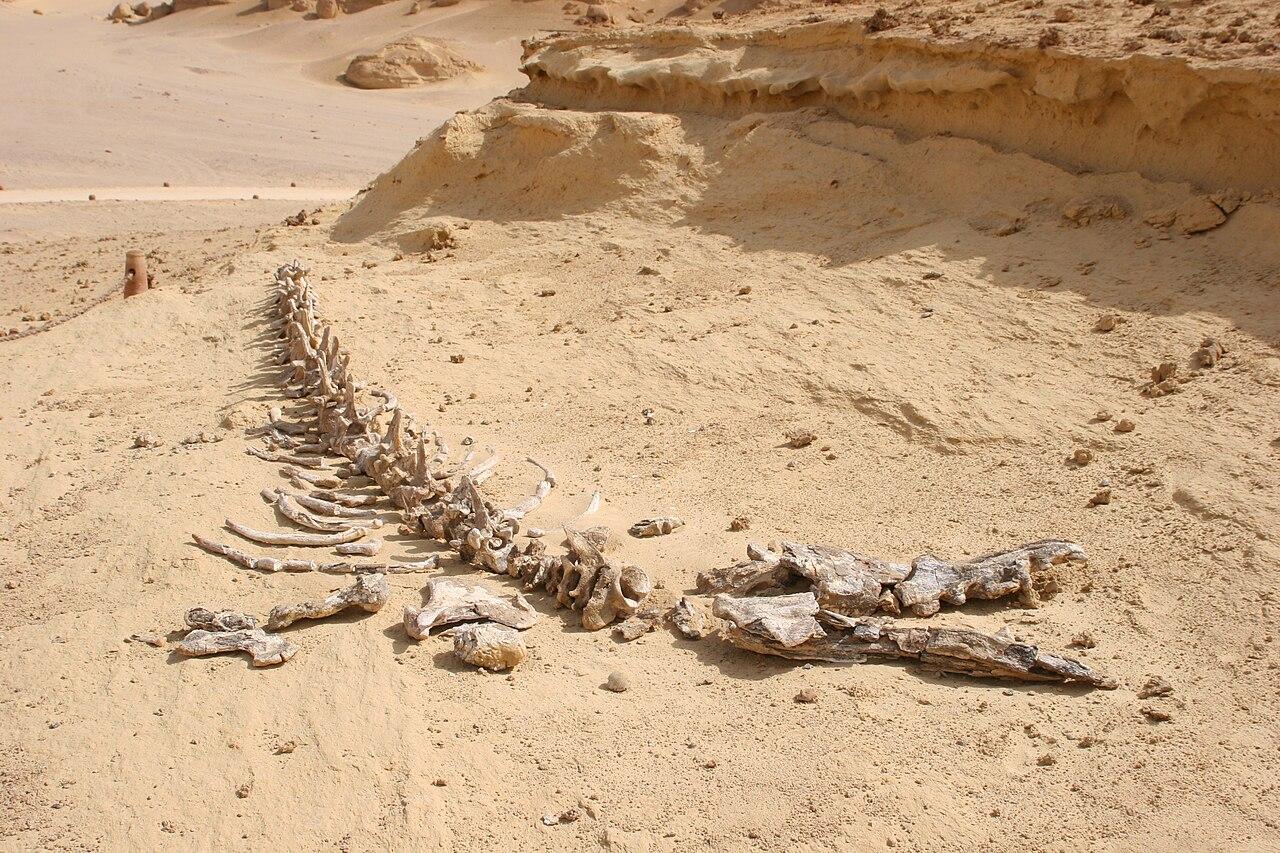
The walking trail loops past more than ten articulated archaeocete whale skeletons left exposed where they were excavated, each with a multilingual interpretive panel. Most of the skeletons are Basilosaurus isis, a serpent-bodied predator 15 to 20 metres long. It had a slender skull and a long jaw lined with sharp triangular teeth. Its stretched-out vertebral column gave it a snake-like undulating motion through the water.
Crucially, Basilosaurus still preserved tiny hind legs about 50 centimetres long, complete with knee, ankle, and even small toes. These vestigial limbs are far too small to have supported the animal's weight on land. They are diagnostic evidence of its terrestrial ancestry, and one of the most often-cited transitional features in vertebrate evolution.
The smaller, more dolphin-like Dorudon atrox, about 5 metres long, is the other dominant whale at Wadi Al-Hitan. Bite marks on Dorudon skulls identify it as the prey species that Basilosaurus hunted.
The on-site Fossils and Climate Change Museum opened in 2016. Its centrepiece is a fully articulated Basilosaurus isis skeleton suspended above the floor. Around it sit skulls, partial skeletons, vertebrae, and pelvic girdles that show the foot-and-leg-bearing condition.
Supporting fauna across the wadi system begins with early sirenians, the sea cows Eotheroides and Protosiren. They document the parallel move of another mammal lineage from land to sea.
The list continues with the giant marine catfish Pseudoeutrichomycterus, several sea turtle genera, and the large mackerel shark Otodus auriculatus (a direct ancestor of Otodus megalodon). Sawfish (Pristis relatives) and crocodilians (Tomistoma) occur too. The small early elephant relative Moeritherium comes from terrestrial intervals nearby in the Faiyum.
Abundant fossilised mangrove root casts (Rhizophora) confirm the setting: a coastal mangrove-fringed estuary opening to the open Tethys.
Trace fossils round out the record: bite marks on bones, gut contents (a Dorudon preserved inside a Basilosaurus skeleton confirms the predator-prey relationship), and burrowing-shrimp trace fossils through the soft Eocene mud.
"Scattered across the attractive landscape of Wadi Al-Hitan is the world's largest and best-known fossil collection of the earliest whales." National Geographic, on a record that runs from land animals with legs through to fully ocean-going whales
 Photo: Tom Horton, CC BY-SA 2.0, via Wikimedia Commons
Geologic History
During the late Eocene, the area that is now the Faiyum depression sat at the southern margin of the Tethys Sea. This warm equatorial ocean stretched from the modern Atlantic to the Pacific. The shoreline lay along a slowly subsiding passive margin. Shallow shelf waters opened east into deeper Tethys and west onto the broad emerging African craton.
The setting was a warm tropical lagoon-and-estuary system with extensive mangrove fringes. Modern marine mammals such as dugongs and manatees feed in the same kind of environment. The warmer Eocene climate let the Tethys support far more marine mammal species than any modern ocean.
Whales in this interval had not yet completed the move from semi-aquatic to fully marine. The Wadi Al-Hitan assemblage captures one of the best-known moments in mammalian evolution.
The Birket Qarun Formation at the base of the section is a glauconitic marine clay-and-marl unit that grades upward into the more sandy Gehannam Formation. Both units accumulated rapidly on the shallow shelf. Articulated skeletons of large vertebrates are common because carcasses sank into soft, fine-grained, oxygen-poor seafloor mud. Burial came before scavengers could pull them apart.
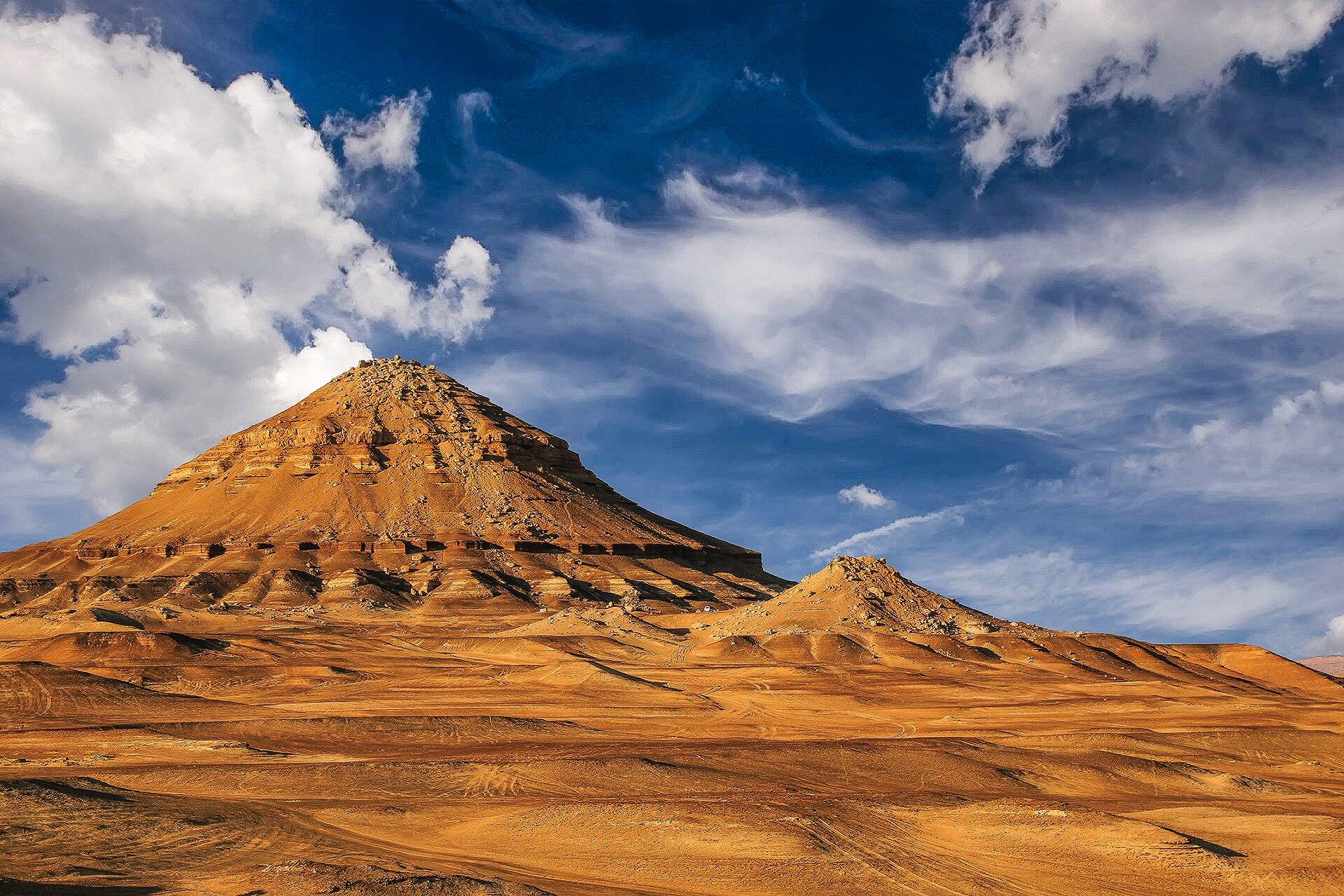
Later uplift, climate change, and persistent northeast trade-wind erosion stripped away tens of metres of Oligocene and younger sediment above. That exhumed the Eocene skeletons at the modern desert surface. The hyperarid climate of the Western Desert, in place since at least the early Holocene, has kept the skeletons in nearly pristine condition. They look much as they did when first uncovered, with little weathering of the bone surfaces.
The British geologist Hugh Beadnell of the Geological Survey of Egypt collected the first whale fossils at the site in 1902 and 1903. His partial Basilosaurus and Dorudon skeletons helped establish the basic anatomy of the early whales. The site received only sporadic attention through the mid-20th century. Systematic modern study began in 1983 when Philip Gingerich of the University of Michigan began annual expeditions in partnership with Egyptian researchers and the Egyptian Geological Museum.
The Michigan team mapped more than 400 skeletons across the wadi system and recovered numerous new species. They used the assemblage to reconstruct the whole sequence of whale evolution. That sequence runs from the slightly older Pakicetus and Ambulocetus of Pakistan and India, through the early protocetids, to the fully aquatic basilosaurids of Egypt.
How Wadi Al-Hitan Came to Be Protected
The Egyptian Environmental Affairs Agency declared Wadi El-Rayan a Protected Area in 1989 and subsequently extended protection to the Wadi Al-Hitan core area. UNESCO inscribed Wadi Al-Hitan as a World Heritage Site in 2005 (Site #1186) under criterion (viii) for outstanding universal value as the world's best-known record of cetacean evolution. The on-site Fossils and Climate Change Museum opened in 2016 with Italian-Egyptian government cooperation. It is both visitor centre and research facility for the Egyptian Geological Museum and the University of Michigan partnership.
 Photo: Hatem Moushir, CC BY-SA 3.0, via Wikimedia Commons
Collecting Rules and Regulations
Is Fossil Collecting Allowed?
No. Removing, hammering, or even touching the in-situ skeletons is prohibited.
Key Points:
- Stay on the marked walking trail at all times
- No fossil collection, no chiselling, no taking rock fragments
- Photography is allowed. Drones are not, without permit
Safety
Wadi Al-Hitan is deep desert, and the whole safety picture follows from that.
The last 35 kilometres of the approach are unpaved desert track with minimal signage. A four-wheel drive is essential after rain and advisable at any time. Self-drive in a standard car is possible in dry weather but is not the sensible choice. Most visitors join a guided day trip or hire a four-wheel drive with a driver in Faiyum. Navigation in this terrain is genuinely difficult, tracks shift with the sand, and a wrong turn puts you a long way from anyone.
Heat sets the season. November through March is the practical window. Outside it, daytime temperatures in the Western Desert are dangerous. There is no shade anywhere along the 2-kilometre trail between the visitor centre and the furthest skeletons. Carry several litres of water per person even for a short walk, and start early.
The trail crosses soft sand and uneven ground. Wear closed shoes with a firm sole rather than sandals. Take a hat and sunglasses, because wind-blown sand is constant and hard on the eyes.
Stay on the marked trail. That is a rule, and it is also the safety advice. The valley is open desert, the skeletons are dispersed, and the interpretive markers are what keep you oriented.
Mobile coverage is unreliable across the protected area. Tell someone your plan, travel with at least one other vehicle if you drive yourself, and carry more fuel than the round trip needs. The visitor centre has shaded seating, toilets, and a small shop, and it is the only such facility for a long way in any direction.
_Panorama.jpg)

