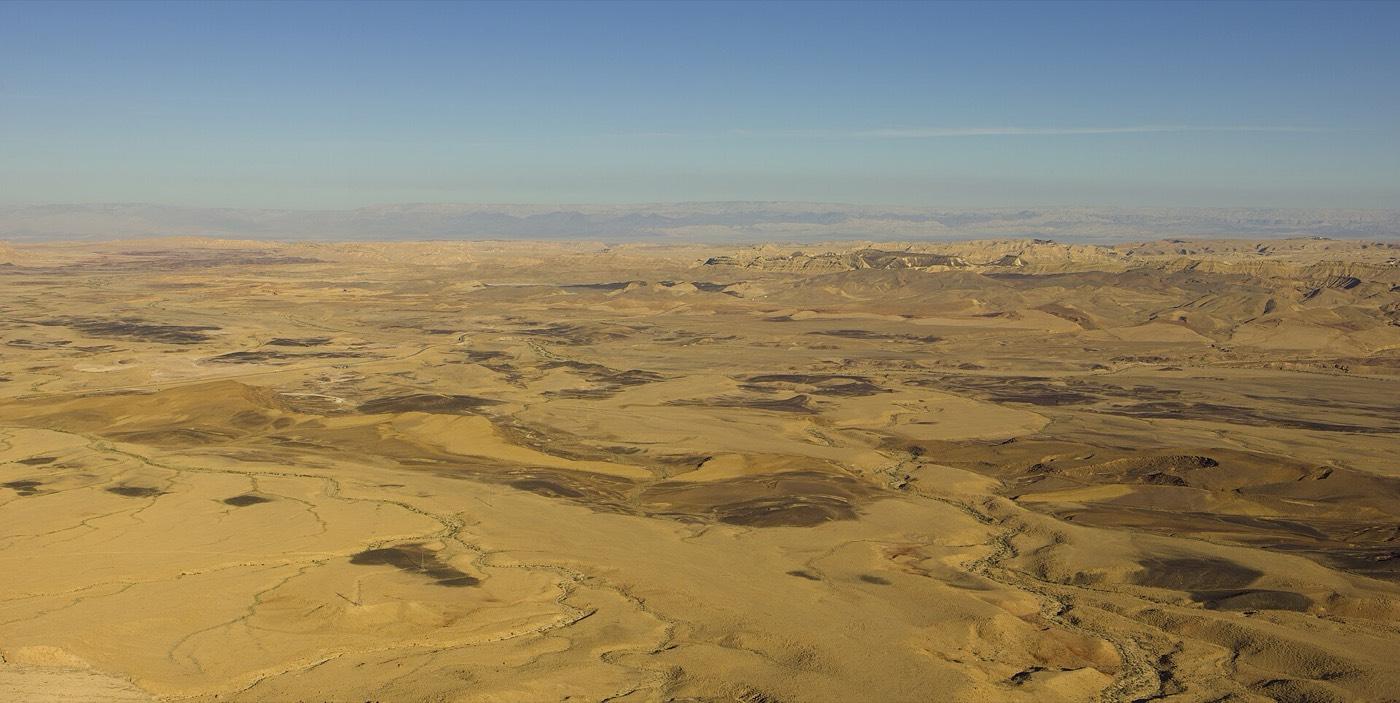
Ammonite Wall, Makhtesh Ramon Fossil Hunting Guide
Image: Godot13 (CC BY-SA 4.0)
A rock face in the Negev covered in Cretaceous ammonites weathered into relief, reached by a marked trail of about 660 metres off Route 40. The fossils are a protected natural phenomenon and collecting them is forbidden.
By Edward Chen · Published 12 September 2026
Introduction
Makhtesh Ramon is a hole in the Negev about 40 kilometres long and 500 metres deep. It is not a crater in the usual sense. A makhtesh is an erosional landform, unique enough to Israel and Sinai that the Hebrew word is used internationally. Water cut through a hard upper layer into softer rock beneath and hollowed it out from the inside. What remains is a closed valley ringed by cliffs.
That process exposes a long sequence of rock, and one bed in it is the reason fossil hunters come. The Ammonite Wall on the southern side carries hundreds of large ammonites weathered into relief on a tilted face.
The wall is a set piece. The shells stand proud of the rock because the surrounding matrix erodes faster. They sit at every angle, cut through at different levels so that some show the outer coil and others the internal chambers.
Collecting is forbidden. This is a site to look at, and the density of what you can see makes that a fair trade.
Location and Directions
The wall is on the southern side of Makhtesh Ramon, reached from Route 40 which runs through the makhtesh floor.
GPS: 30.5758°N, 34.8774°E.
Mitzpe Ramon is the town on the northern rim and the base for any visit. From there, drive Route 40 down into the makhtesh for roughly 15 kilometres and watch for the signed trail.
From the parking area, follow the red-marked trail for about 700 metres to the wall. The walk is short and the ground is stony desert.
The site is open and this page found no entry charge, but check with the Israel Nature and Parks Authority before you rely on that. The Ramon Nature Reserve around it is managed by the Israel Nature and Parks Authority, and the visitor centre in Mitzpe Ramon is worth a stop first for the geological context.
What Fossils You'll Find
Nothing is collectable. The ammonites are a protected natural phenomenon.
What is there is the wall itself. The ammonites are large, some reaching tens of centimetres. They occur in sufficient numbers that the face reads as a mass rather than as scattered specimens.
Ammonites make good index fossils because they evolved quickly and dispersed widely, so a single species pins down a narrow slice of time. That is what makes a face like this scientifically useful as well as photogenic.
Bring a camera and, if you have one, a polarising filter. The desert light is harsh and contrast on the rock face is the usual difficulty.
 Photo: Godot13, CC BY-SA 4.0, via Wikimedia Commons

Geologic History
The ammonites occur in the Tamar Formation, which is Cenomanian, the first stage of the Late Cretaceous, roughly 100 to 94 million years ago.
Note that popular descriptions of the site frequently give an age of about 70 million years. That figure corresponds to the Maastrichtian and does not match the formation the wall is cut in, so treat it with caution.
The setting was the Tethys shelf. Warm, shallow carbonate seas covered what is now the Negev, and ammonites were abundant in them.
The makhtesh itself is much younger. Regional uplift arched these rocks upward, erosion breached the resistant cap. Drainage then stripped the softer interior out to form the closed valley you drive into.
Mitzpe Ramon sits far from any city, and the makhtesh has almost no light pollution. Visitors who come for the geology often stay for the night sky, and the two combine well.
 Photo: Mboesch, CC BY-SA 4.0, via Wikimedia Commons
Collecting Rules and Regulations
Collecting is prohibited. The ammonites are a protected natural phenomenon and the site lies within the Ramon Nature Reserve.
Do not hammer the face, do not lever out shells and do not take loose fragments from the slope below.
Israeli nature protection law is enforced in the reserve, and the site is well known enough to be watched.
Photograph the wall and leave it as you found it.
Makhtesh Ramon is the largest of seven such landforms, five in the Negev and two in Sinai, and they occur nowhere else on Earth. The combination required is specific: a hard cap of resistant rock over soft interior beds, gentle arching. A drainage system able to breach the cap and then excavate what lies beneath.
 Photo: Godot13, CC BY-SA 4.0, via Wikimedia Commons
.jpg)
Safety
This is a desert. Summer temperatures in the makhtesh are extreme and there is no shade on the trail. Visit early or late, and carry far more water than you think you need.
Flash floods occur in the Negev after rain, including rain falling far away. Do not enter dry channels when storms are forecast.
The trail is stony and uneven. Wear proper footwear.
The makhtesh floor has limited mobile coverage in places. Tell someone your plan.
Israeli military firing zones exist elsewhere in the Negev. Observe all signage and do not enter closed areas.
The makhtesh floor holds other geological set pieces worth combining with the wall. The Carpentry, a hillside of prismatic columns formed where sandstone was baked by an intrusion. The Ammonite Wall are the two most photographed, and both lie off Route 40 within a short drive of each other.
 Photo: Godot13, CC BY-SA 4.0, via Wikimedia Commons

 Photo: Godot13, CC BY-SA 4.0, via Wikimedia Commons

 Photo: Godot13, CC BY-SA 4.0, via Wikimedia Commons

Sources
https://woostergeologists.scotblogs.wooster.edu/2011/05/28/a-wall-of-cretaceous-ammonites/ https://www.israel-in-photos.com/ammonite-wall.html https://en.wikipedia.org/wiki/Makhtesh_Ramon https://israel.travel/machtesh-ramon/
Nearby sites
 Bahariya Oasis Fossil Safari Fossil Hunting GuideSpinosaurus aegyptiacus, Carcharodontosaurus saharicus
 Hațeg Country Dinosaurs Geopark Fossil Hunting GuideDinosaurs, Dinosaur eggs
 Pietraroja Plattenkalk Geosite Fossil Hunting GuideScipionyx samniticus (theropod), Notagogus parvus (fish)
 Robbedale Gravel Pit Fossil Hunting GuideTheropod dinosaur teeth, Ornithopod dinosaur teeth