Bayanzag (Flaming Cliffs) Fossil Guide
Image: Bernard Gagnon (CC0)
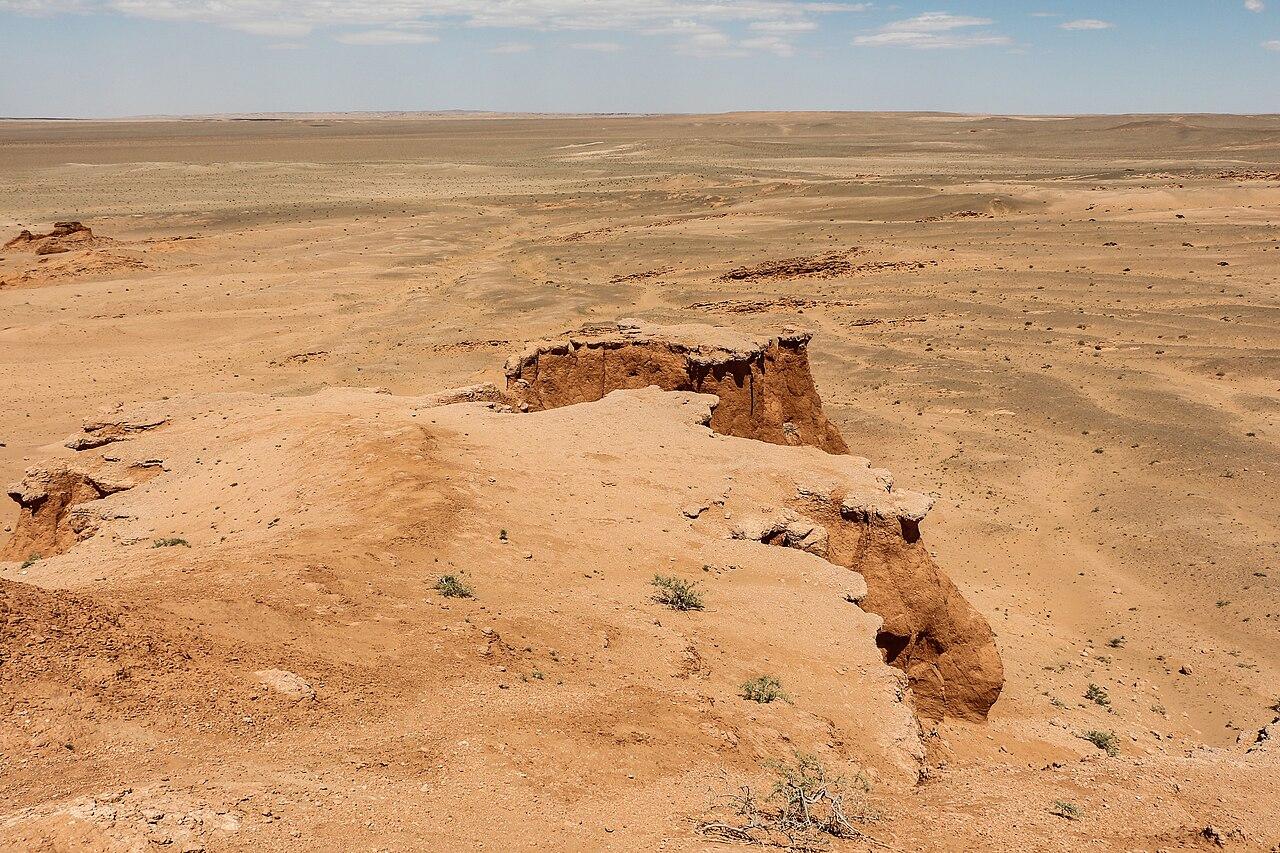
Bayanzag, known internationally as the Flaming Cliffs, is the Mongolian Gobi locality where Roy Chapman Andrews's 1922 American Museum expedition recovered the first dinosaur eggs ever identified, along with hundreds of Protoceratops and Velociraptor skeletons. Visitors can walk freely among the red sandstone cliffs and see weathered bone and eggshell fragments in situ.
By Edward Chen · Updated 26 September 2026
Introduction
Bayanzag, Mongolian for "abundant in saxaul shrubs", is a striking band of orange-red sandstone cliffs about 100 km northwest of the South Gobi aimag capital of Dalanzadgad. The American paleontologist Roy Chapman Andrews of the American Museum of Natural History gave them the nickname "Flaming Cliffs" during his Central Asiatic Expeditions of 1922–1925. It was here in 1923 that George Olsen of Andrews's team collected the first dinosaur eggs ever identified as such. Researchers originally attributed them to Protoceratops and later reattributed them to Oviraptor.
The cliffs continue to produce internationally studied Late Cretaceous fossils today, including beautifully articulated Protoceratops andrewsi and Velociraptor mongoliensis skeletons. The famous "Fighting Dinosaurs" specimen, a Velociraptor locked in combat with a Protoceratops, came from nearby Tugrugeen Shireh. Unlike most marquee fossil sites, Bayanzag is open and informal. Visitors can walk freely along the cliff edge, and fragments of bone and eggshell still weather out onto the slopes.
This guide covers what you will see, how to reach Bayanzag, and the legal and ethical rules around handling fossils in Mongolia.
Location and Directions
Bayanzag is in Bulgan sum (district) of Ömnögovi (South Gobi) Province, Mongolia, roughly 100 km northwest of Dalanzadgad.
Directions to Bayanzag
Almost all visitors reach Bayanzag as part of a multi-day Gobi tour from Ulaanbaatar. The fastest route is to fly Ulaanbaatar–Dalanzadgad (about 1.5 hours) and then drive west by 4×4 (roughly 2–3 hours, much of it on unpaved tracks). Driving the full distance from Ulaanbaatar to Dalanzadgad takes 1–2 days each way.
Most tours stay in nearby ger camps a few kilometres from the cliffs (Three Camel Lodge, Gobi Erdene, and similar). Independent visitors should hire an experienced Mongolian driver and guide. Navigation in the Gobi is by GPS and local knowledge, road signs are minimal, and breakdowns or sandstorms can be serious. Spring (April–June) and autumn (September–October) are the most pleasant seasons. Summer is hot and dusty, and winter is brutally cold.
There is no entry fee or fenced boundary at Bayanzag. Visitors simply walk in. Sunset views from the cliff edge, looking out over the descending desert toward the saxaul forest, are the iconic Bayanzag experience.
Most visitors reach Bayanzag on an organised Gobi circuit rather than independently. A six-day Gobi tour from Ulaanbaatar includes the Flaming Cliffs.
Affiliate link. We earn a commission at no extra cost to you.
 Photo: Richard Mortel, CC BY 2.0, via Wikimedia Commons
What Fossils You'll See
The Djadochta Formation at Bayanzag preserves a Late Cretaceous (Campanian, roughly 75 to 71 million years ago) arid dune-and-interdune environment, with frequent sandstorm deaths and dune collapses producing fully articulated three-dimensional skeletons. Unlike the more common flattened compressions of lacustrine deposits, the Djadochta fossils sit in sandstone as articulated three-dimensional skeletons. That preservation mode has produced some of the best-preserved dinosaur specimens in the world.
The cliffs and adjacent slopes routinely yield surface scatter of bone fragments and dinosaur eggshell pieces. A guide will show you weathered Protoceratops limb bones and fragments of the curved white eggshell Elongatoolithus (the egg type now attributed to oviraptorids). Occasional dinosaur teeth remain in place in the eroding sandstone.
By far the most abundant dinosaur at Bayanzag is the small ceratopsian Protoceratops andrewsi. It is a 1.8-metre-long sheep-sized herbivore with a parrot-like beak and a small bony neck frill. Expeditions have recovered Protoceratops skulls and skeletons by the hundreds across the Djadochta outcrop belt. Researchers interpret the species as the dominant herbivore of the Djadochta ecosystem.
The famous small predator Velociraptor mongoliensis is the second-most-common dinosaur at the site. It is a 2-metre-long feathered dromaeosaur whose Hollywood depiction in Jurassic Park made the species globally famous (though the film version is far larger than the real animal). The Tugrugeen Shireh locality immediately north of Bayanzag produced the iconic 1971 "Fighting Dinosaurs" specimen. It preserves a Velociraptor and a Protoceratops in combat at the moment a collapsing dune buried them alive. The specimen is now displayed at the Mongolian Central Museum of Mongolian Dinosaurs in Ulaanbaatar.
Workers described the oviraptorid Oviraptor philoceratops in 1924 from a skeleton found brooding on a nest of eggs at Bayanzag. For decades they misinterpreted it as an "egg thief" caught in the act. Then similar nests with embryos inside, found in the 1990s, showed the eggs were the oviraptor's own and the adults brooded their young. Other dinosaurs from the Djadochta and adjacent Ukhaa Tolgod localities include the alvarezsaur Mononykus olecranus (with strange single-clawed forelimbs) and the ankylosaur Pinacosaurus grangeri. The list also includes the troodontid Saurornithoides mongoliensis, the small ornithischian Avimimus, and the parrot-faced Psittacosaurus.
Non-dinosaur fossils matter just as much. Small multituberculate mammals (Catopsbaatar, Kryptobaatar) and eutherian mammals (Zalambdalestes lechei, Kennalestes gobiensis), both critical for understanding Late Cretaceous mammal evolution, have been recovered as articulated skulls and partial skeletons. The carnivorous squamate lizard Estesia mongoliensis and several smaller lizards are present. Excavations have recovered embryos in eggs from in-situ nests, including embryos of Oviraptor, troodontids, and Protoceratops. They provide distinctive developmental data on dinosaurs at the point when they hatch.
"In 1922, American paleontologist Roy Chapman Andrews led an expedition here and discovered the first dinosaur eggs ever found in the world, along with hundreds of skeletons of species such as Protoceratops and Velociraptor." Three Camel Lodge
 Photo: James St. John, CC BY 2.0, via Wikimedia Commons
Geologic History
During the Late Cretaceous (Campanian Stage, about 75 to 71 million years ago), what is now the Gobi Desert was a hot, arid inland basin between rising mountain ranges. The Pacific subduction-driven Sino-Korean Block lay to the southeast, and the rising Altai-Sayan and Khangai mountain belts lay to the north and west. The intracontinental position kept the basin far from maritime moisture sources. Prevailing atmospheric circulation produced an arid to hyperarid climate analogous to the modern Gobi or Sahara. Extensive dune fields with interdune ponds and ephemeral streams dominated the landscape. Small isolated water bodies supported limited vegetation and the dinosaurian and mammalian fauna we know from the Djadochta Formation.
The Djadochta Formation itself is divided into the lower Bayn Dzak Member (the principal fossil-bearing unit at Bayanzag) and the upper Tugrugeen Member. Both consist of red-orange, iron-rich, fine to medium aeolian sandstones with thin interbedded silty palaeosols representing brief wet intervals between dune-forming episodes.
Heavy local rainstorms and wind erosion at the dune base triggered sudden sand dune collapses. Those collapses and large coordinated sandstorms buried entire animals alive. They were preserved as articulated skeletons in the dune-collapse and dune-toe positions. The classic "Fighting Dinosaurs" specimen captures a Velociraptor and Protoceratops in combat at the moment a collapsing dune entombed them. The Velociraptor's sickle claw is still embedded in the Protoceratops's throat.
Oxidised hematite from intense Cretaceous chemical weathering colours the red-orange iron-rich sandstones. They give the cliffs their characteristic glow at sunrise and sunset, and they inspired Roy Chapman Andrews's "Flaming Cliffs" nickname. Continued aridity through the Cenozoic protected the deposits from chemical weathering and burial, which would otherwise have destroyed them. Modern wind erosion of the cliff faces continuously exhumes fresh fossils. The cliffs retreat by an estimated 1 to 3 centimetres per year, exposing new bone surfaces every season.
The Roy Chapman Andrews–led American Museum of Natural History Central Asiatic Expeditions of 1922 to 1925 first discovered the Bayanzag dinosaur fauna. They produced the first dinosaur eggs ever identified, the type specimens of Velociraptor and Oviraptor, and most of the original Protoceratops skeletons. Polish-Mongolian expeditions of the 1960s and 1970s (Zofia Kielan-Jaworowska and Rinchen Barsbold) reopened the area to modern scientific work. The more recent American Museum-Mongolian Academy of Sciences expeditions of the 1990s and 2000s (Mark Norell, Michael Novacek, and Rinchen Barsbold) continued it. Together they dramatically expanded the known faunal list, especially with finds at the adjacent Ukhaa Tolgod and Tugrugeen Shireh localities.
How Bayanzag Came to Be Protected
Bayanzag is part of the Cretaceous Dinosaur Fossil Sites in the Mongolian Gobi UNESCO World Heritage Tentative List (added in 2014). It is also a designated protected area within the Mongolian state under the Mongolian National Heritage law. All vertebrate fossils in Mongolia are state property. Export of fossils is illegal and has been aggressively enforced since the 2010s, with several high-profile international prosecutions of trafficked Mongolian specimens (most famously the 2012 repatriation of a Tarbosaurus bataar skeleton from a New York auction). Visitors should under no circumstances buy fossils from local vendors, they are illegally collected and cannot be legally exported.
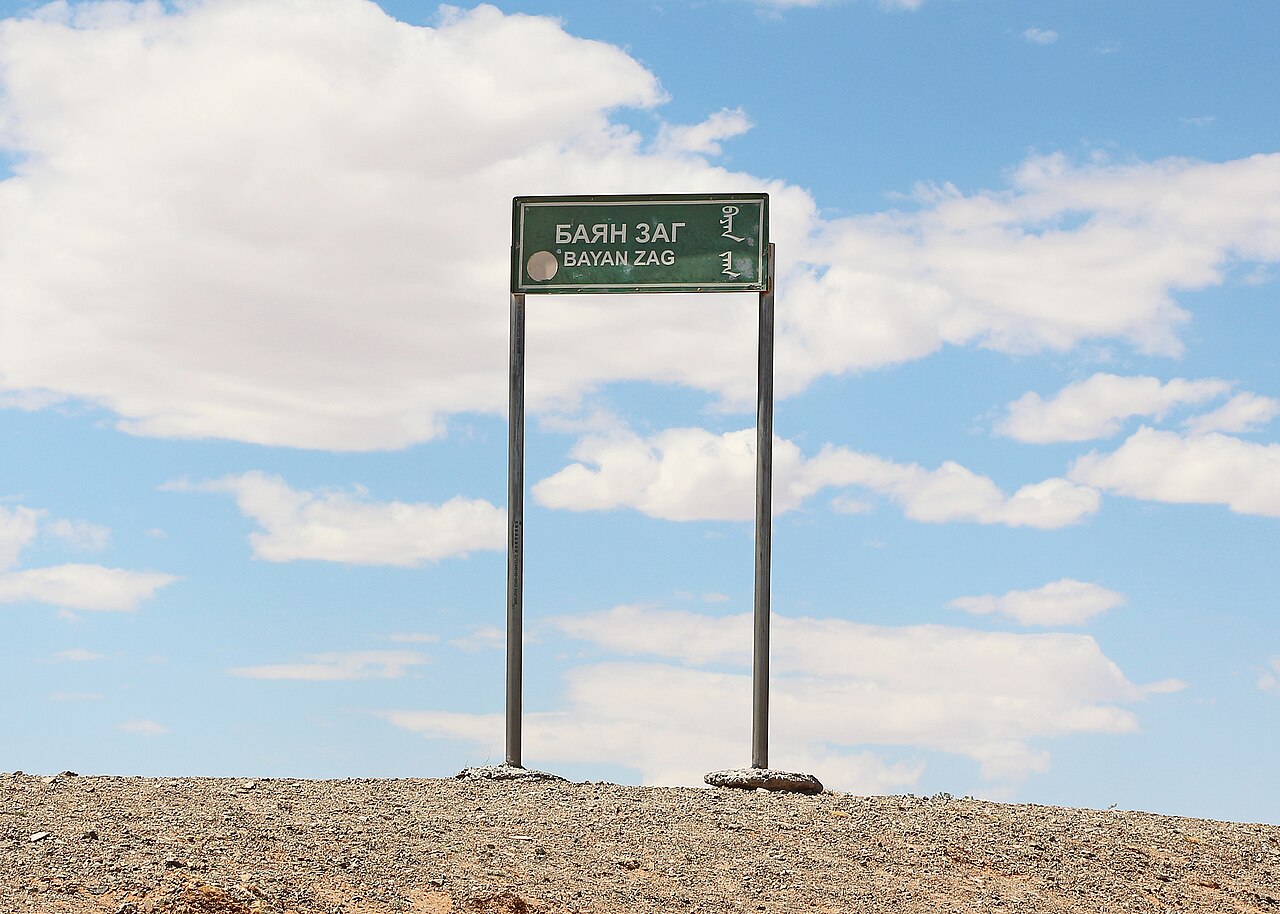 Photo: Bernard Gagnon, CC0, via Wikimedia Commons
Collecting Rules and Regulations
Is Fossil Collecting Allowed?
No. All vertebrate fossils in Mongolia are state property. Export of fossils is illegal and aggressively enforced, with several high-profile international prosecutions of trafficked Mongolian specimens.
Key Points:
- Free walking access, with no entry fee and no fenced boundary.
- No collection, hammering, or removal of any fossil or rock, including small bone or eggshell fragments.
- Stay back from the cliff edge, where the soft sandstone undercuts and collapses.
- Hire an experienced driver and guide for any Gobi travel.
- Carry plenty of water, sunscreen, and dust protection.
- Do not buy fossils from local vendors, which are illegally collected and cannot be legally exported.
Safety
Bayanzag is the most logistically demanding site covered here, and the single most important point is that you should not attempt it independently.
Go with an organised tour or a local driver and guide. The cliffs are around 100 km from Dalanzadgad across unmarked desert tracks with no signage, no fuel, no water, and no reliable mobile coverage. Navigation is by GPS and local knowledge, tracks shift and braid, and a vehicle failure out here is a survival situation rather than an inconvenience. Effectively all visitors arrive as part of a guided trip, and that is the right way to do it.
The Gobi's temperature range is extreme. Summer daytime heat is severe with no shade whatsoever, while nights are cold and the shoulder seasons can bring sub-freezing temperatures and sudden weather. Carry far more water than you expect to drink, cover up rather than stripping down, and bring genuinely warm layers regardless of the daytime forecast.
Sandstorms and wind arrive with little warning, cut visibility, and make the cliff edges hazardous. Get to the vehicle if one builds.
The cliffs themselves are soft, friable sandstone. Do not climb them or stand on the lip, since the edges collapse readily, and do not walk directly beneath the faces. Keep well back from the top.
Medical help is a very long way off. There is no facility at the site, the nearest town is hours away over rough ground, and evacuation from the South Gobi is slow. Travel with a group, carry a basic first aid kit, and make sure somebody outside your party knows your itinerary.
_Mongolia.jpg)

