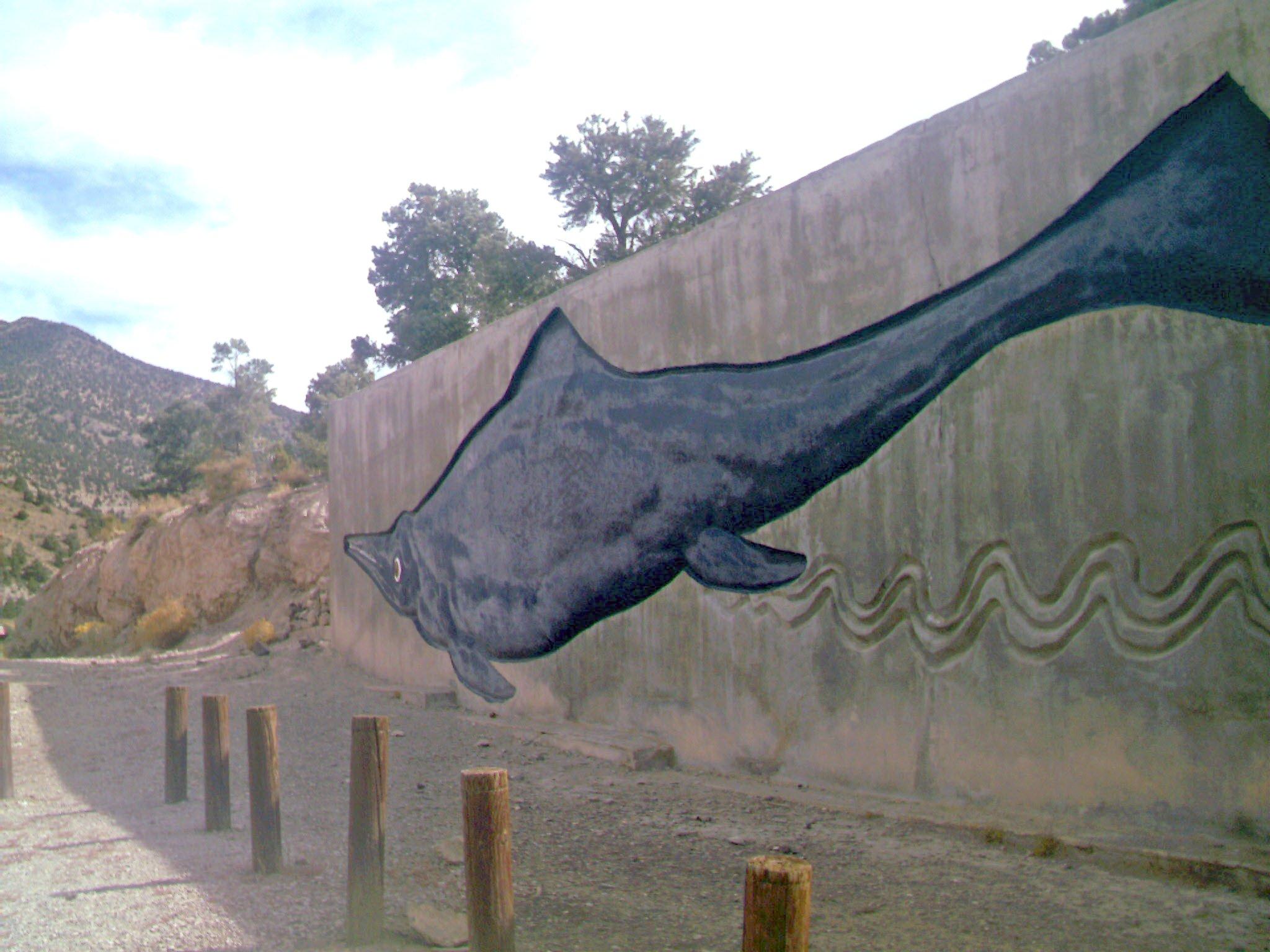
Berlin-Ichthyosaur State Park Fossil Hunting Guide
Image: Alisha Vargas (CC BY 2.0)
Berlin-Ichthyosaur State Park protects more than 1,100 acres in central Nevada that contain the largest known concentration of Shonisaurus popularis, the state fossil. The bone bed lies in the Luning Formation and is viewable inside the Fossil Shelter during ranger-led tours.
By Edward Chen · Updated 2 August 2026
Introduction
Berlin-Ichthyosaur State Park protects more than 1,100 acres on the western slope of the Shoshone Mountains in Nye County, Nevada, at about 7,000 feet elevation. The park combines two protected features: the ghost town of Berlin, a turn-of-the-twentieth-century gold and silver camp with its mill and miners' cabins still standing, and the Ichthyosaur Quarry, which contains the largest known concentration of Shonisaurus popularis skeletons in the world. Shonisaurus was a large ichthyosaur that reached lengths around 15 metres and lived in the open ocean that covered central Nevada during the late Triassic. At the bone bed, the remains of at least 37 individuals lie in hard limestone of the Luning Formation, exposed on a single bedding surface inside the Fossil Shelter. The park was established in 1957 and is administered by Nevada State Parks. Collecting is prohibited inside the park. Visitors view the bone bed during ranger-led tours that run on a scheduled basis through the warm season. This guide covers how to reach the park, what the tours show, the Triassic geology that produced the bed, and the access rules.
Location and Directions
The park sits in remote central Nevada, far from any commercial airport. The nearest fuel stops are at Gabbs, about 23 miles to the west, and at Austin, about 70 miles to the northeast on US-50. From US-50, turn south on State Route 844 at Berlin Junction and drive 24 miles on a paved-then-gravel road to the park entrance.
The mailing address is HC 61 Box 61200, Austin, Nevada 89310. GPS for the Fossil Shelter is 38.8717 degrees north, 117.6044 degrees west. Parking is gravel and free.
The park has two main facilities. The Diana Mine and Berlin townsite occupy the lower elevations near the campground. The Fossil Shelter sits about a mile north of the townsite at the end of a short gravel road. A separate trail loops between the two for visitors who want to see both during one stay.
The park is open year round. The Fossil Shelter and ranger tours run from late March through early November. The townsite, campground, and self-guided trails remain accessible in winter. The campground holds 14 sites on a first-come, first-served basis.
The standard day-use entry fee is 5 US dollars per vehicle for Nevada-registered vehicles and 10 US dollars for out-of-state vehicles. Camping costs 15 to 20 US dollars per vehicle per night depending on registration. The Fossil Shelter tour costs 5 US dollars per adult. Children 12 and under are free.
 Photo: Famartin, CC BY-SA 4.0, via Wikimedia Commons
What Fossils You'll Find
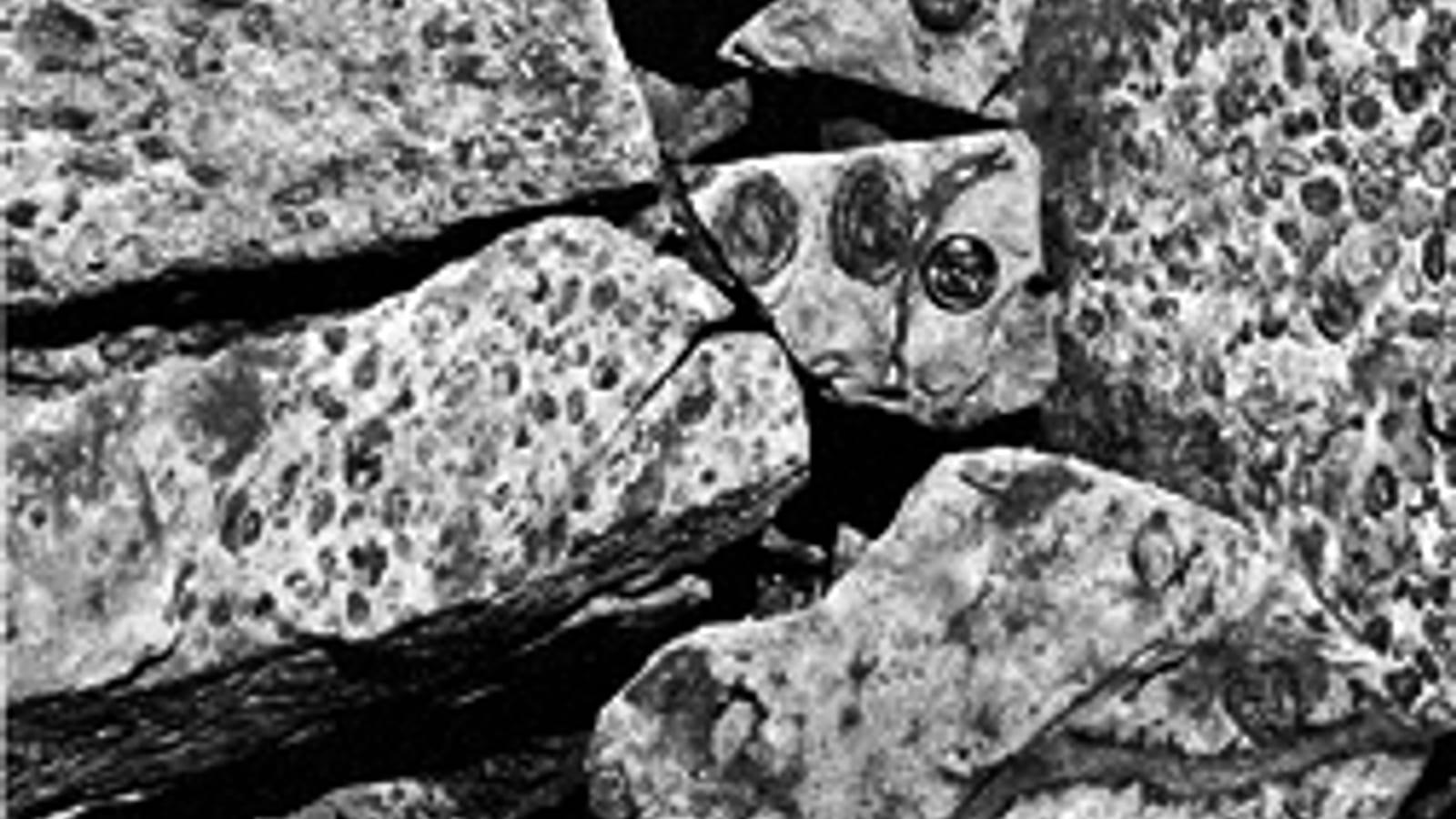
You will not collect at Berlin-Ichthyosaur. What you can do is walk into the Fossil Shelter on a guided tour and see the in-place skeletons of giant ichthyosaurs laid out on a single bedding plane.
- Shonisaurus popularis. The marine reptile that dominates the bone bed and that Nevada designated as its state fossil in 1977. Adult individuals reached around 15 metres in length, comparable in size to a modern sperm whale. At least 37 partial skeletons have been mapped on the quarry surface, mostly disarticulated but with several articulated vertebral columns and rib clusters preserved.
- Other marine fauna. The same Luning Formation layers around the bone bed contain ammonites of the family Tropitidae, halobiid bivalves, and rare belemnoid rostra. These are visible in float blocks along the access road and in the in-place exposures around the shelter.
- Trace fossils. Burrow networks in the limestone above the bone bed record the bottom-dwelling community that lived in the basin between the ichthyosaur stranding events.
The visitor centre at the Fossil Shelter holds prepared display blocks, scale outlines of Shonisaurus, and explanatory panels on the late Triassic ecology. The 2011 Geological Society of America abstract by McMenamin and McMenamin is the most-cited recent reinterpretation of the bone bed.
 Photo: Famartin, CC BY-SA 4.0, via Wikimedia Commons
Geologic History
The bone bed lies in the lower part of the Luning Formation, a sequence of dark grey limestone and shale that accumulated in a shallow to moderately deep marine basin on the western edge of Pangaea during the late Triassic. The bed is dated to the latest Carnian or earliest Norian stage at roughly 217 million years ago, based on conodont biostratigraphy and on the ammonite zonation in the surrounding section.
Central Nevada in the late Triassic lay west of the supercontinent shoreline, in a region of carbonate ramps and offshore basins facing the proto-Pacific. Shonisaurus was a top predator in this open-water setting, feeding on cephalopods and fish. The cause of the mass accumulation at the bone bed has been debated for decades. Early interpretations favoured stranding on a shallow shelf at low tide. A 2011 reinterpretation by Mark and Dianna McMenamin proposed deliberate arrangement of vertebrae as a giant cephalopod midden. Most recent published work treats the bed as a natural mass-mortality event in a poorly oxygenated basin, with later compaction and reworking explaining the arrangement of bones.
After the Triassic, central Nevada was uplifted and deformed during Mesozoic and Cenozoic Cordilleran tectonics. The Luning Formation now dips moderately to the southeast across the Shoshone Mountains, and the bone bed surface exposes a single slab of fossiliferous limestone that local miners first noticed in 1928.
How Berlin-Ichthyosaur Became a Fossil Site
Mining geologists working the Berlin silver district noticed large bones eroding out of limestone above the townsite in 1928. The first detailed description was published by Siemon Muller of Stanford in the 1930s. Major excavation began in 1954 under Charles Camp of the University of California Museum of Paleontology, who recovered partial skeletons that are now held in the UCMP collection at Berkeley. Camp's work continued into the 1960s and produced the holotype description of Shonisaurus popularis in 1976.
Nevada State Parks established the protective unit in 1957 around the Camp quarry and the adjoining Berlin townsite. The current Fossil Shelter, an A-frame metal building, was constructed over the quarry in 1965 to protect the in-place skeletons from weathering. Active research access continues by permit only.
Collecting Rules and Regulations
Collecting is prohibited. Berlin-Ichthyosaur State Park is owned by the State of Nevada and managed by Nevada State Parks. Removing fossil, mineral, or cultural material from the park is prohibited under Nevada Administrative Code 407.
Practical rules:
- The Fossil Shelter may only be entered on a scheduled ranger-led tour. Touching the bone bed surface is not permitted.
- Photography for personal use is allowed during tours.
- A day-use vehicle fee or annual Nevada State Parks pass is required for entry.
- Pets must be leashed and are not allowed inside the Fossil Shelter.
- Drones are not permitted in the park.
- Permits for research collection are issued only to qualified scientists working with an institutional affiliation.
Safety
The park sits at 7,000 feet elevation. Visitors arriving from sea level may feel mild altitude effects on the short walks between the campground and the Fossil Shelter.
Summer temperatures regularly exceed 90 degrees Fahrenheit, with strong sun at elevation. Carry water and sun cover. Afternoon thunderstorms build over the Shoshone Range in July and August. Lightning on exposed ridges is the most serious local hazard.
Rattlesnakes are present throughout the park. Watch foot placement around the historic townsite, where old foundations and mine timbers provide cover.
The access road on State Route 844 is paved most of the way, with the final 5 miles unpaved. Standard passenger vehicles can reach the park in dry weather. Snow and ice can close the road from November through March.
Sources
- Nevada State Parks, "Berlin Ichthyosaur State Park." https://parks.nv.gov/parks/berlin-ichthyosaur
- Muller, S.W., 1936. "Triassic Ichthyosaurs from California and Nevada." University of California Publications in Geological Sciences, 24.
- Camp, C.L., 1980. "Large Ichthyosaurs from the Upper Triassic of Nevada." Palaeontographica Abteilung A.
- McMenamin, M.A.S., and McMenamin, D.L.S., 2011. "Triassic Kraken: The Berlin Ichthyosaur Death Assemblage Interpreted as a Giant Cephalopod Midden." GSA Annual Meeting, Minneapolis. https://gsa.confex.com/gsa/2011AM/webprogram/Paper197227.html
- Berlin Ichthyosaur State Park interpretive panels, on-site, accessed June 2026.