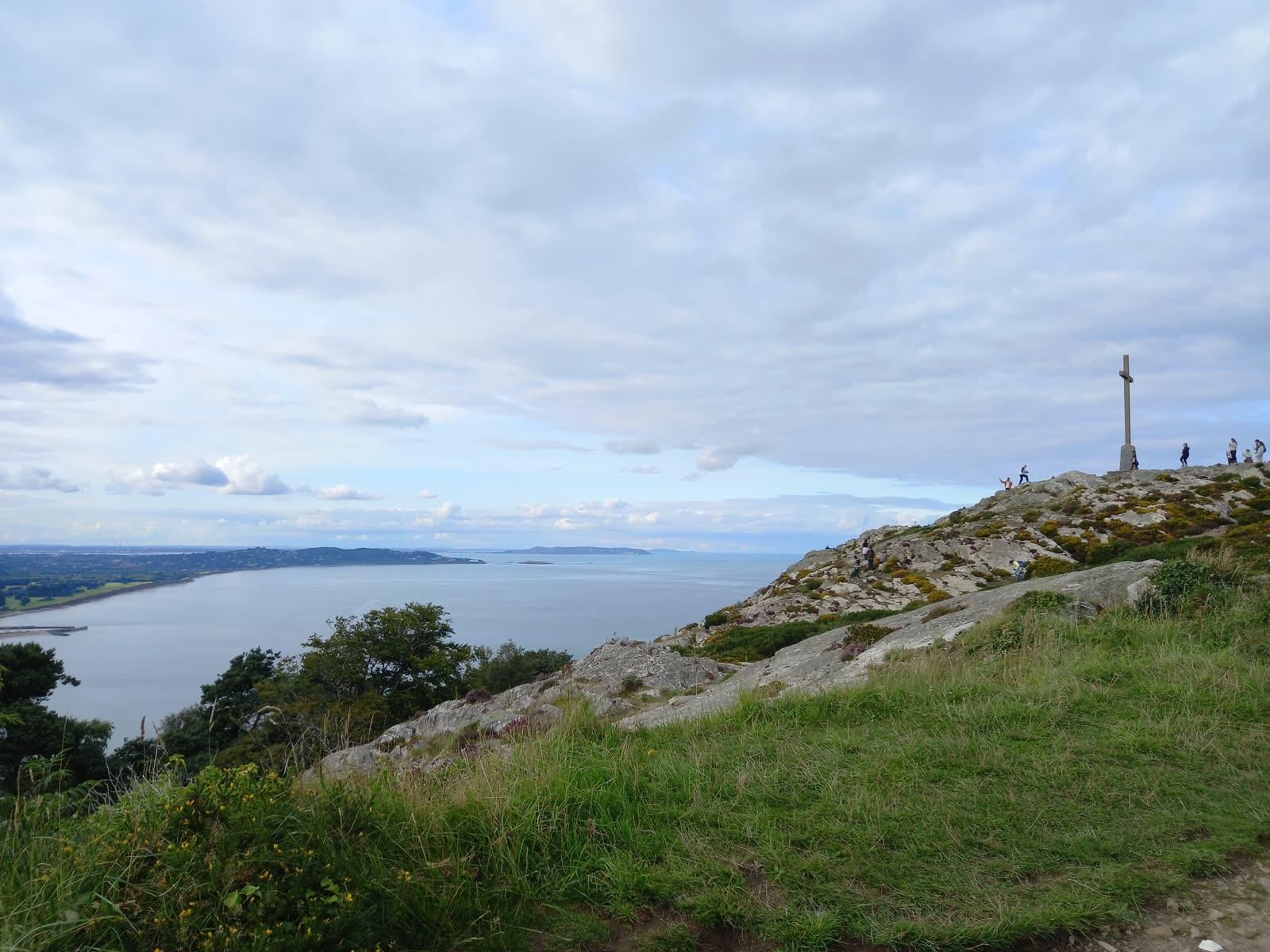
Bray Head Fossil Hunting Guide
Image: Barrowbob (CC BY-SA 4.0)
A Cambrian headland south of Bray in County Wicklow, the type locality for the trace fossil Oldhamia. The fossils are rare and the cliff path is closed, so this is a place to see the rock and read the story.
By Edward Chen · Published 1 October 2026
 Photo: Karie Kuiper, CC BY-SA 4.0, via Wikimedia Commons

Introduction
Bray Head is a headland of Cambrian rock on the coast at Bray, County Wicklow. It is a County Geological Site and the type locality for several trace fossils, including Oldhamia.
The Geological Survey Ireland files it under the Irish Geological Heritage theme of Precambrian to Devonian palaeontology. It recommends the site as a Geological Natural Heritage Area. The Survey calls the Irish Cambrian fossil record very sparse.
Be clear about what you will see. The Survey states that it is very difficult to find any fossils at Bray Head today. Most museum specimens probably came from fresh rock in the railway cuttings, which belong to a live railway.
This page is for people who want to see Cambrian rock and learn the story. It is not a place to hunt for specimens.
The Bray to Greystones cliff walk closed in early 2021 and stays closed. The Bray Head Loop is open, and it climbs to the 241 metre summit.
Location and Directions
Bray Head rises directly south of Bray town. The summit carries a stone cross put up in 1950. It lies at about 53.1905°N, 6.0842°W.
The open route is the Bray Head Loop. It is 5.5 kilometres long, takes about an hour and a half, and climbs about 120 metres. Red arrows mark it, and Wicklow Uplands Council describes it as moderate.
Start on Vevay Road beside the Wilton Hotel roundabout. The bus stop is stop 4208 at Briar Wood. A second start is Lower Windgates on Ballynamuddagh Road, where roadside parking space is small.
A free car park lies at Raheen Park, near the seafront in Bray. A visitor guide lists it. Check the signs on the day.
The loop passes the 1950 cross and returns beside the public footpath along the R761. Cattle graze on the slopes, so keep dogs on a lead.
Wicklow County Council closed the Bray to Greystones cliff walk after landslides and rockfall. Its update of 2 September 2026 says both sections stay closed. It says the cliff and the route are at risk of failure in a number of places.
The Council has not named a reopening date. An Irish Times report in January 2026 gave a cautious estimate of about 36 months. Do not use the cliff path.
What Fossils You'll Find
You will find very few fossils. The one to know is Oldhamia, a trace fossil of radial ridges that looks like the spokes of a wheel.
Oldhamia radiata has ridges that radiate from a centre. Oldhamia antiqua forms semicircular fans of ridges in a line. University College Cork gives the size as 10 to 15 millimetres across.
The marks are not bones or shells. They are traces. Researchers read them as feeding burrows made by a worm-like animal, and the animal itself is not known.
Oldham first recorded Oldhamia from Bray Head in 1844. Edward Forbes described it in 1848. Ruedemann in 1942 argued that a deposit-feeding animal made the radial pattern.
Seilacher and colleagues in 2005 read Oldhamia as burrows that the animal mined beneath microbial mats. The Survey notes that these traces are now known around the world.
Oldhamia sits in the fine, graded tops of green and purple greywacke beds, and the British Geological Survey calls it rare. Nineteenth century surveyors also named structures here Histioderma hibernicum. Most are now read as small sand volcanoes, and a few perhaps belong to Monocraterion.
Geologic History
 Photo: Gareth James, CC BY-SA 2.0, via Wikimedia Commons

The rocks belong to the Bray Group of the Cambrian. The group is more than 4,500 metres thick. It has two formations. The older Devil's Glen Formation is more than 2,000 metres thick, and the younger Bray Head Formation is more than 2,500 metres thick.
The Bray Head Formation consists of well-laminated green and purple greywacke with turbidite structures. Beds of pale quartz arenite, 10 to 100 metres thick, lie between the greywackes. The Survey calls these beds quartzite. They resist erosion and form the summit ridges.
The rock formed in the marine Leinster Basin. Turbidity currents carried sand and mud to the sea floor in pulses. The marks sit in the thin, graded tops of those pulses.
Acritarchs date the rocks. Vanguestaine and colleagues in 2002 found a Skiagia assemblage that points to the middle or late part of the Early Cambrian. That is Series 2, which spans about 521 to 509 million years ago.
University College Cork gives about 540 million years for Oldhamia. That is the base of the Cambrian. The microfossil dating in the British Geological Survey chapter is narrower, and this page follows it.
Collecting Rules and Regulations
Do not collect at Bray Head. The Geological Survey Ireland recommends against any commercial fossil collecting. It also wants a strict ban on any rock operation that harms the railway cuttings.
Bray Head is a Special Area of Conservation, site code 000714, for sea cliffs and dry heath. The National Parks and Wildlife Service lists rocky sea cliffs of about two kilometres, up to 60 metres high.
This guide found no rule that names hand collecting at Bray Head. Treat the rock as protected anyway. The Survey asks for a report to it or to the National Museum of any path work that opens fresh rock.
Leave all rock in place and take photographs.
Safety
Keep off the cliff path. The Council says the cliff and the route are at risk of failure in a number of places. Landslides and rockfall closed it.
A railway line runs at the foot of the cliffs. The line is live. Do not enter the track or the cuttings.
The summit slopes are steep in places. Wear boots with grip, and expect wet ground after rain.
Cattle graze the loop. Keep dogs on a lead and give the animals space.
Irish Sea weather hits the headland. Carry a windproof layer and check the forecast.
Sources
https://gsi.geodata.gov.ie/downloads/Geoheritage/Reports/WW013_Bray_Head.pdf http://nora.nerc.ac.uk/id/eprint/16113/1/12_Cambrian_of_Ireland.pdf https://www.ucc.ie/en/fossil-heritage/irishfossils/oldhamia/ https://bray.ie/wicklow-county-council-update-bray-to-greystones-cliff-walk-progress-september-2nd-2026/ https://wicklowuplands.ie/?p=6563 https://www.npws.ie/sites/default/files/protected-sites/synopsis/SY000714.pdf https://en.wikipedia.org/wiki/Oldhamia https://www.theirishroadtrip.com/bray-to-greystones-cliff-walk/
Nearby sites
 Streedagh Point, County Sligo Fossil Hunting GuideRugose corals, Brachiopods
 Valentia Island Tetrapod Trackway Fossil Hunting GuideTrace fossils, Tetrapod trackways
 Skryje Trilobite Locality Fossil Hunting GuideTrilobites, Brachiopods
 Cambrian Paradoxides Site North of Alnif Fossil Hunting GuideParadoxides, Cambropallas telesto