Clarkia Fossil Bowl Fossil Hunting Guide
The Clarkia Fossil Bowl is a private pay-to-dig site on State Highway 3 in Shoshone County, Idaho. A clay face cut for a snowmobile track in the early 1970s exposes the Miocene Latah Formation, a 16-million-year-old lake bed that splits open to reveal leaves, seeds, insects and fish. Visitors keep what they find.
By Edward Chen · Published 1 October 2026
Introduction
The Clarkia Fossil Bowl is a private pay-to-dig locality at 52450 State Highway 3, in Shoshone County, northern Idaho. A clay face behind the owner's house exposes the Miocene Latah Formation. Visitors pay a daily fee, split the clay with a thin blade, and take home the leaves, seeds, insects and fish they uncover.
Francis L. Kienbaum cut into the hillside in the early 1970s to build a snowmobile track. Leaves spilled out of the cut. He telephoned the University of Idaho, and Dr Charles J. Smiley identified a fossil lake bottom about 16 million years old. The snowmobile track later became a motocross circuit. The fossil face beside it is one of very few pay-to-dig plant localities in the Pacific Northwest.
What makes the site unlike most plant fossil localities is the preservation. The leaves are compressions with the original organic material intact, and many keep their autumn color for a few minutes after the clay opens. Under a microscope, researchers can see cell structure. The color fades on contact with air, so collectors wrap each piece as soon as they lift it.
Location and Directions
The site is about 30 minutes south of St. Maries on State Highway 3, close to mile marker 52 and a half. The OpenStreetMap address record for 52450 State Highway 3 places the entrance at 46.985 degrees north and 116.274 degrees west, in Shoshone County. The clay face is visible from the property, so most first-time visitors find it without difficulty.
Drive up to the house and ask at the door before you walk to the face. The telephone number is (208) 245-3608. Call before you travel. This guide found no operator-published opening hours or season. The property also hosts motocross race events. Both published visitor accounts give the same advice, which is to telephone first.
Parking is on the property, and visitors drive up to the house. St. Maries is the nearest larger town, about 30 minutes to the north. Clarkia sits at 865 m elevation in the northern Idaho mountains, so allow extra driving time in bad weather.
What Fossils You'll Find
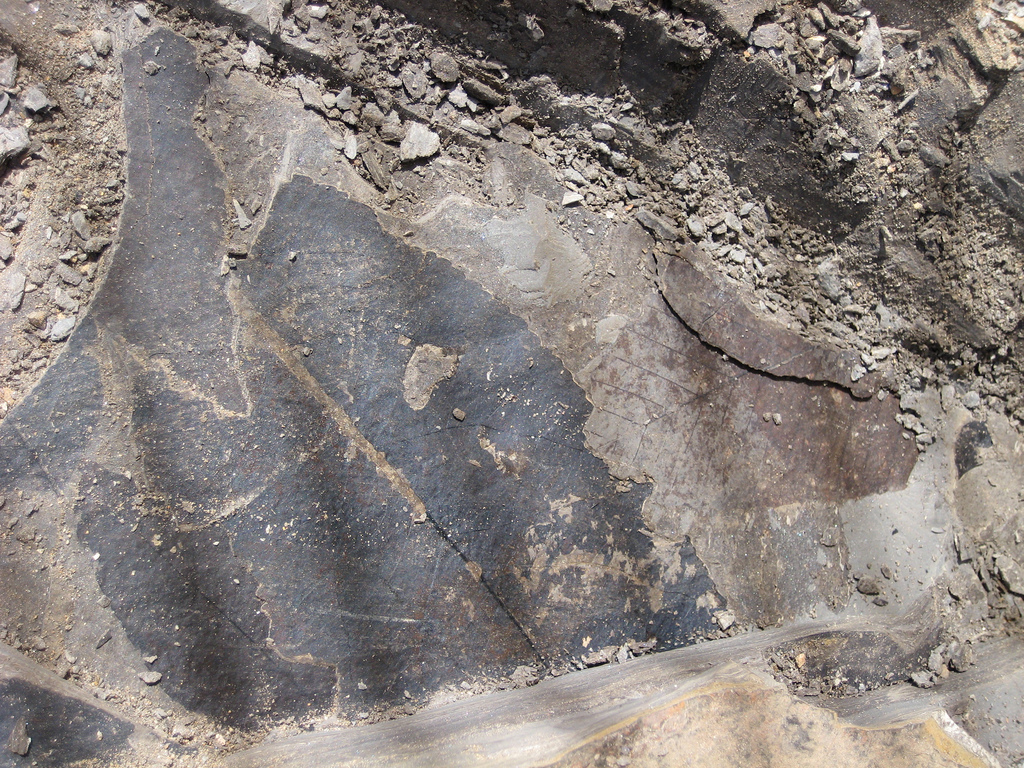 Photo: Bonnie Kirkwood (Flickr: c'estbonne), CC BY-SA 2.0, via Wikimedia Commons

Leaves are the common find and they are abundant. The Clarkia flora includes pines, sequoias and other conifers, magnolias, maples, cypresses, cedars, willows, hazels, laurels, poplars, oaks, beeches, alders and birches. Members of the bean family, vines, ferns, horsetails and mosses also appear. Named taxa from the deposit include the dawn redwood Metasequoia and the greenbrier Smilax magna. Twigs, conifer needles, seeds and flowers come out of the same clay.
Fish are present but much less common. Published work on the deposit records salmonid, cyprinid and centrarchid fish, which is to say trout relatives, minnow relatives and sunfish relatives. Insects also occur in the clay.
Vertebrates on land are rare enough to be news. In 2018 a team described the first tetrapod from the Clarkia lagerstätte, a squirrel specimen catalogued as UWBM 113209 from the Kienbaum family racetrack. The authors could not assign it to any known genus. One published visitor account from July 2021 reports many partial leaves, one complete leaf and no vertebrates in a full day at the face.
Geologic History
In the middle Miocene, Columbia River Basalt Group lava flows spread across what is now eastern Washington and northern Idaho. One flow dammed the valley of the proto-St. Maries River near the present town of St. Maries. The water backed up behind the basalt and formed Lake Clarkia.
Fine clay and silt settled through still water onto an oxygen-poor lake floor. Leaves that fell in did not rot and were not scavenged. That is why the organic matter survives rather than a mineral replacement of it. The sediments belong to the Latah Formation, a Miocene lake-bed unit that crops out across eastern Washington and northwestern Idaho. The Clarkia fossil beds are the best known part of it.
The age is well constrained. The Clarkia beds sit between flows of the Priest Rapids Member of the Wanapum Basalt, which places them at 16.1 to 15.9 million years. An ash layer immediately above the fossil horizon correlates with an ash dated at 15.65 plus or minus 0.07 million years. In mammal terms the deposit falls in the early Barstovian North American Land Mammal Age.
Collecting Rules and Regulations
This is private land and the owner sets the rules. The owner allows collecting, and visitors keep what they find. A July 2021 visitor account records no time limit, no weight limit and no specimen limit. No source addresses commercial-scale collection, so ask at the house if you plan to take a large quantity.
The fee is the one fact this guide cannot settle. An Avista community article from July 2020 gives $10 per person for a full day at the face. A rockhound trip report from July 2021 gives the same $10 figure. Later secondary summaries quote $20 per person per day.
The operator's own website did not resolve in October 2026, and this guide found no current official figure. Confirm the price by telephone before you drive.
Bring your own tools. A thin butter knife or a putty knife splits the clay. Add a hammer to break blocks out of the face. Do not rely on tools from the owner. Bring old newspaper and wrap every specimen at once, because the leaf color and the thin clay layers both degrade in open air.
Safety
The working face is a clay cliff that people excavate by hand, so treat the ground above you as loose. Do not undercut the face, and do not work directly below another person. Wet clay is slick.
The motocross track is live. Races run on the same property, and the fossil face is not separated from the circuit by any barrier described in published accounts. Check with the owner on arrival where you may and may not walk.
The site is exposed with no shade. Carry water and sun protection, as the Avista article advises. Tell somebody your plan before you go. Wear eye protection and gloves when you use the knife and hammer.
Sources
https://depositsmag.com/2019/03/11/the-clarkia-flora-16-million-year-old-plants-offer-a-window-into-the-past/ https://pmc.ncbi.nlm.nih.gov/articles/PMC5995101/ https://en.wikipedia.org/wiki/Latah_Formation https://currentlyrockhounding.com/fossilbowl1/ https://en.wikipedia.org/wiki/Clarkia,_Idaho
Nearby sites
 Stonerose Interpretive Center Fossil Hunting GuideFossil Leaves, Insects
 Ginkgo Petrified Forest State Park Fossil Hunting GuidePetrified wood (Ginkgo), Petrified wood (50+ species)
 Egg Mountain and the Two Medicine Formation Fossil GuideMaiasaura nests, Dinosaur eggs
 Wheeler High School Fossil Beds Fossil Hunting GuideFossil Leaves, Fish