Drumheller Hoodoos Fossil Hunting Guide
Image: Amos Kwok (CC BY-SA 3.0)
The Drumheller Hoodoos, a small group of capped sandstone pillars between Drumheller and East Coulee, Alberta, expose the Late Cretaceous Horseshoe Canyon Formation on top of the marine Bearpaw Formation. The surrounding badlands are productive for hadrosaur and other dinosaur bone fragments, fossil wood, and plants. The hoodoos themselves are a designated provincial historic site, climbing on them is prohibited. Surface fossil collecting on Crown land in Alberta is regulated by the Historic Resources Act.
By Edward Chen · Published 15 June 2026
Introduction
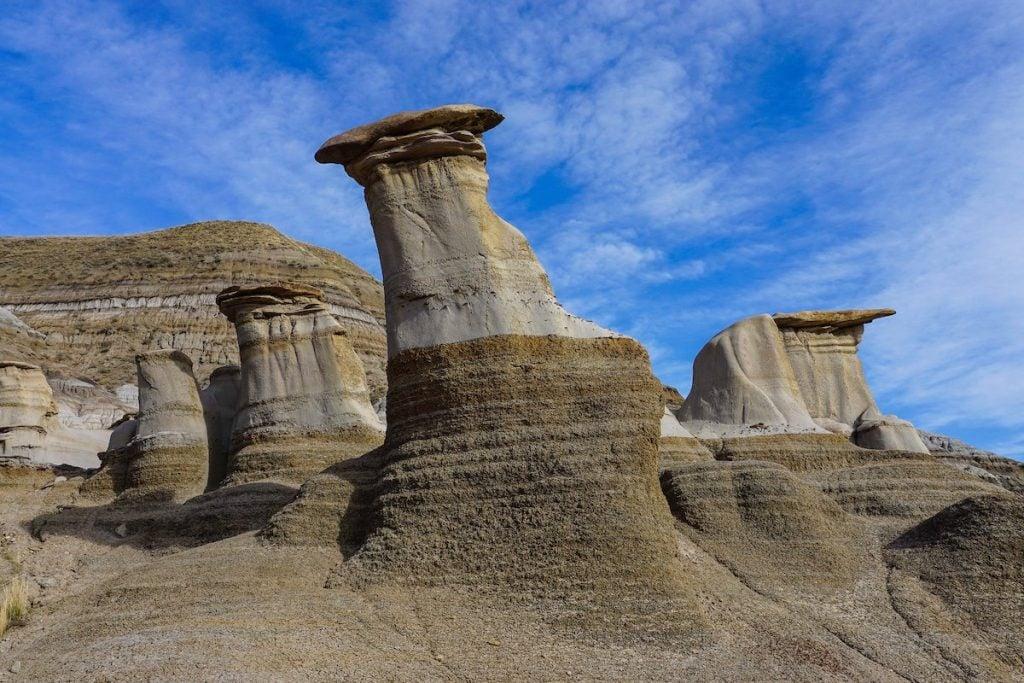
The Drumheller Hoodoos are a tightly clustered group of approximately ten capped sandstone pillars on the south side of Highway 10 about 16 kilometres southeast of Drumheller, Alberta, on the road to East Coulee. They are a designated provincial historic site, protected for their landscape value as one of the most photogenic examples of hoodoo erosion in the Canadian Badlands. Geologically the hoodoos cut through the top of the Late Cretaceous Bearpaw Formation (the dark, slope-forming marine shale at their base) and into the overlying Horseshoe Canyon Formation (the lighter, harder sandstone of the caprock and shafts). The surrounding badlands, both around the hoodoos themselves and along the Red Deer River canyon between Drumheller and East Coulee, are productive for late Cretaceous dinosaur material, though the hoodoos themselves are protected and may not be climbed or collected from.
Fossil collecting in Alberta is regulated by the Historic Resources Act, which requires all vertebrate fossils to remain in Alberta and prohibits commercial sale or export. Surface collection of common invertebrate fossils is permitted on Crown land with reasonable limits. Collection of vertebrate fossils is restricted, and digging or excavation of any fossil requires a permit from the Royal Tyrrell Museum.
This guide covers the hoodoos, the fossils of the surrounding Horseshoe Canyon and Bearpaw exposures, and the regulatory situation.
 Photo: larsjuh, CC BY 2.0, via Wikimedia Commons

Location and Directions
The hoodoos are on Alberta Highway 10 about 16 kilometres east of Drumheller, between Rosedale and East Coulee. The reference coordinates above place a visitor at the main interpretive parking area on the south side of the highway. There is a small paved lot, a short interpretive boardwalk, signage, and a vault toilet. Admission is free. The site is part of Alberta's Dinosaur Trail and is one of the most-visited landmark stops on the Drumheller circuit. From Calgary the drive is about 90 minutes east on Highway 9.
Visit experience
A short boardwalk loops around the cluster of approximately ten hoodoos, with interpretive signage on the geology, on hoodoo formation, and on the cultural significance of the badlands. Climbing the hoodoos is prohibited, both because the formations are fragile and because the rock is slippery and the falls dangerous. The boardwalk is largely accessible. Visitors interested in fossils should plan to combine the hoodoos with stops at the Royal Tyrrell Museum on the west side of Drumheller (the world's flagship dinosaur museum), the Atlas Coal Mine National Historic Site in East Coulee, and Horseshoe Canyon to the west.
What Fossils You'll Find
The hoodoos and their immediate surroundings span the boundary between two Late Cretaceous formations. The base of each hoodoo is the upper part of the Bearpaw Formation, dark grey, sometimes blackish marine shale deposited in the Western Interior Seaway between about 74 and 73 million years ago. Bearpaw fossils where they crop out around Drumheller include marine bivalves (Inoceramus, Baculites), the index ammonite Baculites compressus and several other ammonite genera, sharks teeth, and the occasional marine reptile.
The harder, lighter-coloured pillars and caps of the hoodoos are the lower part of the Horseshoe Canyon Formation, sandstone, mudstone, and coal deposited in coastal-plain and deltaic settings as the seaway retreated to the southeast between about 73 and 67 million years ago. The Horseshoe Canyon Formation is one of the world's great dinosaur-bearing units. Hadrosaur (duck-billed dinosaur) bone is the most commonly found vertebrate material in the badlands of the Drumheller area, both as articulated skeletons and as isolated bones and tooth crowns. Ceratopsian (horned dinosaur) bones and teeth are also common, along with material from theropods including small dromaeosaurs, Albertosaurus (the regional tyrannosaur), and Saurornitholestes. Ankylosaur scutes and tail-club fragments turn up periodically. Crocodile, turtle, and champsosaur material is widespread. Mammal teeth and gar scales appear in some microsites. Coal seams in the formation preserve abundant fossil plants, leaves, wood, and pollen.
The legally important thing to know: the hoodoos themselves are a protected historic site and you may not climb on them or collect from them. The surrounding badlands have various land-status mixes: some are Crown land subject to the Historic Resources Act, some are private, and some are within Dinosaur Provincial Park (a UNESCO World Heritage Site about an hour and a half south where all collecting is prohibited). The Royal Tyrrell Museum's "What to do if you find a fossil" guidance is the operating rule: photograph, document location with GPS, do not dig, and report finds to the museum.
"Fossil collecting is permitted for personal use [in Alberta's badlands generally]; climbing the hoodoos is not permitted since they are rather fragile." Things to Do in Drumheller
 Photo: G Larson en:User:Glenlarson, Public domain, via Wikimedia Commons

Geologic History
During the Late Cretaceous, the modern Alberta region lay on the western shore of the Western Interior Seaway, the inland sea that connected the Arctic Ocean to the Gulf of Mexico. The Bearpaw Formation records a relatively brief return of the open sea about 74 to 73 million years ago, during which dark marine shales were deposited across much of southern Alberta and northern Montana. The Horseshoe Canyon Formation that overlies it records the final regression of the seaway and the establishment of broad coastal-plain swamps, river floodplains, and lagoons on the newly emergent land between about 73 and 67 million years ago. These were the latest Campanian and earliest Maastrichtian landscapes that the famous Alberta dinosaur fauna inhabited.
The modern landscape is glacial in origin. Continental ice sheets covered the Drumheller region in the most recent ice ages and the meltwater of the Red Deer River, swollen by glacial outwash, cut down rapidly through the soft Cretaceous sediments to produce the modern canyon and badlands. The hoodoos themselves are erosional remnants where a harder caprock has protected the softer Bearpaw shale beneath, leaving a tall column standing as the surrounding landscape eroded back.
How the hoodoos became a heritage site
The Drumheller Hoodoos were designated as a provincial historic site in 1980 in recognition of their landscape value and to manage the visitor pressure that was eroding the cluster. The Royal Tyrrell Museum, which opened in 1985 about 30 kilometres west, has anchored the region's identity as one of the world's great dinosaur destinations. Together the hoodoos, the Tyrrell, the Atlas Coal Mine, Horseshoe Canyon, and Dinosaur Provincial Park (south of the Drumheller area) form Alberta's "Dinosaur Trail" tourism corridor.
Collecting Rules & Regulations
Is Fossil Collecting Allowed?
Not at the hoodoos themselves, which are a protected provincial historic site. In the surrounding Alberta badlands generally, surface collection of common invertebrate fossils on Crown land is permitted within reasonable limits. Vertebrate fossils may not be excavated and must be reported.
Key Points:
- Do not climb on the hoodoos. They are fragile and protected.
- Vertebrate fossils anywhere in Alberta are property of the Crown and may not be excavated or removed. Report finds to the Royal Tyrrell Museum.
- Surface collection of common invertebrate fossils (ammonites, Baculites, shells) on Crown land is permitted in reasonable amounts.
- Commercial sale or export of Alberta vertebrate fossils is prohibited.
- Permits for any digging are issued by the Royal Tyrrell Museum.
Safety
The hoodoos are a small, busy roadside site with a boardwalk and steps, and the main risk is what people do to the formations and to themselves by climbing.
Do not climb the hoodoos. They are soft sandstone capped by a harder stone, undercut at the neck, and they are actively eroding. Climbing damages them permanently and risks bringing one down. The site has boardwalks and viewing areas precisely so that people do not need to scramble, and the surrounding slopes are fenced in places for the same reason.
The slopes are loose and steep. Badland surfaces are unconsolidated and the footing gives way, particularly on the climb up beside the formations. Stay on the constructed paths and steps. Bentonite clay in these badlands turns to slick grease when wet, so after rain the informal routes become genuinely hazardous.
Heat and exposure. The coulee has almost no shade and the bare rock radiates heat through the summer, so carry water and use sun protection. There is no water on site.
Rattlesnakes live in the Drumheller badlands and shelter under ledges and in scrub, so watch where you place hands and feet and keep children on the paths. Prickly pear cactus grows across the ground here and the spines go through footwear.
The site is on Highway 10 with a small car park, so take care with traffic when crossing, particularly in summer when it is busy.
Sources
Nearby sites
 Horseshoe Canyon (Drumheller) Fossil Hunting GuideHadrosaur bone, Theropod material
 Dinosaur Provincial Park Fossil Hunting GuideHadrosaurs, Ceratopsians
 Burgess Shale Fossil Hike GuideTrilobites, Anomalocaris
 Tumbler Ridge UNESCO Global Geopark Fossil Hunting GuideTyrannosaurid trackways, Ankylosaur footprints