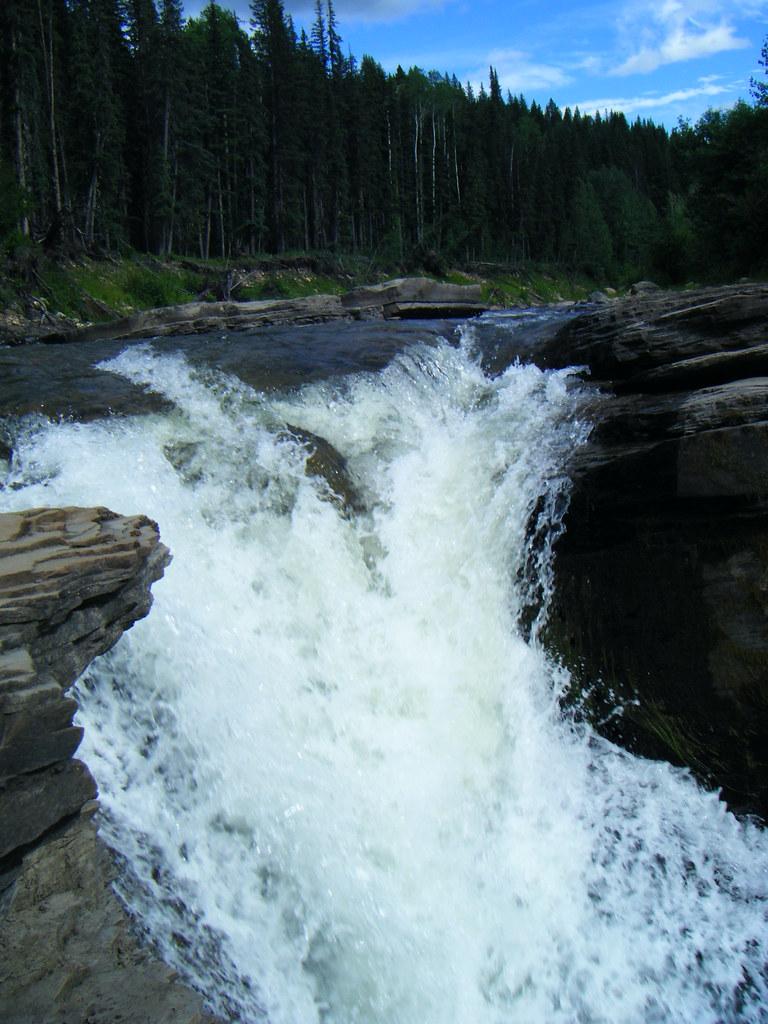
Tumbler Ridge UNESCO Global Geopark Fossil Hunting Guide
Image: D G Brown (CC BY 2.0)
Tumbler Ridge UNESCO Global Geopark in northeastern British Columbia protects Cretaceous dinosaur trackways and bone beds in the Gething, Boulder Creek, and Wapiti formations, including the only known Tyrannosaurid footprints. Trackway tours are run by the Tumbler Ridge Museum.
By Edward Chen · Updated 1 August 2026
Introduction
Tumbler Ridge UNESCO Global Geopark covers about 8,000 square kilometres in the foothills of the Canadian Rocky Mountains in northeastern British Columbia, centred on the small town of Tumbler Ridge. The geopark was designated by UNESCO in 2014, becoming the second UNESCO Global Geopark in North America. The region's Cretaceous rocks preserve a near-continuous record of terrestrial dinosaur activity from the Aptian-Albian Gething Formation up through the Campanian Wapiti Formation, spanning more than 50 million years of foothill stream, swamp, and floodplain deposits. Nine separate non-marine formations contain documented footprints, bone, or plant material, and several creek beds expose long trackway sequences on bedding-plane outcrops. The geopark holds the only known Tyrannosaurid trackway in the world, identified in 2014 on a sandstone bedrock surface in the Wapiti Formation. Most trackway sites can only be visited with the Tumbler Ridge Museum on guided hikes that the museum runs from June through September. Collecting is not permitted inside protected geopark sites. This guide covers how to plan a trip, what the main trackway tours show, the geological story, and the rules that apply.
Location and Directions
Tumbler Ridge sits in the Peace River region of northeastern British Columbia, about 1,200 kilometres northeast of Vancouver and 220 kilometres south of Dawson Creek. The town is reached by Highway 29 from Chetwynd in the north or by Highway 52 from the Alberta side at Grande Prairie.
The Tumbler Ridge Museum, 255 Murray Drive, Tumbler Ridge, BC V0C 2W0, is the gateway for visitors. GPS is 55.1305 degrees north, 120.9844 degrees west. The museum holds the main exhibit hall, a working preparation lab, a children's discovery room, and the tour booking desk.
The closest commercial airports are Dawson Creek (about three hours by road) and Grande Prairie (about three and a half hours). Fuel, lodging, and meals are widely available in Tumbler Ridge. Several sites within the geopark also lie inside Monkman and Bearhole Lake provincial parks, which have separate access notes.
Guided trackway tours run from the museum between mid-June and early September. Typical itineraries include the Flatbed Creek trackway (the original 2000 discovery), the Cabin Pool tracksite, the Six Peaks tyrannosaur prints, and seasonal visits to remote alpine sites. Tour lengths range from 1 to 5 hours. Booking through the museum is required.
What Fossils You'll Find
Inside Tumbler Ridge UNESCO Global Geopark, identifications are based on the Tumbler Ridge Museum collection, the Peace Region Palaeontology Research Centre records, and published work by Lisa Buckley, Charles Helm, and Richard McCrea.
- Tyrannosaurid trackways. A 2014 publication described the world's only known Tyrannosaurid trackway from the Wapiti Formation near Six Peaks Creek, attributed to one of three large theropods that walked across a tidal flat in single file roughly 70 million years ago.
- Ankylosaur footprints. Tetrapodosaurus borealis trackways are abundant in the Gething Formation along Flatbed Creek and at the W'suwet'en site. The Tumbler Ridge ankylosaur footprints are the global type for the ichnospecies.
- Theropod footprints. Multiple theropod ichnotaxa, including Irenesauripus and Columbosauripus, are recorded across Gething and Boulder Creek exposures.
- Hadrosaur footprints. Large four-toed prints attributed to hadrosaurs occur in the Wapiti Formation alongside the Tyrannosaurid trackways.
- Plant fossils. Coal-rich layers in the Gates and Gething formations preserve ferns, ginkgo leaves, and bennettitales.
- Marine invertebrates. Older Triassic and Jurassic marine rocks on the geopark's western edge contain ammonites, bivalves, and ichthyosaur material.
The museum holds bone material from one of only three confirmed dinosaur bone beds in British Columbia, recovered from the Wapiti Formation in 2003. Several mounted casts and full-size murals run along the gallery walls.
Geologic History
The Cretaceous strata of the Tumbler Ridge area sit on the eastern edge of the Western Canada Sedimentary Basin, west of the Alberta foothills and east of the high Rocky Mountain Trench. The rocks were deposited in a foreland setting along the eastern flank of the rising Cordillera. From oldest to youngest, the main dinosaur-bearing units are:
The Gething Formation, Aptian in age at roughly 130 to 122 mya, is a coal-bearing fluvial-deltaic sequence that records floodplains, channel sands, and coal swamps inhabited by ankylosaurs and theropods. The Flatbed Creek trackways, including the type ankylosaur ichnospecies Tetrapodosaurus borealis, sit in the upper Gething Formation.
The Gates Formation, Albian, and the Boulder Creek Formation, late Albian, are sandier units with abundant plant fossils and additional trackway exposures.
The Wapiti Formation, Cenomanian to Campanian in age at roughly 97 to 73 mya, is a thick fluvial succession that contains the Tyrannosaurid trackway, hadrosaur prints, and the 2003 bone bed. The unit correlates with the Belly River and Edmonton group strata of southern Alberta.
The trackway-bearing sandstones formed in floodplain settings near the Western Interior Seaway coast. As sea level rose and fell across the Cretaceous, the area shifted between coastal swamp, riverine plain, and tidal flat, leaving the long stratigraphic record now exposed in creek beds across the geopark.
After Cretaceous deposition, Laramide compression folded and uplifted the rocks. Pleistocene glaciers stripped overburden and exposed bedding surfaces in creek bottoms, where modern stream cutting reveals fresh trackway slabs every few years.
How Tumbler Ridge Became a Fossil Site
The first major trackway was identified in 2000 by Mark Turner and Daniel Helm, two local children, on the banks of Flatbed Creek. Their identification led to the establishment of the Tumbler Ridge Museum Foundation and to the Peace Region Palaeontology Research Centre. Lisa Buckley and Richard McCrea took on full-time research positions and led the discovery and documentation of dozens of additional sites through the early 2000s and 2010s.
The Tumbler Ridge UNESCO Global Geopark was designated in 2014 in recognition of the regional density of trackway sites and bone localities, the well-preserved Cretaceous stratigraphy, and the active research and education program at the museum. The Tyrannosaurid trackway publication followed later that year. The geopark continues to add new tracksites as creek erosion exposes fresh surfaces.
Collecting Rules and Regulations
Collecting is prohibited at protected geopark tracksites. British Columbia's Heritage Conservation Act and the BC Fossil Management Framework restrict removal of fossils from designated provincial heritage sites and Crown land. The geopark sites within Flatbed Creek, Six Peaks Creek, and Monkman Provincial Park are listed under this regime.
Practical rules:
- Most tracksites are accessible only on guided hikes led by the Tumbler Ridge Museum. Booking through the museum is required.
- Standing on or rubbing the trackway surfaces is not allowed. Interpreters indicate viewing zones.
- Photography for personal use is welcomed at all sites.
- Drones require advance written permission from the museum.
- Pets are not permitted on guided tours.
- Research collection is done by permit, under the BC Fossil Management Framework.
- Outside the protected geopark sites, casual surface collection of common invertebrate fossils on Crown land may be permitted under the BC framework. Confirm boundaries before any collecting trip.
Safety
Northeastern British Columbia bears black bear and grizzly bear populations. All guided tours carry bear spray and proceed with bear-aware noise. Visitors should carry bear spray on any backcountry travel in the geopark and store food in sealed containers.
Tracksite hikes cross creek beds with slippery cobbles. Sturdy waterproof boots and trekking poles are useful on the longer tours. Some sites require shallow creek crossings.
Summer temperatures range from 15 to 28 degrees Celsius. Mosquitoes and biting flies are heavy from late May through mid-July. Carry insect repellent. Afternoon thunderstorms build in July and August.
Tumbler Ridge sits at 770 metres elevation. Weather in the alpine sites can shift quickly. Carry rain gear and warm layers on every tour.
Sources
- Tumbler Ridge UNESCO Global Geopark, "Paleontology." https://www.tumblerridgegeopark.ca/index.php/paleontology/
- Tumbler Ridge Museum Foundation. https://www.trmf.ca/
- UNESCO Global Geoparks Network, "Tumbler Ridge." http://www.globalgeopark.org/GeoparkMap/geoparks/Canada/12512.htm
- McCrea, R.T. et al., 2014. "A 'Terror of Tyrannosaurs': The First Trackways of Tyrannosaurids and Evidence of Gregariousness and Pathology in Tyrannosauridae." PLoS ONE, 9.
- Buckley, L.G. and McCrea, R.T., 2009. "The Sauropod Footprint of British Columbia." Ichnos, 16.