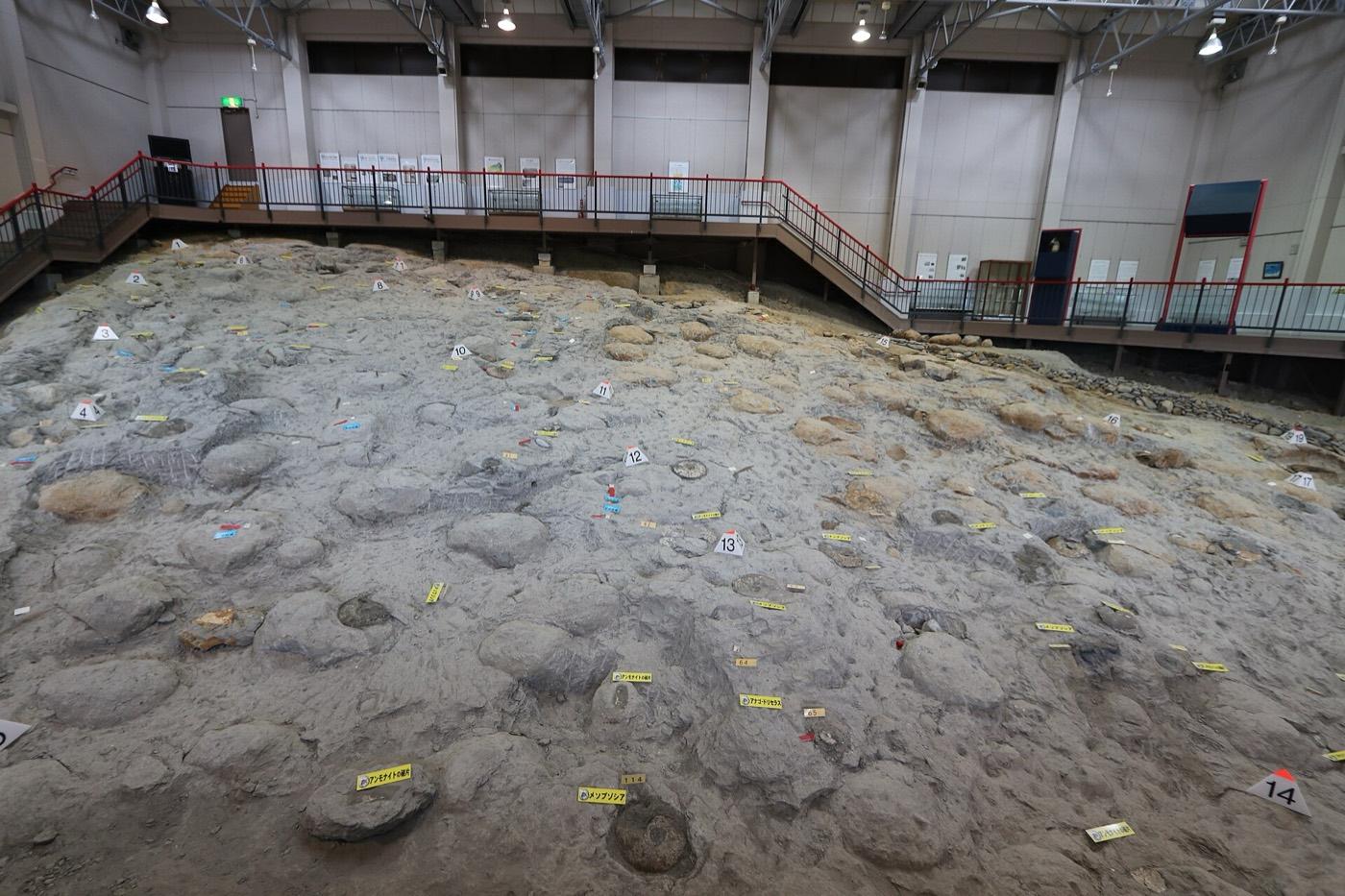
Iwaki City Ammonite Center Fossil Hunting Guide
Image: Osumi Akari (CC BY-SA 4.0)
A municipal centre in Fukushima built directly over a Late Cretaceous ammonite excavation. Weekend sessions lend you a hammer and chisel, and the instructor decides which of the common finds you keep.
By Edward Chen · Published 11 September 2026
Introduction
Japan runs public fossil digging as a municipal service, and the Iwaki City Ammonite Center is one of the clearest examples. The building stands directly on a Late Cretaceous ammonite excavation, and the outdoor dig area is part of the same exposure.
The arrangement is simple. You arrive during a session, collect a hammer and chisel at the front desk, and work the rock outside under supervision. Fossils you dig up belong to the centre by default, and the instructor decides which of the common ones you keep.
That is still a rare offer. Most in-situ fossil sites of scientific standing are viewing-only, and most places that let you dig are commercial operations working imported or screened material. Here the exposure is real and the access is public.
Location and Directions
The centre is at Ōhisa in Iwaki, a large coastal city in southern Fukushima Prefecture.
GPS: 37.1756°N, 140.9434°E. The centre sits well outside the main built-up area of Iwaki, about 15 kilometres north of the city centre.
Iwaki is reachable from Tokyo by train on the Jōban Line and by road.
Digging sessions run every Saturday and Sunday, from 10:00 to 11:30 and from 13:30 to 15:00. The centre does not run them on weekday public holidays. Sessions are cancelled in heavy rain and in extreme heat, so check before you commit to the journey.
Admission is charged. The combined dig and viewing ticket is 730 yen for adults, 560 yen for high school and college students, and 370 yen for younger pupils. Viewing alone costs less.
Sessions are normally walk-in, and the desk stops taking entries at the start time. Golden Week and the September holiday week run on full advance reservation through the centre's own website.
Hammers and other digging tools are lent. Bring your own work gloves, a plastic bag and newspaper, because the centre stopped selling them at the desk in 2024. Children from elementary school age can dig, and those below the fourth grade need an adult with them.
Manage expectations about what a session produces. You work real rock in a real exposure, and that means most visitors find fragments rather than complete shells. A whole ammonite is a good day, not a guaranteed outcome, and the staff are clear about this.
What Fossils You'll Find
Ammonites are the headline, and the centre is named for them. The Futaba Group of this region produces a Late Cretaceous marine fauna.
Bivalves, gastropods and shark teeth occur alongside them. Plant material is present in some horizons.
What you dig up belongs to the centre in principle. Common material, which means bivalves, shark teeth and ammonites, is given to you as a souvenir once the supervising instructor has checked and approved it. Anything of research value stays at the centre for study and display.
The Futaba Group is also the unit that produced Futabasaurus suzukii, a plesiosaur described from Iwaki, which gives an indication of what the beds can hold.
Futabasaurus suzukii is worth a note of its own. The specimen was found in 1968 by a high-school student, Tadashi Suzuki, and the species was formally described in 2006 and named after him. The skeleton showed shark tooth marks, and shark teeth were found with it.
 Photo: Osumi Akari, CC BY-SA 4.0, via Wikimedia Commons

Geologic History
The Futaba Group is Late Cretaceous, broadly Coniacian to Santonian, roughly 89 to 85 million years ago.
The sediments were deposited near a coast, with marine, marginal-marine and terrestrial components. That mixture is why the fauna includes both marine shells and plant material.
Japan at the time lay on the eastern margin of Asia, before the opening of the Sea of Japan separated the islands from the mainland.
Ammonites were abundant in these seas and diversified into a wide range of shell forms and then died out at the end of the Cretaceous.
Iwaki also has the Iwaki City Coal and Fossil Museum, known locally as Horuru, which covers both the region's mining history and its palaeontology. It is a separate institution from the Ammonite Center and is the better option in bad weather.
Collecting Rules and Regulations
Collecting is permitted within the organised session, in the designated dig area, using the tools provided.
Fossils dug up in a session belong to the centre by default. Show every find to the instructor, who decides what you keep.
Do not collect outside the session or outside the designated area. Surrounding land is not open ground.
Japan protects designated natural monuments strictly, and some fossil localities elsewhere in the country are off limits entirely. The permission here is specific to this facility.
Sessions can fill, particularly in Japanese school holidays, and instructions on site are given in Japanese. A translation app is worth having.
Iwaki is a practical base for a wider trip. The city sits on the Pacific coast with beaches and hot springs, and it is close enough to Tokyo for a weekend. Combining the dig with the coal and fossil museum makes a full day even if the weather cancels the field session.
Safety
Wear eye protection and gloves. The centre lends dust glasses, you bring the gloves, and hammering rock sends chips flying.
The dig area is an excavation with uneven, loose surfaces. Wear footwear with grip.
Sessions are cancelled in bad weather, and that decision is the centre's rather than yours.
Summers in Fukushima are hot and humid. Carry water.
One practical caution. The centre is a municipal facility rather than a tourist operation, English-language information is limited, and session arrangements are published in Japanese. Confirming by phone or through a Japanese-speaking contact before you travel from outside the country is worth the effort.
Sources
http://www.ammonite-center.jp/excavation.html http://www.ammonite-center.jp/guidance.html http://www.ammonite-center.jp/ https://www.guidoor.jp/en/places/5568 https://japantravel.navitime.com/en/area/jp/spot/02301-pn0000200/ https://en.wikivoyage.org/wiki/Iwaki https://www.tripadvisor.com/Attraction_Review-g780846-d1384012-Reviews-Iwaki_City_Ammonite_Center-Iwaki_Fukushima_Prefecture_Tohoku.html
Nearby sites
 Fukui Prefectural Dinosaur Museum and Katsuyama Dig Fossil Hunting GuideDinosaurs, Plants
 Sangjogam County Park Dinosaur Trackway Fossil Hunting GuideTrace fossils, Dinosaur tracks
 Wido Dinosaur Egg Site Fossil Hunting GuideDinosaur eggs, Dinosaur nests
- Sihetun Fossil Dig Site GuideFeathered dinosaurs, Early birds