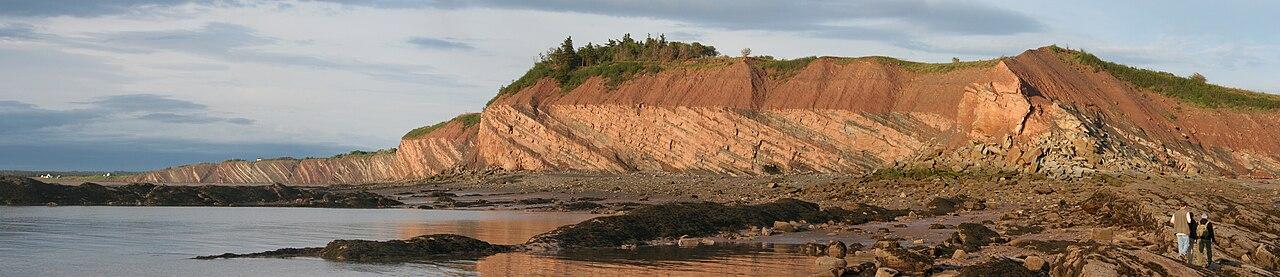
Joggins Fossil Cliffs Fossil Hunting Guide
Image: Michael C. Rygel (CC BY-SA 3.0)
The Joggins Fossil Cliffs on the Bay of Fundy expose the world's most complete record of life in the Carboniferous "Coal Age" 310 million years ago, including fossilized lycopsid trees standing upright as they grew. The beach is free to access. Fossil collecting requires a Heritage Research Permit issued by the Nova Scotia Museum.
By Edward Chen · Updated 31 July 2026
Introduction
The Joggins Fossil Cliffs rise nearly 30 metres above the Bay of Fundy on the Cumberland Basin coast of Nova Scotia, exposing roughly 15 km of continuously stacked Carboniferous strata. Designated a UNESCO World Heritage Site in 2008, Joggins preserves the most complete record of terrestrial life from the Pennsylvanian "Coal Age" anywhere on Earth, including upright fossilized lycopsid trees, the earliest known reptile Hylonomus lyelli, and dense tetrapod trackways.
The beach below the cliffs is publicly accessible free of charge from May through November. The Joggins Fossil Centre at the top of the cliff provides exhibits, guided beach tours, and food service. Fossil collecting is illegal without a Heritage Research Permit from the Nova Scotia Museum, visitors should photograph finds and report notable specimens to the Centre.
This guide covers what to look for, how to time the tides safely, and the permit rules that protect one of paleontology's best-known localities.
Photo: Smithsonian National Museum of Natural History, CC0, via Smithsonian Open Access
Location and Directions
Joggins is a small village on the north shore of the Chignecto Bay arm of the Bay of Fundy, about 45 km southwest of Amherst, Nova Scotia.
Directions to the Joggins Fossil Cliffs
From the Trans-Canada Highway (Hwy 104) at Amherst, take Exit 4 onto Highway 302 south, then Highway 242 to Joggins. The Joggins Fossil Centre at 100 Main Street has paid parking, exhibits, and a café. Beach access is via a wooden staircase at the northwest end of the village.
The best-known visitor consideration is the tide. The Bay of Fundy has the highest tides in the world (up to 15 m), and at high tide much of the fossil-bearing beach disappears against the cliff. Visitors should consult the Joggins tide chart and aim to leave the beach at least two hours before high tide. Falling rocks from the eroding cliff are a constant hazard, never sit, climb, or dig at the cliff face.
 Photo: Dustin M. Ramsey, CC BY-SA 2.5, via Wikimedia Commons

What Fossils You'll Find
Joggins exposes a coal-bearing succession of the Joggins Formation (Bashkirian–Moscovian, latest Early Pennsylvanian to earliest Middle Pennsylvanian, about 318 to 313 million years old), deposited in a rapidly subsiding equatorial coastal floodplain on the southern margin of the rising Maritimes Basin.
The cliffs are most famous for fossil lycopsid trees preserved in growth position. Lepidodendron and Sigillaria trunks up to 6 metres tall stand vertically in the cliff face just as they grew, with their roots (Stigmaria) still attached and ramifying through the underlying palaeosol. Many of these trees became hollow as they died and rotted, creating natural pitfall traps that infilled with sediment and the small terrestrial animals that fell in. In 1852, Sir William Dawson and Sir Charles Lyell split open one such trunk and collected the bones of Hylonomus lyelli, a small lizard-like animal now recognised as the oldest known reptile and Nova Scotia's provincial fossil. Dendrerpeton acadianum and several other early amniotes and amphibians have come from the same trunk casts.
Photo: Smithsonian National Museum of Natural History, CC0, via Smithsonian Open Access
On the beach below the cliffs, visitors regularly find fossil plant impressions weathering out of fresh slabs. The most common are the diamond-patterned bark of Lepidodendron, the ribbed stems of the giant horsetail Calamites (some up to 30 cm in diameter), the long parallel-veined leaves of Cordaites, and the elegant fronds of seed ferns like Neuropteris, Alethopteris, and Sphenopteris. Tetrapod and arthropod trackways are common on overturned slabs at the base of the cliff: long parallel rails of the giant millipede Arthropleura, snake-like trails of large eurypterids, and the small footprints of early tetrapods like Hylopus and Dendrerpeton. Whole Arthropleura body fossils up to 2 metres long are very rare but documented from Joggins. Complete carapaces of the small eurypterid Eoscorpius and the freshwater shrimp-like crustacean Anthrapalaemon are more often recovered. Marine and brackish invertebrates including the bivalves Naiadites and Carbonicola, and the freshwater clam-like Anthracosia, occur in thin marine bands between the coal seams. Coal seams, ironstone nodules, and ferns are everywhere. The iron-stained, sulphur-smelling pyritic shales near the coals locally preserve charcoal evidence of Pennsylvanian wildfires.
"Fossils are protected in Nova Scotia and may only be collected with a permit issued by the Nova Scotia Museum." Joggins Fossil Institute
 Photo: M.C. Rygel, CC BY-SA 3.0, via Wikimedia Commons

Geologic History
During the Pennsylvanian, the Cumberland Basin lay essentially on the palaeo-equator at the heart of the assembling supercontinent Pangea, on the southern margin of the rising Acadian–Variscan mountain belt. The basin subsided rapidly under tectonic loading and accumulated more than 1,400 metres of stacked, fossil-bearing Coal Measures sediment in only about five million years. Dense lowland forests of lycopsid trees, giant horsetails, tree ferns, and the gymnosperm Cordaites grew on a humid, monsoonal deltaic plain crossed by sluggish channels and dotted with shallow swamps and oxbow lakes. Recurring sea-level fluctuations periodically drowned the plain with brackish and marine bands. Each cycle produced a stacked package of coal, shale, sandstone, and palaeosol that records one chapter of the coastal floodplain's history.
The Cumberland Basin is unusual in the global Pennsylvanian record because subsidence kept pace with sediment supply, so almost every part of the depositional environment is preserved continuously and at high resolution. The result is the world's most complete record of the Coal Age, what UNESCO calls "the iconic site of the world's Coal Age", and the type section against which other Pennsylvanian sites are compared.
The Joggins cliffs played a foundational role in the development of geology and evolutionary thinking. Sir Charles Lyell visited in 1842 and again in 1852 with William Dawson, and called the section "the finest example in the world of a natural exposure in continuous section." Charles Darwin cited Joggins in On the Origin of Species as an example of long, slow subsidence preserving a deep record of life. Dawson, who later became principal of McGill University, worked Joggins for decades and described many of the trunk-cast tetrapods and early amniotes. His 1855 book Acadian Geology remains an essential reference. The Geological Survey of Canada and Nova Scotia Museum researchers have continued active fieldwork ever since.
Modern erosion of the cliffs, driven by the world's highest tides in the Bay of Fundy, retreats the section at about 50 centimetres per year on average, fast enough to expose new fossils continuously, but also fast enough that any specimen still in place will be lost to the sea within decades if not collected by permitted researchers.
How Joggins Came to Be Protected
The cliffs are protected by the Nova Scotia Special Places Protection Act and a Heritage Research Permit system administered by the Nova Scotia Museum. Joggins was inscribed as a UNESCO World Heritage Site in 2008 (Site #1285). The Joggins Fossil Centre, opened in 2008 alongside the inscription, is the public-facing visitor and research facility, with the Joggins Fossil Institute as the non-profit operator.
 Photo: M.C. Rygel, CC BY-SA 3.0, via Wikimedia Commons

Collecting Rules and Regulations
Is Fossil Collecting Allowed?
Not without a permit. Collection of any fossil requires a Heritage Research Permit from the Nova Scotia Museum.
Key Points:
- Beach access is free, year-round, outside Centre hours
- No collecting, hammering, or digging without a Heritage Research Permit
- Report notable finds at the Joggins Fossil Centre
- Leave the beach at least two hours before high tide
- Stay back from the cliff face, rockfall is constant
Photo: Smithsonian National Museum of Natural History, CC0, via Smithsonian Open Access
Safety
Joggins is a serious site, and the two things that make it scientifically important, a 30-metre cliff of soft Carboniferous strata and the Bay of Fundy at its foot, are also what make it dangerous.
The tide here is the largest on Earth. The Bay of Fundy has the greatest tidal range of any body of water in the world, and the water moves fast across a shallow, gently shelving beach. A stretch of foreshore that is comfortably wide on a falling tide can be gone entirely within an hour or two. Consult a tide table before you set out, plan your walk around low water, and leave the beach at least two hours before high tide. Do not gamble on the margin. There is no route up the cliff, so being caught between the water and the rock face is not a situation you can climb out of.
Rockfall is constant, not occasional. The cliffs are actively eroding, which is precisely why fresh fossils keep appearing on the beach, and material comes down without warning in all weather. Stay well back from the base, do not shelter under overhangs, and do not climb. Give the cliff more room after rain, frost, or a storm.
Wear boots with a firm sole and good grip. The beach is a mix of rock ledge, boulders, and slippery weed, and the shale underfoot is uneven. Nova Scotia weather changes quickly on this coast, so bring layers and something windproof even in summer, and note that fog can arrive fast and cut visibility along the shore. Mobile coverage is patchy at beach level. Tell someone where you are going and when you expect to be back, and if you are visiting for the first time, call in at the Joggins Fossil Centre, where staff will tell you the day's tide times and current cliff conditions.
Sources
Nearby sites
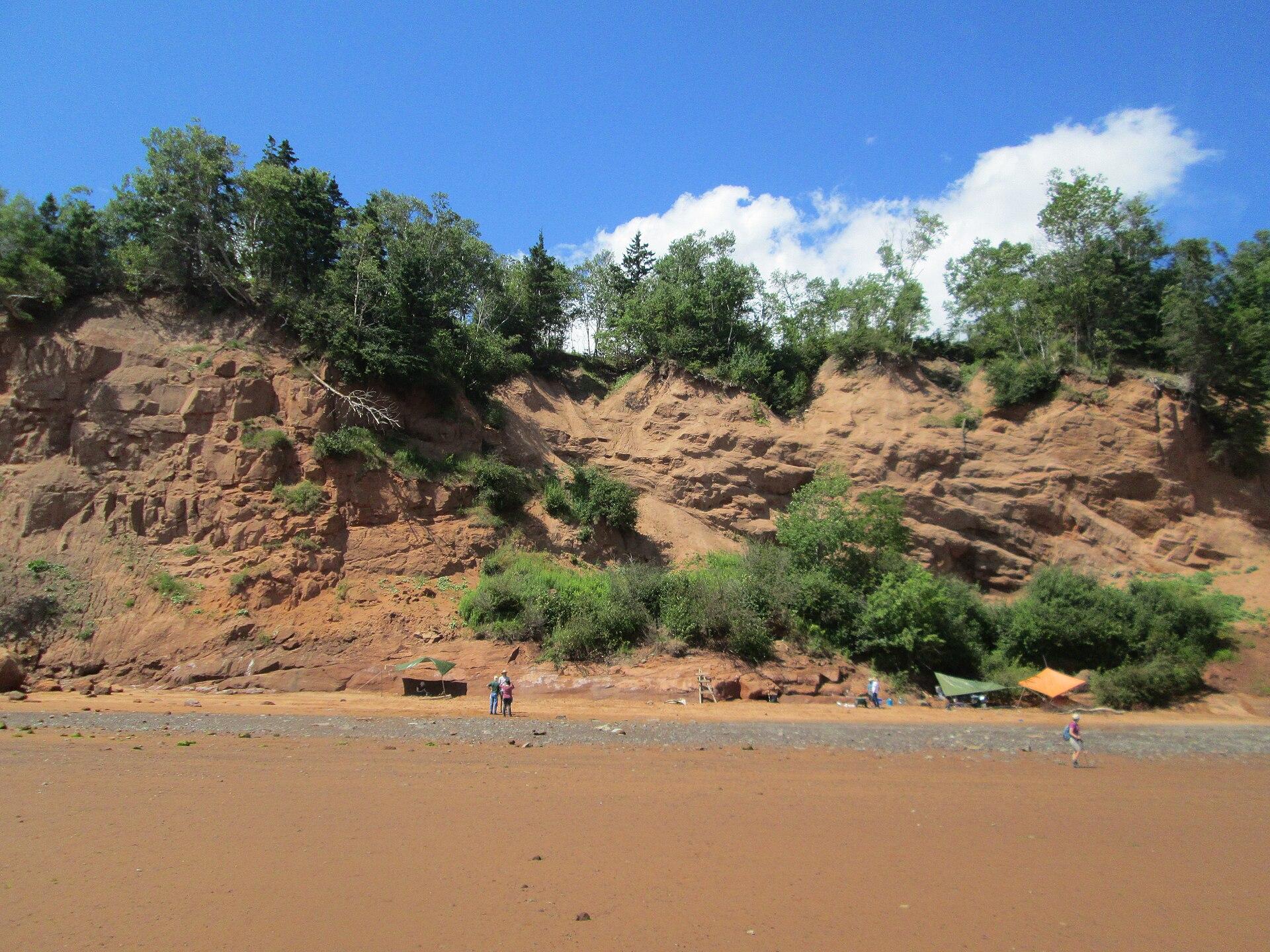 Wasson Bluff, Parrsboro Fossil Hunting GuideDinosaurs, Dinosaur tracks
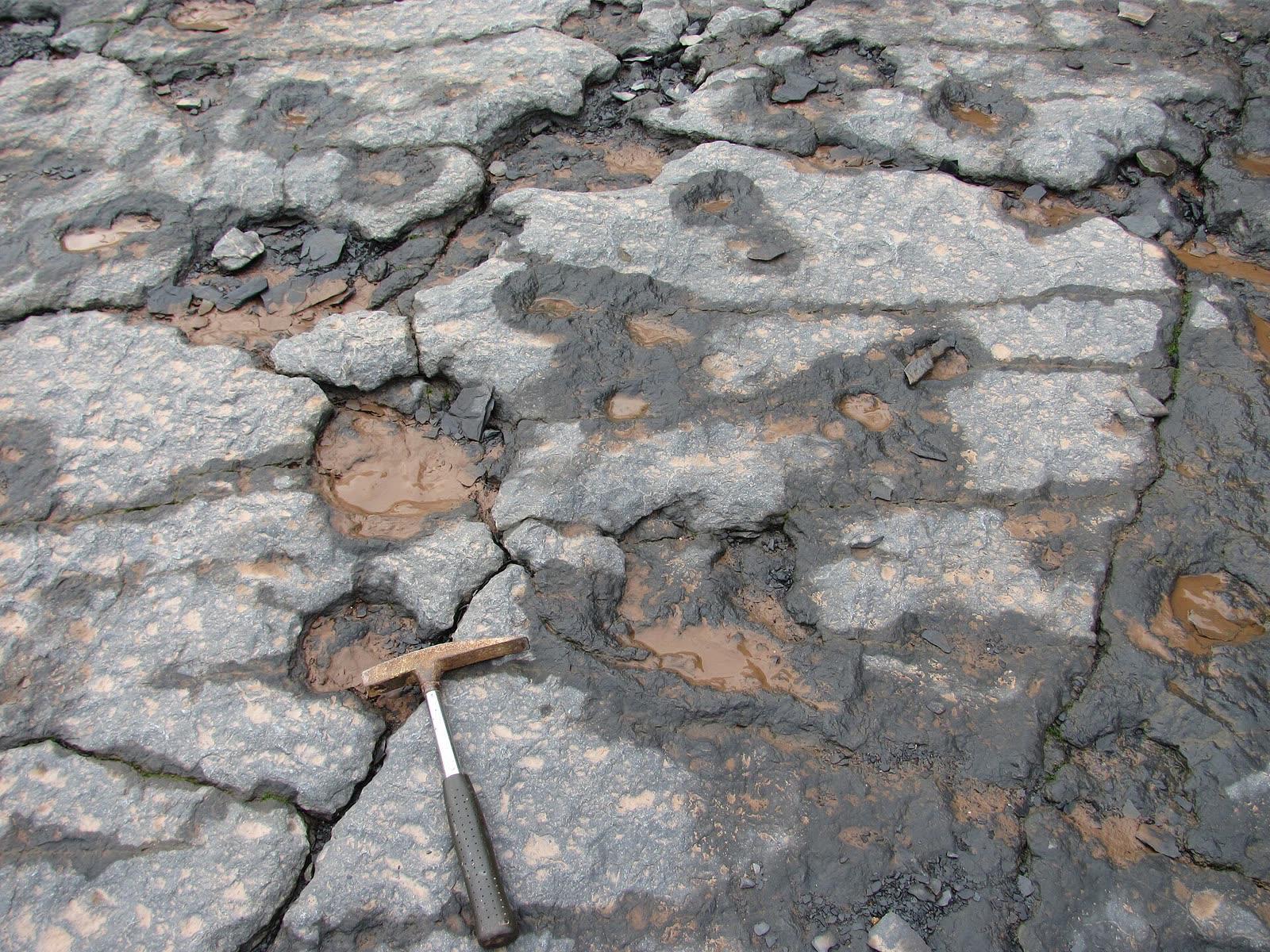 Blue Beach, Avonport Fossil Hunting GuideEarly tetrapods, Tetrapod trackways
 Stonehammer UNESCO Global Geopark Fossil Hunting GuideParadoxides regina (trilobite), Carboniferous tetrapod trackways
 Arisaig Provincial Park Fossil Hunting GuideBrachiopods, Trilobites