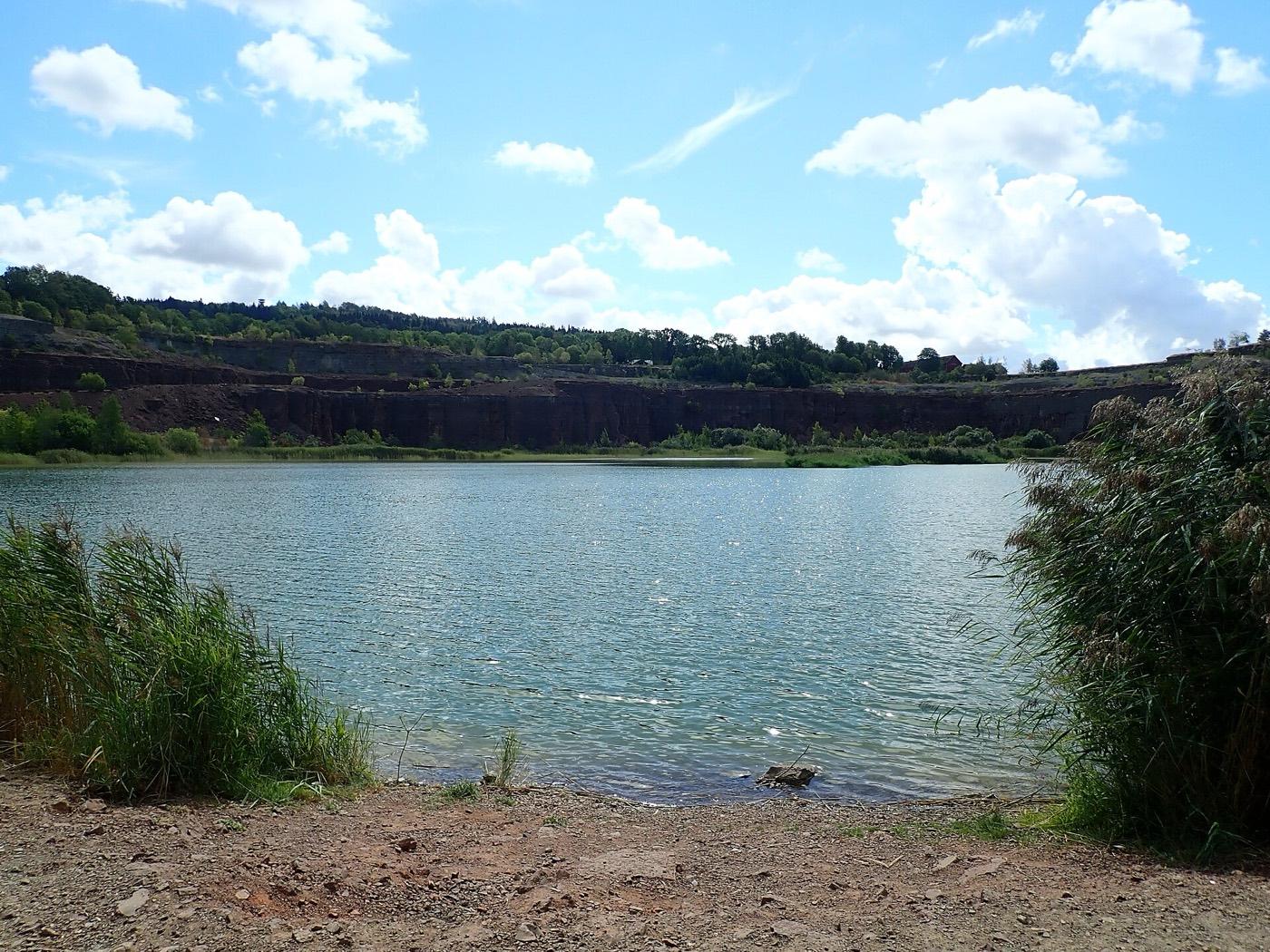
Kinnekulle Quarries Fossil Hunting Guide
Image: I99pema (CC BY-SA 4.0)
A flat-topped hill above Lake Vänern where old quarries cut Cambrian alum shale and Ordovician orthoceratite limestone. Trilobites come from the shale and orthocone nautiloids from the limestone. The allemansrätten gives walking access to the ground, though not a right to collect.
By Edward Chen · Published 11 September 2026
Introduction
Kinnekulle is a table mountain, and its shape is the reason it holds fossils. A cap of hard diabase protected the softer sedimentary rocks beneath it from the glaciers that stripped the surrounding plain. The result is a layered hill rising above Lake Vänern with the whole Lower Palaeozoic succession stacked inside it.
Quarrying exposed those layers. Old workings at Kakeled, Hällekis, Österplana and Råbäck cut Cambrian alum shale and Ordovician orthoceratite limestone, and their spoil is where collectors work.
The orthoceratite limestone is a rock most Europeans have walked on and never noticed. Polished, it became a favoured flooring and cladding stone, and the pale spiral and cone sections in it are the shells of orthocone nautiloids.
Sweden also has the allemansrätten, the right of public access, which makes the hill unusually easy to explore.
Location and Directions
Kinnekulle stands in Götene municipality in Västergötland, on the eastern shore of Lake Vänern, between Gothenburg and Stockholm but much closer to the former.
GPS for Hällekis, the quarry village on the north-west of the hill: 58.6292°N, 13.4381°E.
The classic collecting grounds are the old quarries. Kakeled on the south-west of the hill is a former quarry known for Upper Cambrian fossils. Hällekis and Österplana are limestone workings. Råbäck is an alum shale quarry.
There is a marked walking route, the Kinnekulleleden, and the hill is well served by paths, parking and signage. A railway line runs to Hällekis.
A practical note on the orthocones. In the field they appear as pale elongated sections through grey limestone, and in cross-section as circles with internal partitions. Those partitions, the septa, are the diagnostic feature. A smooth pale streak without them is more likely to be a crinoid stem or a weathering artefact.
What Fossils You'll Find
Two rock types, two assemblages.
The Cambrian alum shale is a black, organic-rich, fissile rock. It yields trilobites, often flattened, and agnostids. It also contains the Orsten, which preserves tiny arthropods in three dimensions inside limestone nodules. Orsten fossils are microscopic, and a laboratory recovers them by acid preparation rather than anyone finding them by eye in the field.
The Ordovician orthoceratite limestone yields orthocone nautiloids, the straight-shelled relatives of the modern nautilus. Some are substantial, and a long conical shell section in grey limestone is the signature find of the hill.
Brachiopods, graptolites and crinoid fragments occur in both units.
 Photo: Adgberg, CC BY-SA 4.0, via Wikimedia Commons
Geologic History
The succession runs from Cambrian through Ordovician and into Silurian, capped by the diabase sill that preserved it. This page is filed under the Ordovician, because the orthoceratite limestone is the unit the hill is known for. The trilobites come from the Cambrian alum shale below it.
The alum shale accumulated in a deep, poorly oxygenated sea. Low oxygen is why it is black, why it is rich in organic matter, and why it preserves fossils so well. The same property made it a target for the alum industry and later for uranium prospecting.
The orthoceratite limestone above it records a shallower, better-oxygenated sea in the Ordovician, when Baltica lay at tropical latitudes and carbonate accumulated steadily.
Slow sedimentation is the key to the nautiloid concentration. Shells had time to accumulate on the seafloor, and there was little clastic mud to dilute them.
The terraces are the hill's defining feature. Each unit weathers back at its own rate, so the softer shales cut in while the harder limestone and the diabase cap stand proud. The stepped profile that results is visible from across Lake Vänern.
 Photo: James St. John, CC BY 2.0, via Wikimedia Commons
Collecting Rules and Regulations
Sweden's allemansrätten gives a broad right to walk on land. It does not extend to taking fossils: the county boards state that loose fossils belong to the landowner and fall outside it.
That right does not override protected-area rules. Parts of Kinnekulle are nature reserves, and reserve regulations take precedence.
Check the signage at each quarry. Some are managed, some are on private land, and some are protected. The Länsstyrelsen for Västra Götaland is the responsible authority.
Collect from spoil and loose material rather than from faces. Take a few specimens, not a load.
Commercial collecting is a different matter from personal collecting and requires permission.
If you want to see what the limestone looks like polished, the churches and manor houses around the hill are built from it. Husaby church nearby uses the local stone throughout. Orthocone sections show clearly on dressed surfaces.
Safety
Quarry faces are unstable. Keep clear of the base and do not climb them.
Splitting shale sends fragments flying, so wear eye protection.
Alum shale contains uranium and its decay products, and weathered alum shale can release radon. Casual outdoor visits are not a concern, but do not collect large quantities of black shale to keep indoors.
Some old workings hold deep water with steep sides. Keep children close.
Swedish woodland carries ticks. Cover your legs and check afterwards.
The hill is layered in a way that rewards a systematic visit. From the shore of Lake Vänern upward you pass sandstone, alum shale, limestone, shale and the diabase cap, each forming its own terrace. Walking from the lake to the summit takes you through the whole Lower Palaeozoic in a few hours.
Sources
https://www.paleontica.org/sites/fossil_site.php?plaats=105&language=en https://www.lansstyrelsen.se/vastra-gotaland https://en.wikipedia.org/wiki/Kinnekulle https://www.thefossilforum.com/topic/110596-are-there-more-fossil-sites-other-than-kinnekulle-in-v%C3%A4sterg%C3%B6taland-sweden/

%208.jpg)