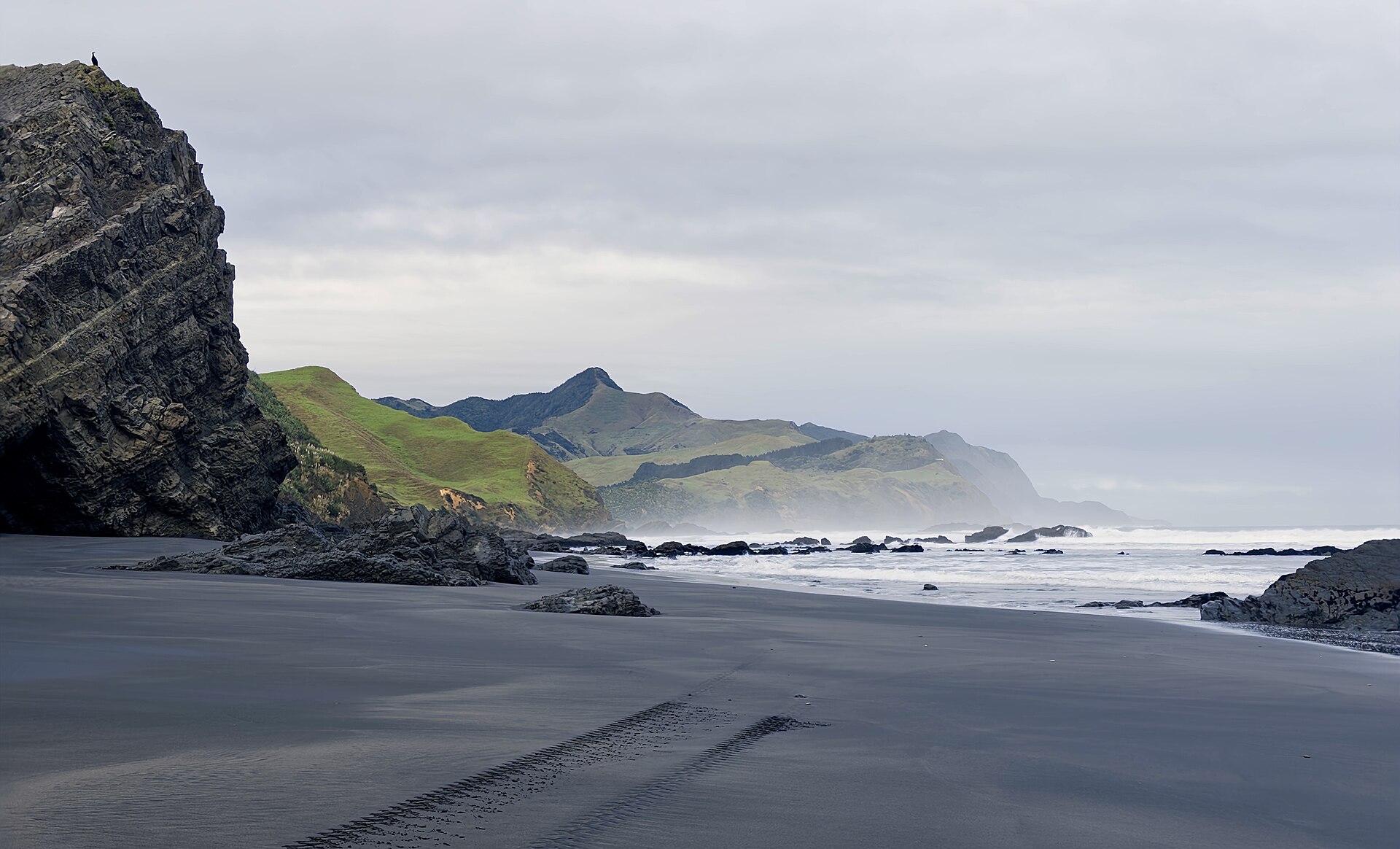
Kiritehere Beach, Marokopa Fossil Hunting Guide
Image: Tom Ackroyd (CC BY-SA 4.0)
A remote west-coast Waikato beach where a Triassic shellbed crops out in the wave platform. The Arawi Formation is packed with the flat bivalve Monotis, and the site is one of New Zealand's most accessible Murihiku exposures.
By Edward Chen · Published 14 September 2026
Introduction
Kiritehere Beach sits on the rugged west coast of the Waikato, south of the small settlement of Marokopa. Black sand, high cliffs and a heavy Tasman swell characterise the shore.
At low tide a wave-cut platform is exposed, and in it a shellbed crops out that is crowded with fossil bivalves. The shells belong to Monotis, a flat, ribbed, thin-shelled genus that occurs in extraordinary abundance in Late Triassic rocks around the Pacific.
The rocks belong to the Arawi Formation, part of the Murihiku Supergroup. The Murihiku is one of the major terranes that make up the basement of New Zealand, and it records a long stretch of Mesozoic marine deposition.
The site appears in the GeoTrips series maintained by the Geoscience Society of New Zealand, which is a good sign of both its interest and its accessibility.
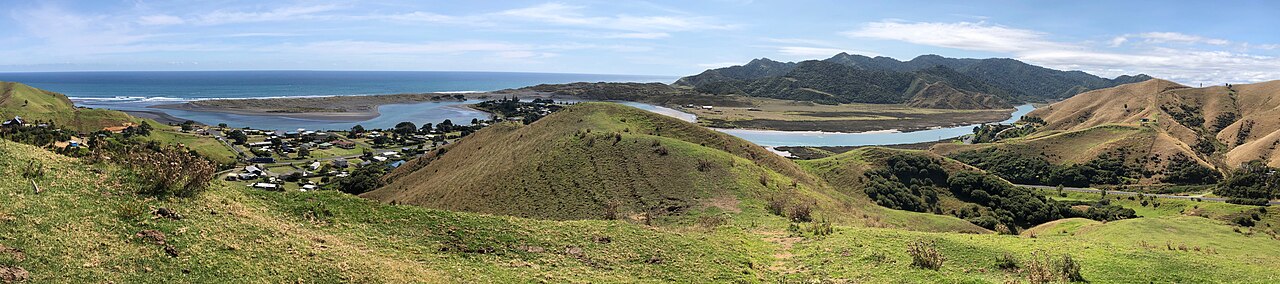 Photo: Johnragla, CC BY-SA 4.0, via Wikimedia Commons

Location and Directions
Kiritehere is on the Waikato west coast, a short distance south of Marokopa and roughly 55 kilometres west of Te Kūiti.
GPS: 38.3271°S, 174.6978°E.
The drive from Te Kūiti or Waitomo runs on narrow rural road through hill country and takes longer than the map suggests. The final stretch to the beach is narrow.
Parking is at the beach end of the road. The productive exposure is a large shore platform at the south end of the beach. The rock beds there slope, and whole slabs carry fossil shells.
Tide is the controlling factor. The fossil-bearing platform is only exposed at low water, and there is no point attempting a visit near high tide.
Check the tide table for the Waikato west coast and aim for the two hours either side of low water.
There are no facilities at the beach. Marokopa has very limited services and Te Kūiti is the nearest town of any size.
 Photo: Tom Ackroyd, CC BY-SA 4.0, via Wikimedia Commons

What Fossils You'll Find
Monotis dominates completely. The shells are thin, flat and finely ribbed, and in the shellbed they lie packed against one another in enormous numbers.
This abundance is a global phenomenon. Monotis blooms mark a narrow interval in the Late Triassic across the Pacific rim, and the genus is used as an index fossil for that interval.
Brachiopods occur alongside the bivalves. Other molluscs are present in smaller numbers.
Ammonites turn up occasionally and are a genuinely good find here. Marine reptile bone has been recorded from the Murihiku rocks of this coast but is very rare.
Condition varies a great deal. Shells in the platform itself are often crushed flat, while those in harder blocks keep more of their original shape.
Loose blocks on the beach are the sensible place to look. The sea has already freed them, and they often show a clean cross section through the shellbed.
Geologic History
The Murihiku Supergroup accumulated between roughly 260 and 145 million years ago, spanning the Permian through the Jurassic. It represents sediment shed into a forearc basin along the active margin of Gondwana.
New Zealand did not exist as a landmass then. These rocks formed offshore from the eastern edge of Gondwana, where an ocean plate descended beneath the continent.
The Arawi Formation falls in the Late Triassic part of that sequence. Volcanic ash and sand were carried into the basin from the arc, and marine animals lived and died in the water above.
Monotis probably lived attached to floating objects or on soft seafloor mud in dense populations. Whatever the ecology, mass deaths produced beds made almost entirely of their shells.
Later movement folded the whole Murihiku terrane into a long syncline and accreted it onto the New Zealand landmass. The beds now stand tilted in a coastal platform.
 Photo: Tom Ackroyd, CC BY-SA 4.0, via Wikimedia Commons

Collecting Rules and Regulations
New Zealand does not have a blanket ban on collecting common invertebrate fossils from beaches, but several rules apply.
Land ownership matters. Check whether the ground above the beach is private or Māori-owned land, and do not cross it without permission.
Areas administered by the Department of Conservation have their own rules, and collecting on conservation land generally requires authorisation.
Protected New Zealand objects legislation covers scientifically significant fossil material, including vertebrates. Report anything that looks like bone. Do not remove it.
GNS Science or the Geoscience Society can advise on significant finds.
Take a small sample at most. Do not hammer the platform, and leave the shellbed intact for the next visitors.
Safety
This is an exposed west-coast beach with a powerful surf and strong rips. Do not swim.
Tides can cut off sections of the shore below the cliffs. Go out on a falling tide and keep an eye on the water.
Cliffs along this coast are unstable and shed rock. Stay clear of their base.
The wave platform is slippery with weed and has deep gaps. Move slowly and wear boots with grip.
Mobile coverage is poor. Tell someone your route and when you expect to be back.
Weather changes fast on this coast, and rain arrives from the Tasman with little warning.
Sources
https://www.geotrips.org.nz/ https://en.wikipedia.org/wiki/Murihiku_Terrane https://www.gns.cri.nz/
Nearby sites
 Honeycomb Hill Caves Fossil Hunting GuideMoa (Pachyornis, Dinornis, Megalapteryx), Haast's eagle (Hieraaetus moorei)
 Curio Bay Petrified Forest Fossil GuidePetrified wood, Conifer trunks
 Painted Cliffs Maria Island Fossil Hunting Guidetrace fossils, sedimentary structures
 Ischigualasto Provincial Park Fossil GuideEarly dinosaurs, Eoraptor