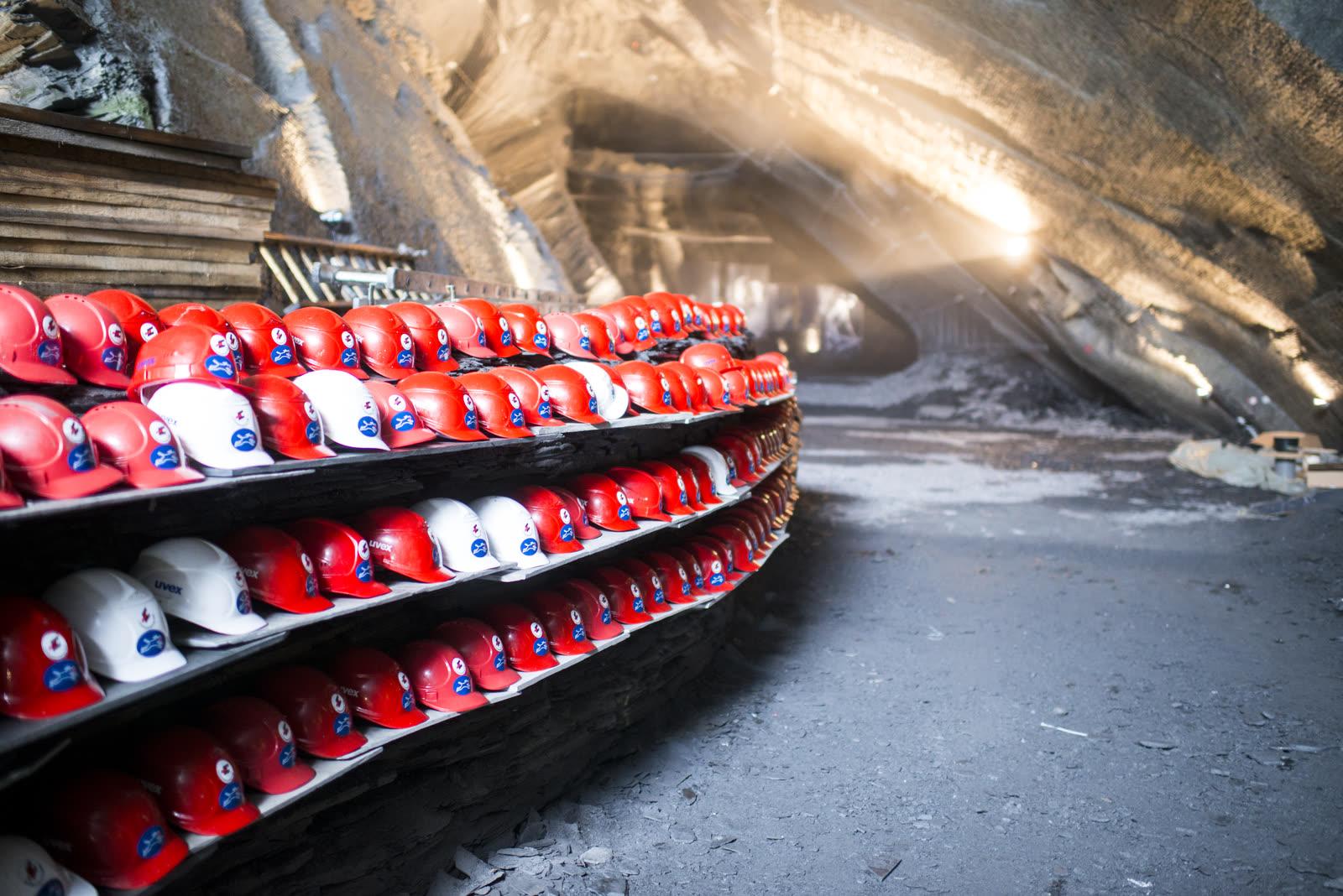
Landesplattenberg Engi Fossil Hunting Guide
Image: Samuel Trümpy Photography / Kanton Glarus (CC BY 2.0)
A slate mine in Canton Glarus whose Oligocene slates hold the Glarus fish fossils, along with sea turtles and early birds. Entry is on a guided tour only, and the tours run on set dates each season.
By Edward Chen · Published 1 October 2026
Introduction
The Landesplattenberg is a former slate mine at Engi in the Sernf valley of Canton Glarus. Its slate yields the Glarus fish fossils, which collectors traded across Europe in the 18th century.
Miners cut roofing and writing slate here from the 16th century. The first written mention of the slate quarry dates from 1565. In 1705 the naturalist Johann Jakob Scheuchzer visited and paid miners to collect fossils.
The canton took over the mine in 1833 and gave it its present name. The mine closed in 1961 and reopened as a show mine in 1995.
You can enter the mine on a guided tour only. The tour shows fish, turtles and birds from the slate. It starts with a slide presentation and then climbs to the adit. This page treats the mine as a guided site where you look at fossils and do not collect them.
The Landesplattenberg is not the Glarus thrust. The thrust is the UNESCO Sardona feature, and it lies elsewhere in the same region. The Sardona website lists the mine as an experience in the area, and that is all.
Location and Directions
Engi lies in the Sernf valley, south of Schwanden in Canton Glarus. The mine and its exhibition pavilion are at Sernftalstrasse 109, at the village exit.
By car, leave the A3 at Niederurnen (exit 44). Follow the cantonal road through Glarus and Schwanden up the Sernf valley to Engi. Parking is at the pavilion.
By public transport, take the SBB train to Schwanden and change to the bus. Get off at the stop named Landesplattenberg Engi. The pavilion is about two minutes on foot from that stop.
The public tour meets at the pavilion. Assemble between 13:15 and 13:30. The tour starts at 13:15.
The 2026 public tours run from 9 July to 8 November. The tourism listing names dates that include 8, 15, 18 and 25 October and 1 and 8 November. Check the operator's calendar before you travel.
You do not need to register in advance for the public tour. Adults pay CHF 28, teenagers CHF 23 and children CHF 16. Pay in cash only.
The tour takes about two and a half hours. It starts with a slide presentation and then climbs about 130 meters uphill to the adit. It runs in German. Ask the operator by telephone on 055 642 55 55 if you need another language.
The operator also runs group tours almost every day for registered groups. A group of 1 to 15 people pays CHF 420, plus CHF 28 for each extra person. Listings give the operator's season as March to December, with January and February closed.
What Fossils You'll Find
 Photo: Staatliche Naturwissenschaftliche Sammlungen Bayerns, CC BY-SA 4.0, via Wikimedia Commons
The slate holds marine fish, and fish are the reason people come. A Swiss leisure listing says the mine and the pavilion show early fish, turtles and birds. You see them on the tour and in the exhibition, and you do not find them yourself.
Early collectors named many of the fish. Palaeorhynchus glarisianus and Palaeorhynchus longirostris are billfish with long snouts. Fistularia koenigi is a cornetfish. Scopeloides glarisianus is a bristlemouth, and a 2012 study examined its feeding habits.
Other species include Homorhynchus colei, Acanthopleurus serratus, Balistomorphus orbiculatus, Palaeogadus troscheli and Thyrsitocephalus alpinus. Tyler and Micklich described a larval surgeonfish, Glarithurus friedmani, in 2011.
Opisthomyzon glaronensis is the early remora. Friedman and colleagues described it in 2013 from the Engi Slates, in rock younger than about 32 million years.
The slate also holds a sea turtle, Glarichelys knorri, and an early bird, Protornis glarniensis. De Pietri and colleagues studied the bird in 2013.
Heat and pressure changed the rock after burial. Metamorphism has distorted many of the fossils.
Geologic History
 Photo: Paebi, CC BY-SA 4.0, via Wikimedia Commons
The fish lived in the Oligocene, about 33 to 28 million years ago. This was the Rupelian age. The sea was the western Paratethys.
The Matt Formation belongs to the North Helvetic Flysch. Siegenthaler named it in 1974. Its lower part is the Lower Matt Sandstones, laid down by turbidity currents. Its upper part is the Engi Slates, the fine rock that holds the fish.
Later the Alpine collision squeezed the rocks. Gasser and den Brok (2008) mapped tight folds in the Engi Slates, folded at scales from tens of meters to hundreds of meters. The folds lean toward the north-west, and the slate has no axial-plane foliation.
Older Eocene marls were thrust over the folded slates along a plane that dips 16 to 25 degrees to the north-east.
Scheuchzer found fossils here in 1705. Fish from the Engi slates traded across Europe in the 18th century. Blainville and Agassiz described them in the early 19th century, and Brignon (2016) reviewed the history.
Collecting Rules and Regulations
You cannot collect in the mine. You enter on a guided tour, and the guide controls where you stand.
No source for this page states a collecting rule for visitors. Treat every fossil as look-only. Do not split, chip or remove slate, in the mine or in the spoil outside it.
The mine is an operating visitor site, and the guide leads each tour.
If you think you have found a fossil, tell the guide. Do not take it away.
Safety
The mine stays at about 11 °C all year. Wear warm clothing even in summer. Wear solid shoes, as the operator advises.
The walk to the adit climbs about 130 meters uphill. Allow time to rest. The operator provides helmets, and you must wear one.
The tour is not suitable for wheelchairs. The listing for the audio walk states this.
Keep with the group and follow the guide's instructions at all times.
Bring cash. Public tours and food are cash only.
Sources
https://www.myswitzerland.com/en-gb/experiences/events/oeffentliche-fuehrung-im-landesplattenberg-engi-2026/ https://www.museums.ch/de/museumsbesuch/museen/museen/landesplattenberg-engi-2739.html https://unesco-sardona.ch/en/erlebnis/engi-quarry https://www.showcaves.com/english/ch/mines/Engi.html https://en.wikipedia.org/wiki/Matt_Formation https://pmc.ncbi.nlm.nih.gov/articles/PMC3730593/ https://sjg.springeropen.com/articles/10.1007/s00015-008-1258-0 https://www.freizeit.ch/freizeit/14752/landesplattenberg
_3386855051.jpg)
