Lesvos Petrified Forest Fossil Hunting Guide
Image: Tomisti (CC BY-SA 4.0)
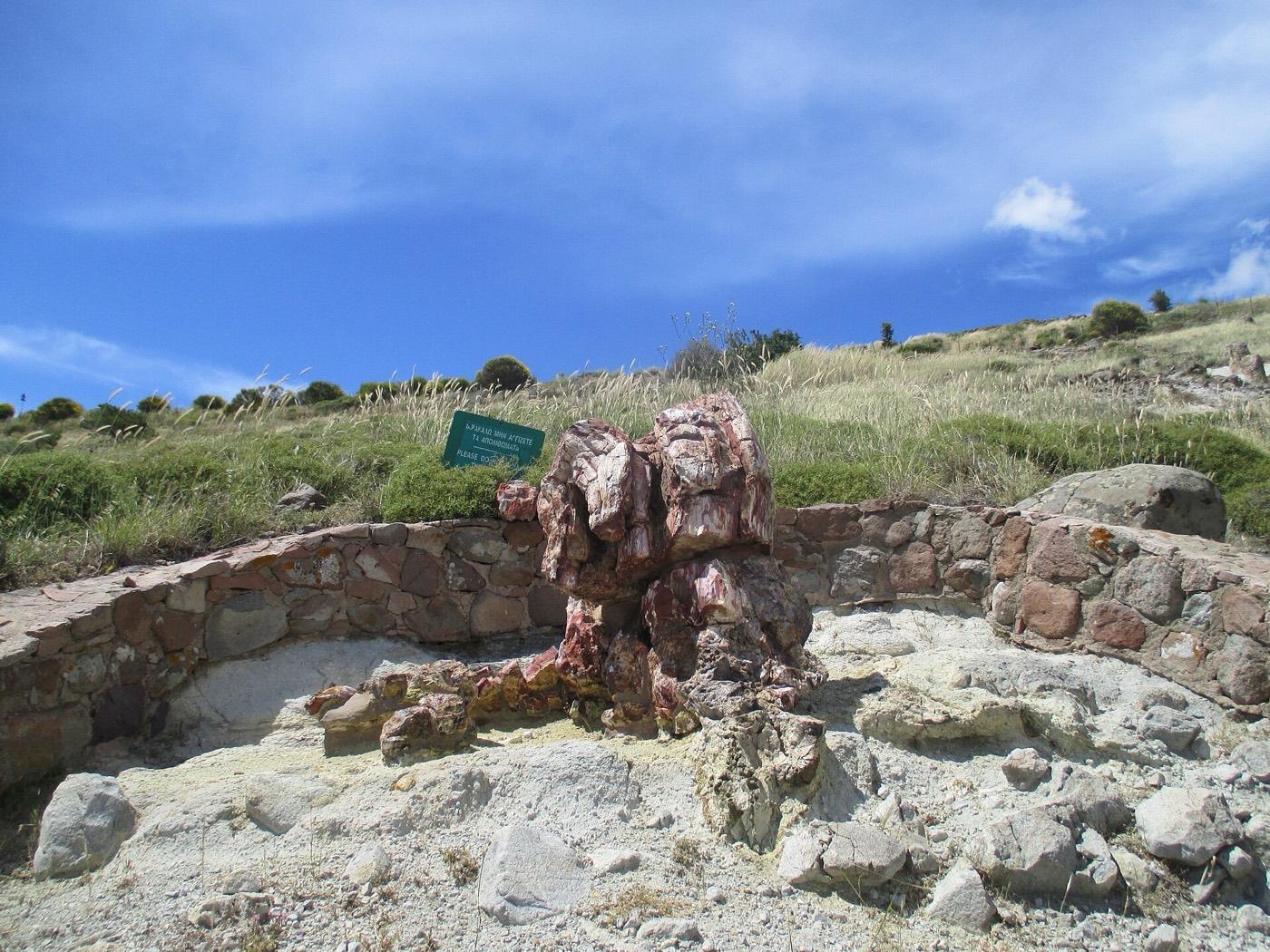
Silicified Early Miocene trunks standing where they grew on western Lesvos, protected as a natural monument and interpreted from a museum at Sigri. A single ticket covers the museum and the forest parks.
By Edward Chen · Published 11 September 2026
Introduction
Most petrified wood is found lying down. On western Lesvos a number of trunks are still standing, rooted in the ground they grew in, turned to silica.
The petrified forest covers a large part of the western end of the island. It formed when Early Miocene volcanism buried a subtropical forest in ash, and silica-rich groundwater replaced the wood cell by cell. Because the replacement worked at cellular scale, growth rings and internal structure survive.
The Natural History Museum of the Lesvos Petrified Forest at Sigri is the centre of the operation. It was founded in 1994 and is a founding member of the European Geoparks Network. It manages, studies and protects the forest as well as explaining it.
Location and Directions
Sigri is at the western end of Lesvos, about 90 kilometres from Mytilene, the island's main town and port.
GPS: 39.2114°N, 25.8548°E.
The museum can be reached by bus, car or motorbike. The drive across the island is long and the western roads are slower than the distance suggests, so allow time.
The museum opens Monday to Sunday, 09:00 to 17:00, and closes on the main Greek public holidays. The Main Petrified Forest Park and the Sigri Park open Monday to Sunday, 08:00 to 16:00.
General admission is 10 euros and covers the museum and the Petrified Forest parks, except Nissiopi. That combination is the reason to buy at the museum rather than turning up at a park gate.
The Nissiopi Marine Park needs its own 15 euro ticket for the glass-bottomed boat, which leaves Sigri harbour daily at 10:30.
Which park to choose matters. The protected area includes several separately managed sites, and the Sigri park by the museum is the most developed. The Bali Alonia and Plaka sites hold other concentrations of trunks, and the museum will advise on which are open and which suit the time you have.
What Fossils You'll Find
Nothing is collectable, and the prohibition is enforced.
You see standing and fallen silicified trunks, root systems preserved in place, and fragments of fossil wood across the landscape. Some trunks are large, and the standing examples are the ones people travel for.
Leaf and fruit material is preserved in the finer volcaniclastic sediments and is displayed in the museum.
The museum interprets the whole system, from the eruption that buried the forest to the chemistry that replaced the wood.
The scale is the thing that does not come across in photographs. The protected area covers a large part of western Lesvos rather than a single grove. Trunks appear across the hillsides, in road cuttings and along the shore. Some are even preserved on the seabed offshore.
 Photo: Tomisti, CC BY-SA 4.0, via Wikimedia Commons
Geologic History
The forest was buried in the Early Miocene, roughly 20 to 17 million years ago, during a phase of intense volcanism in the north Aegean.
Ash falls and pyroclastic flows covered a subtropical forest. Volcanic ash is rich in silica, and groundwater moving through it carried that silica into the buried wood.
Silica precipitated inside and around the cell walls, and it replaced organic material but kept its structure. That is why the fossil wood shows rings, vessels and bark.
Later erosion stripped away much of the covering volcanic material and exposed the trunks at the surface, standing as they had grown.
The museum runs an active research and conservation programme, including excavation of new trunks and consolidation of exposed wood. Silicified wood looks permanent but it fractures along old cracks and spalls in frost, so the standing trunks need maintenance.
 Photo: Tomisti, CC BY-SA 4.0, via Wikimedia Commons
Collecting Rules and Regulations
Collecting is prohibited. The petrified forest is a declared natural monument and a UNESCO Global Geopark, and removing petrified wood is an offence.
This is not a formality. Petrified wood is attractive and portable, and a protected monument of this size cannot be watched everywhere at once over the years. That is part of why the protection and the interpretation are as active as they are.
Do not pick up fragments, including small ones on paths.
If you want petrified wood for a collection, buy legally sourced material from a licensed dealer elsewhere. Do not take it from a protected forest.
Getting to Sigri is the main logistical issue. It sits at the far western end of a large island, roads are slow, and bus services are limited. Most visitors hire a car in Mytilene, and a day trip needs several hours on the road.
 Photo: Tomisti, CC BY-SA 4.0, via Wikimedia Commons
Safety
The parks are open, exposed hillside with rough paths and little shade.
Lesvos summers are very hot. Visit early or late, carry water, and use sun protection.
The ground is uneven and stony, with loose fragments underfoot. Wear proper footwear.
Snakes are present on Lesvos and are most active in warm weather. Stay on the paths.
Fire risk is high in summer. Observe any restrictions in force.
The museum also runs the geopark side of the operation, including research, school programmes and the management of the protected sites. So it is the single point of contact for anything beyond a standard visit.
Sources
https://www.lesvosmuseum.gr/en/visit-petrified-forest-lesvos https://www.lesvosmuseum.gr/en/visit-museum https://en.wikipedia.org/wiki/Natural_History_Museum_of_the_Lesvos_Petrified_Forest https://www.lesvosmuseum.gr/en/getting-museum