Luoping Biota National Geopark Fossil Hunting Guide
Image: Kcx36 (CC BY-SA 4.0)
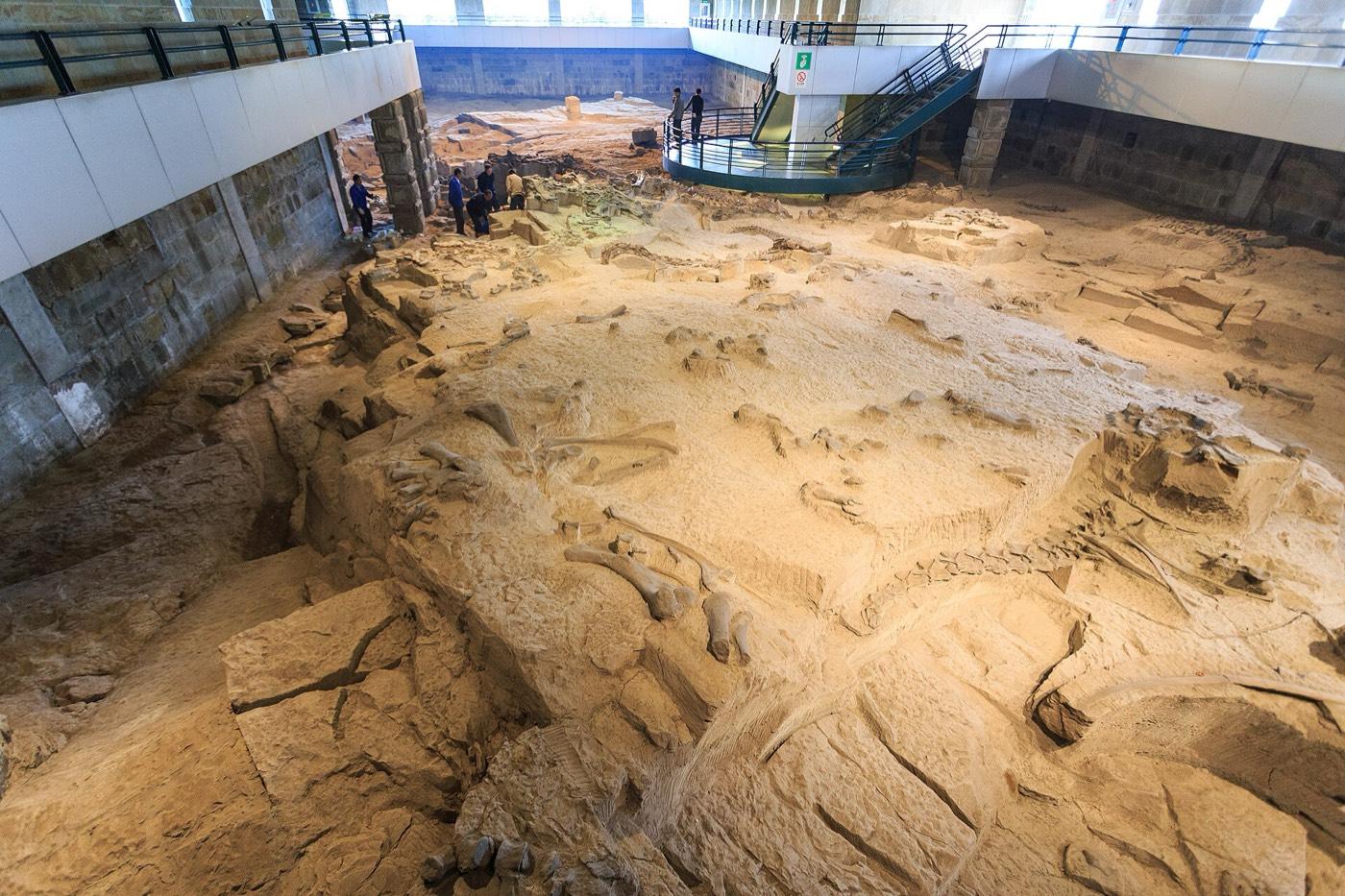
A Middle Triassic marine fossil bed in Member II of the Guanling Formation at Daaozi, Luoping County, Yunnan. Nearly 20,000 macrofossils have been logged, more than 90 per cent of them arthropods. It became a national geopark in 2011.
By Edward Chen · Published 12 October 2026
Introduction
Nearly 20,000 macrofossils have been logged from a 16 metre interval of limestone near Daaozi village in Luoping County, Yunnan. Arthropods make up more than 90 per cent of that count, fishes 4 per cent and bivalves 2 per cent.
Hu and co-authors published the assemblage in 2011 under the name the Luoping biota. They read it as the first fully complex Triassic marine ecosystem, assembled some 10 million years after the end-Permian extinction at 252 million years ago.
Benton and co-authors tracked the site from its identification in 2007 to its acceptance as a national geopark in 2011. Their 2022 account records rapid building of visitor facilities and high visitor numbers.
Read the formation name carefully. The host rock here is the Guanling Formation, and that name also belongs to a county 200 km east in Guizhou. The two are not the same deposit.
The Luoping biota is Anisian, Middle Triassic, about 244 to 243 million years old. The Guanling Biota of Guizhou is Carnian, Late Triassic, about 237 to 227 million years old, and it sits in the Xiaowa Formation. Hu and co-authors state the relationship directly: Luoping predates the Guanling Biota.
Location and Directions
The fossil beds lie at Daaozi village, Luoping County, in Qujing prefecture, eastern Yunnan. Chinese sources also spell the village Dawazi or Da'aozi.
GPS: 24.7797°N, 104.3279°E. Those are the coordinates published for quarry 1 and recorded in the Paleobiology Database for the Dawazi collections.
Shangshikan is the hill that carries the main logged section, a short distance north-east of the village. A second measured section at Daaozi gives the conodont samples that date the biota.
Luoping county town sits on the Shanghai to Kunming rail corridor between Kunming and Qujing. Daaozi is a road journey from the county town through terraced farmland.
Opening hours, admission prices and advance booking are not documented by the geopark in any source this page could verify. Telephone the Luoping county culture and tourism bureau before travelling.
What a visitor can expect to see is also uncertain. The main section is not a natural cliff. Hu and co-authors describe it as the product of intensive excavation led by one of their co-authors. The exposure a visitor meets is engineered ground.
Photographs taken inside the Luoping County Museum in August 2026 show specimens from the Guanling Formation at Daaozi on open display, labelled with their collection years. That museum, in the county town, is the one confirmed place to see the material.
What Fossils You'll Find
Collecting is prohibited. The list below describes what the beds hold.
Crustaceans are the dominant group. Hu and co-authors record decapods, isopods, cycloids, mysidiaceans, conchostracans and ostracods.
Feldmann and co-authors named three decapods from these beds in 2012: Tridactylastacus sinensis, Koryncheiros luopingensis and Yunnanopalinura schrami. The isopod Protamphisopus baii came from the same interval in 2010.
Yunnanolimulus luopingensis is the horseshoe crab. Several specimens keep their appendages, which is unusual for a fossil xiphosurid.
Fishes run to more than 25 taxa across nine families of basal actinopterygians, plus coelacanths. Named forms include the long-snouted predator Saurichthys yunnanensis, the perleidid Luopingichthys, the neopterygian Gymnoichthys inopinatus, Luoxiongichthys hyperdorsalis and Sangiorgioichthys sui.
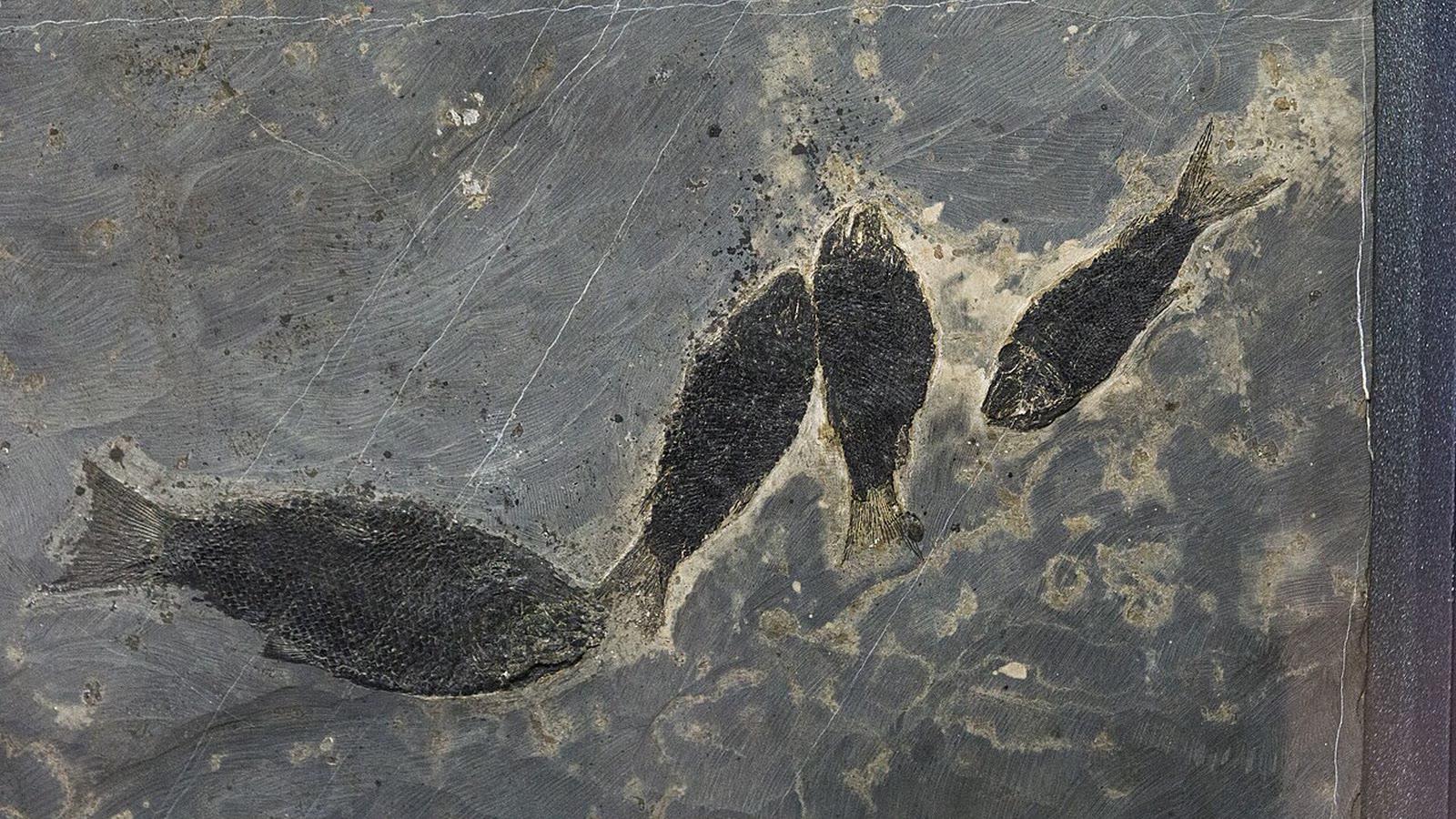
At least three beds in the lower part of the interval carry mass fish deaths, with many well-preserved individuals on a single bedding plane.
 Photo: Kcx36, CC BY-SA 4.0, via Wikimedia Commons

Marine reptiles are the rarest headline group, at under 1 per cent of the counted specimens. That figure is worth holding onto, because popular accounts describe them as common. Ichthyosaurs, sauropterygians, thalattosaurs, prolacertiforms and rare archosaurs are all present.
Dianopachysaurus dingi is the pachypleurosaur named from the Anisian Guanling Formation of Yunnan in 2011. Luopingosaurus imparilis, a long-snouted pachypleurosauroid from Member II at Luoping, followed in 2023. Mixosaurus is the ichthyosaur and Dinocephalosaurus the long-necked prolacertiform.
Molluscs include bivalves, gastropods, ammonoids and belemnoids. Only two belemnoids have been recovered, and both keep their arm hooks and beak parts.
Plants are mostly conifer branches and leaves, complete enough to show they travelled only about 10 km from land. Millipedes turn up in very small numbers.
Geologic History
The Guanling Formation is exposed across eastern Yunnan and western Guizhou, on the south-western Yangtze Platform next to the Nanpanjiang Basin. It divides into two members.
Member I runs 333 metres of mudstone and argillaceous dolomite, with a volcanic ash bed at its base. Member II runs 580 metres of nodular, silty and micritic limestone with dolomite bands. The Yangliujing Formation above it adds 1,204 metres of dolostone.
The Luoping biota sits in the middle part of Member II, in a package about 16 metres thick at Daaozi. Thick-bedded, heavily bioturbated limestones bound it top and bottom.
Conodonts from beds 41 and 43 belong to the Nicoraella kockeli Zone, which marks the Pelsonian Substage of the Anisian Stage. The Paleobiology Database places that interval at roughly 244 to 243 million years ago. The International Commission on Stratigraphy puts the whole Anisian between about 247 and 241.5 million years ago.
Preservation turns on oxygen and microbes. Fine horizontal laminae and the near absence of burrowing animals point to a low-energy, semi-enclosed basin within the platform, with dysoxic to anoxic bottom water. Pyrite framboids and abundant organic matter in the dark sediment support that reading.
Microbial mats coat the upper surfaces of the micritic limestones. Hu and co-authors argue the mats sealed carcasses quickly, which held soft tissue and kept skeletons articulated. They borrow the death mask model first applied to Ediacaran fossils.
Of more than 10,000 specimens counted at the time of their study, 99 per cent were complete. Almost all are flattened, and three-dimensional preservation is very rare.
The same dark micritic limestones have been mapped across roughly 200 square kilometres. Outside that area Member II is pale and bioturbated, and the preservation does not hold.
 Photo: Oilshale, CC0, via Wikimedia Commons

Collecting Rules and Regulations
Collecting is prohibited. Luoping is a national geopark and the beds are a protected geological relic.
The site exists in its present form because the state chose to protect it rather than quarry it. Specimens from the main excavation are held at the Chengdu Geological Center, under the LPI and LPV catalogue prefixes.
Do not hammer the section, do not split slabs, and do not buy fossils from sellers near the village. Chinese law treats unauthorised removal of protected fossil material as an offence, and material of this kind is covered.
If you want a Luoping fossil in your hand, that is what the county museum is for. Ask the staff rather than the hillside.
No source confirms whether the excavated section itself is open to the public. Benton and co-authors record facilities and visitors, but no accessible document describes a route onto the outcrop. Treat on-site access as unconfirmed and ask locally.
Safety
The ground at Shangshikan is a worked excavation in limestone and calcareous mudstone. Keep away from any cut face. Excavated faces in thin-bedded limestone shed slabs without warning.
Spoil heaps from the dig are loose underfoot. Boots with ankle support are worth the weight.
Eastern Yunnan sits at moderate altitude with a wet summer. Heavy rain makes the farm tracks into Daaozi slippery, and the clay turns greasy.
Luoping is farmland in active use, including the rapeseed fields the county is known for. Walk field margins, close gates and ask before crossing a plot.
Carry water. There is no shade on an open section and no facilities at the outcrop.
Phone signal is generally workable in the valley, but tell someone where you are going if you leave the road.
Sources
https://pmc.ncbi.nlm.nih.gov/articles/PMC3119007/ https://doaj.org/article/be5af0db084e463f921938ac0cf3b443 https://paleobiodb.org/data1.2/colls/list.txt?base_name=Yunnanolimulus&show=loc,strat https://stratigraphy.org/chart https://bioone.org/journals/Journal-of-Paleontology/volume-86/issue-3/11-113.1/Macrurous-Decapoda-from-the-Luoping-Biota-Middle-Triassic-of-China/10.1666/11-113.1.full https://en.wikipedia.org/wiki/Dianopachysaurus https://en.wikipedia.org/wiki/Luopingosaurus https://commons.wikimedia.org/wiki/Category:Luoping_County_Museum
Nearby sites
 Chengjiang Fossil Site, Maotianshan Fossil Hunting GuideTrilobites, Arthropods
 Guanling Fossil National Geopark Fossil Hunting GuideMarine reptiles, Ichthyosaurs
 Lufeng World Dinosaur Valley Fossil Hunting GuideLufengosaurus huenei, Yunnanosaurus huangi
 Zigong Dinosaur Museum, Dashanpu Fossil Hunting GuideDinosaurs, Sauropods