Zigong Dinosaur Museum, Dashanpu Fossil Hunting Guide
Image: Zhangzhugang (CC BY 4.0)
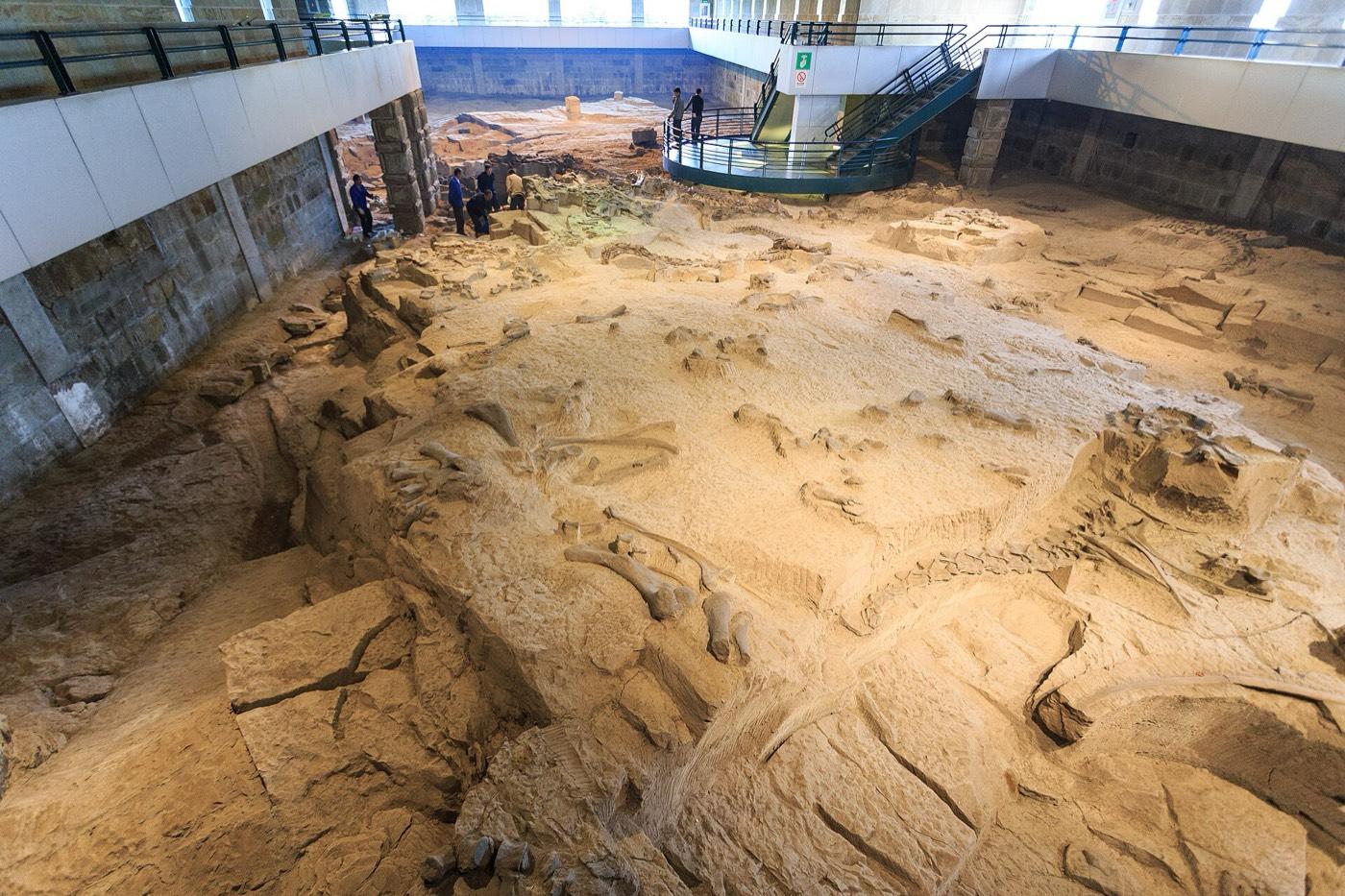
A museum built directly over a Middle Jurassic bonebed at Dashanpu in Sichuan, where excavated bone is left in the rock and viewed in place. It opened in 1987 as the first museum in Asia devoted almost entirely to dinosaurs.
By Edward Chen · Published 12 September 2026
Introduction
The Middle Jurassic is poorly represented almost everywhere. Most of the famous dinosaur faunas are Late Jurassic or Cretaceous, and the gap between them is one of the real holes in the record. Dashanpu fills part of it.
Quarrying at Dashanpu, on the edge of Zigong in Sichuan, exposed a dense concentration of Middle Jurassic vertebrates in the 1970s and 1980s. Rather than remove everything, the authorities roofed the excavation and built a museum over it. Bone remains in the rock where it was found, and visitors look down on it.
The museum opened in 1987 and was the first in Asia devoted almost entirely to dinosaurs. The International Union of Geological Sciences lists Dashanpu as a geoheritage site of international standing.
Location and Directions
Dashanpu is a township about 7 kilometres north-east of central Zigong, in the south of Sichuan province.
GPS: 29.3989°N, 104.8261°E.
Zigong is reachable by rail and road from Chengdu and Chongqing. Local buses and taxis run out to the museum.
Admission is charged. Check current opening before you travel, because Chinese museum hours change seasonally and around public holidays, when the site is busy.
Zigong is also known for salt mining and for its lantern festival, so the dinosaur museum is one of several reasons visitors come.
What Fossils You'll Find
Nothing is collectable. The point of the site is the excavation floor, where bone lies as it was buried.
The Shaximiao Formation produced a Middle Jurassic fauna dominated by sauropods. Shunosaurus, a short-necked sauropod with a bony tail club, is the best known and is represented by many individuals. Omeisaurus and Mamenchisaurus are the long-necked forms, the latter carrying one of the longest necks of any known animal.
Huayangosaurus, the early stegosaur named from Dashanpu, occurs here, as do theropods, small ornithopods, and non-dinosaurian material including fish, turtles and crocodile relatives.
Gigantspinosaurus is sometimes listed with the Dashanpu animals. It comes from the Upper Shaximiao rather than from this quarry.
The density is the thing that registers in person. This is not one skeleton on a wall but a jumble of many animals in a single bed.
Mamenchisaurus deserves its own note. Its neck exceeded 40 percent of total body length, supported by unusually long cervical vertebrae. The proportions are extreme even among sauropods. Specimens from Sichuan are the basis for that reputation.
 Photo: Zhangzhugang, CC BY 4.0, via Wikimedia Commons
Geologic History
The Shaximiao Formation is Middle Jurassic, broadly Bathonian to Callovian, roughly 168 to 161 million years ago. The lower and upper members are sometimes treated separately, and the Dashanpu material comes from the lower part.
The Sichuan Basin was an inland lowland with rivers and lakes, ringed by uplands. Red beds accumulated across it through much of the Mesozoic, which is why the province holds such a long terrestrial record.
Carcasses were carried into a channel and concentrated there. That is the standard explanation for a bonebed of this type. It accounts for the mixture of species and the disarticulated state of much of the material.
The Middle Jurassic gap is worth restating, because it is the reason specialists travel here. Fossil-bearing rocks of this age are scarce worldwide. So a single rich locality carries disproportionate weight when researchers reconstruct how sauropods and stegosaurs evolved between the Early and Late Jurassic faunas.
 Photo: Zhangzhugang, CC BY-SA 4.0, via Wikimedia Commons
Collecting Rules and Regulations
Collecting is prohibited. China treats vertebrate fossils as state property, and enforcement is active following international prosecutions for fossil trafficking.
Do not buy fossils in China and do not attempt to export any. Penalties are serious, and material offered to tourists is frequently either illegal or fake.
Photograph the excavation and leave everything where it is.
Shunosaurus is the animal to look for. Sauropods are usually pictured as defenceless, but Shunosaurus carried a bony club at the end of its tail. The Dashanpu material is complete enough to show it clearly. It is one of the few sauropods known from good skull material as well.
 Photo: Zhangzhugang, CC BY-SA 4.0, via Wikimedia Commons
Safety
This is an indoor museum with walkways and presents no unusual hazards.
The excavation hall is large and can be poorly lit in places. Watch your footing on the viewing structures.
Sichuan summers are hot and humid, and the region is seismically active.
Visit outside Chinese public holidays if you can, because crowding at popular museums during Golden Week is severe.
Zigong itself is an old salt-mining city, and the Zigong Salt Industry History Museum, in the Shaanxi Guild Hall and the ancient drilling works are the other reasons visitors stop. The lantern festival in winter is the busiest period.
The bonebed came to light by accident rather than by survey. Students at a road bank near Dashanpu found the first Shunosaurus material in 1977. Systematic work followed once the density of the deposit became clear. Dong Zhiming, Zhou Shiwu and Zhang Yihong described and named Shunosaurus lii in 1983.
The Sichuan Basin's red beds run from the Triassic through the Cretaceous, which gives the province one of the longest continuous terrestrial records in Asia. Dashanpu is the richest window into the middle of it.
 Photo: Zhangzhugang, CC BY-SA 4.0, via Wikimedia Commons
 Photo: Zhangzhugang, CC BY 4.0, via Wikimedia Commons
Sources
https://iugs-geoheritage.org/geoheritage_sites/dashanpu-middle-jurassicdinosaur-fossils-site/ https://en.wikipedia.org/wiki/Zigong_Dinosaur_Museum https://en.wikipedia.org/wiki/Shaximiao_Formation https://www.tandfonline.com/doi/full/10.1080/02724634.2021.1995737