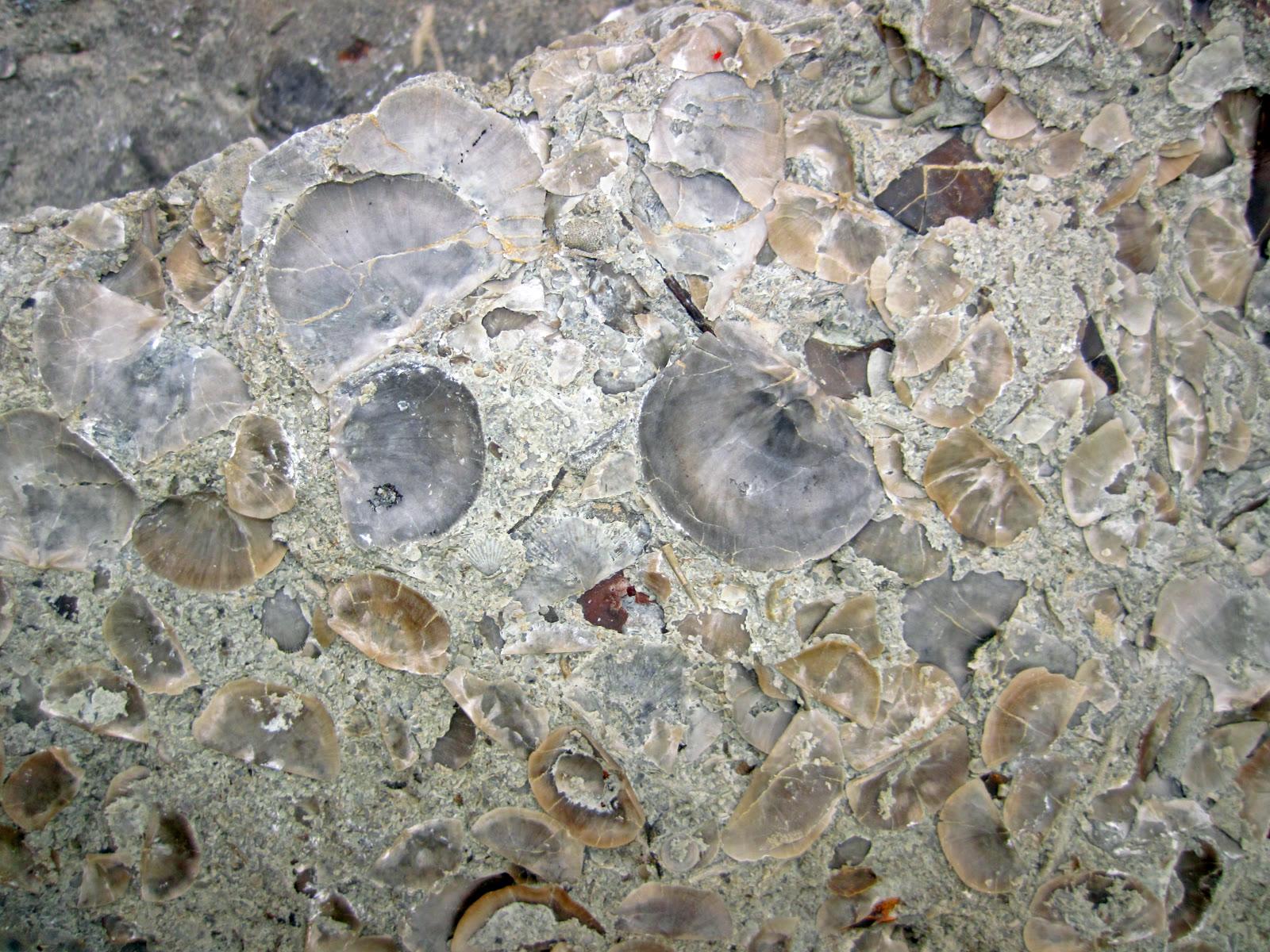
St. Leon Roadcut Fossil Hunting Guide
Image: James St. John (CC BY 2.0)
The St. Leon roadcut just off I-74 in southeastern Indiana is one of the most productive free public fossil sites in the United States. The exposed Waynesville and Liberty formations of the Upper Ordovician yield brachiopods, bryozoans, horn corals, crinoid stems, and the trilobites Flexicalymene and Isotelus by the handful. Surface collecting only. No digging or tools.
By Edward Chen · Updated 31 July 2026
Introduction
The St. Leon roadcut is a long, exposed roadside cut along Indiana State Road 1, immediately off Interstate 74 at Exit 164 in southeastern Indiana. It exposes a steeply layered section of Upper Ordovician (Katian, roughly 451–446 million years ago) Waynesville and Liberty formations, the same Cincinnatian-series rocks that underlie the famous Cincinnati Arch fossil region. The cut is widely considered one of the most productive free public fossil sites in the United States: pull off the shoulder, scan the talus slope, and pick up identifiable invertebrate fossils within minutes.
Indiana Department of Transportation has not formally posted the cut for collecting, but it is universally treated as a public-access surface-collecting site by the fossil-hunting community, and the Indiana Geological Survey's amateur-friendly literature points enthusiasts to similar Cincinnatian roadcuts. Tools and digging are not allowed. Collecting is by hand from the loose scree.
Location and Directions
The cut is just east of the village of St. Leon, in Dearborn County, about 25 miles west of Cincinnati, Ohio.
Directions to the St. Leon Roadcut
From Cincinnati: take I-74 west about 22 miles to Exit 164 (St. Leon / Indiana SR-1). The exit ramp ends at SR-1. Turn south (left). The long roadcut starts within a few hundred yards on both sides of the road and continues for nearly a mile along SR-1.
The richest horizon is the "butter shale" of the upper Waynesville, famous for trilobites, but the material to collect gathers at the toe of the slope rather than on the face. After rain, freshly washed scree concentrates trilobites and brachiopods there. Read the safety section below before you park, because this is an active state highway.
What to bring: a small bucket or canvas bag, knee pads, a small bristle brush, magnifier, sunscreen, water, and a safety vest if you have one. No hammers, chisels, picks, or motorised tools.
What Fossils You'll Find
The Waynesville and Liberty formations of the Cincinnatian Series (upper Ordovician, Katian Stage) record warm, shallow subtropical seas across the Cincinnati Arch about 451 to 446 million years ago. The fauna is famously dense and easy to collect, generations of midwestern paleontologists have cut their teeth on Cincinnatian fossils, and most museum reference collections in the eastern United States hold material from this area.
Brachiopods dominate the surface scree by sheer numbers. The broad-shelled, strongly ribbed Hebertella occidentalis and the closely related Platystrophia ponderosa are the most easily recognised, often weathering out as complete pedicle valves or whole double shells. The thin, fan-shaped Strophomena planumbona and the larger, semicircular Rafinesquina alternata are common in the more clay-rich horizons. The small, ribbed Zygospira modesta (which still preserves articulated valves at the millimetre scale), Plaesiomys subquadrata, and the punctate Pionodema subaequata round out the brachiopod fauna. Whole brachiopod coquina slabs, dense storm-concentrated death assemblages, are the iconic Cincinnatian collectible.
Bryozoans occur in all three growth modes: ramose colonial Heterotrypa and Dekayia as fragmenting branches, fenestrate Phylloporina and Constellaria as lace-like fragments, and encrusting Spatiopora coating brachiopod shells and crinoid columnals. The horn corals Grewingkia canadensis and the smaller Streptelasma are common as conical solitary corals 1 to 3 centimetres tall, often complete and easily polished. Crinoid columnals are everywhere, the small, hollow, ringed disc shapes are unmistakable, and whole crinoid crowns and calyxes of Cincinnaticrinus, Glyptocrinus, and Anomalocrinus turn up rarely but reliably. Echinoderm material also includes plates of the starfish-like Promopalaeaster and the cystoid Hybocystites.
The most prized find at St. Leon is the small enrolled trilobite Flexicalymene meeki, typically 2 to 5 centimetres long when fully grown. The trilobite occurs throughout the section but is concentrated in the soft, fissile "butter shale" horizon of the upper Waynesville Formation, a clay-rich bed that produces complete enrolled specimens with striking detail when split carefully. The much larger trilobite Isotelus gigas (the Ohio state fossil, and Ordovician North America's largest known trilobite at over 70 centimetres) occurs as pygidia and head shield fragments along the cut. Whole specimens are rare but well documented and have come from the St. Leon cut several times in the last few decades. Other arthropods include the smaller trilobite Cryptolithus, the eurypterid Megalograptus, and ostracods.
Cephalopod fragments are common, straight-shelled orthocones (Endoceras, Treptoceras) reach a metre or more in length and turn up as broken segments, along with the small coiled Cyclonema gastropods, the larger gastropod Liospira, bivalves (Modiolopsis, Ambonychia), and the conulariid Conularia. Sponges and algae occur as fragments. Trace fossils, burrows, trails, and bioturbation, are present in many slabs.
Rock & Gem Magazine ranks St. Leon among the most productive free public fossil-collecting sites in the country, citing the abundant brachiopods, horn coral, crinoids, and the occasional trilobite.
Geologic History
The Cincinnatian Series, globally the type series for the upper Ordovician, was deposited in a warm, tropical epicontinental sea that covered the eastern interior of Laurentia (the proto-North American continent) during the late Ordovician. The continent at the time was rotated roughly 90 degrees from its modern orientation and lay across the equator. What is now southeastern Indiana sat at about 20 degrees south, in a setting analogous to the modern Bahama Banks. Thin alternating limestones, marls, and shales record subtle sea-level fluctuations and storm events on the gently dipping carbonate ramp that extended westward from the Taconic Highlands of the modern Appalachian region.
The Waynesville and Liberty formations are the second and third formations from the top of the Cincinnatian section in this area (just below the Whitewater Formation that caps the system). They were deposited in moderately shallow normal-marine waters with abundant epibenthic shelly invertebrates, brachiopods, bryozoans, crinoids, trilobites, accumulating in great densities and periodically reworked by storms into the storm-concentrated coquinas that dominate the modern roadcut. The "butter shale", a soft, fissile, dark grey clay-rich bed in the upper Waynesville, represents a low-energy interval where Flexicalymene trilobites could enroll and be buried in growth position, preserving complete specimens.
The Cincinnati Arch is a broad, low, north-south-trending structural high that uplifted these rocks gently above the surrounding basins (Illinois Basin to the west, Appalachian Basin to the east) during the late Paleozoic and again during Cenozoic Appalachian rejuvenation. The arch's broad, gentle structure means the Cincinnatian Series crops out across the surface for tens of thousands of square kilometres of southeastern Indiana, southwestern Ohio, and northern Kentucky, providing some of the easiest fossil-collecting access in North America.
Quaternary glaciation pushed the Wisconsinan ice sheet to within about 30 kilometres of St. Leon but did not cover the immediate area, so the Ordovician rocks crop out cleanly. The St. Leon roadcut was created when Interstate 74 was completed through southeastern Indiana in the 1970s, slicing through the gently east-dipping Waynesville and Liberty formations on either side of the State Road 1 overpass.
How the St. Leon Roadcut Came to Be a Collecting Site
The cut was almost immediately discovered by Cincinnati-area collectors after I-74 was opened, and has been a Cincinnati Dry Dredgers, Greater Cincinnati Mineral Society, Earth Science Club of Northern Illinois, and Indiana University–Bloomington geology department field-trip staple since the late 1970s. The Indiana Department of Transportation has not formally posted the cut for collecting, but Indiana is generally permissive of surface-only roadside fossil collecting on the cut faces of state highways, and the long-established de facto status is well understood by the regional collecting community.
Collecting Rules and Regulations
Is Fossil Collecting Allowed?
Yes, surface collecting is permitted as personal-use recreational rockhounding. Tools and digging are not permitted on roadside cuts in Indiana.
Key Points:
- Free public access. No permit or fee
- Surface collecting only, no hammers, chisels, picks, or digging
- No collection on private land adjacent to the cut without permission
- No collection from active drainage gullies or unstable scree
- Best after rain when fresh scree is washed clean
Safety
SR-1 is an active state highway with truck traffic and limited sight lines around the curves, and the cut runs along it for nearly a mile. This is the hazard that matters at St. Leon.
Park completely off the carriageway on the wide shoulder, well away from a bend, and get out on the side away from the lane. Wear bright clothing or a high-visibility vest. Keep children within arm's reach for the whole visit, and do not let anyone cross the road on foot. If the only space is on a curve, drive on and find another stretch.
The scree slope is loose and steep in places. Collect from the toe of the slope rather than climbing it, which is where the washed material concentrates anyway. Stay out of the drainage gullies cut into the face, since those are the parts of the slope that move.
The Waynesville shale is slick when wet and the whole slope drains onto the shoulder after rain. Wear boots with a firm sole and expect mud. Kneeling on scree for any length of time is hard going, which is why regulars bring pads.
There is no shade, no water, and no facilities along the cut. Summers in southeastern Indiana are hot and humid, so carry water. Ticks are present in the grass above the cut, and copperheads occur in the region and favour warm rock piles.
Sources
- Rock & Gem Magazine: St. Leon, Indiana Fossils: A Collector's Dream Site
- The Fossil Forum: Rare goodies from the St. Leon roadcut, Indiana
- Nautiloid.net: Cincinnati / St. Leon fossil hunting
- The Fossil Forum: Hunting the roadcuts of Indiana's Ordovician
- Rock & Gem: Trammel Fossil Park & Cincinnati Arch collecting
Nearby sites
 Hueston Woods State Park Fossil Hunting GuideBrachiopods, Bivalves
 Trammel Fossil Park Fossil Hunting GuideTrilobites, Brachiopods
 Big Bone Lick State Historic Site Fossil Hunting GuideAmerican mastodon (Mammut americanum), Columbian mammoth (Mammuthus columbi)
 East Fork State Park Fossil Hunting GuideTrilobites, Brachiopods