Halkyn Mountain Fossil Hunting Guide
Image: Lauren (CC BY 3.0)
Halkyn Mountain rises over the Dee estuary in northeast Wales as a broad open plateau of Carboniferous limestone. Mining hollows, swallow holes, and the surface scars of more than two thousand years of lead working cut across it.
By Edward Chen · Updated 1 August 2026
Introduction
Halkyn Mountain rises over the Dee estuary in northeast Wales as a broad open plateau of Carboniferous limestone. Mining hollows, swallow holes, and the surface scars of more than two thousand years of lead working cut across it. The rock that drew the Romans, and later the eighteenth and nineteenth century lead barons, is the same rock that holds the fossils. The plateau exposes the Visean limestones of the Clwyd Limestone Group, formed in warm shallow seas roughly 340 to 330 million years ago. Brachiopods, rugose and tabulate corals, crinoid stems, bryozoans, and the occasional gastropod weather out of the limestone scars and spoil heaps. The site is unusual in Wales because the mining heritage has done much of the geologist's work already, opening sections that would otherwise be buried beneath grass and gorse. Halkyn Mountain is also registered common land, with public rights of access on foot, but it is criss-crossed by abandoned shafts and active quarry workings that demand caution. This guide covers how to find the better fossiliferous ground, what the limestone records about the Carboniferous tropical seas, and how to collect responsibly on a working SSSI.
Location and Directions
The site lies on the open common above Halkyn village, in Flintshire, North Wales, postcode CH8. A useful starting point is the lay-by and footpath access at Pant-y-Pwll Dwr, grid reference SJ 207 712, on the minor road that climbs from Halkyn village onto the common.
From the A55 North Wales Expressway, leave at junction 32A signed Halkyn. Follow the B5123 up into Halkyn village, then take the minor road past the church and Halkyn Castle estate, climbing onto the open common. Several pull-ins and informal lay-bys give parking for a handful of cars. There is no formal car park, no toilets, and no cafe on the common itself. The village pub and shop are the nearest facilities.
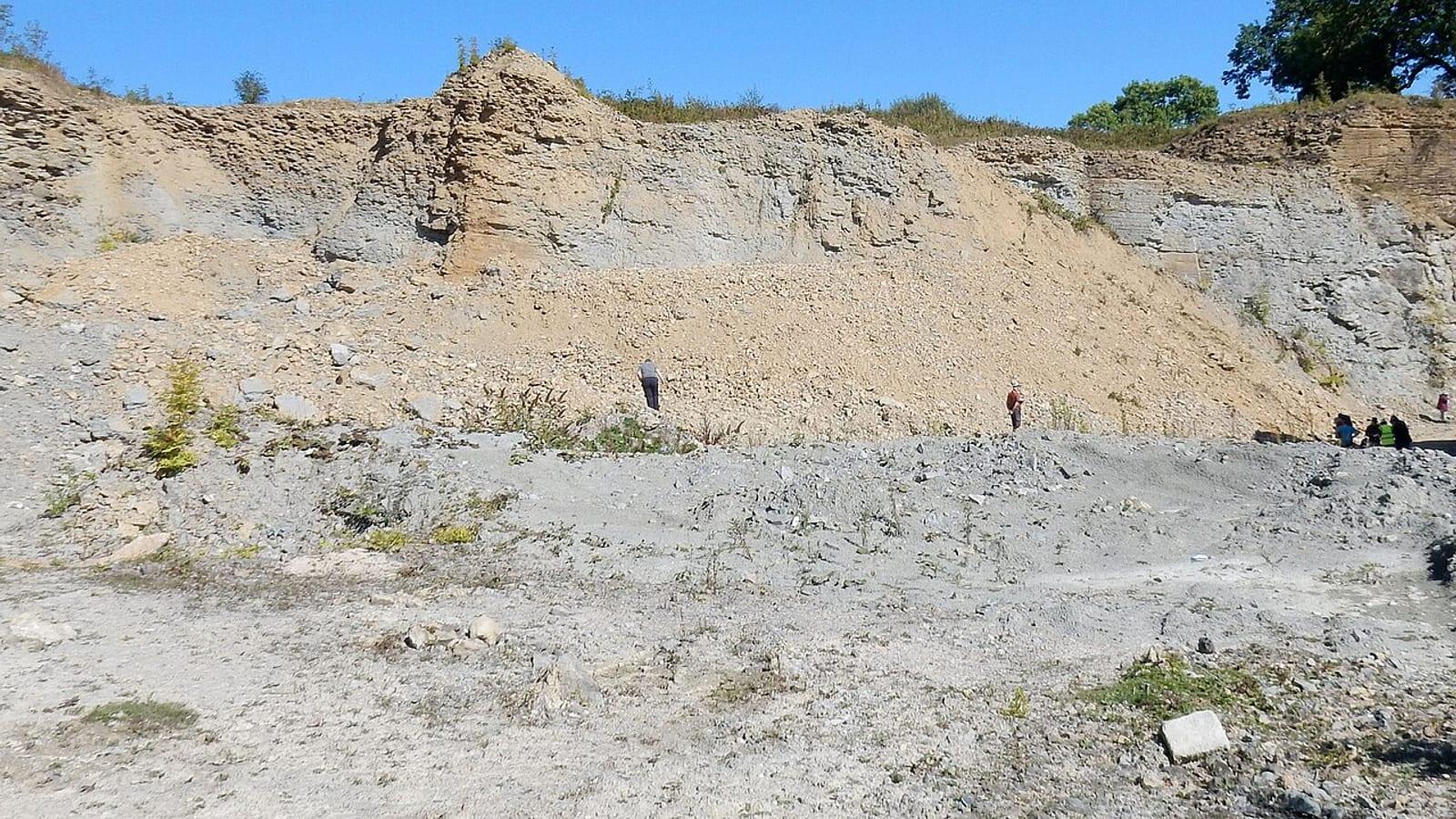
From the parking lay-by, follow the network of public footpaths and bridleways across the common. The fossiliferous ground is concentrated around the old lead workings on the southeast side of the plateau, roughly 1 kilometre from the road. Spoil heaps and small abandoned quarries along the trackways are the most productive search areas. The active Pant-y-Pwll Dwr Quarry sits on the eastern flank and is fenced. Do not enter the active quarry under any circumstances, and respect its blast warnings.
Weather matters more than tides on Halkyn Mountain. The plateau is exposed and the wind cuts across it in any season. Visibility drops fast in low cloud, and the mining hollows become genuinely dangerous when you cannot see the ground in front of you. Avoid the site in fog. Winter mud makes the spoil heaps slippery, and summer bracken hides shaft mouths. Late spring and autumn give the cleanest ground.
What Fossils You'll Find
The limestone here is fossiliferous throughout, but most material is scattered as broken fragments in spoil rather than complete specimens. The best collecting strategy is to walk the spoil heaps and old quarry floors, picking weathered blocks and turning them over rather than hammering anything in place.
Brachiopods are the dominant fossil. Productids, with their large concave-convex shells and spine bases, are common in the bedded limestones. Spirifers, with their wing-shaped outlines and ribbed valves, appear in many spoil blocks. Smaller athyrids and rhynchonellids show up as rounded shells in the finer-grained beds.
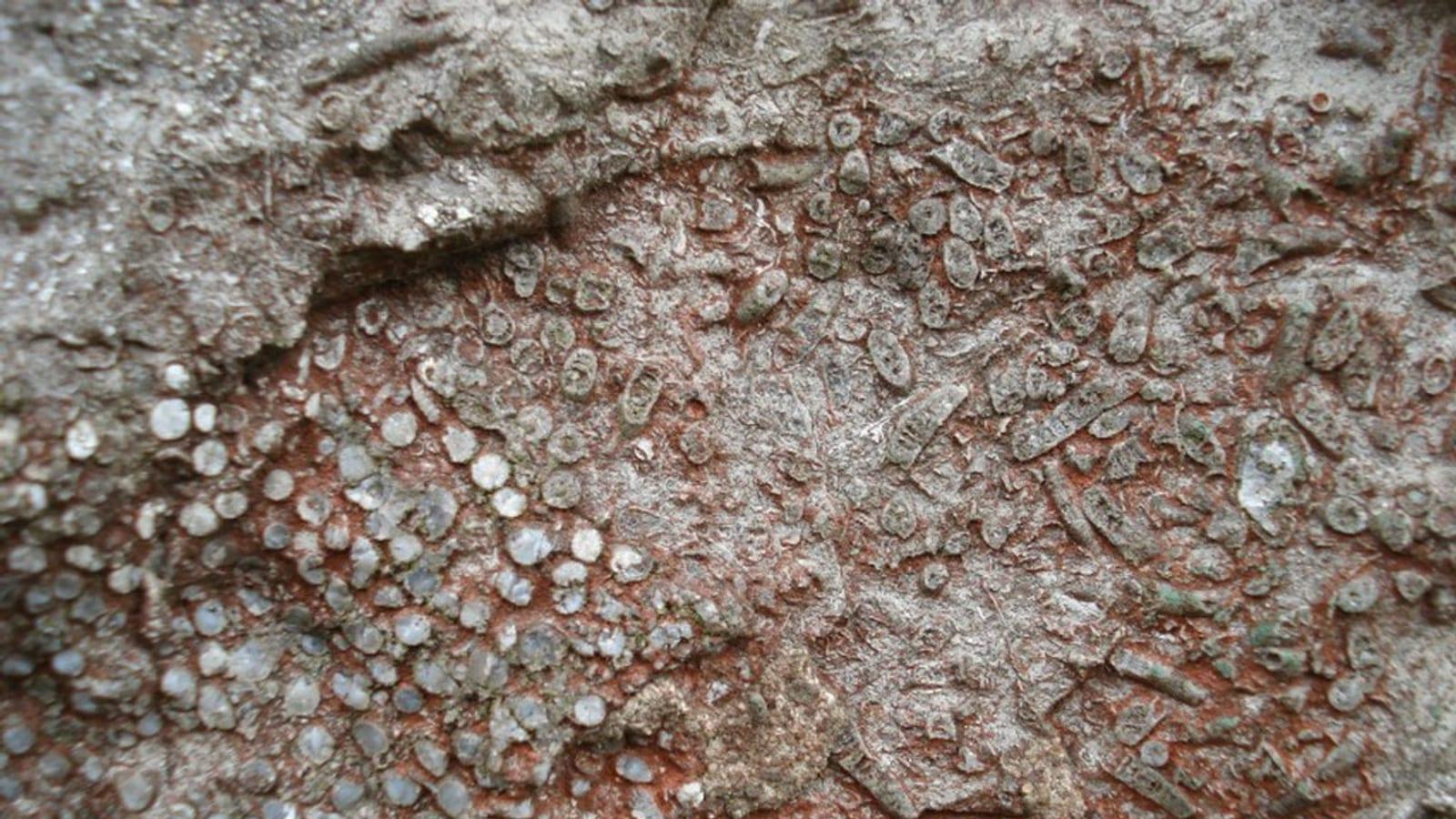
Corals include both solitary rugose forms and colonial tabulate genera. Look for horn-shaped sections of rugose corals, sometimes 5 to 10 centimetres long, weathered out of darker bands in the limestone. Colonial Lithostrotion and Syringopora show as honeycomb or tube-bundle textures on broken faces. The photograph in the existing post shows a typical bedded coral float block from the quarry margins.
Crinoid stem segments are everywhere. They appear as small disc-shaped ossicles with a central canal, sometimes still articulated into short columns. Whole calyces are rare and worth a careful look. They tend to occur in shell-rich pockets representing storm-reworked debris.
Bryozoans include fenestrate forms with their lacy net textures and encrusting types on shell surfaces.
Gastropods are less common but present, usually as small turreted moulds.
The spoil from old lead workings has the advantage of presenting rock that has been broken open and turned over by miners. Weathered surfaces show fossil content that bedrock outcrops would hide. The same spoil also contains galena fragments and quartz veining. Do not pocket the galena as it is lead sulphide and should be handled with care.
Geologic History
Halkyn Mountain exposes part of the Clwyd Limestone Group of the Carboniferous, deposited during the Visean stage roughly 340 to 330 million years ago. The relevant local units are the Loggerheads Limestone Formation in the lower part of the section and the Cefn Mawr Limestone Formation higher up, both well-bedded grey marine limestones with subordinate dolomitised intervals.
In the Visean, what is now North Wales sat just south of the equator, on the broad carbonate shelf that fringed the southern margin of the Laurussian continent. The seas were warm, clear, and shallow, with water depths of a few tens of metres over much of the shelf. Carbonate-secreting organisms thrived in these conditions: crinoids carpeted the seafloor with their long stems, brachiopods filtered the water column, corals built small patches of biostrome, and bryozoans encrusted any hard surface. When these animals died, their skeletons accumulated as carbonate sand and gravel, later cemented into the limestone now visible at Halkyn.
Storm beds and grainstone layers within the formation represent higher-energy episodes that swept skeletal debris into shell hashes. These are the most productive horizons for fossil hunters, because the durable shells and stem fragments concentrated in them while mud washed away.
After the Carboniferous, the limestones were buried, fractured, and faulted during the Variscan and later tectonic events. Mineralising fluids moved up the faults and deposited galena, sphalerite, and barite in vein networks. This is the orefield that drove two thousand years of mining at Halkyn, Talargoch, and the wider Pennine-style ore province. Erosion through the Mesozoic and Cenozoic stripped off later cover, and the limestone now forms the open plateau of the mountain.
How Halkyn Mountain Became a Fossil Collecting Site
This is an industrial-heritage site rather than a natural-erosion one. The Romans worked the lead veins under Halkyn for galena, and the mines reopened repeatedly through the medieval period, reaching their peak in the eighteenth and nineteenth centuries when Halkyn was one of the richest lead districts in Britain. Mining left a landscape of shafts, adits, levels, and spoil heaps that exposed the host limestone in section everywhere. Modern fossil collectors benefit from this incidental excavation. Almost every productive search site on the mountain is a mining feature.
Quarrying for limestone aggregate continues today at Pant-y-Pwll Dwr Quarry on the eastern margin, which periodically supplies fresh spoil to the surrounding ground. The mountain itself is registered common land under the Commons Act, with public rights of access on foot, and parts of it are designated as a Site of Special Scientific Interest for both geology and biology.
Collecting Rules and Regulations
Surface collecting of loose specimens is permitted. Hammering the bedrock or in-situ outcrops is not. Halkyn Mountain is an SSSI, and the standard SSSI fossil collecting code applies: take only loose material from spoil and float, do not damage outcrops, and report scientifically significant finds.
The active Pant-y-Pwll Dwr Quarry is private working ground. Do not enter the active quarry, do not collect from its faces, and do not cross any fenced or signposted boundary.
Practical rules:
- Take only loose material from spoil heaps and float. Do not hammer in-situ outcrops.
- Report scientifically notable finds, as the SSSI collecting code requires.
- Dogs are welcome on the common but should be on a lead near livestock.
- No fees apply for access to the common. Parking is informal and free.
If you want context for what you are seeing, the Grosvenor Caving and Mining Heritage exhibits at the nearby Halkyn United Mines and the Welsh Mines Trust resources cover the industrial side. The British Geological Survey's regional geology guides cover the rocks.
Safety
Halkyn Mountain is an old lead field, and the ground is full of holes.
Open shafts are the largest hazard. More than two thousand years of mining left shafts, adits, and subsidence hollows across the common, many of them unfenced or fenced with wire that failed long ago. Never approach the lip of an unsecured hole, never lean over one for a better view, and treat any circular depression in the grass as a shaft until you know otherwise.
Summer bracken hides shaft mouths completely, which is a reason to prefer late spring and autumn beyond the cleaner ground for collecting. Stay on the established footpaths and bridleways where you can.
Fog is the other serious risk. The plateau is exposed, visibility drops fast in low cloud, and the mining hollows become genuinely dangerous when you cannot see the ground ahead. Do not go up in fog, and come down if it closes in. Carry a torch and a charged phone.
Spoil heaps are unstable. Work from the edges and do not climb the steep sides. Wear sturdy boots, and eye protection if you split loose blocks.
Galena and other lead minerals are scattered through the spoil. Galena is lead sulphide. Handle it as little as possible, do not pocket it, keep it away from children, and wash your hands before eating or drinking.
The active Pant-y-Pwll Dwr Quarry on the eastern flank is fenced working ground with blasting. Do not enter it or cross any signposted boundary, and heed the blast warnings.
The common carries grazing livestock, so keep dogs on a lead near stock and near shaft mouths. There are no toilets, no cafe, and no formal car park, and the nearest facilities are the pub and shop in Halkyn village.
Sources
- British Geological Survey, "Carboniferous Limestone of North Wales, Loggerheads and Cefn Mawr Limestone Formations." https://www.bgs.ac.uk/
- Natural Resources Wales, "Halkyn Mountain SSSI citation." https://naturalresources.wales/
- Halkyn District United Mines Ltd, "Halkyn mining heritage." https://halkynminingheritage.org/
- Welsh Mines Society, "Halkyn lead orefield." https://www.welshmines.org/
- UK Fossils Network, "Halkyn Mountain." https://ukfossils.co.uk/