Yunyang Dinosaur Fossil Wall Fossil Hunting Guide
Image: STW932 (CC0)
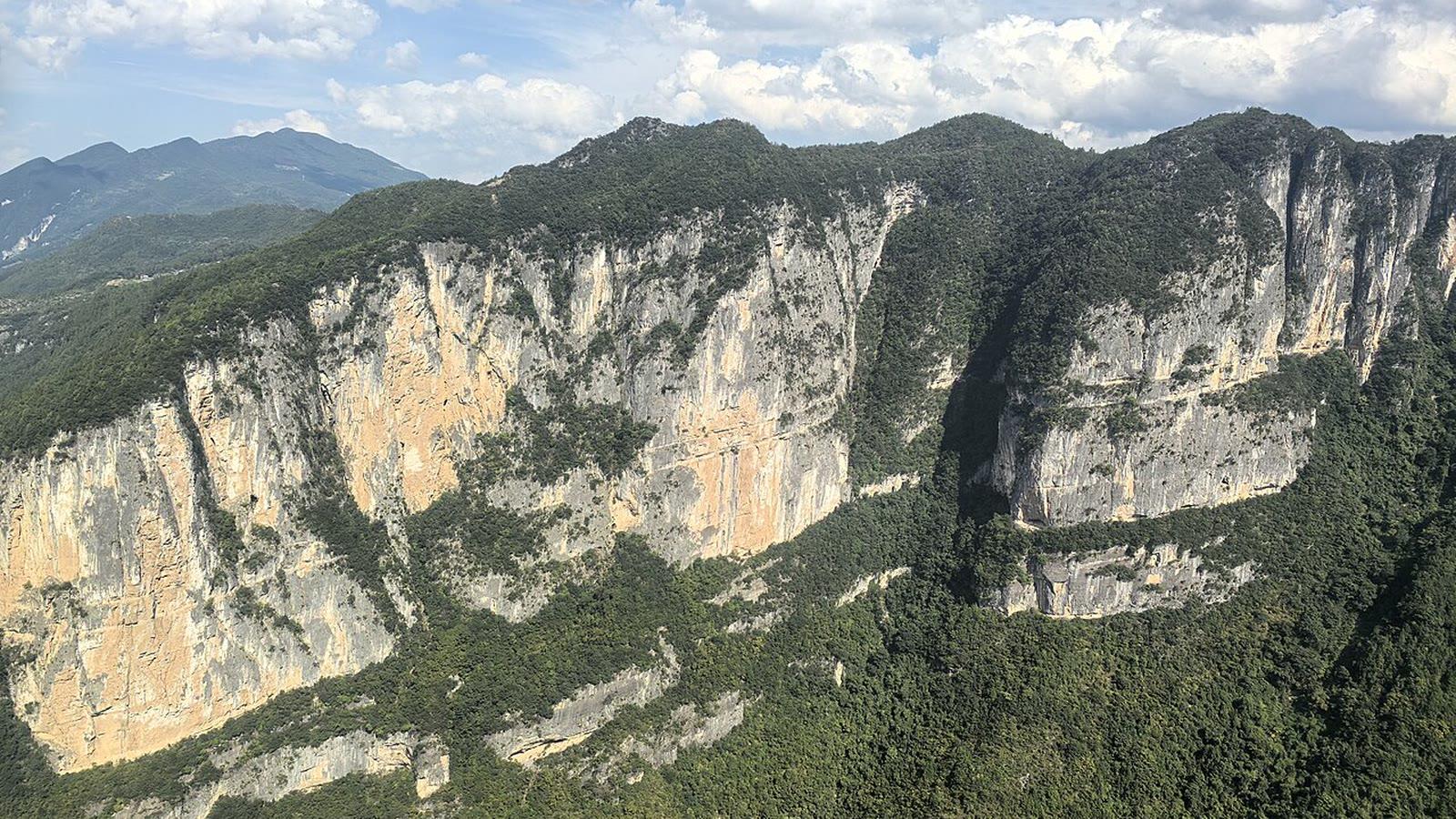
A single rock face at Pu'an in Yunyang County, Chongqing, with about 5,000 Middle Jurassic dinosaur fossils left in the lower Shaximiao Formation and roofed over. UNESCO added the surrounding geopark to its network in 2025.
By Edward Chen · Published 12 October 2026
Introduction
UNESCO records one outcrop at Pu'an in Yunyang County, Chongqing, as 150 metres wide and 6 to 10 metres high. About 5,000 dinosaur fossils lie exposed on that one face.
None of it has been lifted out. A roofed structure covers the rock, and the Chinese government calls the building the Yunyang On-site Dinosaur Fossil Protected Shelter. Visitors look at bone where it was buried.
The face belongs to a longer belt. UNESCO describes an 18 km stretch of sedimentary rock laid down between 175 and 161 million years ago. Chinese sources call that belt the Great Wall of Dinosaur Fossils. The Global Geoparks Network calls the deposit the largest single-layer Jurassic dinosaur fossil cluster on the planet.
In 2025 UNESCO added the surrounding Yunyang Global Geopark to its network. The geopark covers 112,400 hectares inside the Three Gorges Reservoir area.
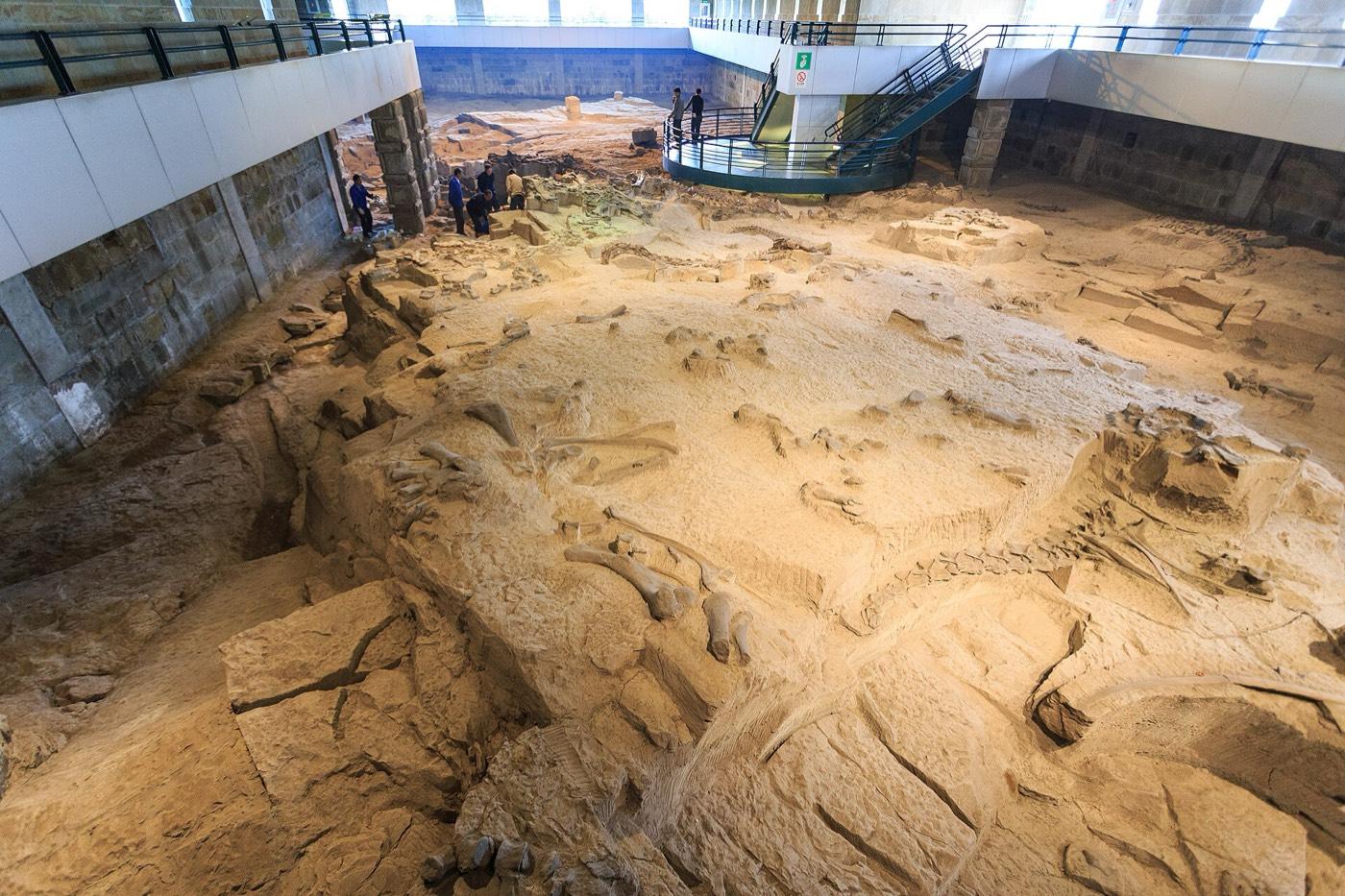
Do not confuse Yunyang with Zigong. Both expose the lower Shaximiao Formation, and both roof an excavation rather than empty it. They sit about 250 km apart, in different provinces, and they have produced different animals. Nothing named from Dashanpu has been reported from this wall.
Location and Directions
The quarry is at Laojun Village, Pu'an Township, Yunyang County, in the north-east of Chongqing Municipality. Dai and colleagues give that address for the 2016 discovery of the quarry.
GPS: 30.8693°N, 108.9240°E. That point is the Pu'an Township settlement in OpenStreetMap, not the rock face. The published papers locate the quarry inside this township but give no coordinates.
Yunyang county seat sits on the Yangtze about 40 km north-west of Pu'an. Road and rail reach the county from Chongqing city and from Wanzhou. Pu'an is a further drive south-east into hill country.
No source this page could load publishes opening hours, an admission price or a booking rule for the shelter. Chinese government photographs dated January 2025 show members of the public at the face, so access of some kind exists. Telephone the Yunyang county culture and tourism bureau before you travel.
The geopark holds other geosites that are easier to plan around. UNESCO lists sinkholes, canyons, caves and stone columns, including one sinkhole 335 m deep that it ranks fifth in the world. Zhangfei Temple is the cultural stop.
 Karst country at Longgang in Yunyang County, a separate geosite in the same geopark and not the fossil wall. Photo: STW932, CC0, via Wikimedia Commons

What Fossils You'll Find
Nothing may be taken. What follows is what researchers have named from the rock.
Sauropods carry most of the published record. Omeisaurus puxiani was named by Tan and colleagues in Historical Biology from specimen CLGRP V00005. Before that, the same group described a single mid-cervical vertebra from the lower Shaximiao beds at Pu'an in Vertebrata PalAsiatica in 2018. They assigned it to Omeisaurus without a species and called it the easternmost occurrence of the genus.
Yuzhoulong qurenensis followed in 2022 in Royal Society Open Science, on holotype CLGRP V00013. It is an early-branching macronarian, and the species name comes from Quren, the old name for Yunyang county. Only the exposed surfaces were prepared. The rest of the skeleton stays in the quarry.
Bashanosaurus primitivus is the stegosaur. Dai and colleagues named it in the Journal of Vertebrate Paleontology, from material recorded as coming from the Dinosaur Fossil Wall locality.
Two more animals come from Laojun Village but not from the wall. They sit in the Xintiangou Formation, which lies below the Shaximiao.
Yunyangosaurus puanensis is one of them, and the name invites a mistake worth naming here. It is a theropod, a possible megalosauroid, and not a sauropod. Dai and colleagues described it in Scientific Reports in 2020 from holotype CLGPR v00002, eleven presacral vertebrae with ribs and chevrons. The horizon is the upper Xintiangou Formation.
Sanxiasaurus modaoxiensis is the other, a small plant-eating neornithischian. Its holotype came out of a 5 m exploratory trench about 240 m from the lower Shaximiao fossil wall.
UNESCO's own description adds turtles, crocodile relatives, ray-finned fishes and early amphibians. Reporting from the 2017 announcement put the wall at five dinosaur groups or more.
Geologic History
The lower Shaximiao Formation is exposed widely across the Sichuan Basin. Dai and colleagues describe it as thick purplish-red sandstone and mudstone deposited on land, possibly around a shallow lake. At Pu'an the sauropod bone came from purplish-red silty mudstone in the middle of the formation.
The age of the formation is contested, and the argument is worth following before you quote a figure. Regional correlation and invertebrate fossils have long placed it in the Bathonian to Callovian. A run of detrital zircon studies since then has pushed parts of it younger, into the Callovian and Oxfordian.
Yunyang has its own number. A zircon uranium-lead sample from below the bone-bearing horizon gave a maximum depositional age of 166.0 plus or minus 1.5 million years. On that basis Dai and colleagues place the bone horizon in the Bathonian.
This page carries UNESCO's range of 175 to 161 million years in its frontmatter. That is the figure UNESCO publishes for this site, and it covers the whole fossil-bearing stretch. The wall itself is the narrower Bathonian slice inside it.
The Xintiangou Formation underneath is older. Dai and colleagues call the part that produced Yunyangosaurus the lower Middle Jurassic. So two formations at one village span a long run of Middle Jurassic time. That is the part of the Jurassic thinnest in the global record.
UNESCO reads the wider geopark as nearly 260 million years of geological history. An inland sea disappeared, and a land surface replaced it. The karst landforms belong to the carbonate part of that story and not to the red beds that hold the bone.
 Karst at Longgang, Yunyang County. The geopark's limestone geosites are a separate part of its record from the Jurassic red beds. Photo: STW932, CC0, via Wikimedia Commons

Collecting Rules and Regulations
Collecting is prohibited. Treat the shelter as look and photograph only.
China treats vertebrate fossils as state property, and this face is both a protected geological relic and a working excavation. The Yuzhoulong authors record that the local government approved their work and that unprepared bone remains in the quarry.
Do not touch the exposed bone. Do not hammer or scrape any part of the face or the spoil around the building.
The Chongqing Laboratory of Geoheritage Protection and Research holds the specimens. That institution supplies the CLGPR and CLGRP catalogue prefixes used in the papers above.
Do not buy fossils in Chongqing and do not attempt to take any out of China. Removing protected fossil material without authorisation is an offence.
Safety
The wall is roofed, so the main hazards lie on the way in and in the rest of the geopark.
Confirm the shelter is open before you commit to the drive. No published timetable covers it, and Pu'an is a long way from the county seat.
Roads through the Three Gorges hill country are narrow, steep and winding. Heavy rain brings landslides and rockfall onto them. Chongqing summers are long, hot and humid, and the heat on open ground is serious from June to September.
Stay behind the barriers inside the shelter. The face is loose rock holding fragile bone, and a slip into it damages the specimen and the visitor.
The karst geosites carry different risks. Longgang has large unfenced drops, wet rock and a wire bridge over a gorge. Treat those as a separate trip with separate footwear.
Carry water and tell someone your route. Mobile coverage in the townships is workable but not reliable off the main roads.
Sources
https://www.unesco.org/en/iggp/yunyang-unesco-global-geopark https://www.unesco.org/en/iggp/geoparks/list https://doi.org/10.1098/rsos.220794 https://pmc.ncbi.nlm.nih.gov/articles/PMC6954265/ https://biotech.chinaxiv.org/abs/201812.00010 https://en.wikipedia.org/wiki/Bashanosaurus https://en.wikipedia.org/wiki/Sanxiasaurus https://www.globalgeopark.org/News/News/14684.html https://english.www.gov.cn/news/202504/12/content_WS67f9ab31c6d0868f4e8f19d4.html https://global.chinadaily.com.cn/a/201706/29/WS59bbf859a310ded8ac1905c6.html
Nearby sites
 Zigong Dinosaur Museum, Dashanpu Fossil Hunting GuideDinosaurs, Sauropods
 Guanling Fossil National Geopark Fossil Hunting GuideMarine reptiles, Ichthyosaurs
 Luoping Biota National Geopark Fossil Hunting GuideCrustaceans, Fish
 Chengjiang Fossil Site, Maotianshan Fossil Hunting GuideTrilobites, Arthropods