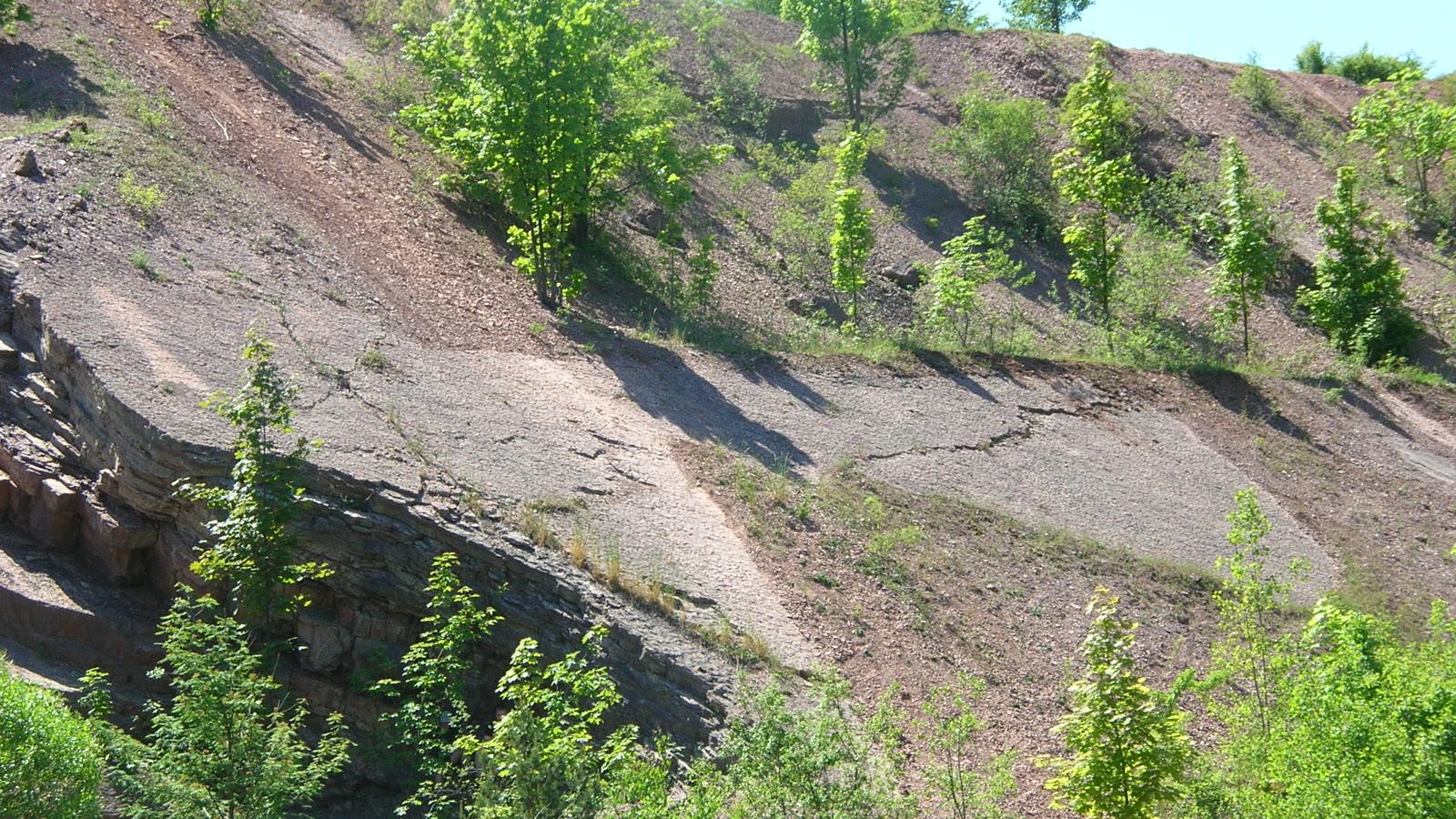
Zachełmie Quarry, Zagnańsk Fossil Hunting Guide
Image: Robert Niedźwiedzki (CC BY-SA 3.0)
An abandoned dolomite quarry in the Holy Cross Mountains that holds the oldest tetrapod footprints known anywhere. The tracks are 395 million years old and they moved the water-to-land transition back by 18 million years.
By Edward Chen · Published 17 September 2026
Introduction
The accepted sequence ran one way. Lobe-finned fish such as Tiktaalik, described in 2006 and dated to about 375 million years, came first. The first four-legged animals followed them onto land some time after.
Zachełmie broke that sequence. In 2010 a team working in this abandoned quarry described trackways cut into Middle Devonian dolomite, and the rock was 395 million years old.
The prints are 18 million years older than the earliest tetrapod body fossils. They are 10 million years older than the oldest elpistostegids, the group Tiktaalik belongs to.
They show a body plan that the sequence said did not yet exist.
Trackways and many isolated prints have been recorded here. Both front and back feet appear, and several prints show separate digits.
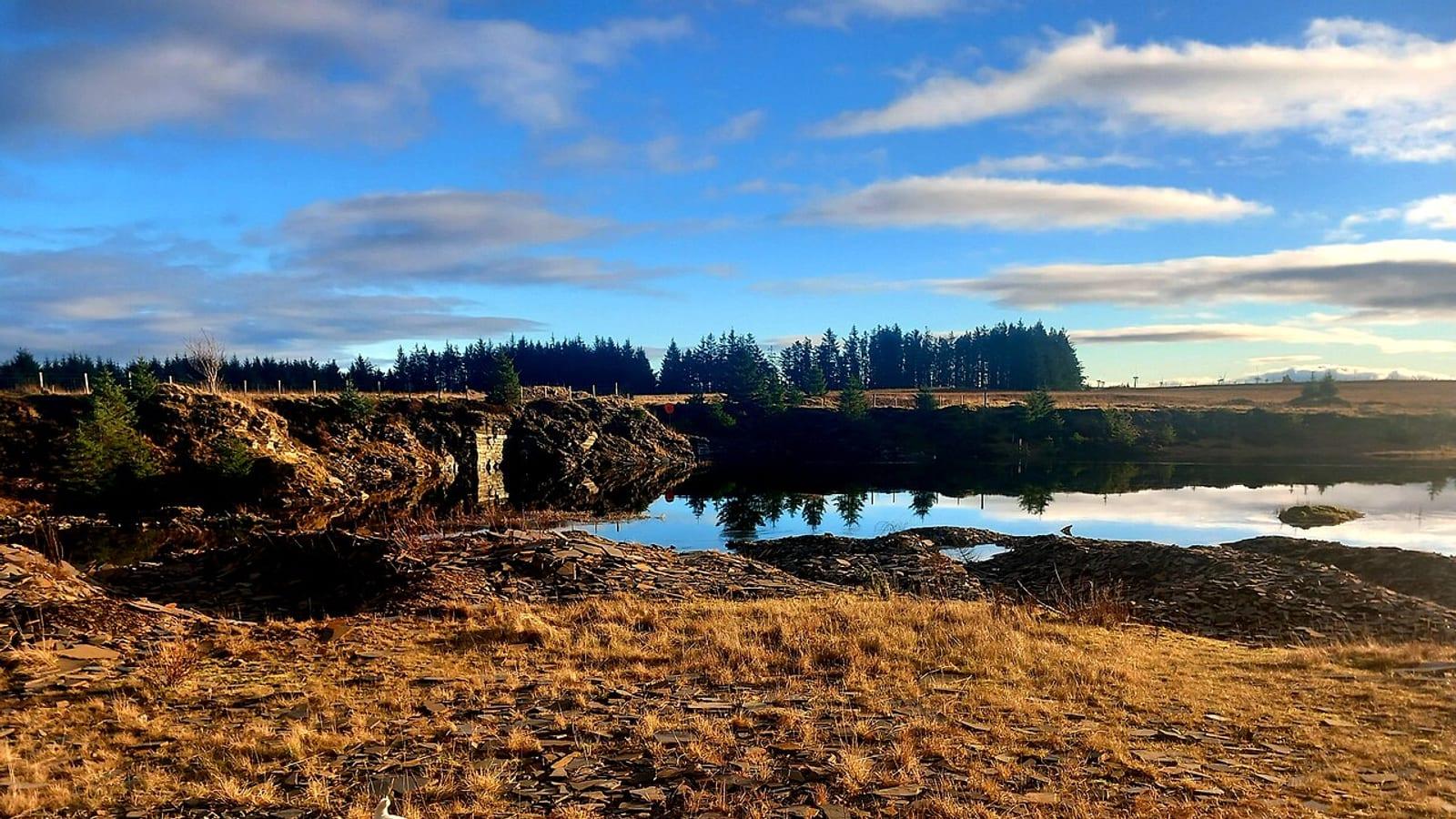
The quarry itself is small, abandoned and quiet. Nothing about it announces that the argument over how vertebrates came ashore now starts in this hole in the Polish countryside.
 Photo: Robert Niedźwiedzki, CC BY-SA 3.0, via Wikimedia Commons
Location and Directions
The quarry is at Zachełmie, on the northern edge of Zagnańsk, roughly 12 km north of Kielce in the Świętokrzyskie Voivodeship.
Zagnańsk sits on the DW750 road and has a railway station on the Kielce to Skarżysko-Kamienna line. From Kielce the drive takes about 20 minutes.
The village is better known locally for Bartek, an oak tree of great age that draws its own visitors. Signposts point to the oak rather than to the quarry, so use the reserve name when you ask directions.
The site became a nature reserve in 2010, by an order of the Kielce regional directorate covering just under eight hectares. An information board stands at the southern wall, where the accessible tracks are.
What Fossils You'll Find
You find nothing, and that is the point. This is a viewing site.
The trackways are the reason to come. Some of the original surfaces were lifted for conservation and study, and the remainder stay in place on the southern wall of the quarry.
The prints are shallow depressions in grey dolomite. They reward patience and low sun far more than they reward a hammer.
Stromatolites occur through the same dolomite. These are layered structures built by microbial mats, and they give the rock surfaces their knobbly, cauliflower texture.
Trace fossils of invertebrates share the beds with the tetrapod prints. The 2018 study of the site used them to reconstruct the environment around the track-makers.
Body fossils are rare here. The record at Zachełmie is a record of movement rather than of bones.
 Photo: Robert Niedźwiedzki, CC BY-SA 3.0, via Wikimedia Commons
Geologic History
The quarry exposes the Wojciechowice Formation, a dolomite of Eifelian age in the Middle Devonian.
The rock formed on a broad, shallow carbonate platform. Conditions moved between lagoon and open marine, and the water was often only centimetres deep.
The original reading was marginal marine, a lagoon or intertidal flat. The 2018 study overturned it.
That work found a succession of ephemeral lakes with a restricted, non-marine biota. The track-makers moved in and around short-lived fresh water rather than across a tidal flat.
The Holy Cross Mountains expose Palaeozoic rock over a wide area. Zagnańsk lies outside the boundary of the Świętokrzyski UNESCO Global Geopark, so the quarry stands on its own rather than as one of its geosites.
In 2022 the International Union of Geological Sciences named the site one of the First 100 Geological Heritage Sites.
Collecting Rules and Regulations
Collecting is not permitted. Zachełmie has been a nature reserve since 2010, and Polish reserve rules protect the rock surfaces along with everything else inside the boundary.
Do not hammer, do not take loose material, and do not make casts or rubbings of the prints.
The trackway surfaces are soft dolomite and they weather. Walking on the marked track surfaces damages them, so stay off the protected faces.
Photography is welcome and costs the site nothing. Early or late sun across the bedding plane shows the prints far better than midday light.
Entry is free. Polish reserve rules keep visitors on the designated routes, so follow the marked path rather than wandering the quarry floor.
Safety
An abandoned quarry has loose faces. Keep away from the base of the walls, particularly after rain or frost.
The quarry floor holds water in places and the dolomite becomes slippery when wet.
There are no facilities at the site. The nearest shops and cafes are in Zagnańsk village.
Mobile coverage is generally good in this part of the Świętokrzyskie hills, but tell someone your plan if you visit alone.