Englewood Beach Fossil Hunting Guide
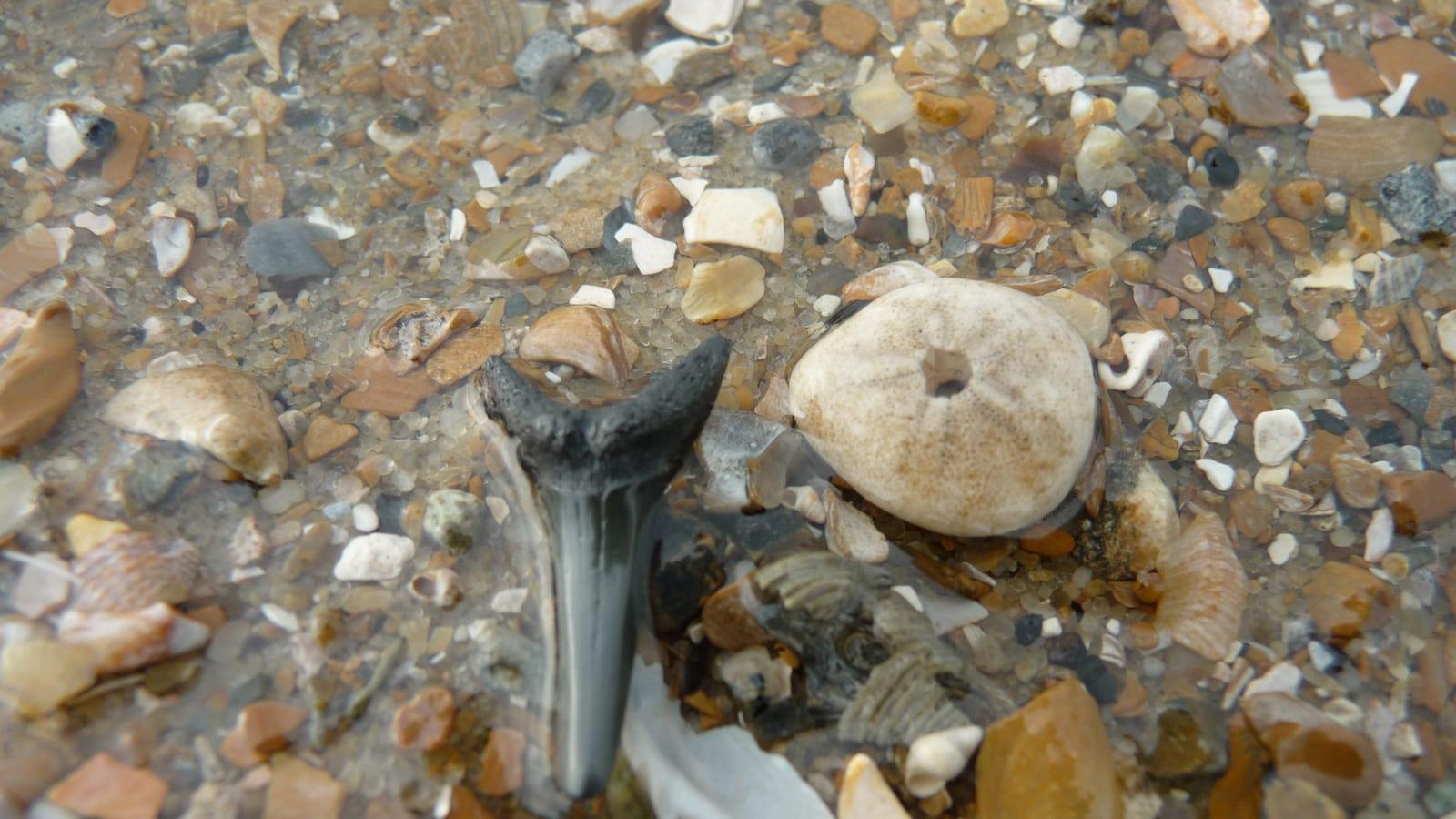
Image: Dominik Vogt (CC BY-SA 3.0)
Englewood Beach is the local name for the public stretch of Manasota Key on Florida's Gulf coast, in Charlotte County, immediately south of Venice.
Englewood Beach is the local name for the public stretch of Manasota Key on Florida's Gulf coast, in Charlotte County, immediately south of Venice. It catches the same offshore Miocene phosphate teeth that make Caspersen Beach famous, but it sees a fraction of the foot traffic and the productive area concentrates around tidal passes rather than running the full length of the beach. Stump Pass at the south end of Manasota Key is the standout: the pass cuts between Manasota Key and Don Pedro Island, and tidal currents through the inlet sort heavy lag material into the beach gravel on either side. North along Manasota Key, the broader Englewood Beach access points (Chadwick Park, Blind Pass Beach, Middle Beach) all hold teeth in their swash zones, with productivity highest at low tide and after the storms that recharge the offshore phosphate supply. This guide covers how to find the four useful access points, where on each beach to focus, what to expect to recover, the geology that produces the teeth, and the rules that govern collecting on public Florida beaches.
Location and Directions
The "Englewood Beach" area covers about seven miles of Manasota Key, the barrier island west of the town of Englewood. There is no single address. Four access points matter:
Englewood Beach (Chadwick Park) is at 2100 N. Beach Road, Englewood, FL 34223. From US 41 (Tamiami Trail) in Englewood, take West Dearborn Street west, then Beach Road across the Tom Adams Bridge onto Manasota Key. Chadwick Park is on your left a short distance south of the bridge. Free parking. Restrooms, pavilions, and a snack bar.
Stump Pass Beach State Park is at 900 Gulf Boulevard, Englewood, FL 34223. Continue south on Beach Road from Chadwick Park. The road becomes Gulf Boulevard. The state park entrance is at the south end of Manasota Key. Pay the day-use entrance fee at the self-service iron ranger. From the parking lot, a flat sand trail leads roughly one mile south through coastal scrub to the tip of the key at Stump Pass. The pass beach is the single most productive collecting spot on this section of coast.
Blind Pass Beach (Middle Beach) is at 6725 Manasota Key Road, Englewood, FL 34223. North of the Tom Adams Bridge along the key. Free parking, dune walkovers, restrooms.
Manasota Beach at the north end of the key, in Sarasota County, is at 8570 Manasota Key Road, Englewood, FL 34223.
Tide windows are essential. Plan for the two hours on either side of low tide, when the swash zone is widest and the coarse gravel layer is exposed. After winter cold fronts and tropical systems, fresh material is delivered onto the berm and collecting improves for several days. Stump Pass is also strongly tide-driven because the inlet currents reverse with the tide and concentrate teeth on both sides of the pass.
What Fossils You'll Find
Shark teeth dominate the wrack line at all four access points.
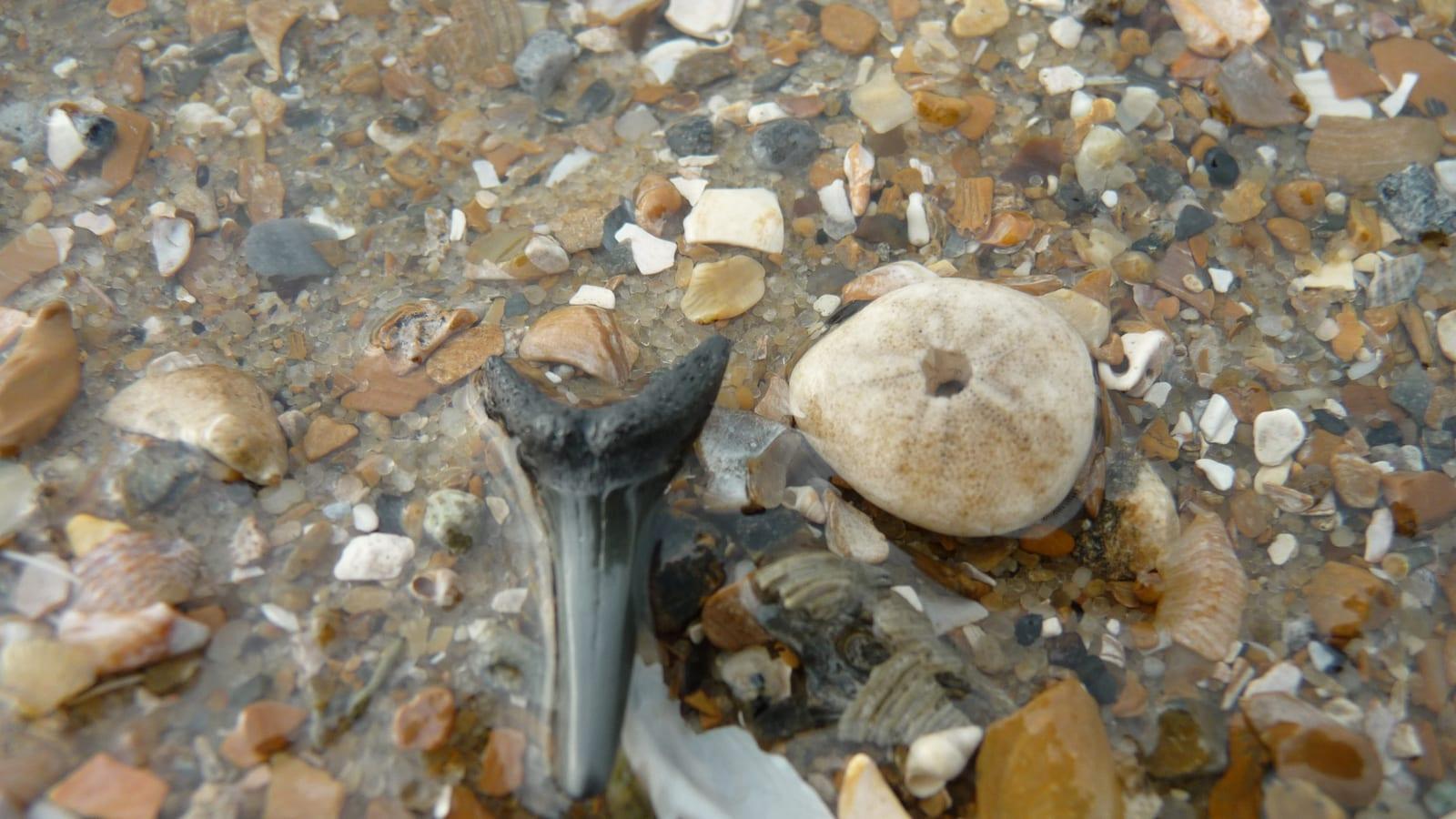
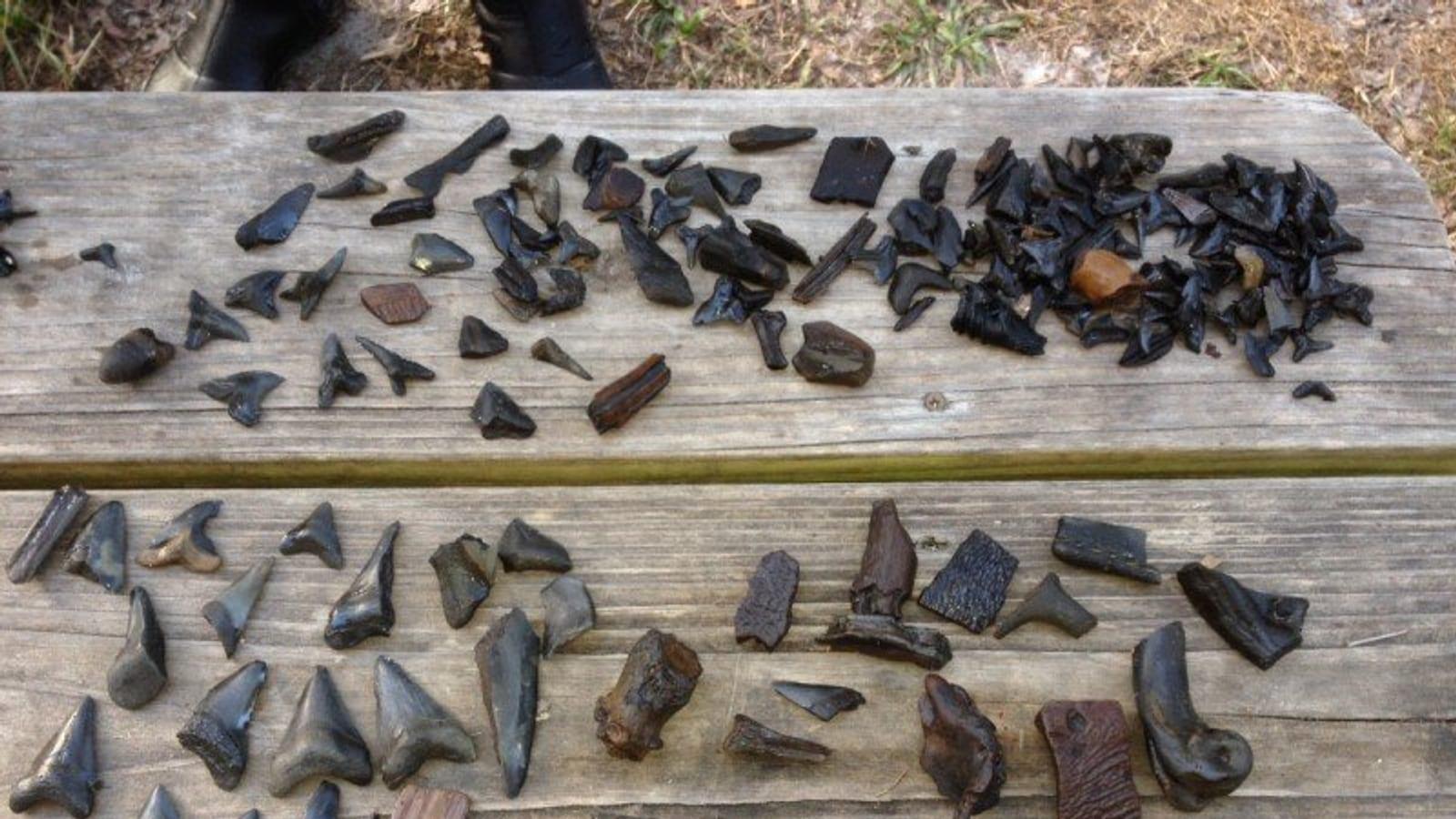
Small shark teeth in the quarter-inch to one-inch range are by far the most common: lemon, bull, sand tiger, tiger, requiem, and small mako teeth. Most are jet black or dark gray from phosphate staining. A smaller fraction are brown or tan.
Megalodon and chubutensis fragments turn up most often at Stump Pass, where the inlet currents do the sorting work. Whole large megalodon teeth are uncommon at any of these beaches but the area is well known for partials and worn fragments. The serrated triangular crown is unmistakable when you find one.
Ray and skate dental plates and stingray barbs appear in the same lag deposits as the shark teeth.
Marine mammal bone fragments including dugong rib pieces and dolphin vertebrae occur occasionally.
Shell hash from the Pleistocene Caloosahatchee and Bermont formations supplies pectens, Strombus, Busycon, and ark shells to the wrack line. Many are still glossy and clearly modern. The older Pleistocene shells are often chalky and worn.
The standard tool is a long-handled scoop sifter, sold at most Englewood and Venice tackle shops. Hand collecting works fine in the wrack line. The sifter pays off on the heavier gravel berms at Stump Pass and Blind Pass.
Geologic History
The Englewood-area teeth share their source with the Venice and Caspersen beaches and arrive on the shore by the same offshore-to-shore transport process.
Hawthorn Group, including the Peace River Formation (Middle Miocene to Early Pliocene, roughly 16 to 4 million years). This phosphatic shallow-marine sequence is the source rock for the megalodon and chubutensis teeth, the bulk of the smaller shark and ray teeth, and the marine-mammal bone. It is mined inland for fertilizer phosphate. Offshore, it is the dominant fossil-producing horizon under the inner Gulf shelf. Wave action and storm surge break teeth free from these submarine outcrops and roll them shoreward.
Caloosahatchee Formation and Bermont Formation (Pliocene to early Pleistocene, roughly 3 million to 1 million years). These shell-rich units crop out under shallow water along the southwest Florida coast and contribute the bulk of the older mollusk material in the wrack line. They also yield occasional terrestrial mammal bone reworked from the same time period.
Holocene barrier islands. Manasota Key itself is a Holocene barrier built from quartz sand and shell hash reworked by longshore drift over the past several thousand years. The key holds no in-place fossils. The beach is a delivery system, not a source.
Inlet dynamics at Stump Pass. Tidal flow through Stump Pass moves an enormous volume of sediment back and forth daily. The inlet currents sort heavier objects (teeth, bone, dense shell) into lag gravels on both sides of the pass, which is why the south end of Manasota Key is the most productive collecting spot in the area.
How Englewood Beach Became a Fossil Collecting Site
Englewood Beach has been used by Charlotte County residents and seasonal visitors for casual shark-tooth collecting for decades. Chadwick Park was acquired by the county and developed as a public beach in the mid-20th century. Stump Pass Beach State Park was established in 1971 and expanded in 1991 to include the southern tip of Manasota Key. Neither park was created for paleontological reasons, and there has never been any quarrying or excavation aimed at exposing fossils. The teeth on these beaches arrive by natural offshore erosion and longshore transport, and the supply is renewed by every Gulf storm that mobilizes the offshore phosphate beds. The area's lower visitor density compared to Venice is the main reason it remains productive.
Collecting Rules and Regulations
Surface collecting of shark teeth, ray plates, and shell material is allowed for personal, non-commercial use at all four access points. Charlotte County and Florida State Parks rules permit visitors to take small quantities of loose material from the wet sand and wrack line.
Practical rules:
- Collect only loose surface material in the swash zone and along the wrack line. Do not dig into the dunes, the back-beach, the seagrass, or any in-place sediment.
- A flat-handled scoop sifter is allowed and is the standard local tool. No motorized or powered equipment.
- The state park (Stump Pass) prohibits removing any plant material, sand, or in-place geological material. Loose shells and teeth on the beach surface are not affected by this rule.
- Florida vertebrate fossil rules: a Florida Vertebrate Paleontology Permit is required to collect vertebrate fossils from state-owned submerged lands or from in-place state-land deposits. Surface collecting on the beach itself does not require this permit. Any diving or offshore excavation does.
- Sea turtle nesting season runs May 1 through October 31. Stay off the dunes, do not disturb marked nests, and do not use white flashlights after dark.
- Stump Pass has a day-use entrance fee. Chadwick Park, Blind Pass, and Manasota Beach have free parking.
- All four beaches are open from 8:00 a.m. to sunset.
- Dogs are allowed on Manasota Beach (north end) but not on the other three beaches.
Sources
- Charlotte County Community Services, "Chadwick Park / Englewood Beach." https://www.charlottecountyfl.gov
- Florida State Parks, "Stump Pass Beach State Park." https://www.floridastateparks.org/parks-and-trails/stump-pass-beach-state-park
- Florida Geological Survey, "Hawthorn Group and Peace River Formation." https://floridadep.gov/fgs
- Florida Museum of Natural History, "Florida Vertebrate Paleontology Permit." https://www.floridamuseum.ufl.edu/vertpaleo-permit/
- FossilGuy, "Venice Area Shark Teeth." https://www.fossilguy.com/sites/venice/