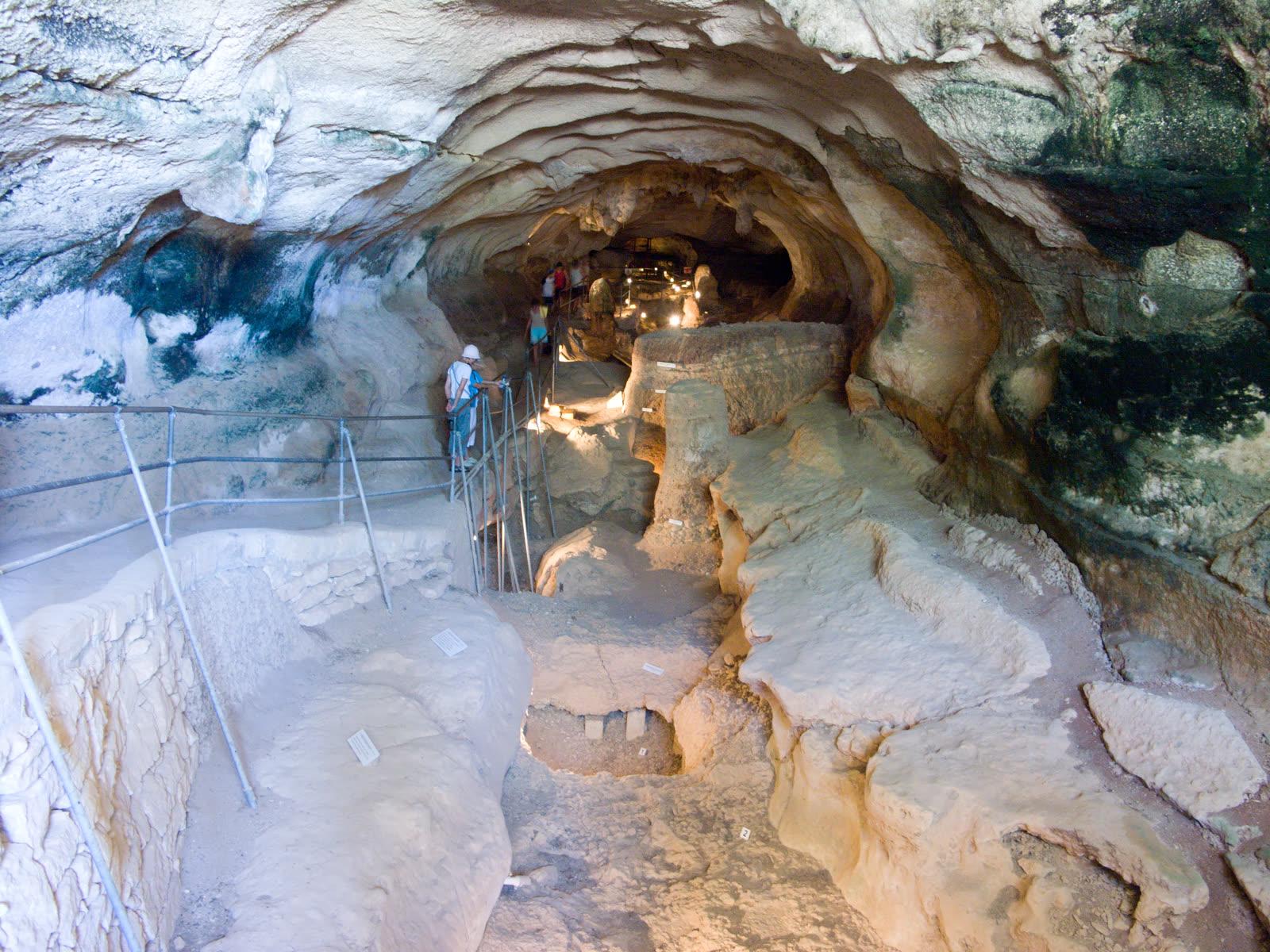
Għar Dalam Cave and Museum Fossil Hunting Guide
Image: Jean-Christophe Benoist (CC BY 2.5)
A 144 meter cave in Birżebbuġa whose sediments hold Pleistocene bones of dwarf elephants, a hippopotamus, deer and a giant swan. Visitors walk the first 50 meters and see the bones in a Victorian museum.
By Edward Chen · Published 1 October 2026
 Photo: Continentaleurope, CC BY-SA 4.0, via Wikimedia Commons
Introduction
Għar Dalam is a cave in Birżebbuġa, in the south-east of Malta, whose sediments hold the bones of Ice Age animals. Heritage Malta runs the cave and its museum. The cave is 144 meters long, and visitors may enter the first 50 meters.
The bones come from animals that lived on Malta in the Pleistocene and are now extinct there. They include dwarf elephants, a hippopotamus, red deer, bears, wolves and a giant swan. Heritage Malta says no such animals have lived on the islands for thousands of years.
The museum shows the bones in a hall that keeps a Victorian-style display. It is one of a handful of such displays left in Europe, according to Heritage Malta. The George Zammit Maempel Hall explains the cave's history and the species on panels.
This is a fee site and a look-only site. You pay to enter, and the rules do not let you dig or collect. The bones in the cases are the best fossils you will see.
The site is also a Natura 2000 area. A small population of the endemic cave woodlouse Armadillidium ghardalamensis lives in the dark parts of the cave. The Lesser Horseshoe Bat roosts there too.
Location and Directions
The address is Għar Dalam Road, Birżebbuġa. The cave lies at about 35.8364°N, 14.5280°E. The closest bus stop is one minute away on foot. Heritage Malta says parking bays are close to the site.
Heritage Malta lists a gift shop, lockers, a seating area and food and drink on site. Audio guides come in ten languages, including English, Maltese, German, Italian and Spanish. Heritage Malta describes the access as partial, because some areas cannot be fully reached by people with mobility impairments.
The only ticket on the official page is a combined ticket for Għar Dalam and Borġ in-Nadur. Adults aged 18 and over pay 6.50 euros. Youths aged 12 to 17, senior citizens aged 60 and over, students and people with concessions pay 5 euros. Children aged 6 to 11 pay 4 euros, and children aged 1 to 5 enter free. Heritage Malta members and passport holders enter free.
Borġ in-Nadur Prehistoric Complex has no visitor access until further notice because of road works. A single-site price for Għar Dalam is not listed on the page this guide read. Ask at the desk.
A Heritage Malta notice gives the hours as 9:00 to 17:00, with last admission at 16:30. Heritage Malta sets last admission at 30 minutes before the site shuts, at all its sites. All Heritage Malta sites close on 1 January, Good Friday and 24, 25 and 31 December.
The weekly opening days are not clear. Other sources list different days, and the official hours table could not be read. Check the Heritage Malta opening hours page before you travel.
No source this guide read requires a booking. You can ask for a guided tour through the form on the site page. The telephone is 21657419 within Malta.
What Fossils You'll Find
 Photo: Continentaleurope, CC BY-SA 4.0, via Wikimedia Commons
You see the bones in the museum, and a few Pleistocene fossils are still visible in the cave. The hall of old cases holds rows of bones from the excavations of the 19th century.
The elephants are dwarfs. The small Palaeoloxodon falconeri stood about one meter at the shoulder. Busk named it Elephas falconeri in 1867. A Maltese form once called Elephas melitensis is now treated as the same species.
A larger dwarf elephant, Palaeoloxodon mnaidriensis, also lived on Malta. Adams named it Elephas mnaidriensis in 1874 from the Mnaidra gap. Molars from Għar Dalam that scientists assigned to P. mnaidriensis differ from those of P. falconeri.
Whether one or several dwarf elephant species lived on Malta is still uncertain. Scarborough (2022) says the paleoarchipelago likely included three species from Malta. Check a museum label before you quote a species name.
The hippopotamus is Hippopotamus melitensis, which Major named in 1902 from Għar Dalam material. Marra (2026) says the Maltese record is too thin to show that it is a separate endemic species. The same paper says the Sicilian hippo, Hippopotamus pentlandi, may also have lived on Malta.
The cave also holds red deer, Cervus, the brown bear Ursus cf. arctos, the wolf Canis lupus and the red fox Vulpes vulpes. Parker named the giant swan Cygnus falconeri in 1865. It was about one third larger than a mute swan and possibly flightless.
Do not mistake the large skeletons in the old hall for fossils. Heritage Malta says the complete skeletons stand there for comparison. Their labels read Recent and name a modern African elephant, hippopotamus and red deer.
Geologic History
The cave is a phreatic tube, a passage that groundwater carved. Its floor holds layers of sediment that radiometric dating has placed in order, from Layer II at the top to Layer VIII at the base.
The oldest layers are the lowest. Layer VIII is a sterile clay that is older than about 167,000 years. Layer VII is a bone breccia, the traditional Hippopotamus layer. It holds hippos, dwarf elephants, deer and swans and is older than about 166,000 years.
Layer V holds dwarf elephants, hippos, deer and carnivores and dates to between 167,000 and 151,000 years ago. Layer IV, the upper red earth, holds deer and dates from 116,000 to 20,000 years ago. Layers III and II hold domestic animals and pottery from the Holocene.
Heritage Malta puts the earliest bones at over 160,000 years old. A 2025 Heritage Malta book places some Maltese animal assemblages near 400,000 years, but it does not tie that age to this cave.
The animals came from Sicily. Heritage Malta says sea levels fell in the Ice Age, and the animals crossed on land bridges. Once the sea rose, the island trapped the animals, and they shrank or grew by the island rule.
Recent research is less sure about how and when they arrived. Marra (2026) says the swimming ability and dispersal routes of hippos are still debated. She says the timing of colonization is only partly resolved. Scarborough (2022) treats the islands as a paleoarchipelago with different periods of isolation.
Collecting Rules and Regulations
Do not collect, dig or take anything. The Cultural Heritage Act (Chapter 445) counts paleontological sites and deposits as cultural heritage. Article 43(1) says such excavations or explorations "can only be made by the Superintendent, or with the written permission of the Superintendent".
Article 43(2) tells anyone who discovers an object, even by accident, to inform the Superintendent immediately. If you think you have found a bone outside the cave, report it and leave it in place.
Inside the cave, stay on the walkway and in the first 50 meters. Visitors cannot enter the inner cave. Heritage Malta says the ceiling is low and the ground is slippery. The closure also protects the rare woodlouse that lives there.
Safety
Walk slowly on the cave walkway. Heritage Malta warns that the ground in the deeper parts is slippery and the ceiling is low. That is why the inner cave stays shut.
Do not go past the barriers. The cave also shelters bats and a rare woodlouse.
Malta is hot in summer. Outside the cave, carry water and wear a hat.
Sources
https://heritagemalta.mt/explore/ghar-dalam/ https://heritagemalta.mt/opening-hours/ https://heritagemalta.mt/?p=3709 https://pmc.ncbi.nlm.nih.gov/articles/PMC13514239/ https://open.uct.ac.za/items/20de75ba-b327-4ed5-afc7-b8ae8f4889be https://en.wikipedia.org/wiki/G%C4%A7ar_Dalam https://en.wikipedia.org/wiki/Palaeoloxodon_falconeri https://en.wikipedia.org/wiki/Palaeoloxodon_mnaidriensis https://en.wikipedia.org/wiki/Cygnus_falconeri https://www.eui.eu/Projects/InternationalArtHeritageLaw/Documents/NationalLegislation/Malta/chapt445.pdf https://heritagemalta.mt/?p=217568