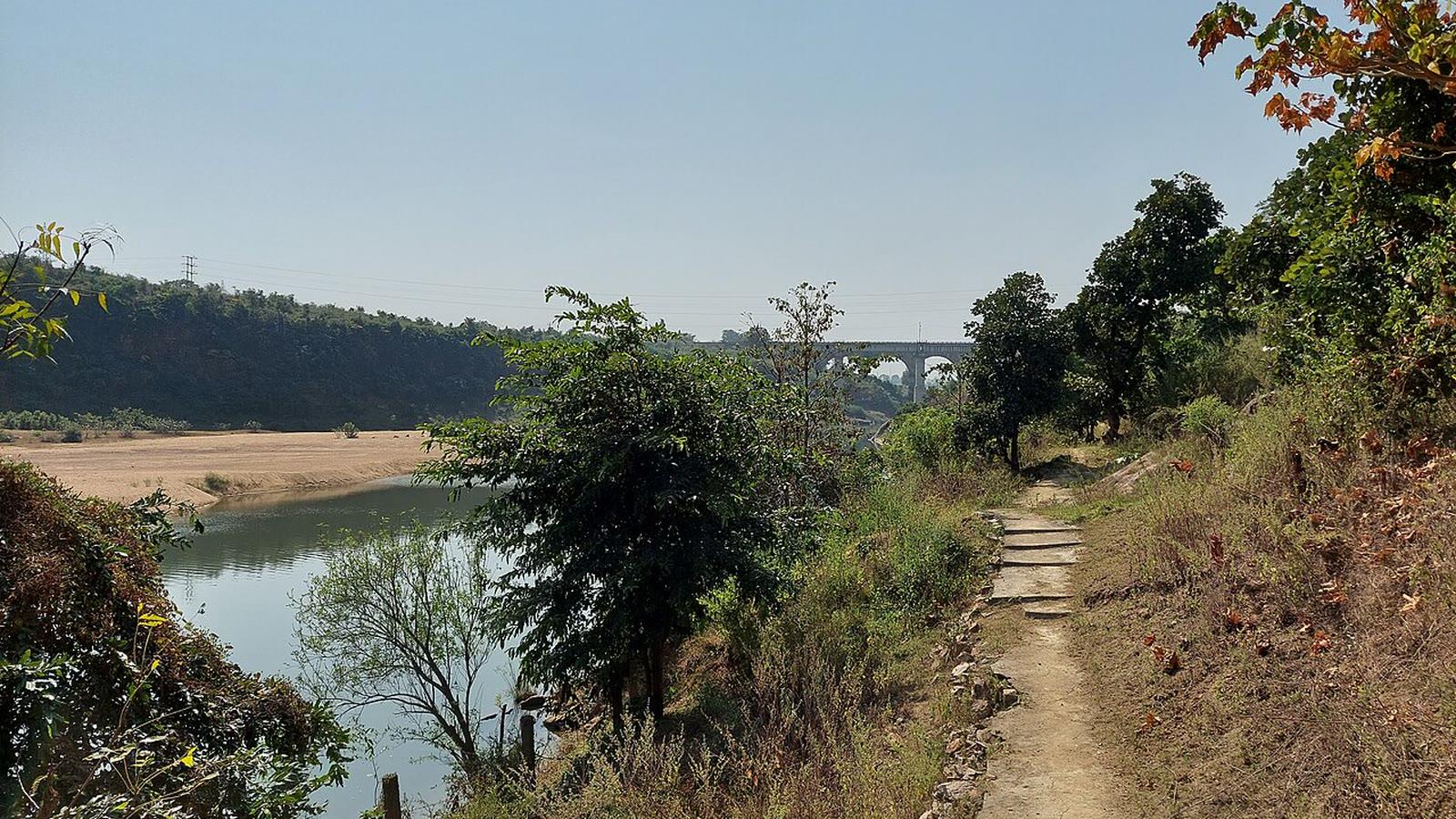
Marine Gondwana Fossil Park, Manendragarh Fossil Hunting Guide
Image: Tushar0034 (CC0)
A National Geological Monument on the Hasdeo River in central India, where Early Permian cold-water marine shells, bryozoans and crinoids lie in the shales of the Talchir Formation at the base of the Gondwana sequence.
By Edward Chen · Published 12 October 2026
Introduction
Marine fossils are rare in the Gondwana rocks of peninsular India, and Manendragarh is where they are best exposed. A 2023 study in Geological Magazine by Adrita Choudhuri and colleagues single this stretch of the Hasdeo River out. It is the only Indian locality where marine fossils occur in the Talchir Formation beside conglomerates of possible glacial origin.
The fossil beds record a cold-water sea that reached the middle of the Indian landmass in the earliest Permian. Shells, bryozoans and crinoids lie in black and grey shale that rests directly on Precambrian granite.
The Geological Survey of India has declared the locality a National Geological Monument. It appears in the Ministry of Mines list of geo-heritage sites as the Lower Permian marine bed at Manendragarh. The Chhattisgarh Forest Department has since developed the river bank as a visitor site with an interpretation centre.
Location and Directions
The park lies on the Hasdeo River at Ammakherwa, about 2 km from the Manendragarh district headquarters, in Manendragarh-Chirmiri-Bharatpur district of northern Chhattisgarh. The Chhattisgarh government gives the postal address as Near Hasdeo River, Ammakherwa, Manendragarh 497442.
GPS: 23.2076°N, 82.2194°E.
Manendragarh railway station is the closest railhead and sits on the South East Central Railway network. The state government names Darima Airport, near Ambikapur, as the closest airport. Both are listed on the Surguja division tourism page for the park.
The fossil-bearing outcrops do not stop at the park boundary. Choudhuri and colleagues mapped four sections along a 2.5 km transect on the north-west bank of the Hasdeo. Outcrops of the granite basement bound that transect at both ends. Press reports describe the developed park itself as running about 1 km along the bank.
Visiting conditions follow the central Indian seasons. The south-west monsoon runs from June to September and raises the Hasdeo. April and May are very hot on open ground. November to February gives the most comfortable walking.
Opening hours and any entry charge are not documented in the state government listing. Contact the Manendragarh Forest Division before travelling.
 Photo: Ankitashu, CC BY-SA 3.0, via Wikimedia Commons
.jpg)
What Fossils You'll Find
The fauna is a cold-water marine assemblage, and bivalves dominate it. Choudhuri and colleagues list Eurydesma mytiloides, Eurydesma cordatum, Eurydesma globosum and Eurydesma playfordi from the Manendragarh beds. The same table adds Aviculopecten sp., Deltopecten and the gastropod Pleurotomaria nuda. Eurydesma is the genus that ties this fauna to Permian Gondwana floors in Australia, Argentina, Brazil, Oman and South Africa.
The brachiopod Trigonotreta hesdoensis was named by Sahni and Dutt in 1959. Its species name comes from the Hasdeo River itself. The Indian Stratigraphic Lexicon also records the brachiopod Spirifer hesdoensis, the bryozoan Protoretipora cf. ampla, the gastropod Euomphalus and the foraminifer Trochammina hesdoensis from the Manendragarh Member.
Bryozoans, crinoid fragments and foraminifers occur through the same beds. Trace fossils recorded from the member include Skolithos, Cruziana and Rhizocorallium.
Two kinds of preservation sit side by side. In the lowest 2 m of black shale the shells are intact, many of them benthic animals still in life position. Higher up, cross-stratified calcarenite beds about 20 cm thick carry broken shell debris, which the 2023 study reads as storm deposits. Both are confined to the southern, seaward end of the mapped transect.
Geologic History
The Talchir Formation forms the base of the Gondwana sequence across peninsular India and rests nonconformably on Precambrian basement. The Indian Stratigraphic Lexicon dates it to the late Asselian and Sakmarian stages of the earliest Permian, roughly 295 to 291 million years ago. It places the fossil-bearing Manendragarh Member in the late Asselian. The fluvial Barakar Formation overlies it.
At Manendragarh the formation sits in the Rewa Sub-basin, a fault-controlled half-graben within the north-west to south-east Son-Mahanadi Basin. Black marine shale lies directly on granite, which means the sea arrived quickly over an eroded land surface.
Choudhuri and colleagues interpret the basin as an interior sea. Seawater spilled over a steep basement ridge during a transgression, then circulation behind the ridge stayed restricted. Fine lamination in the black shale points to slow deposition in stagnant water. Angular granite boulders larger than 80 cm sit within that shale, which indicates a steep basin margin close by.
The muddy conglomerates are the contested part of the record. The 2023 study separates beds formed by glacial action from beds formed by density flows and mass movement. Alternating glacial and interglacial phases produced an interbedded succession of grey shale and density-flow deposits. Earlier workers correlated the Manendragarh glacier with the late stage of the P1 phase of the late Palaeozoic glaciation of Gondwana.
Published age figures for these beds vary. Shah and Shastry in 1975 gave the marine fossil beds an Early Permian age of 280 to 240 million years. Ram-Awatar and colleagues repeated that range in 2013. Press coverage of the park has quoted 250, 290 and 293 million years. The stratigraphic position of the Talchir Formation is the firmer guide, and that puts the fauna in the earliest Permian.
 Photo: Ankitashu, CC BY-SA 3.0, via Wikimedia Commons
.jpg)
Collecting Rules and Regulations
Do not collect. This is a National Geological Monument declared by the Geological Survey of India, and the land is managed by the Manendragarh Forest Division.
Do not hammer, chisel or lever any block of shale or conglomerate. The fossils are the reason the site is protected.
Do not remove loose fragments from the bank or the river bed. Removal of material from a protected geo-heritage site is an offence.
Photograph specimens where they lie. Report anything that looks new to the forest division staff at the interpretation centre.
Keep to the made paths. Fossils occur at the base of the exposed section, and the bank erodes.
The Geological Survey of India or the state government takes the protection measures at a declared geo-heritage site, according to the Ministry of Mines. Treat all rock here as protected.
Safety
The Hasdeo River is the main hazard. Do not enter the channel during or after rain. The river rises fast in the south-west monsoon between June and September, and the sand bars shift.
The bank is steep in places and the shale weathers to a slippery surface. Wear closed walking shoes with grip. Do not stand under an overhanging face of shale, because blocks fall from undercut banks.
Heat is the second hazard. April and May regularly pass 40°C on open ground in northern Chhattisgarh. Walk early, carry water, and do not rely on shade along the bank.
Snakes are active in the warm months in grass and scrub along the river. Watch where you put your feet and hands.
The park sits in forest division land away from the town. Tell someone your plan, travel in daylight, and do not assume mobile coverage along the river. The nearest town services are at Manendragarh, about 2 km away.
Sources
https://division-surguja.cg.gov.in/places-centres/national-marine-gondwana-fossils-park/ https://doi.org/10.1017/S0016756823000353 https://repository.up.ac.za/items/1256b278-5fc1-4142-97ca-ee41cea46c50/full https://indplex.geolex.org/formations/Talchir%20Fm https://www.thehitavada.com/Encyc/2025/4/29/Gondwana-Marine-Fossil-Park-inaugurated-as-major-tourist-attraction.html
Nearby sites
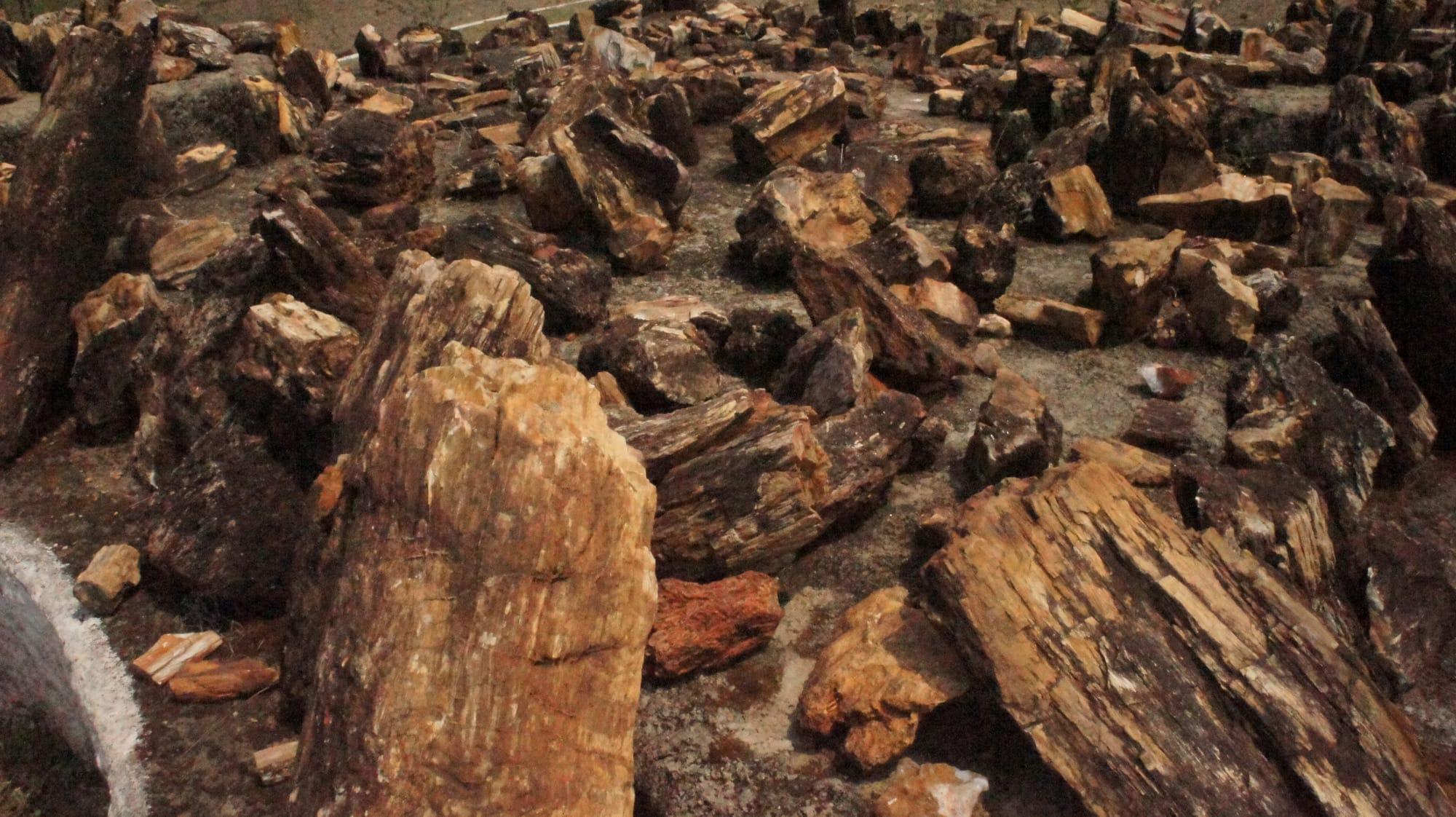 Ghughua National Fossil Park Fossil Hunting GuidePetrified Wood, Seeds and Fruits
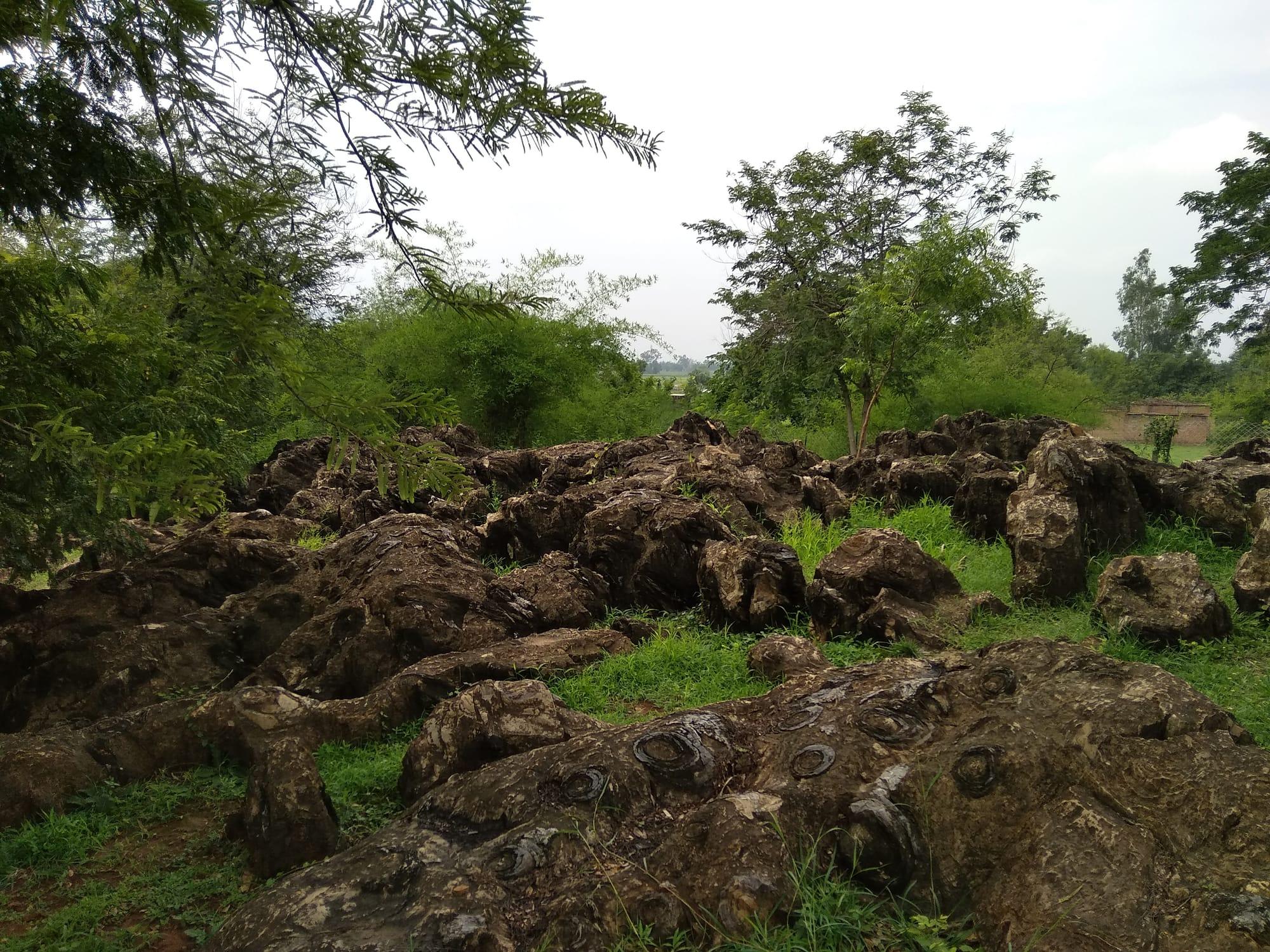 Salkhan Fossils Park: 1.4-Billion-Year-Old StromatolitesStromatolites, Microbialites
 Lameta Geological Park Fossil Hunting GuideIsisaurus colberti, Jainosaurus septentrionalis
 Wadadham Fossil Park Fossil Hunting GuideDinosaur Bones, Dinosaurs