Sathanur National Fossil Wood Park, Perambalur Fossil Hunting Guide
Image: Arivazhagan.ma (CC BY-SA 4.0)
A National Geological Monument in Perambalur district built around one petrified conifer trunk over 18 m long, lying in Late Cretaceous nearshore sandstone of the Garudamangalam Formation. Notified by the GSI in 1951.
By Edward Chen · Published 12 October 2026
Introduction
Read this paragraph before anything else. Tamil Nadu has two protected sites called the National Fossil Wood Park, and they are not the same place. This page covers the one at Sathanur in Perambalur district. The other is at Tiruvakkarai in Villupuram district, roughly 150 km away, and this website has a separate page for it. They differ in almost every way that matters.
Sathanur holds one petrified conifer trunk over 18 metres long in Late Cretaceous marine sandstone, and the Geological Survey of India notified it in 1951. Tiruvakkarai holds more than 200 trunks spread over nine fenced enclaves in the Neogene Cuddalore Sandstone, and the notification came in 1940. The rocks at Sathanur are about 80 million years older.
The confusion runs deeper than the shared name. Some of the trunks displayed at Sathanur were brought in from Tiruvakkarai. A visitor can stand at Sathanur and look at wood from the other park without knowing it.
M. S. Krishnan of the Geological Survey of India first reported the Sathanur tree in 1940. The park that grew around it now includes an education centre, a museum of regional fossils and a children's park.
Location and Directions
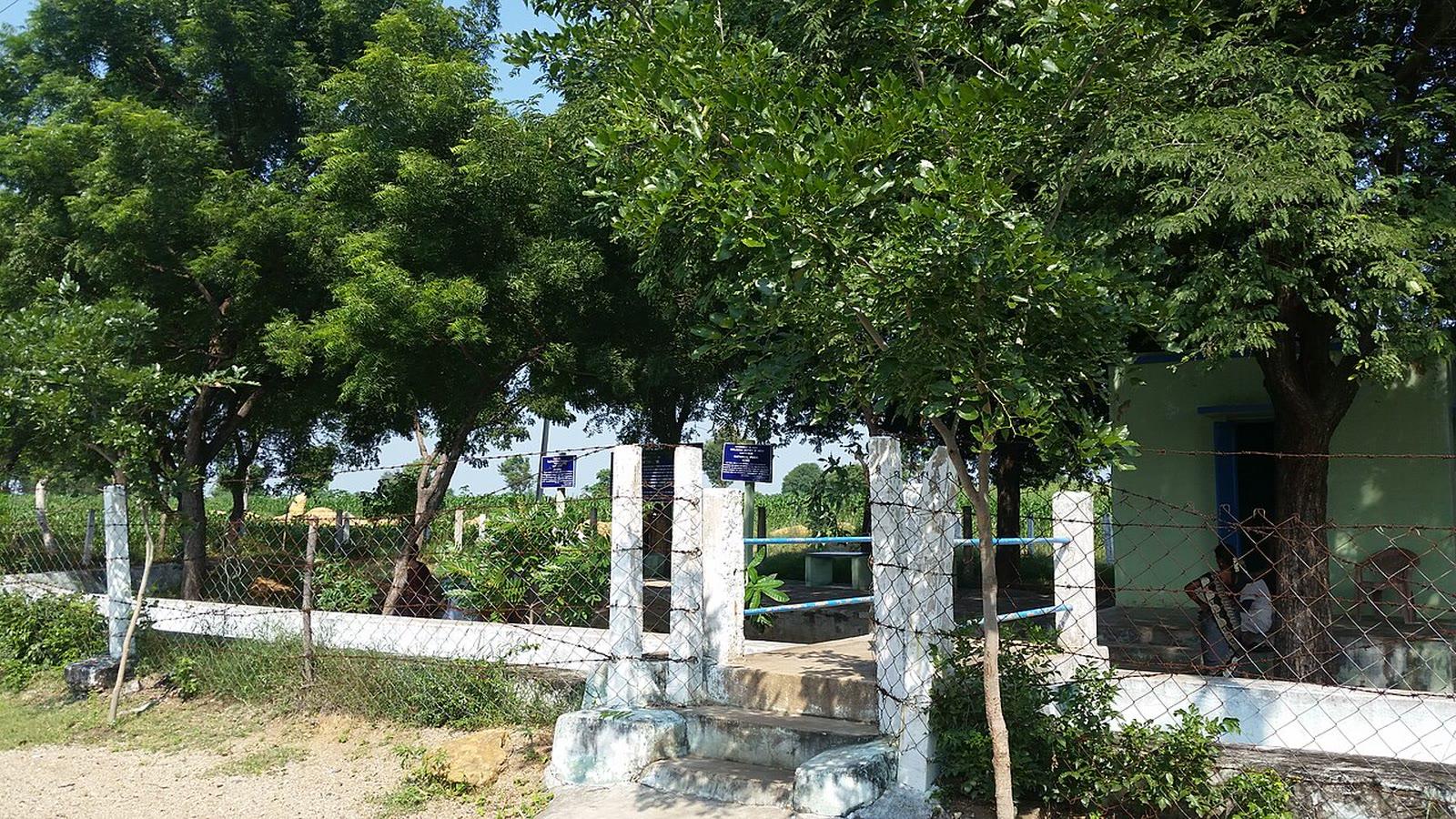
Sathanur village lies in Perambalur district, about 23 km from Perambalur town. The district administration gives the park's position as 11.164581, 78.976975.
GPS: 11.1646°N, 78.9770°E.
Town buses run from Perambalur to Sathanur village. The district administration names Trichy as the closest airport, with road onward to Perambalur.
By rail, the nearest useful stops are Trichy Junction and Ariyalur station, both on the Chennai to Trichy line, with road for the last leg.
Neither the Geological Survey of India nor the Tamil Nadu or district governments publish opening hours or an entry charge for this park in any source this page could load. The state tourism department describes the education centre, museum and children's park without giving times. Telephone the Perambalur district administration or the Tamil Nadu tourism helpline before you travel.
November to February gives the most comfortable conditions. March to May is severe in interior Tamil Nadu, and the park has very little shade. The north-east monsoon brings most of the year's rain between October and December.
 Photo: Arivazhagan.ma, CC BY-SA 4.0, via Wikimedia Commons

What Fossils You'll Find
Nothing may be collected. The park exists to hold one specimen in place.
That specimen is the trunk. The Indian Stratigraphic Lexicon records fossil wood 18 metres long preserved at Sattanur village, lying parallel to the bedding of the rock. The district administration gives the length as over 18 metres, and the state tourism department as nearly 18 metres. All three agree on the order of magnitude.
The wood is conifer, which makes it a gymnosperm. The district administration draws the point out: the tree shows conifers holding the land vegetation before flowering plants took over. No published source that this page could load names the wood to species, so the page does not give one.
Smaller trunks occur outside the park. The district administration lists fossil trees a few metres long in stream sections near Varagur, Anaipadi, Alundalipur and Saradamangalam.
Animal fossils occur in the same rock, which is the detail that separates Sathanur from a petrified forest on land. The Kulakkalnattam Sandstone Member that holds the trunk is bioturbated sandstone grading into sandy coquina. The lexicon records the burrow traces Palaeophycus, Planolites and Skolithos from it. The Anaipadi Calcarenite Member above carries ammonites of the Lewesiceras zone, plus the burrow systems Thalassinoides and Ophiomorpha.
The education centre has four halls. Their displays run through the solar system, the origin of the Earth and the big bang. The last two cover the origin of life and evolution, and then the petrified tree itself. The museum holds fossils collected around the district.
Some of what is on display came from elsewhere. Three photographs of the park on Wikimedia Commons say so in their own descriptions. The trunks they show came from the Tiruvakkarai park in Villupuram district and are kept at Perambalur for display. Ask the staff which pieces are local.
Wood from Tiruvakkarai on display at Sathanur, per the photographer's own file description. Photo: P Jeganathan, CC BY-SA 3.0, via Wikimedia Commons

Geologic History
The park sits in the Cauvery Basin, which holds the thickest Cretaceous marine sequence in peninsular India. Blanford divided that sequence into three groups, the Uttatur, the Trichinopoly and the Ariyalur. All three crop out in a belt running north from Tiruchirappalli.
The trunk lies in the Garudamangalam Formation, in its lower unit, the Kulakkalnattam Sandstone Member. The Indian Stratigraphic Lexicon names the formation after Garudamangalam village. It gives the type locality as the villages of Kulakkalnattam, Anaipadi, Alandiapur, Saturbhugam and Garudamangalam in Ariyalur district.
The lexicon dates the formation to the Coniacian and Santonian stages, from 89.39 to 83.65 million years ago. That is the current reading, following Reddy and colleagues in 2013 and Nagendra and colleagues in 2018. Earlier work by Sastry and colleagues in 1968 and Sundaram and colleagues in 2001 put it in the Turonian and Coniacian instead. This page carries the current range in its frontmatter.
The Karai Formation lies below, across an unconformity that spans the late Turonian. The Campanian Sillakkudi Formation lies above, across a second unconformity spanning the late Santonian. So the formation is a package bounded top and bottom by missing time.
The setting was the coast, not a forest floor. The lexicon reads the formation as nearshore marine deposition in a highstand, with mixed sand and carbonate and a river-mouth bar. The base is transgressive littoral to shallow marine material resting on an eroded surface of the Karai Formation. The sequence coarsens upward as the shoreline advanced seaward again.
That setting explains the trunk. The lexicon records fossil driftwood in the basal part of the formation. A tree grew inland, a river carried it down, it grounded on a nearshore sand body, and sediment buried it. Silica-bearing groundwater replaced the wood tissue afterwards. The trunk lying parallel to bedding is consistent with a log coming to rest rather than a tree dying where it stood.
Several very different ages are in print for this site, and knowing why helps. The district administration says the trunk sits in rocks about 100 million years old and elsewhere refers to over 120 million years. A regional newspaper has given over 120 million years. Those figures sit outside the formation's own dated range. The formation boundaries are the firmer guide, which is why this page uses 89.4 to 83.7 million years.
The modern landscape is a pediplain, a surface worn flat by erosion across the Cretaceous rocks, with isolated hills of crystalline granulite standing above it. The trunk itself sits in the sandstone and parallel to its bedding, not directly on that granulite.
 Photo: P Jeganathan, CC BY-SA 3.0, via Wikimedia Commons

Collecting Rules and Regulations
Collecting is prohibited. Sathanur is a National Geological Monument held by the Geological Survey of India.
The rule is easier to accept here than at most sites, because the monument is one object. There is no scatter of loose material to take and no argument that a fragment would never be missed.
Do not climb on the trunk, lean on it, or stand pieces of rock against it. Silicified wood is brittle and splits along its own grain.
Do not hammer or chisel anywhere inside the park, including the display pieces near the education centre.
The smaller trunks in the stream sections at Varagur, Anaipadi, Alundalipur and Saradamangalam sit outside the fence. Treat them as part of the same protected resource. Photograph them and leave them.
Report anything that looks newly exposed to the education centre staff.
Safety
Heat is the main hazard and it is worse here than the temperature suggests. Do not visit between March and May without water and a hat. Interior Tamil Nadu reaches the high thirties in Celsius through those months, and the open ground around the trunk gives almost no shade.
Watch your footing on the display area. Broken silicified wood holds edges sharp enough to cut through a thin sole, so wear closed shoes.
Snakes use the scrub and the gaps between stone blocks in the warm months. Do not reach into cavities or step over a block you cannot see behind.
The stream sections away from the park carry water fast during the north-east monsoon, between October and December. Do not walk a channel bed when rain is falling upstream.
Perambalur town, 23 km away, has the nearest hospital. Mobile coverage along the village roads is workable but not certain, so tell someone your plan.
Sources
https://indplex.geolex.org/formations/Garudamangalam%20Fm https://perambalur.nic.in/tourist-place/fossil-tree/ https://en.wikipedia.org/wiki/National_Fossil_Wood_Park,_Sathanur https://tamilnadutourism.tn.gov.in/destinations/perambalur-district https://indplex.geolex.org/formations/Sillakkudi%20Fm https://commons.wikimedia.org/wiki/Category:National_Fossil_Wood_Park,_Sathanur
Nearby sites
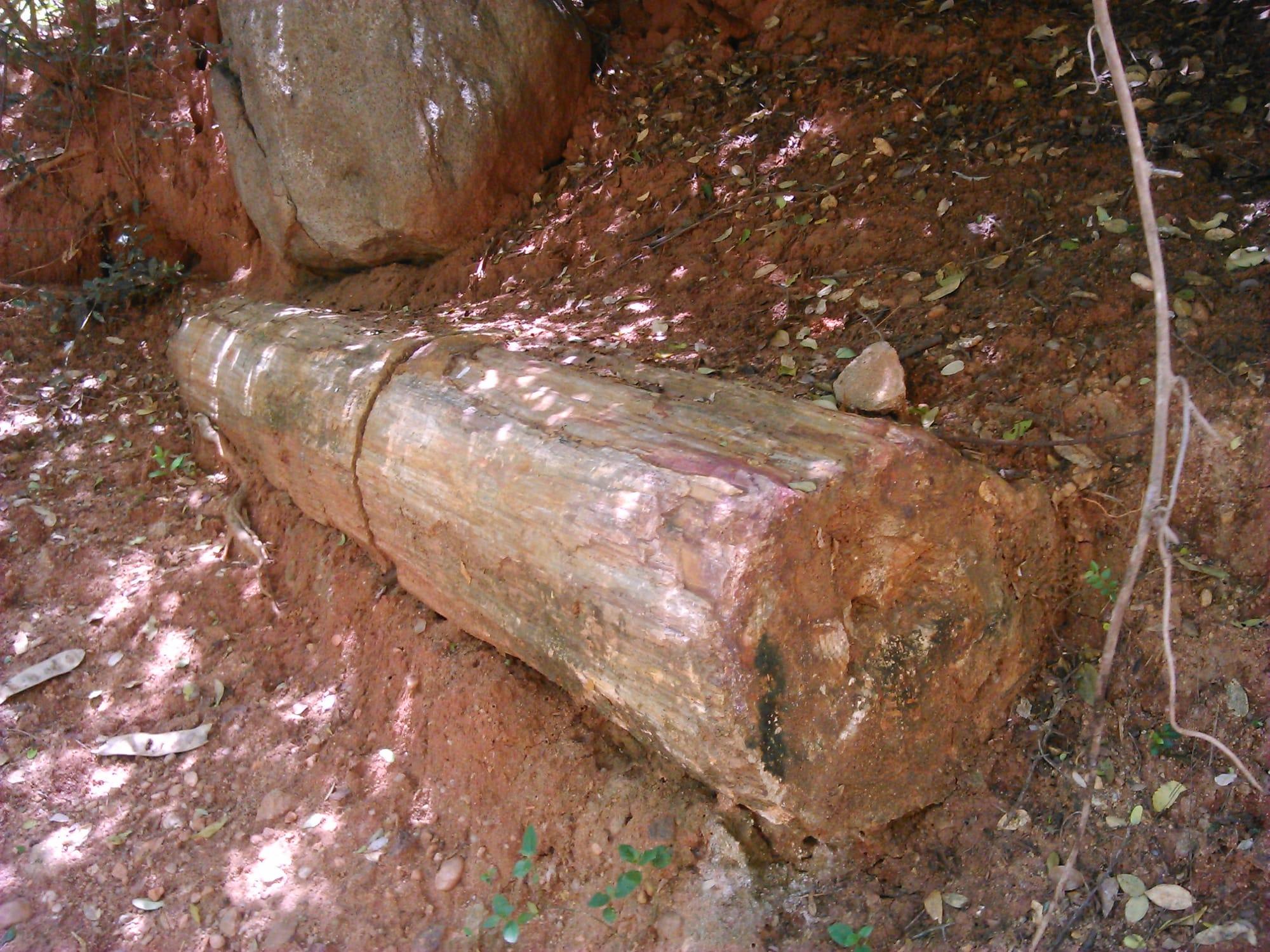 National Fossil Wood Park at Tiruvakkarai Fossil Hunting GuidePetrified Wood, Plants
 Wadadham Fossil Park Fossil Hunting GuideDinosaur Bones, Dinosaurs
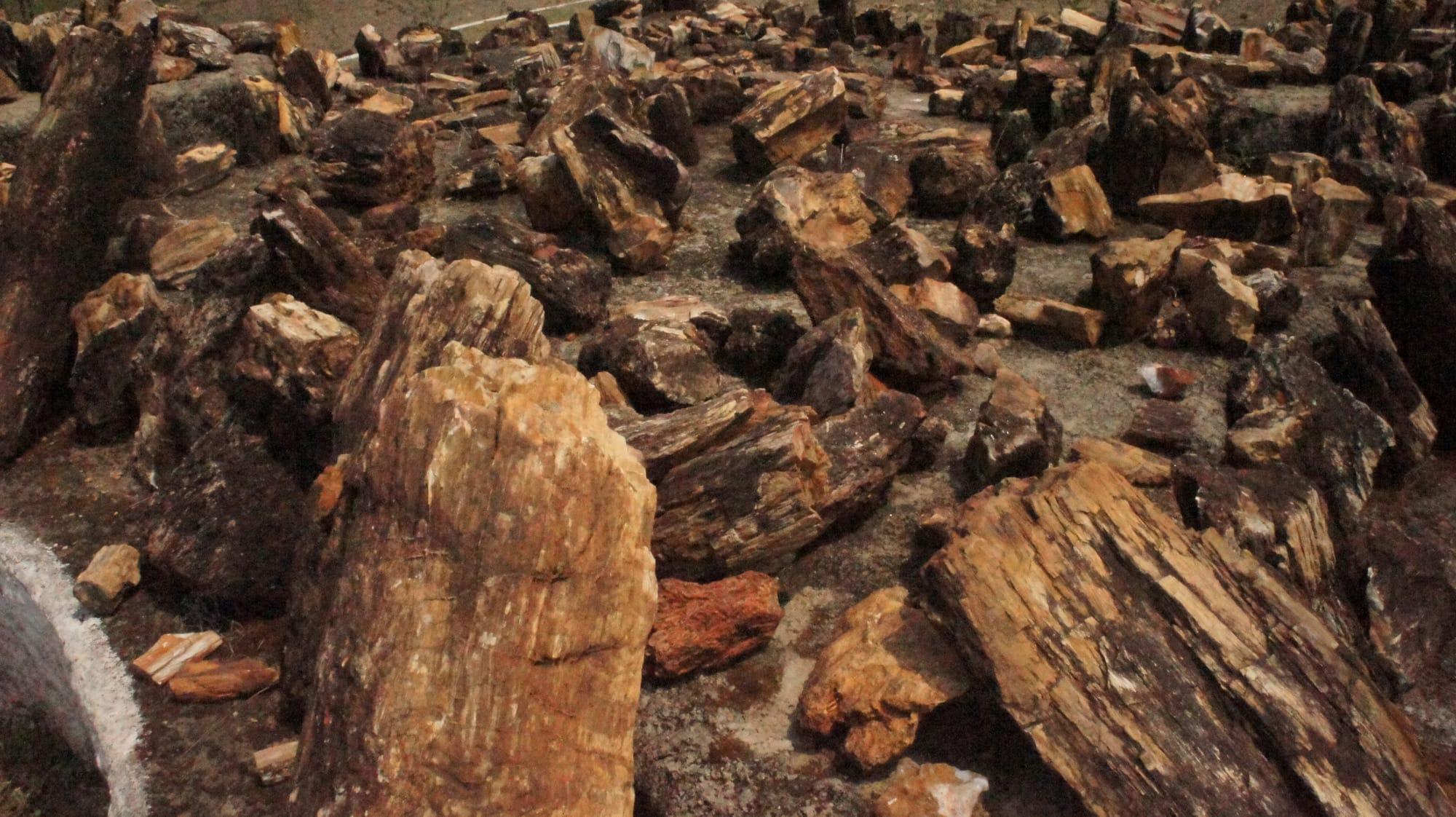 Ghughua National Fossil Park Fossil Hunting GuidePetrified Wood, Seeds and Fruits
 Lameta Geological Park Fossil Hunting GuideIsisaurus colberti, Jainosaurus septentrionalis