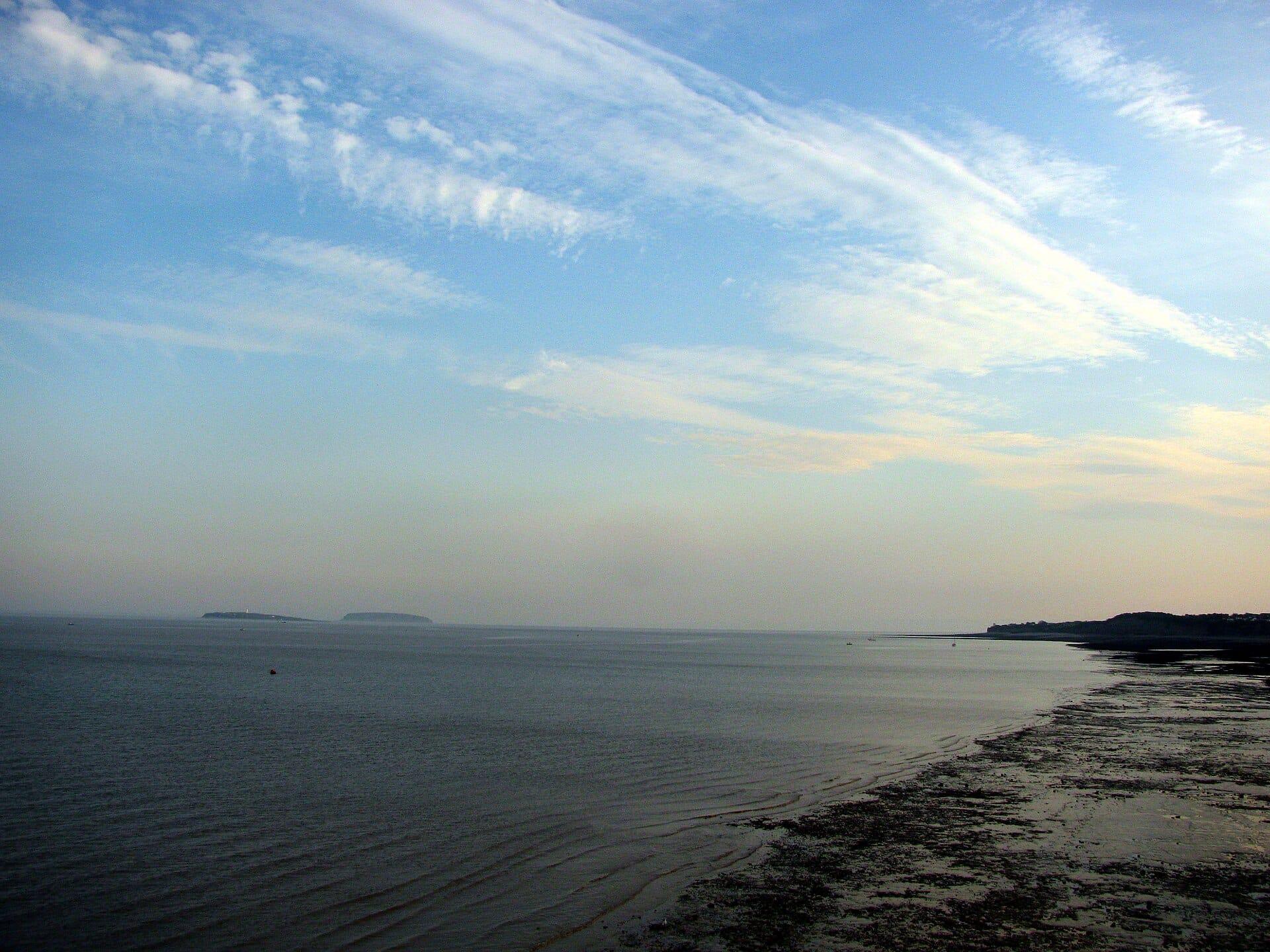
Penarth Beach Fossil Hunting Guide
Image: Humphrey Bolton (CC BY-SA 2.0)
Penarth Beach in South Wales exposes the Rhaetian Penarth Group at the Triassic-Jurassic boundary, yielding ammonites, bivalves, fish teeth, and bone beds from approximately 201 million years ago. It is the most visited fossil site in Wales and is free to access year-round.
By Edward Chen · Updated 31 July 2026
Introduction
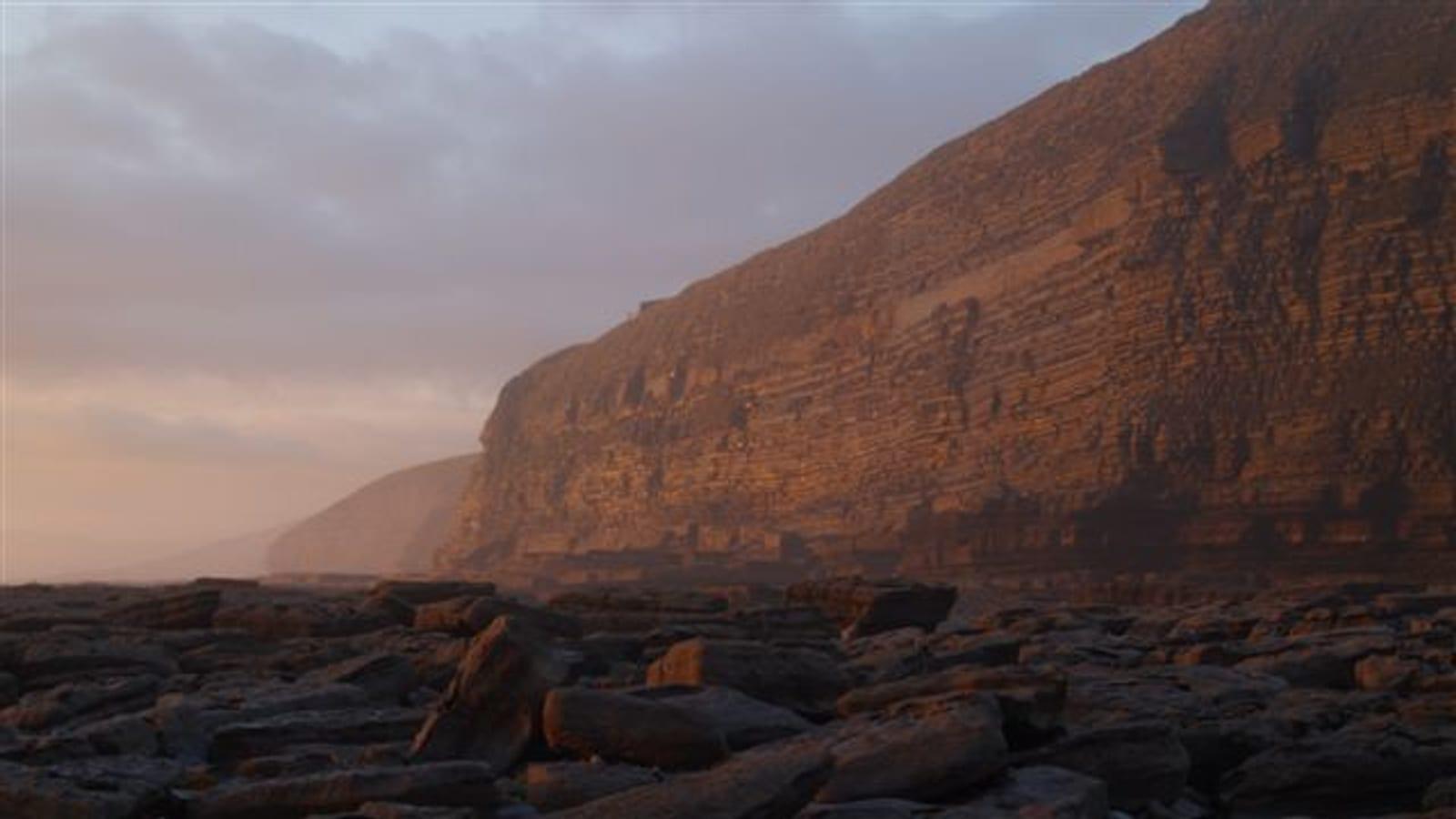
Penarth Beach sits on the northern shore of the Bristol Channel in the Vale of Glamorgan, roughly four miles south of Cardiff city centre. The cliffs here expose a compact but exceptionally rich sequence of rocks from the very end of the Triassic Period, approximately 201 million years ago, a moment in Earth history when a shallow inland sea began flooding across what had been an arid desert landscape. The result is one of the most fossiliferous Triassic shorelines in Britain, and the most popular fossil hunting destination in Wales.
The rocks belong to the Rhaetian Penarth Group, a set of dark grey to black mudstones and thin limestones named directly after this location. The formation is the type section for the Rhaetian stage across Britain, meaning that the strata here serve as the standard reference point against which equivalent rocks elsewhere are compared. The Penarth Group is described in detail by the British Geological Survey and the Palaeontological Association, both of which confirm that the foreshore yields a distinctive assemblage of bivalves, fish remains, and occasional ammonites.
Above the Rhaetian beds, the cliff transitions into the Blue Lias, the lowest unit of the Jurassic Lias Group, adding a second fossiliferous horizon to the site. The two formations together give Penarth an unusual dual character: visitors walking south along the foreshore from the pier pass through time from the Jurassic into the Triassic as the strata step down in age.
Location and Directions
Penarth town is well served by public transport. The X91 bus connects Cardiff city centre to Penarth Esplanade in under twenty minutes. Penarth railway station is a fifteen-minute walk uphill from the seafront and receives services from Cardiff Queen Street roughly every thirty minutes.
By car, follow the A4160 south from Cardiff and look for signs to Penarth Esplanade. Pay-and-display parking runs the length of the Esplanade alongside the beach. Spaces fill quickly on summer weekends. An alternative car park sits on Clive Place, a short walk from the pier.
Access to the foreshore is from the bottom of the pier steps or from any of the slipways along the Esplanade. The beach is shingle and flat rock platform. Sturdy footwear with a grip sole is advisable. Public toilets and a cafe are located in the pier pavilion. The pier itself is a Victorian cast-iron structure and charges a small entry fee to walk to the end, though the fossils are found on the beach, not on the pier.
Walk south from the pier towards Cardiff Barrage along the foreshore. The fossiliferous Rhaetian beds appear in the cliff face and as loose boulders and slabs on the beach. Fossils are found throughout this stretch. The best concentrations are roughly 200 to 600 metres south of the pier where the Westbury Formation outcrops at low tide.
 Photo: Penarth's Pebble Beach by David Roberts, CC BY-SA 2.0, via Wikimedia Commons
What Fossils You'll Find
The most productive layer is the Westbury Formation, a dark grey to near-black mudstone forming the lower part of the Penarth Group. According to the BGS account of this formation, thin-shelled bivalves dominate the fauna. Rhaetavicula contorta is the index fossil of the Rhaetian stage and occurs in abundance here, often forming dense shell pavements in loose slabs on the foreshore. Other common bivalves include Eotrapezium concentricum and Chlamys valoniensis, both identifiable by their fan-shaped outline and fine ribbing.
Bone beds within the Westbury Formation are the site's most distinctive feature. These thin, conglomeratic layers are packed with the scales, teeth, and spines of Late Triassic fish, including Gyrolepis, Acrodus, Hybodus, and Saurichthys. The teeth of these sharks and bony fishes are small, typically a few millimetres across, but numerous and well preserved, often appearing as dark, shiny objects among the pebbles on the foreshore. A patient search after the tide drops usually turns up several examples. The BGS also notes the presence of teeth and bones from marine reptiles, including early ichthyosaurs and plesiosaurs, though these are rare and should be reported to museum staff if found.
The overlying Lilstock Formation and the Blue Lias above yield ammonites, bivalves such as Gryphaea (devil's toenails), brachiopods, and gastropods. The ammonites from the Blue Lias at Penarth tend to be smaller than those at nearby Watchet or Lyme Regis but are still regularly found loose on the foreshore. Psiloceras planorbis, one of the earliest Jurassic ammonites, has been recorded from the basal Blue Lias at nearby Lavernock Point.
In 2015, fossil hunters Nick and Rob Hanigan discovered the articulated skeleton of Dracoraptor hanigani at Lavernock Point, a small theropod dinosaur from the earliest Jurassic, now housed at the National Museum Wales in Cardiff. This find confirms that vertebrate remains of significance are occasionally encountered along this coastal stretch.
Geologic History
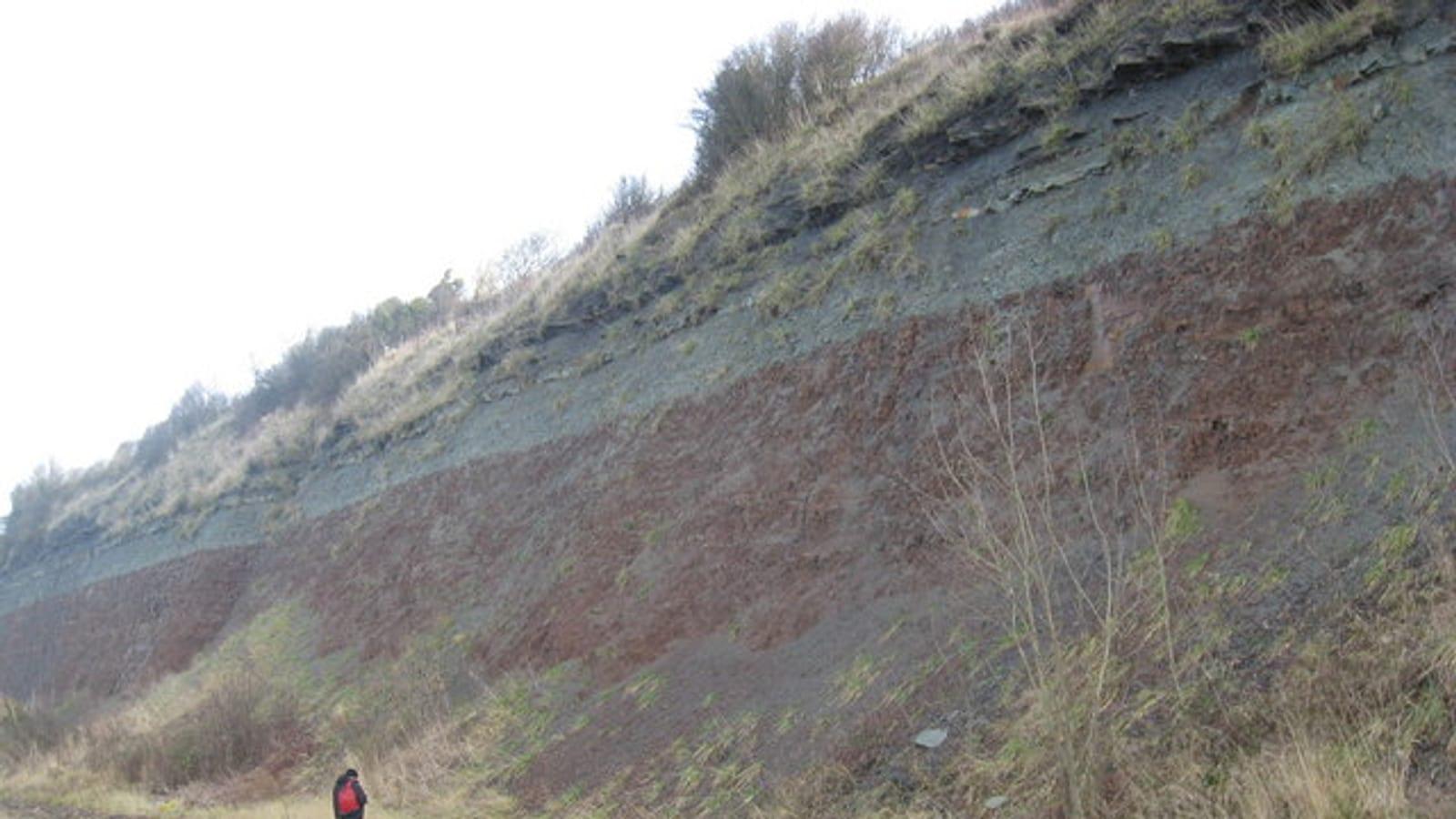
By the Late Triassic, the land that is now South Wales was a semi-arid interior, far from any ocean, under conditions resembling a dry Mediterranean climate. The nearest sea lay to the south. The red and purple Mercia Mudstone Group that forms the upper part of the cliffs at Penarth Head records this terrestrial phase: these beds are almost entirely unfossiliferous, deposited in temporary lakes and river channels under an arid sky.
The Penarth Group marks the moment the sea finally arrived. A marine transgression flooded northwards from the Tethys Ocean during the Rhaetian stage, approximately 201 million years ago, drowning the desert and depositing the dark marine muds of the Westbury Formation. The sudden abundance of marine life recorded in the bone beds and shell pavements reflects a rapid ecological takeover by organisms colonising a newly submerged shelf.
The end-Triassic extinction event, one of the five largest mass extinctions in Earth history, occurred immediately above the Penarth Group. The Blue Lias above represents the recovery phase in the earliest Jurassic, when ammonites and other marine invertebrates diversified rapidly following the extinction. At Penarth, and at the nearby section at Lavernock Point, this boundary is exposed in the cliff face, making the site one of the accessible end-Triassic boundary sections in Britain.
 Photo: Looking south on the beach at Penarth by Steve Daniels, CC BY-SA 2.0, via Wikimedia Commons
Collecting Rules and Regulations
Penarth Beach is designated a Site of Special Scientific Interest (SSSI) under UK law. This does not prevent fossil collecting from loose material on the foreshore. Fossils found in loose rocks, boulders, and beach shingle may be collected as normal.
What the SSSI designation does prohibit is digging directly into the cliff face or hammering the bedrock. The cliffs at Penarth are actively eroding and the foreshore receives a constant supply of fresh material. There is no need to excavate from the cliff to make finds. Collecting should be restricted to loose material already separated from the rock.
For significant vertebrate finds, particularly fish remains from the bone beds or any material that appears to be reptile or dinosaur bone, standard best practice is to photograph the find in place before moving it, and to contact the Amgueddfa Cymru (National Museum Wales) in Cardiff, which maintains an active palaeontology collection.
Safety
The cliffs at Penarth are actively eroding and have produced cliff falls without warning. The BGS and UK Fossils both advise keeping clear of the cliff base. Do not stand directly beneath the cliff face, and do not attempt to extract fossils from the rock face at height.
The foreshore is covered at high tide. Collecting is safest in the two hours either side of low water. Check tide times before visiting. The tidal range in the Bristol Channel is among the highest in the world, reaching over twelve metres at spring tides. The foreshore boulders are covered in seaweed and can be slippery. Footwear with grip is important.
The site is family-friendly and suitable for children old enough to walk on uneven rocky ground. No specialist tools are required. Fossils are found by searching loose boulders and shingle rather than by hammering.
Sources
https://ukfossils.co.uk/penarth/ https://earthwise.bgs.ac.uk/index.php/Penarth_Group,_Permo-Triassic,_Bristol_and_Gloucester_region https://en.wikipedia.org/wiki/Penarth_Group https://palass.org/publications/field-guides-fossils/9/no-9-fossils-rhaetian-penarth-group https://en.wikipedia.org/wiki/Lavernock