Phu Wiang Dinosaur Park Fossil Hunting Guide
Image: Wickanet (CC BY 3.0)
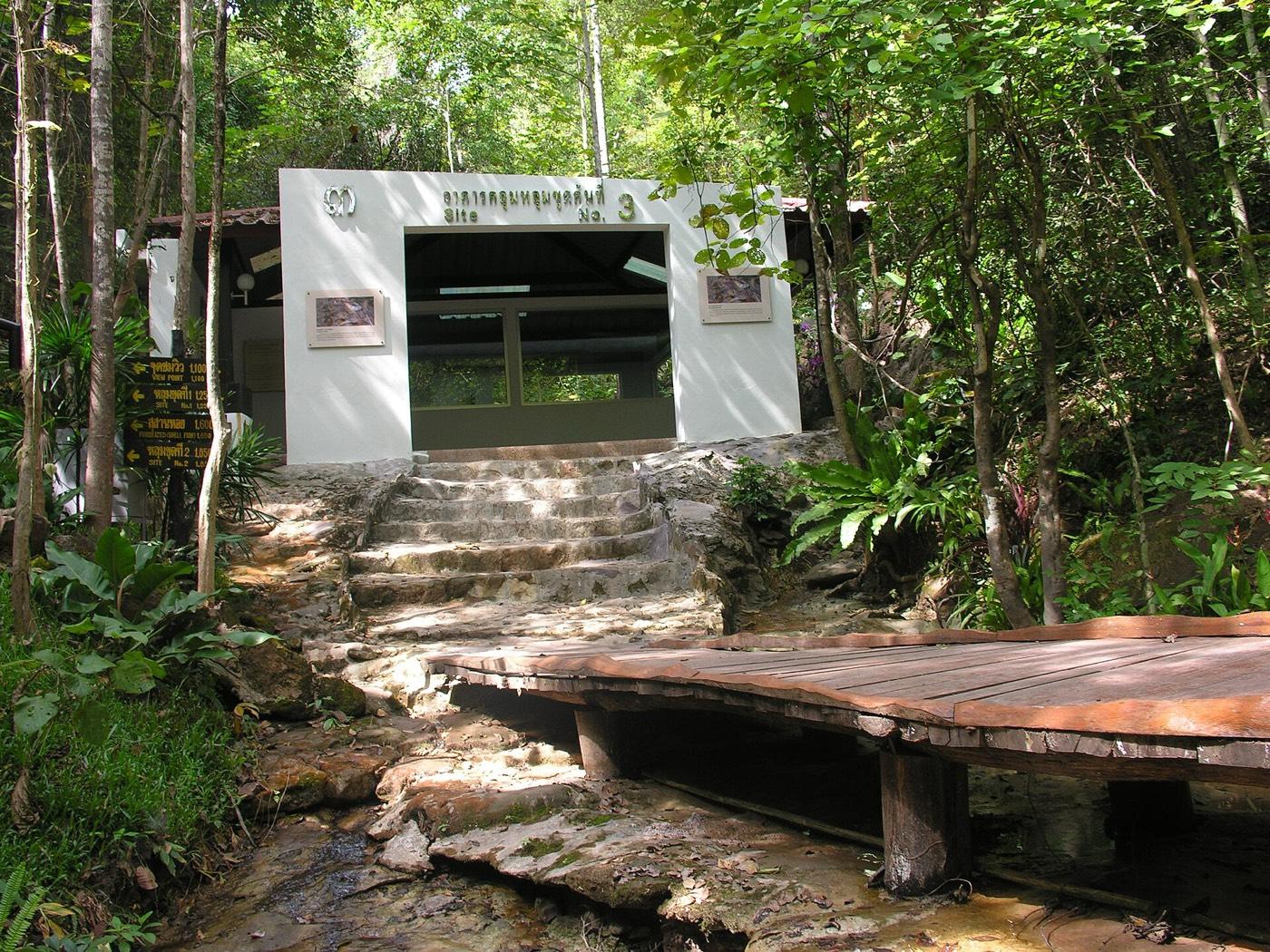
The Khon Kaen locality that gave Phuwiangosaurus sirindhornae its name, inside Phu Wiang National Park. Several excavation pits are roofed and left open, and a museum sits at the foot of the hills.
By Edward Chen · Published 12 September 2026
Introduction
Thai dinosaur palaeontology began at Phu Wiang. A geologist prospecting for uranium in 1976 picked up a bone fragment in these hills, and the identification that followed opened the country's Mesozoic record.
The animal that came out of it, Phuwiangosaurus sirindhornae, carries the place in its name. It was formally described in 1994 and is Thailand's best known dinosaur.
Phu Wiang is a ring of hills enclosing a basin, and the excavation sites are scattered across the slopes inside the national park. Several pits have been roofed and left open so that bone can be seen in the ground.
The Phu Wiang Dinosaur Museum sits at the foot of the hills and holds the prepared material.
Location and Directions
Phu Wiang National Park is in Wiang Kao district, Khon Kaen province, in north-east Thailand.
GPS: 16.6782°N, 102.2671°E.
Khon Kaen city is about 80 kilometres east and has an airport and rail connections. The park is reached by road, and a vehicle is effectively necessary because the excavation sites are spread out.
Both the national park and the museum charge admission. National park entry fees in Thailand are higher for foreign visitors than for Thai nationals, which is standard policy rather than an irregularity.
Confirm which pits are currently open. Shelters are maintained on and off, and not all are accessible at all times.
What Fossils You'll Find
Nothing is collectable. The excavation sites are protected within a national park.
Site 1, sometimes called Pratu Tee Ma, is the pit where the original Phuwiangosaurus material was found, and it remains the principal stop.
Theropod material occurs, including Siamotyrannus isanensis, described in 1996. It was argued at the time to be an early tyrannosauroid, and that interpretation has been debated since.
Small theropod tracks are preserved elsewhere in the park. The combination of body fossils and trackways in one protected area is part of what makes Phu Wiang worth the detour.
Phu Wiang matters to Thai palaeontology in the same way Lyme Regis matters to British. It is where the discipline started locally, and the people who worked it went on to open the other sites in the region. The Thai-French palaeontological programme that ran from the 1980s came out of the early Phu Wiang finds.
 Photo: ★Kumiko★, CC BY-SA 2.0, via Wikimedia Commons

Geologic History
The bone-bearing rocks belong to the Sao Khua Formation of the Khorat Group. Recent dating places it in the late Valanginian to early Hauterivian, roughly 134 to 132 million years ago.
The Khorat Plateau was a continental lowland drained by large rivers. Sandstones and mudstones accumulated on floodplains under a seasonal climate, and the red colour of much of the sequence records oxidising conditions.
Phu Wiang's basin shape is not a crater. It is an eroded structural feature, where softer rock inside a ring of resistant sandstone has been stripped out. That erosion is what exposed the fossil beds.
Set expectations on what the pits look like. These are modest excavations under simple roofs, with bone visible in the ground, rather than large mounted displays. The museum below holds the reconstructions. Doing the museum first and the pits afterwards makes far more sense than the reverse.
Collecting Rules and Regulations
Collecting is prohibited. The sites lie inside a national park and Thai law protects both the park and the fossils.
Removing anything from a Thai national park is an offence, fossils included.
Do not buy fossils locally and do not attempt to export any.
The operative law is the Fossil Protection Act B.E. 2551, of 2008, which the Department of Mineral Resources administers. Section 25 requires anyone who finds something that could reasonably be a fossil to notify the local competent officer within seven days. Section 28 makes trading in fossils an offence without a licence from the Director-General. Taking a fossil out of the Kingdom needs its own licence.
Keep to the marked routes between excavation shelters.
Siamotyrannus is the theropod worth asking about. Described in 1996 from Phu Wiang, it was presented as an early tyrannosauroid, an identification that made it important for the origin of that group. Later analyses moved it elsewhere among the carnosaurs, and the question is not fully settled.
Safety
The park is hilly and the paths between sites are uneven. Wear proper footwear.
Isan heat is severe from March to May, and there is limited shade on the approach walks. Carry water.
The rainy season from May to October makes tracks slippery and can close parts of the park.
Snakes and biting insects are present. Stay on paths.
Khon Kaen is the practical base. The city has flights from Bangkok, and hotels across the price range. So the Phu Wiang trip works as a day out rather than an expedition.
The uranium prospecting detail is not incidental. Much of what is known about the Khorat Plateau's geology came out of mineral surveys rather than palaeontological expeditions. The first Thai dinosaur was found by a geologist looking for something else entirely.
The park's ring of hills encloses a broad basin. The excavation sites are scattered around its inner slopes rather than concentrated in one place. That is why a vehicle matters and why visitors who arrive on foot see only a fraction of what is there.
Sources
https://en.wikipedia.org/wiki/Phu_Wiang_National_Park https://en.wikipedia.org/wiki/Phu_Wiang_Dinosaur_Museum https://en.wikipedia.org/wiki/Sao_Khua_Formation https://novataxa.blogspot.com/2014/02/1994-phuwiangosaurus-sirindhornae.html
Nearby sites
 Phu Kum Khao and the Sirindhorn Museum Fossil Hunting GuideDinosaurs, Sauropods
 Khorat Fossil Museum and Petrified Wood Fossil Hunting GuidePetrified wood, Mammals
 Tarutao Trilobite Site, Satun Geopark Fossil Hunting GuideTrilobites, Brachiopods
 Port Island (Chek Chau), Hong Kong Fossil Hunting GuideDinosaurs