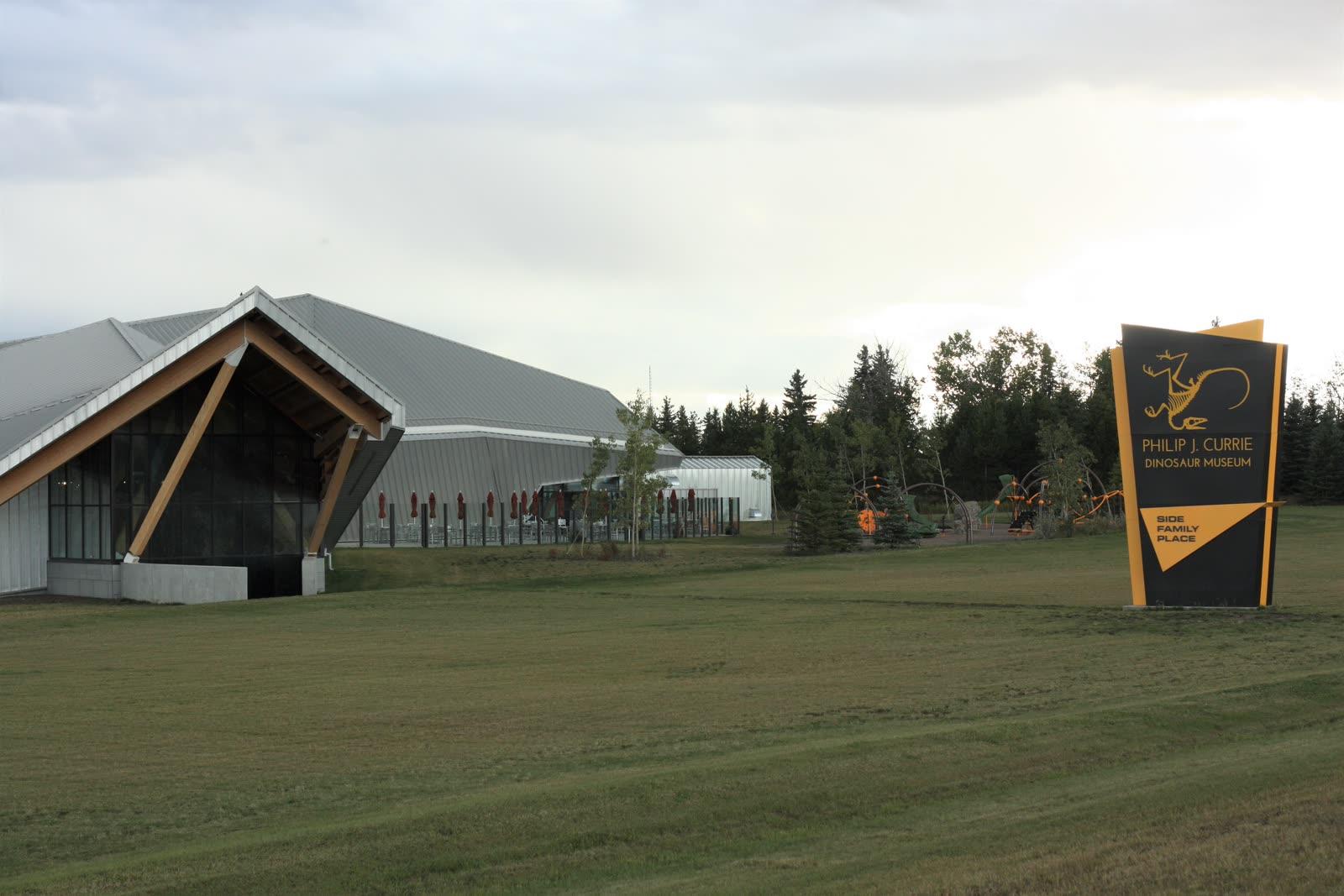
Pipestone Creek Bonebed Fossil Hunting Guide
Image: Ribbet32 (CC BY-SA 4.0)
Pipestone Creek Bonebed near Wembley, Alberta, is Canada's densest dinosaur bonebed, with more than 7,000 bones of the horned dinosaur Pachyrhinosaurus lakustai from the Wapiti Formation. The only public access is a guided tour run by the Philip J. Currie Dinosaur Museum.
By Edward Chen · Published 1 October 2026
Introduction
Pipestone Creek Bonebed is a Late Cretaceous dinosaur quarry about 25 km southwest of Grande Prairie in northwest Alberta. Researchers have recovered more than 7,000 bones of the horned dinosaur Pachyrhinosaurus lakustai here. Reports describe it as the densest dinosaur bonebed in Canada. The bones lie in the Wapiti Formation and are about 72 to 73 million years old.
Public access is by guided tour only. The Philip J. Currie Dinosaur Museum in Wembley runs the tours. The county has closed the trail to the bonebed to independent visitors. You cannot collect fossils here.
Local teacher Al Lakusta found the bonebed in 1973. The species name lakustai honors him. Royal Tyrrell Museum staff and volunteers excavated the site from 1986 to 1989, and the Philip J. Currie Dinosaur Museum now runs the public tours.
Location and Directions
The bonebed lies about 800 m upstream from the point where Pipestone Creek meets the Wapiti River. It is less than 25 km southwest of Grande Prairie. The tour meets at the Pipestone Creek Campground, a county campground at 702038 Range Road 81A. From Wembley, drive south on Range Road 82 for 11 km. The campground entrance is on the west side of the road.
You must arrange your own transport to the campground. The campground has no cell service.
The Philip J. Currie Dinosaur Museum is at 9301 112 Avenue in Wembley. It is about 23 km west of Grande Prairie at the junction of Highway 43 and Highway 72. The phone number is 587-771-0662.
What Fossils You'll Find
 Photo: Ribbet32, CC BY-SA 4.0, via Wikimedia Commons
The bonebed holds one main species. Pachyrhinosaurus lakustai is a centrosaurine ceratopsian, a horned dinosaur with a thick bony boss on its nose in place of a horn. Estimates put an adult at about 5 m long and 2 tonnes in weight. Researchers have recovered more than 7,000 specimens.
Published work gives a bone density of 30 to 50 elements per square meter on average. The densest parts hold 100 to 300 fossils per square meter. The bones fall into four age groups, from juveniles to full-grown adults.
You see the active excavation on the tour. The tour has three parts. You visit the Shed Museum at the site. You hike to the excavation. You then prospect for fossils along Pipestone Creek.
The museum in Wembley holds more of the story. Its lab tours cost $5 per person. They run Wednesday to Sunday at 12:00 and 14:00 in summer, and Thursday to Sunday at 12:00 and 14:30 in winter.
Geologic History
The bones come from Unit 4 of the Wapiti Formation, a Late Cretaceous (Campanian) river deposit in the Grande Prairie region. The museum gives the age as 73 million years. Argon-argon dating of the bonebed gives 71.89 million years, with an error of 0.14 million years.
The thick bone layer records a mass death. Researchers describe the site as a mass mortality, perhaps a failed attempt by a herd to cross a river in flood. The mix of juveniles and adults supports the idea of a herd that included young animals.
The Wapiti Formation is a nonmarine deposit of the Late Cretaceous. The bonebed lies 800 m upstream from where Pipestone Creek meets the Wapiti River.
Collecting Rules and Regulations
Do not collect at the bonebed. The county campground page states that the county has closed the trail to the bonebed until further notice. Independent public access is not available. The only route is the museum tour.
Alberta law covers every fossil in the province. Under the Historical Resources Act, every fossil found in Alberta belongs to the Crown. A person who legally collects a surface fossil holds it as custodian only. Excavation of any kind needs a permit, and the province issues permits only to qualified palaeontologists. Alberta bans collecting outright in provincial parks, national parks and protected areas. Penalties under the Act reach $50,000 and one year in prison.
The tour includes fossil prospecting along the creek. The museum does not say whether you may keep finds. Ask your guide before you pick anything up. Hand any find to the guide or the museum.
Safety
Wear good walking or hiking shoes. The tour walk is about 2.5 km. Bring water, sunscreen, bug spray and a hat.
The walk has no washrooms once it starts. Use the campground washrooms first.
The tour is weather dependent. The museum may cancel it. Check with the museum before you drive out.
All participants must sign a safety waiver. Children under 14 must stay with an adult. The tour accepts ages 5 and up and holds a maximum of 15 people.
Tour Details and Booking
The standard tour costs $25 for adults aged 18 and over and $10 for youth aged 5 to 17. A palaeontologist-led tour costs $35 for adults and $15 for youth. Groups of 6 or more get 20 percent off. Each tour lasts 2 hours.
The 2026 tours ran Wednesday to Saturday, with the last standard dates on 16 to 19 and 23 to 26 September. The museum publishes dates one season at a time. Check dinomuseum.ca for next season. Book by email at bookings@dinomuseum.ca or by phone at 587-771-0662.
The museum charges admission of $15 plus GST for adults and $8 plus GST for children aged 4 to 17. The campground opens 15 May to 15 October and charges $29 per night for an unserviced site.
Sources
https://dinomuseum.ca/bonebed-tour https://dinomuseum.ca/planning-your-visit https://dinomuseum.ca/hours-admission https://www.countygp.ab.ca/parks-recreation-community/campgrounds-parks-trails-and-playgrounds/pipestone-creek-campground/ https://www.tyrrellmuseum.com/research/found_a_fossil https://www.researchgate.net/publication/386250639 https://www.academia.edu/16680069/A_new_Pachyrhinosaurus_bonebed_from_the_late_Cretaceous_Wapiti_Formation https://en.wikipedia.org/wiki/Pachyrhinosaurus