Shivalik Fossil Park, Saketi Fossil Hunting Guide
Image: Vjdchauhan (CC BY-SA 3.0)
A National Geological Monument on the Markanda River in Sirmaur district, built on the Siwalik beds that produced its own fossils. A museum and six life-size models stand on soft sandstones and clays of the Tatrot Formation.
By Edward Chen · Published 12 October 2026
Introduction
The Geological Survey of India notified the fossil park at Saketi as a National Geological Monument in 1974. The park stands on the beds that produced the bones it displays.
Saketi, also written Suketi, lies on the left bank of the Markanda River in Sirmaur district, Himachal Pradesh. The ground is soft sandstone and clay of the Middle and Upper Siwalik subgroups.
A museum on the premises holds the fossils. Outside it stand six life-size fibreglass models of the animals that the local rock produced.
The claims made for the park need handling with care. India's Ministry of Tourism calls it one of a kind in Asia. A stronger version circulates, that it was the first park in Asia developed at the actual fossil discovery site. That wording traces back to tourism listings rather than to the Geological Survey. This page reports who says it instead of asserting it.
This is the first Siwalik locality covered on this site. The geology section below therefore sets out the whole Siwalik framework rather than assuming it.
Location and Directions
Saketi sits about 21 km from Nahan, the district headquarters of Sirmaur. A 4 km link road leaves the highway that runs up from Haryana.
GPS: 30.5060°N, 77.2378°E. That is the OpenStreetMap node for Suketi village. The Wikipedia article on the park carries a different coordinate pair, and it falls north-east of Nahan, on the wrong side of the town. This page does not use it.
From Chandigarh, take a bus to Kala Amb, about 70 km, then a taxi for the last 5 km. From Ambala the bus run to Kala Amb is about 40 km, with the same short taxi leg. After the Markanda bridge on the road towards Yamunanagar, a Himachal Tourism board marks the turning.
No Himachal Pradesh government page and no Geological Survey of India page that this research could load publishes opening hours or an entry charge. Commercial travel listings report roughly 09:30 to 17:00, closure on Tuesdays and public holidays, and free entry. None of that is confirmed by the operator. Telephone the forest office at Nahan before you commit to the journey.
Time the visit for the dry months. November to March gives comfortable walking in the Siwalik foothills. The south-west monsoon runs from July to September and fills the Markanda. April to June is very hot on open ground.
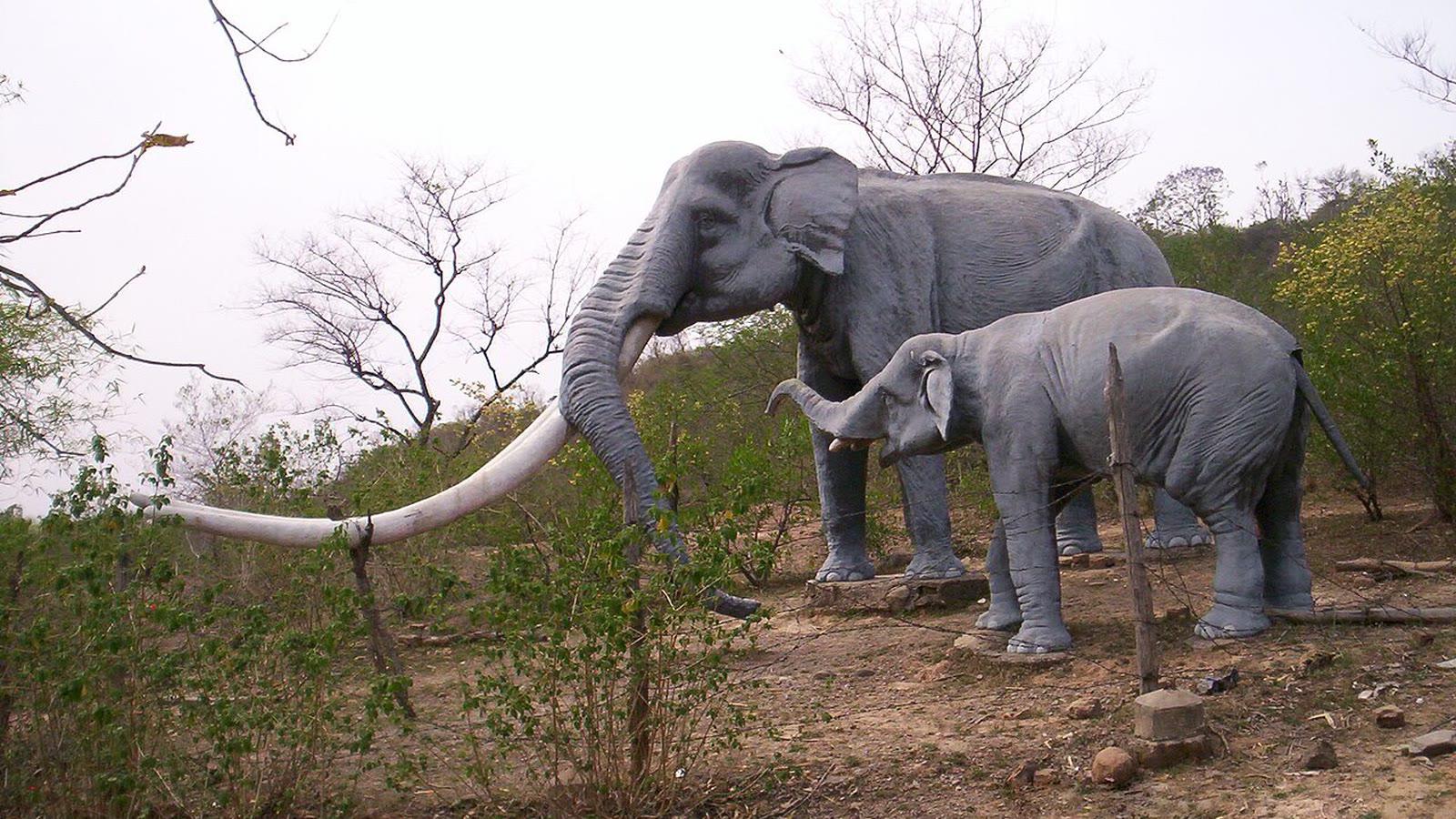
 Model proboscideans at the park, with tusks the photographer measured at 18 feet. Photo: Vjdchauhan, CC BY-SA 3.0, via Wikimedia Commons

What Fossils You'll Find
Nothing may be collected. What follows is what the museum holds and what the beds around Saketi have produced.
The Geological Survey of India published a catalogue of the museum's fossils in 2013. The Siwalik Fossil Museum itself opened on the park premises in May 2014.
The names need care, because several of them circulate in forms that no longer match current usage. This page gives the correction each time.
Stegodon ganesa is the proboscidean the park is known for, named by Falconer and Cautley from Siwalik material. Park signage and many listings spell it ganesha. The original spelling is ganesa, and the Paleobiology Database keeps it. Stegodon insignis occurs in the same collection.
Sivatherium giganteum is the short-necked giraffid with branched ossicones on its skull. The binomial is current and holds.
Hexaprotodon sivalensis is the Siwalik hippopotamid, also named by Falconer and Cautley. Enhydriodon sivalensis, a large otter, comes from the same beds.
The giant tortoise appears in the museum list as Colossochelys atlas. Falconer and Cautley published Megalochelys in 1837 and then replaced it with Colossochelys in 1844, and the earlier name has priority. Current usage is Megalochelys atlas. The caption on the park's own model photograph already uses it.
Gavialis browni is the crocodilian in the list. Some summaries of the park give the crocodile as Crocodylus instead. Gavialis is the gharial genus, which is a narrow-snouted fish eater and not a true crocodile, so this page follows the museum list.
Paramachairodus sp. is the sabre-toothed cat. The Paleobiology Database treats Paramachaerodus as the correct original spelling of the genus, so expect both forms in print.
Six sets of models stand in the open: proboscideans, Sivatherium, Hexaprotodon sivalensis, the giant tortoise, the sabre-toothed cat and a crocodilian. They are resin and fibreglass, and they are the reason the park works for a first visit. The bones in the museum are fragmentary. The models tell you what the fragments belonged to.
 Stegodon ganesa from the Siwaliks, figured by C. W. Andrews. Public domain, via Wikimedia Commons

Geologic History
The Siwalik Group is the debris of the Himalaya. Sediment shed off the rising mountains filled a trough along their southern front from the middle Miocene onwards. Rivers spread sand and mud across that trough, and the pile reached several kilometres in thickness. Later thrusting lifted the whole stack into the low ranges that now carry its name.
Workers divide the group into Lower, Middle and Upper subgroups. The Lower is mostly mudstone, the Middle mostly thick sandstone, and the Upper takes in coarser sands, conglomerates and the youngest beds.
Saketi sits in the Tatrot Formation, which straddles the top of the Middle Siwalik and the base of the Upper Siwalik. The Indian Stratigraphic Lexicon takes the Markanda River Section at Saketi as the reference section for that formation. It gives the section a thickness of 250 m and records 48 mammalian taxa from it, 20 of them useful as biostratigraphic markers.
A second name applies to the same rock. Nanda in 2015 called the Saketi interval the Saketi Formation, and the lexicon lists that as a synonym of the Tatrot Formation. Both names appear in print for the beds under the park.
The lithology is fine to coarse grey sandstone with variegated mudstones and siltstones. The lexicon reads the setting as a meandering river with a floodplain, in cycles that coarsen upward. The climate signals conflict with each other. Palaeosols and iron concretions point to warm, humid ground. Concretions in the channels point to semi-arid spells. Mottled palaeosols point to waterlogged, reducing conditions.
The age range matters because the summaries disagree with each other. The lexicon dates the Tatrot Formation from the latest Miocene at about 5.5 million years to the Pliocene at 2.58 million years. The Dhok Pathan Formation lies below it in a gradational contact. The Pinjor Formation lies above it across a tectonic contact.
That dating settles the period value on this page. The base of the Quaternary sits at 2.58 million years, which is exactly where the Tatrot Formation stops. The park's own rocks therefore fall wholly in the Neogene, and the frontmatter says neogene. The Pinjor Formation above is the Quaternary part of the Upper Siwalik, and the park does not sit on it. That distinction is why tourism pages describing these fossils as Plio-Pleistocene are using the wider subgroup span rather than the formation under your feet.
Other figures are in circulation and are worth recognising for what they are. Government tourism text gives the fossils as about 2.5 million years old. Summary pages give 1 to 2.5 million years. One travel page gives 8.5 million years. The formation boundaries are the firmer guide.
Why so much bone comes out of this rock is a matter of setting. A river floodplain at the foot of a rising mountain range buries carcasses quickly and then does it again for several million years. Hugh Falconer and Proby Cautley worked this ground in the 1830s and named a long list of the animals. That is why Siwalik species names run through the whole literature on Asian Neogene mammals.
Collecting Rules and Regulations
Collecting is prohibited. Saketi is a National Geological Monument held by the Geological Survey of India. The Survey runs the park jointly with the Government of Himachal Pradesh.
Do not hammer, dig or scrape the sandstone and clay. The rock here is soft, which is the whole problem. It weathers fast, loose bone turns up at the surface, and a fragment lifted today is a fragment the next survey cannot record.
Report anything that looks like bone to the park staff rather than pocketing it. A specimen with a recorded position is worth something to the museum. A specimen in a bag is worth nothing to anybody.
Do not buy fossils from sellers near the park or along the Kala Amb road.
Stay on the paths between the models and inside the museum. The river bank outside the park boundary is not an open collecting ground.
Safety
Heat is the first problem. Do not walk the open ground between April and June without water. The Siwalik foothills pass 40°C in those months and the park has limited shade.
The Markanda is the second. Stay out of the river bed during the monsoon, from July to September. The channel rises fast off the Siwalik slopes and the bars shift between floods.
Soft sandstone and clay make poor footing. Wet clay is slippery, and the river undercuts the banks, so do not stand below an overhanging face.
Snakes are active in the warm months in grass and scrub. Watch where you place feet and hands.
Nahan, 21 km away, holds the nearest hospital of any size. Travel in daylight, tell someone your route, and do not count on mobile coverage off the link road.
Sources
https://indplex.geolex.org/formations/Tatrot%20Fm https://en.wikipedia.org/wiki/Shivalik_Fossil_Park https://en.wikipedia.org/wiki/Suketi https://prod.incredibleindia.gov.in/content/incredible-india-v2/en/destinations/dehradun/shivalik-fossil-park-museum.html https://en.wikipedia.org/wiki/Megalochelys https://paleobiodb.org/data1.2/taxa/list.txt?match_name=Megalochelys,Colossochelys,Stegodon%20ganesa,Sivatherium%20giganteum,Paramachairodus,Hexaprotodon%20sivalensis,Gavialis%20browni&show=attr,app,parent
Nearby sites
 Spiti Valley: Shaligram Ammonites of the Tethys SeaAmmonites, Belemnites
 Akal Wood Fossil Park Fossil Hunting GuidePetrified Wood, Plants
 Lameta Geological Park Fossil Hunting GuideIsisaurus colberti, Jainosaurus septentrionalis
 Salkhan Fossils Park: 1.4-Billion-Year-Old StromatolitesStromatolites, Microbialites