Brijuni National Park Dinosaur Tracksites Fossil Hunting Guide
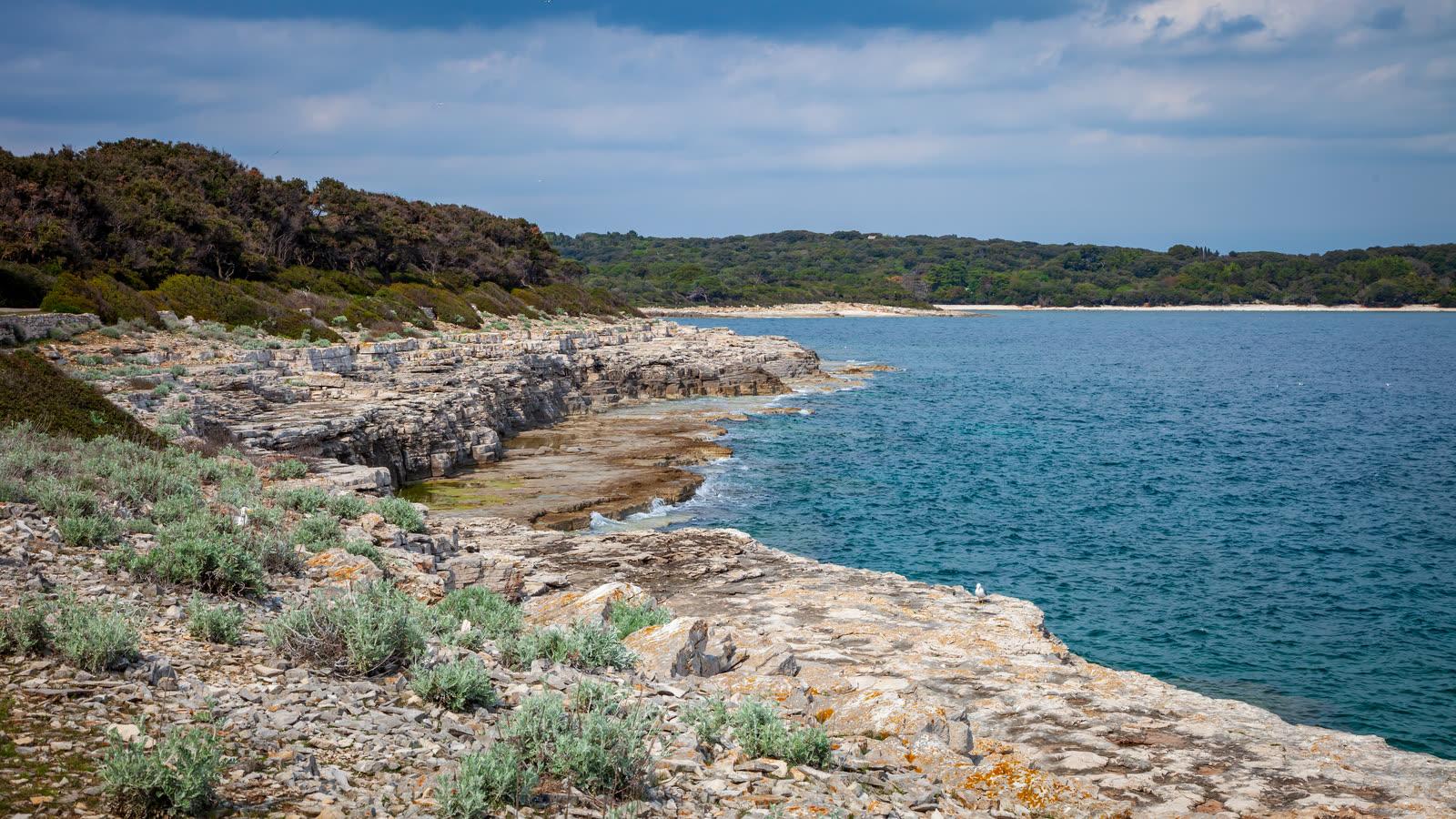
Image: David Lukšić (CC BY-SA 4.0)
Croatia's best-known dinosaur footprints, 294 recorded across nine sites in the Brijuni archipelago. Two tracksites on Veliki Brijun are open to visitors, and the park runs the boat from Fažana. Collecting is prohibited.
By Edward Chen · Published 1 October 2026
 Photo: David Orlovic, CC BY-SA 4.0, via Wikimedia Commons
.JPG)
Introduction
Brijuni National Park records 294 fossil dinosaur footprints at nine sites in the archipelago off Istria. Small theropods made 167 of them, large theropods 60, sauropods 40 and ornithopods 27.
The oldest tracks lie at Cape Vrbanj, also called Barban or Pogledalo. They formed 130 to 125 million years ago in the Early Cretaceous. The other sites are younger, at about 105 million years.
Four of the tracksites are on Veliki Brijun, the main island: Pogledalo, Ploče, Kamik or Plješivac, and Trstike or Debela Glava. Mezga and Bajraktarević described them in 2004.
Only two are open to visitors. Ploče and Vrbanj are on the visitor route. Kamik and Trstike lie in an area that the Croatian Ministry of Defence manages, and visitors cannot enter it. The outer islands of Vanga, Galija and Vrsar are also off limits.
You see these tracks where they lie, on a normal visit, and you do not collect them. The park is a ticketed national park, and you reach it by the park's own boat.
Location and Directions
The boat to Veliki Brijun leaves from the town center of Fažana, near Pula. The ride takes about 15 minutes. The park office at Brionska 10 in Fažana sells tickets, and the park also sells them online.
When the boat docks at Veliki Brijun, a tourist train and a guide meet you. The park's boat schedule changes by season. Winter has two sailings a day, and spring and summer have many more, up to 12.
The park FAQ says Brijuni is open every day except in January and February. The boat schedule still lists winter sailings for those months. Confirm the dates before you travel.
You can visit on your own with a Brijuni Pocket Guide ticket. Walk, or rent an electric car, an electric scooter or a bicycle at the Sports Centre.
The first print is at the harbor. A limestone block at the jetty carries a clear three-toed footprint, probably from a large theropod. The block came from a Brijuni quarry, so it is not an original track. The park dates the discovery to 1999 and the marking to 2008.
Ploče lies on the Zelenikovac peninsula. The Zelenikovac Educational Trail is 1,300 meters long and has 25 information boards. It runs from Javorica Bay toward Cape Ploče, crosses Cape Kozlac and ends at Rankun Bay.
The park says the Ploče visit runs in four sessions a day with an expert guide. Each lasts about an hour and includes a one kilometer walk. Croatia Week reports that visitors register at the info point on arrival.
Vrbanj lies in the north of Veliki Brijun, close to the Safari Park. A Croatia Week article says a tourist train takes visitors there. A theropod sculpture stands on the cape, near the Dino Park.
Telephone the park on +385 52 525 881 or +385 52 525 882, or write to izleti@np-brijuni.hr. The park does not publish one standard ticket price on its pages that this guide read, so check the shop before you go.
What Fossils You'll Find
The tracks are dinosaur footprints in limestone. Ploče has about 50 small theropod prints, and Vrbanj has about 60 large theropod prints.
The Vrbanj prints are the Late Barremian ones. Mezga and Bajraktarević found large theropod tracks in intertidal sediment. Tracks of the large carnosaur type outnumber a rare, slender form.
The Late Albian sites show a different group. They hold prints of small to medium theropods and of small and medium ornithopods, and also possible turtle prints.
Parallel trackways at some Late Albian sites may show that small ornithopods moved in groups. The same team mapped 145 dinosaur footprints and 75 possible turtle prints. Of these, 111 prints form 14 trackways.
The park's own count of 294 prints is larger. It includes later finds and the outer islands.
This guide found no ichnospecies names for the Brijuni tracks in the sources it read. The sources describe the trackmakers by group.
Other fossils lie along the Zelenikovac trail. The park lists shells of the gastropod Nerinea, 3 to 4 centimeters tall and about 105 million years old. It also lists ripple marks and a bone breccia with mammal bone fragments. Early rudist bivalves occur in small patch reefs.
Geologic History
 Photo: Dguendel, CC BY 3.0, via Wikimedia Commons

Istria belongs to the northwest part of the Adriatic-Dinaridic carbonate platform. Mezga and colleagues (2007) describe five megasequences in its rocks. The Late Albian tracks lie in the third, which runs from the upper Albian to the upper Santonian.
The park uses its own names for the rock units. The Mali Brijun Unit is about 125 million years old. It formed in a shallow sea where cyanobacteria and algae thrived, and it holds stromatolites and ripple marks. It covers central and eastern Veliki Brijun and all of Mali Brijun, and it includes the Dino Park near the Safari Park.
The Kanfanar Unit is about 120 million years old. It is the Istrian Yellow limestone, a building stone that workers quarried on the islet of Sveti Jerolim.
The Crna Unit is the youngest Cretaceous rock, at about 110 million years. A rise in sea level flooded old land and made shallow coastal seas. Eight of the nine known tracksites lie in this unit.
The park gives 110 million years for the Crna Unit on one page and about 105 million years on another. Both figures point to the late Early Cretaceous. This guide knows of no formal formation name for the tracks.
The tracks formed in lagoons and tidal flats that the sea left bare at times.
Collecting Rules and Regulations
Do not collect. The park code of conduct bans damage to geological and paleontological finds such as fossils and ichnofossils. It also bans digging them up. It also bans the collection of other living or non-living natural objects.
On 24 April 2021 Croatia declared 24 dinosaur fossil sites in the park a protected part of nature under the Nature Protection Act. Croatia Week calls them the first protected fossils in the country.
Stay on the marked trails. Do not touch, trace, chalk or cast the prints. Take photographs.
Keep dogs on a leash where dogs may go. Swim only at marked areas. The park does not allow you to walk around in a swimsuit.
Safety
Stay on the marked path at Ploče and Vrbanj. Do not enter the area around Kamik and Trstike. The Ministry of Defence manages it, and visitors cannot enter.
The tracks lie on open coastal limestone with little shade. Carry water and sun protection in summer.
Watch your footing near the shore. Wet coastal limestone is slippery.
The boat has a fixed schedule. Check the last sailing back to Fažana before you start your walk.
Sources
https://np-brijuni.hr/en/dinosaurs-on-brijuni https://www.np-brijuni.hr/en/brijuni/geological-and-paleontological-heritage/1-26 https://np-brijuni.hr/en/explore-brijuni/trails/educational-trail-zelenikovac https://np-brijuni.hr/en/plan-your-visit/how-to-reach-brijuni https://np-brijuni.hr/en/boat-schedule-for-veliki-brijun https://np-brijuni.hr/en/plan-your-visit/useful-information/frequently-asked-questions https://www.np-brijuni.hr/en/plan-your-visit/useful-information/code-of-conduct https://riviste.unimi.it/index.php/RIPS/article/view/6364 https://www.croatiaweek.com/dinosaur-footprints-and-bones-discovered-on-brijuni-become-first-protected-fossil-in-croatia/ https://www.istra.hr/en/experience/culture/geological-paleontholitic-sites/national-park-brijuni
Nearby sites
 Pietraroja Plattenkalk Geosite Fossil Hunting GuideScipionyx samniticus (theropod), Notagogus parvus (fish)
 Hațeg Country Dinosaurs Geopark Fossil Hunting GuideDinosaurs, Dinosaur eggs
 ENCI Quarry and Sint-Pietersberg Fossil Hunting GuideShark teeth, Echinoids
 Bernissart Iguanodons (RBINS, Brussels) Fossil Hunting GuideIguanodon bernissartensis (articulated skeletons), Mantellisaurus atherfieldensis