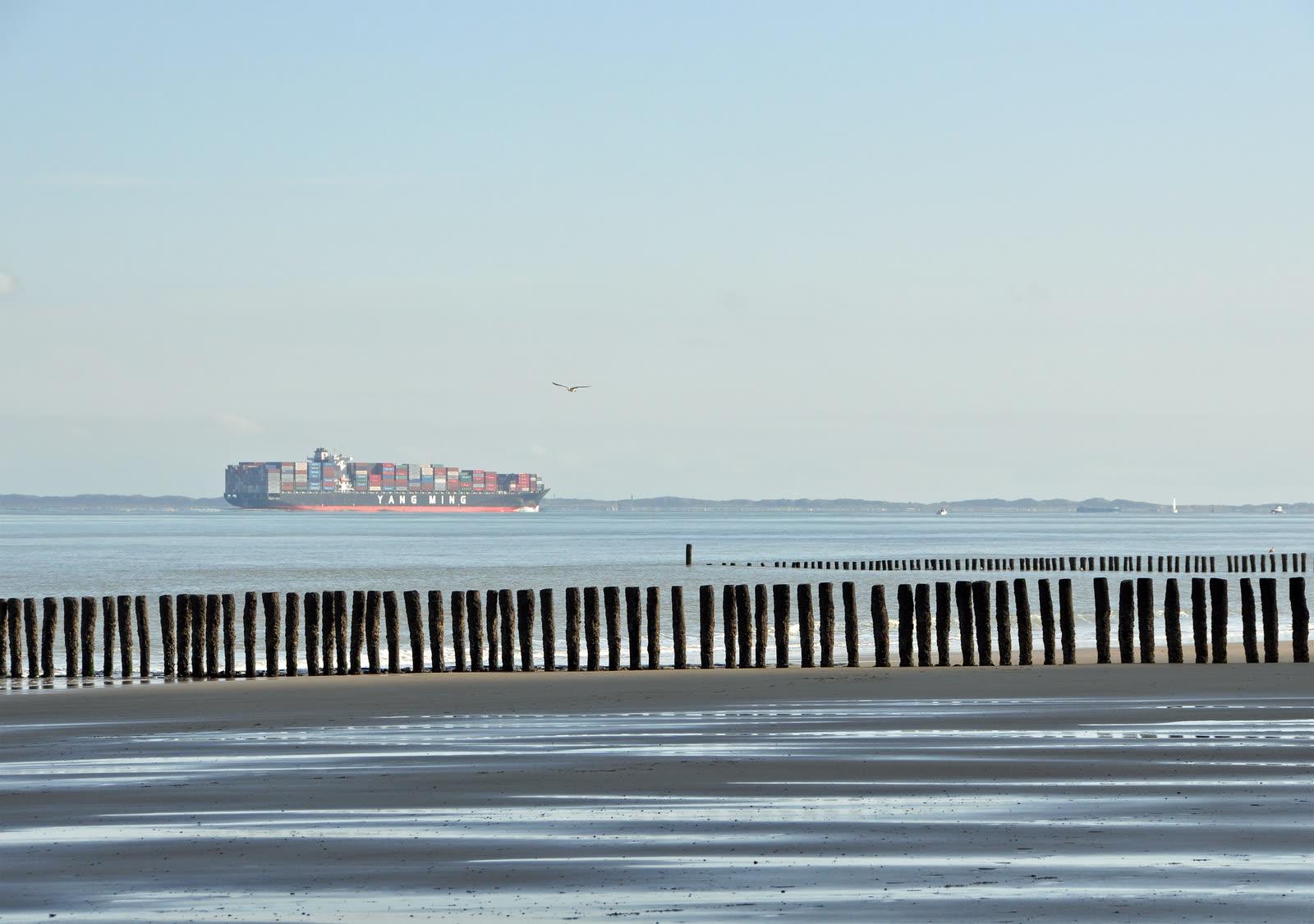
Cadzand-Bad Beach Fossil Hunting Guide
Image: Marc Ryckaert (CC BY-SA 4.0)
Cadzand-Bad beach in Zeeland, Netherlands, is a free public beach where Eocene to Pliocene shark teeth wash ashore from offshore layers and from sand nourishment. Search near the tide line.
By Edward Chen · Published 1 October 2026
 Photo: Marc Ryckaert (MJJR), CC BY 3.0, via Wikimedia Commons

Introduction
Cadzand-Bad is a public beach on the Dutch North Sea coast, in the municipality of Sluis, Zeeland. It is free to enter at all times. Shark teeth, ray spines and other Tertiary fossils wash ashore here.
The fossils do not come out of a cliff. This coast has no cliff or rock face. The teeth arrive from layers on the sea floor and from sand that machines pump onto the beach.
That mechanism decides how you search. You look at the tide line and the fresh sand, not at one rock layer. The sections below explain the mechanism, then the species and the rules.
The beach runs from Het Zwin on the Belgian border to the Zwarte Polder at Nieuwvliet-Bad. The Zwarte Polder lies at the mouth of the Westerschelde. Henk Vink described the beach in 2021 in the magazine Gea. He says the famous finds date from the 1980s.
Location and Directions
The village of Cadzand-Bad lies at 51.3783°N, 3.3889°E, in the far southwest of the Netherlands. It lies close to the Belgian border. The beach itself runs northeast along the coast to Nieuwvliet-Bad.
Vink gives the best stretch as the part from the radar tower toward the Zwarte Polder. Signs in Cadzand-Bad mark the route. The beach is a public beach, so no gate, ticket or booking applies.
Vink advises you to walk the tide line about half an hour after high water. In summer many searchers pick over the best spots. Spring and autumn work best. Winter also works well, and weekdays are quiet.
The sources do not state parking details, fees for parking or the nearest tide station. Look up a tide table for the Westerschelde mouth before you go. Check the parking rules at the village on arrival.
Bring a sieve with fine mesh, because many teeth are small. Cadzand.org also suggests a handcart, a bucket and a spade. Vink recommends a visit to the Zwin visitor center and the Visserijmuseum in Breskens. Both show shark tooth collections.
What Fossils You'll Find
 Photo: Dominik Vogt, CC BY-SA 3.0, via Wikimedia Commons

Shark teeth are the main find. They range from a few millimeters to more than 15 cm. Waves have rolled and worn most teeth. Iron minerals color them blue-grey, greenish brown or black.
Souverein and Stoel listed the best known species in 1995. The list includes Cosmopolitodus hastalis, listed there as Isurus hastalis, and Carcharocles angustidens. It also names Carcharocles megalodon, Striatolamia macrota, Hexanchus griseus and Galeocerdo latidens. The names follow the 1995 article, and some genera have changed since then.
Two species in that list are specific Cadzand finds. These are the great white shark, Carcharodon carcharias, and Galeocerdo latidens. Langeveld and colleagues confirm great white teeth from Cadzand and Nieuwvliet. They are usually Pliocene.
Cadzand.org states that Cosmopolitodus hastalis is the most common Miocene tooth near the Zwarte Polder. It states that the Eocene Striatolamia macrota is more common toward Het Zwin. Cadzand.org writes the first name as Isurus hastalis.
Other finds include ray spines, fish vertebrae and otoliths. Otoliths are ear stones, and some come from dolphins. Vink also shows the crab Coeloma balticum, the snail Ceratostoma erinaceum and bone from large sea mammals.
Fossil shells look like modern shells, but they are duller and slightly decalcified. You must know which shells are fossil. Vink calls this the hard part.
Which name to use for the common Miocene shark
The shark long called Isurus hastalis now carries several names. This guide uses Cosmopolitodus hastalis. A 2023 peer-reviewed note in Afzettingen uses that name for two Cadzand teeth. Reinecke and colleagues in 2011 and Bor and colleagues in 2012 also use it.
Höltke and colleagues in 2022 place the species in Carcharodon, as Carcharodon hastalis. Older books and cadzand.org still use Isurus. These names all point to one tooth type. If a label or book gives one of them, it means the same shark.
Geologic History
Miocene and Pliocene sediments hold the fossils. The sea covered much of the Netherlands in those periods, and sediment piled up and eroded in turn. Late in the Miocene the sea withdrew. Erosion removed the light material and left heavy pieces, mainly phosphate nodules.
In northwest Flanders and Zeeuws-Vlaanderen these layers lie just under the surface. They dip steeply seaward and form the sea floor off the coast. Souverein and Stoel note that they lie close beneath the Pleistocene cover sand.
Currents, tides and surf churn the sea floor. Fossils in the layers wash ashore. The sea mixes the sediment again and again, so one beach can hold teeth of very different ages. The 1995 article places them in the Eocene, Oligocene, Miocene and Pliocene.
The teeth do not come from animals that died on this beach. Many sharks shed teeth through their lives, and one animal can lose up to 1,000. Currents then sort the loose teeth into local concentrations. The 1995 authors state that large numbers of teeth do not need to come from dead animals.
Sand nourishment
Storms strip sand from the beach. To replace it, dredgers suck up sand from the sea floor and spray it onto the beach. Fossils in that sand arrive with it. Ebb and flood currents then wash teeth out of the sand again.
Vink dates the famous finds to the 1980s. Nourishments then used sand from Pleistocene and Eocene layers. They gave huge numbers of fossils, mainly shark teeth. Part of the work repeated in 1996. Vink calls the late 1990s the golden time and says fossils do not lie around in masses today.
Nourishment continues. In 2025 Rijkswaterstaat placed 610,000 cubic meters of North Sea sand between Cadzand Haven and the Verdronken Zwarte Polder. It runs a recurring program. No source says how many teeth the 2025 sand contained.
Collecting Rules and Regulations
Cadzand-Bad is a public beach and Vink states that it is freely accessible at all times. No source that this guide read states a collecting limit or a permit rule. Cadzand.org mentions none.
Key Points:
- Collect on the open beach only.
- Do not dig into dunes or sea walls.
- Do not enter Het Zwin nature reserve to collect. Its collecting rules are not documented here.
- Obey signs and cordons near nourishment work.
- Ask the local tourist office if you plan to collect large amounts.
Dutch rules on collecting fossils for sale or in bulk are not documented in the sources. Keep to hand collecting of loose finds on the beach.
Safety
Check the tide before you leave, because the best search time follows high water. Walk back up the beach before the tide returns. Check the weather. Storm surf can reach high on the sand, and strong wind makes the beach unpleasant.
Stay out of cordoned areas. Rijkswaterstaat closes the work area during nourishment, and the beach reopens when the new sand is dry and firm. Fresh sand can be soft.
Stay on the beach and away from dunes and sea defenses. These protect the land behind them.
The sources name no other hazard. In summer many people use the beach, so watch children near the water.
Sources
https://natuurtijdschriften.nl/pub/1025344/GEA2021054001012.pdf https://cadzand.org/en/shark-teeth.php https://natuurtijdschriften.nl/pub/1025487/AZ2023044001005.pdf https://natuurtijdschriften.nl/pub/1021528/AZ2021042004005.pdf https://www.rijkswaterstaat.nl/nieuws/archief/2025/03/meer-zand-voor-het-strand-van-cadzand-en-groede https://shark-references.com/species/view/3264 https://nl.wikipedia.org/wiki/Cadzand-Bad
Nearby sites
 ENCI Quarry and Sint-Pietersberg Fossil Hunting GuideShark teeth, Echinoids
 Winterswijk Quarry, Gelderland Fossil Hunting GuideMarine reptile bones, Reptile footprints
 Gram Clay Pit Fossil Hunting GuideShark Teeth, Megalodon
 Ries Crater Nordlingen Meteorite Impact Geopark Fossil Hunting Guidesuevite impact breccia