Stonewall Quarry Park Manitoba Fossil Hunting Guide
Image: JD554 (CC BY-SA 3.0)
Stonewall Quarry Park sits inside the old Winnipeg Supply and Fuel lime quarry 25 km north of Winnipeg, where the uppermost Ordovician Stonewall Formation is exposed in the walls of the Red Pit. The town's official park guide lists cephalopods, brachiopods, trilobites, crinoids, corals, and gastropods as fossils you can find in the park.
By Edward Chen · Updated 1 August 2026
Introduction
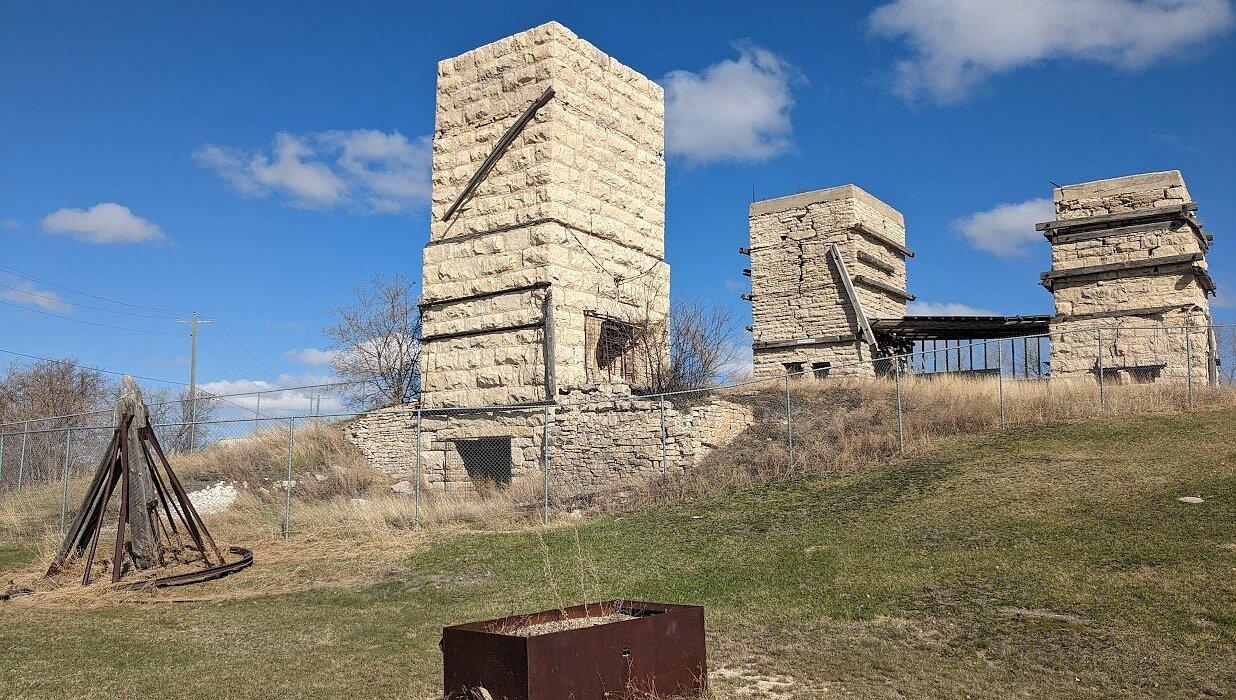
Stonewall Quarry Park is a 30-hectare municipal heritage and recreation park inside the limits of the Town of Stonewall, about 25 kilometres north of Winnipeg in Manitoba's Interlake country. The park is built on top of the worked-out Winnipeg Supply and Fuel Company lime quarry that gave the town its name and its economic backbone from 1880 until quarry operations ceased in 1967. The site preserves three large 1905 draw kilns, the original "Red Pit" test quarry, an interpretive trail through the pits, and the Heritage Arts Centre and Interpretive Centre at 166 Main Street.
The fossil interest at Stonewall is that the quarried limestone belongs to the Stonewall Formation, an uppermost-Ordovician to lowermost-Silurian dolomitic carbonate unit. The Town of Stonewall lists fossil hunting as one of the park's heritage walk activities and tells visitors that "the park is full of fossils from the Ordovician Period.. Cephalopods, brachiopods, worm tunnels, trilobites, crinoids, corals and gastropods are just some of the types that you can find in the park," with fossils visible in the walls of the Red Pit. The park does not publish a written collecting policy, so this guide treats Stonewall as a viewing site, phone the Interpretive Centre at +1 (204) 467-7980 before any planned collection.
This guide covers what fossils the formation produces, how to reach the park, and the geology of the worked stone.
Photo: Smithsonian National Museum of Natural History, CC0, via Smithsonian Open Access
Location and Directions
Stonewall sits in the Rural Municipality of Rockwood, about 25 kilometres north of Winnipeg via Provincial Trunk Highway 7 and Provincial Trunk Highway 67. The park is on the north side of the town, a five-minute walk from the Interpretive Centre at 166 Main Street.
Directions to Stonewall Quarry Park
From Winnipeg, take Highway 7 north for about 22 kilometres to the Stonewall exit, then follow Highway 67 west into town. Main Street runs north-south through the centre of Stonewall. The Interpretive Centre is at the south end of the park. Free parking is available beside the Heritage Arts Centre and at the kilns lot at the north end of the park.
The Interpretive Centre houses six galleries: The Ordovician Sea, Manitoba Rocks, An Industry Town and Its People, The Quarries, Amazing Uses of Limestone, and A Story Told. Per the Town of Stonewall, the Interpretive Centre is open daily 11:00 to 17:00, and admission is by donation. (Verify before visiting. One third-party tourism directory currently lists a paid admission scale that does not match the Town's own statement.)
Quarry Park's outdoor trail and the Red Pit are open year-round during daylight hours. The kilns, slag pile, glacial striations, and dynamite shack are all signed stops on the heritage walk. Cell coverage is reliable. The closest accommodation, fuel, and restaurants are in central Stonewall.
 Photo: Robert Linsdell, CC BY 2.0, via Wikimedia Commons
What Fossils You'll Find
The Stonewall Formation at the park is a finely crystalline dolomitic limestone deposited in a warm, shallow tropical epicontinental sea that covered the Manitoba Interlake during the latest Ordovician. The most accessible fossiliferous exposure inside the park is the Red Pit, the failed test pit dug in the 1960s when the company tried to deepen the working face. The red staining comes from iron, which was what eventually ended commercial quarrying, iron-bearing rock explodes when cooked in a lime kiln, and the walls preserve a fresh, fossil-bearing section that is otherwise covered by quarry waste.
According to the Town of Stonewall, the assemblage you can see in the Red Pit and along the heritage trail includes:
- Cephalopods. Straight-shelled (orthoconic) nautiloids are characteristic of the upper Ordovician carbonate platform of the Manitoba outcrop belt and are the most distinctive of the park-listed fossils.
- Brachiopods. Articulate brachiopod valves and casts are common at the surface and through the dolomite.
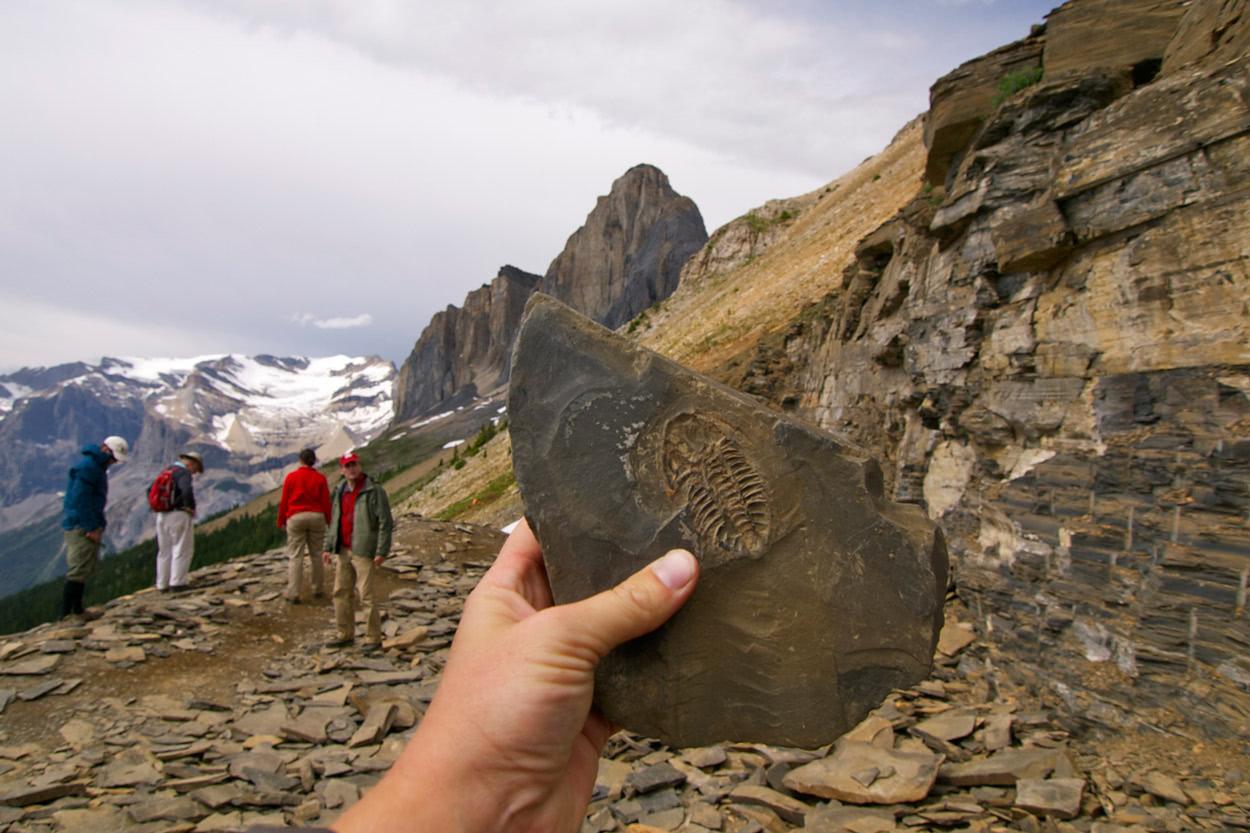
- Trilobites. Late Ordovician trilobite material is rarer than the brachiopods and corals but is documented at the site by the Town's own visitor guide.
- Crinoids. Columnals (the small donut-shaped stem ossicles that supported the crinoid stalk) and rarer calyx fragments occur scattered across the trail surface and in the pit walls.
- Corals. Tabulate and rugose corals occur as both solitary horn-coral forms and small colonies. The Stonewall Formation includes both branching and massive corallum styles.
- Gastropods. Coiled snail steinkerns and impressions occur in the dolomite.
- Worm tunnels and other bioturbation features are abundant on bedding surfaces.
The Interpretive Centre's Ordovician Sea gallery reconstructs the same fauna in a diorama originally designed by Betsy Thorsteinson of the Manitoba Museum and is the best first stop for figuring out what to look for outside.
Geologic History
The Stonewall area sits on the eastern edge of the Williston Basin, where the Phanerozoic sedimentary cover laps onto the southwest flank of the Precambrian Canadian Shield. Town historian Graham A. MacDonald, writing for the Manitoba Historical Society, notes that Stonewall is located on the boundary of Silurian and Ordovician deposits in Manitoba's Interlake country. The rock the kilns processed is the dolomitic upper Stonewall Formation, first defined and named for the town's quarries by E. M. Kindle of the Geological Survey of Canada in 1914.
In the modern stratigraphic framework used by the Manitoba Geological Survey, the Stonewall Formation is a finely crystalline dolomite with a basal argillaceous and sandy dolomite (the Williams Member) and two thin sandstone beds in the middle and at the top. Isotope chemostratigraphy places the upper Stonewall Formation in the latest Ordovician Hirnantian stage, and the Ordovician–Silurian boundary is drawn at the disconformable upper surface of the formation. In practical terms, the fossils you see in the Red Pit walls are about 445 to 443 million years old and come from the very end of the Ordovician, just before the Hirnantian glaciation that triggered the late Ordovician mass extinction.
During that time, the Manitoba Interlake lay several degrees south of the equator on the broad western shelf of the proto-North American craton called Laurentia. The shelf supported clear, warm, shallow seas with extensive carbonate sedimentation. Cephalopods, brachiopods, corals, and crinoids were the dominant invertebrate elements of the benthic community, with bioturbating polychaete worms reworking the carbonate mud across most of the shelf. Periodic shallowing and salinity rises through the late Hirnantian drove the dolomitisation of the limestone after burial, replacing original calcite with dolomite at the molecular level. The Williams Member at the base of the formation and the thin sandstones higher in the section record the few influxes of clastic sediment from the Canadian Shield to the east.
After deposition, the Stonewall Formation was buried beneath younger Silurian, Devonian, and (in surrounding parts of the Williston Basin) Mesozoic strata. Around Stonewall, Pleistocene glacial erosion stripped most of the post-Silurian cover and left the resistant dolomite within a few metres of the modern surface. The thin overburden of glacial till and topsoil, visible in the park's Natural Bluff signed stop, is part of what made the Stonewall deposit so easy to quarry.
How the Quarry Park Came to Be
Samuel J. Jackson, the Irish immigrant after whom the town was nicknamed, homesteaded in the Grassmere area in 1876 and recognised that the surface limestone could feed the demand for ballast and quicklime from the Canadian Pacific Railway. Jackson built the first kilns in town later that decade. In 1882 the Williams brothers, professional lime burners from the Forest of Dean in Gloucestershire, took over the pot kilns and started running them at scale. Larger continuous draw kilns were built in 1905. Three of them still stand in the park today.
By 1927 the Winnipeg Supply and Fuel Company controlled all of the local quarries, and the kilns ran continuously until 1967 when the discovery of iron-stained "red rock" in the test pit made it uneconomic to deepen the working face. The company donated the worked-out quarry to the Town of Stonewall, which built the Kinsman Lake recreation area in the southern pit between 1956 and 1963 and opened the heritage-focused Quarry Park with its Visitor Centre in 1985. The Heritage Arts Centre and the modern Interpretive Centre at 166 Main Street form the current public face of the site.
Collecting Rules and Regulations
Is fossil collecting allowed?
The Town of Stonewall's own park guide lists fossil hunting as a heritage-walk activity and identifies the specific fossil groups visitors can find in the Red Pit walls and on the trail surface, but the park's website does not state a written collecting or souvenir policy. Until the Town publishes one, treat the site as viewing-only:
- Photograph fossils in place rather than removing them
- Do not use hammers, chisels, picks, screens, or other tools
- Stay on signed trails and outside the fenced areas of the Red Pit
- Call the Interpretive Centre on +1 (204) 467-7980 before any planned collection to confirm the current rule (verify before visiting)
The park is a public municipal heritage site, not a provincial or federal protected area. The provincial framework that would otherwise apply to fossil removal from public land in Manitoba, the Heritage Resources Act, C.C.S.M. c. H39.1, treats fossils as heritage objects requiring permits for excavation but does not by itself prohibit casual surface pickup at municipal parks, so the operative rule is whatever the Town sets at the site.
The Interpretive Centre staff are the right point of contact for any unusual surface find. Articulated or unusual specimens should be reported rather than moved, both as good practice and because under the Heritage Resources Act the Province retains an interest in scientifically significant heritage objects.
Safety
Quarry walls are unstable. The Red Pit is signed and partly fenced. Do not climb the faces or work below an overhang. The interpretive trail surfaces are even and family-friendly, but the broader site is an industrial heritage landscape with kilns, slag piles, and old machinery scattered through it. Pets are welcome on the trails on leash. In summer the site is exposed and unshaded. Carry water and sun protection. In winter the Town grooms cross-country ski and snowshoe trails through the park.
Sources
- Town of Stonewall, Stonewall Quarry Park: Take a Walk Through History (operator description of fossils, Red Pit, kilns, heritage walk)
- Town of Stonewall, Stonewall Quarry Park Interpretive Centre (hours, galleries, address, contact)
- Manitoba Historical Society, Graham A. MacDonald, "Scratching the Ancient Ground of Manitoba's Interlake: Stonewall and its Quarry Park," Manitoba History No. 33 (Spring 1997) (history of the quarry, kilns, formation naming)
- Manitoba Geological Survey, Geology of southern Manitoba (GAC-MAC field guidebook B4) (stratigraphy of the Stonewall Formation, Big Horn Group, Hirnantian assignment)
- Travel Manitoba, Stonewall Quarry Park directory listing (visitor logistics)
- Manitoba Heritage Resources Act, C.C.S.M. c. H39.1 (provincial framework for heritage objects)
_(9447098824).jpg)